Brand:

Eurotherm EPC3016 1/16 DIN Programmable PID Controller

Description

Overview

The Eurotherm EPC3016 is a panel-mounted single-loop programmable PID controller in the compact 1/16 DIN size. It belongs to the EPC3000 range, which Eurotherm designed with native high-speed Ethernet and Achilles Level 1 certification for resilience against cyber attack, so it is suited to digitised plants that connect their temperature loops to a network. The input is quoted at 0.1 percent of reading, enough to meet the AMS2750F and CQI-9 accuracy requirements after field calibration. In a 48 mm square face the EPC3016 packs enhanced PID with a cutback function, up to twenty ramp and soak profiles, wireable maths and logic blocks, and six freely configurable alarms.

Seven Star LLC is an independent supplier serving Oman and the GCC. We list the EPC3016 for plants that need a modern small-format controller or a like-for-like replacement for an older 1/16 DIN instrument.

Inside the Eurotherm EPC3016: control and function blocks

The control engine offers two PID sets as standard and eight as an extension, each with separate proportional bands for heat and cool. The enhanced autotune uses a cutback function to limit overshoot and oscillation. Gain scheduling allows the controller to select a PID set on deviation, absolute temperature or output level. AC supply voltage monitoring feeds a feedforward function, and process variable and setpoint feedforward are also available. An enhanced unbounded valve-positioning algorithm operates motorised valves without a slidewire. Function blocks cover math, logic, multiplexing, BCD conversion, counter, timer, totaliser and sixteen-point linearisation, tied together by 50 wires in the standard toolkit or 200 with the enhanced toolkit.

Eurotherm EPC3016 technical specifications

Specification Eurotherm EPC3016 data
Format 1/16 DIN, cut-out 45 x 45 mm (minus 0.0, plus 0.6 mm), weight 250 g
Power 100 to 230 V AC plus or minus 15 percent, 24 V AC or 24 V DC; 6 W
Display LCD with backlight; main PV 4 digits, 3 decimal places; scrolling third line
Analog inputs 1 universal input at 20 Hz; optional auxiliary 4 to 20 mA or 0 to 10 V at 4 Hz
Input accuracy 0.1 percent of reading; calibration accuracy at 25 degrees C per range table
Input types Thermocouples, Pt100 and Pt1000 RTD, 4-20 mA, 0-20 mA, 10 V, 2 V, 0.8 V, 80 mV, 40 mV, zirconia and pyrometers
Sample time Process 50 ms; thermocouple 62.5 ms; RTD 100 ms
Sensor break AC sensor break detected within 3 seconds worst case
Built-in outputs 1 Form C relay; optional contact-closure input and CT input
Optional modules Up to 2: Form A relay, logic I/O, DC analog, triac
Relay rating Minimum 100 mA at 12 V, maximum 2 A at 264 V AC resistive
Alarms and recipes 6 alarms; 5 recipes with 40 parameters
Programmer options 20×8, 10×24, 1×24 or 1×8 profiles
Protection Standard bezel IP65 and UL50E Type 12; washdown bezel IP66 and Type 4X
Operating range 0 to 55 degrees C; 5 to 90 percent RH non-condensing
Safety and approvals CE, UL, cUL, EN 14597 TR, EN ISO 13849-1 Performance Level C for PV input to alarm; FM option

How EPC3016 differs from other EPC3000 variants

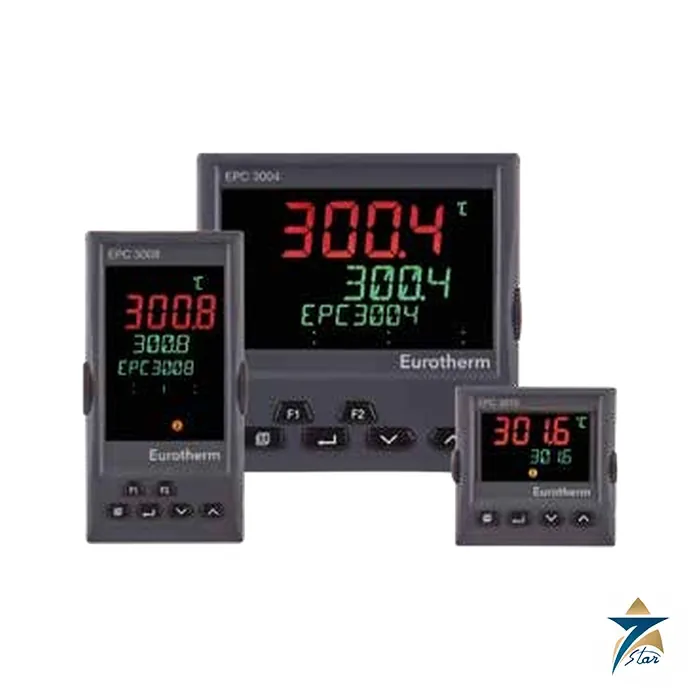
The EPC3000 range has three sizes. The EPC3016 is 1/16 DIN (45 x 45 mm cut-out, 250 g, 6 W). The EPC3008 is 92 x 45 mm cut-out, 350 g and 9 W, and the EPC3004 is 92 x 92 mm, 420 g and 9 W. Those larger models add a second universal input option, a 24 V transmitter power supply, two programmable function keys, a bar graph, a second display line, up to three optional modules, two contact-closure inputs and open-collector logic I/O. The EPC3016 has one universal input, up to two optional modules, an optional auxiliary input for remote setpoint and one communications port rather than two. Its PV display is four digits where the EPC3008 shows four and a half and the EPC3004 shows five digits in green and red.

Communications, safety and configuration

A shielded RJ45 port supports 10/100BASE-T auto-sensing, Modbus TCP, EtherNet/IP and BACnet, fixed IP or DHCP and Bonjour discovery. Serial EIA-485 half duplex and EIA-422 or EIA-232 full duplex use Modbus RTU at 9600 or 19200 baud. For safety work, the PV-to-alarm path is rated to Performance Level C under EN ISO 13849-1, and EN 14597 TR type approval is held. The FM version meets the temperature limit and supervisory switch standard, class number 3545. Configuration and backup use free Eurotherm iTools over a USB cable, Ethernet or serial, and OEM Security helps protect the setup against viewing, cloning or reverse engineering.

Applications in Oman and the GCC

The EPC3016 suits furnaces, ovens, dryers, extruder zones, water heaters, laboratory chambers and packaging machines where a programmable profile or a networked setpoint is useful. Plants that follow aerospace or automotive heat-treat standards can use the AMS2750F and CQI-9 accuracy statement, while facilities teams can read process values over Modbus TCP or BACnet. The washdown bezel option is useful in food and beverage and chemical wash areas.

Installation and commissioning

Prepare a 45 x 45 mm opening and keep the instrument out of corrosive or explosive atmospheres. Use shielded cable for the RJ45 link and keep wiring to the 12 V logic outputs short, with an external snubber on inductive relay loads as recommended in the datasheet. Set the input type, range and units, choose the control output, start the autotune and then test alarms and recipes. Backup the configuration through iTools so a replacement can be commissioned quickly. Double-check the order options: the optional input, comms module and I/O modules are chosen at order time.

Selection and maintenance notes

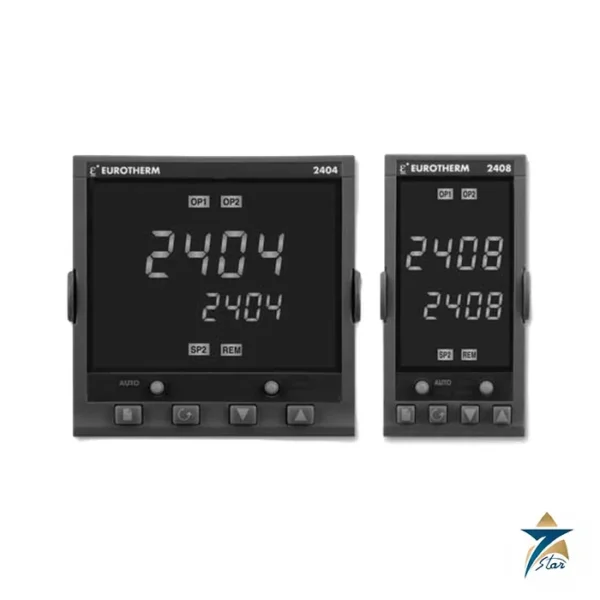
When choosing an EPC3016, decide first on the supply (mains or 24 V), the communications option, whether the auxiliary analog input is needed for remote setpoint, and which two output modules the loop needs. Communication addresses are compatible with the Eurotherm 2400 controller, which makes it easier to replace an older unit in a networked panel without rewriting the supervisory addressing. In service the controller needs only routine terminal checks and a periodic input verification during planned shutdowns. Keyboard life is typically 100,000 operations, and parameter help text scrolls on the lower line to guide the technician.

Related items you may also need: VEGA VEGATOR 121 Controller for 8/16 mA Vibrating Switches | Murphy Tattletale Annunciators and Magnetic Switches for Engine and Motor Shutdown | Janitza UMG 96RM Panel Power Analyser RS485 Modbus | All Eurotherm products.

Documents and quotation

The EPC3000 datasheet, covering the Eurotherm EPC3016, is attached to this page. Send an RFQ with the full order code, quantity and delivery location in Oman or the GCC to receive a quotation.

Datasheets & Documents
  • PDF Datasheet Eurotherm EPC3016 1/16 DIN Programmable PID Controller Datasheet Download
Reviews (0)

Reviews

There are no reviews yet.

How would you rate this product?

It takes about 10 seconds — just tap a star. Your email is never published.

About brand

Eurotherm is a British maker of temperature controllers, process recorders and SCR power controllers, best known for compact PID controllers such as the 3200 and 2400 families. The company was set up in 1965 as Eurotherm Controls in Worthing, West Sussex, to build temperature controllers, and in 1970 its directors created related companies for data recorders, process control and drives. A holding company, Eurotherm International, followed in 1974 and was listed on the London Stock Exchange in 1978. Since 31 October 2022 the company has belonged to Watlow.

Eurotherm company profile

Founded 1965, Worthing, West Sussex, United Kingdom, as Eurotherm Controls
Headquarters Worthing, West Sussex, United Kingdom; core manufacturing in Ledziny, Poland
Ownership Watlow since 31 October 2022; earlier owned by Siebe, Invensys and Schneider Electric
Core technology PID temperature and process controllers, programmers, graphical recorders and thyristor (SCR) power controllers
Typical applications Furnaces and heat treatment, ovens, glass and ceramics, plastics extrusion, sterilisers, chillers, trace heating and laboratory equipment
Standards and approvals AMS2750 field-calibration suitability for Nadcap work, CQI-9 accuracy, 21 CFR Part 11 recording option, EN 14597 TR type approval, EN 60947-4-3 for power controllers

Milestones

  • 1965: The company is formed in Worthing to manufacture temperature controllers.
  • 1970: Related companies are created for data recorders, process control and variable speed drives.
  • 1978: The holding company is listed on the London Stock Exchange.
  • 1998: Siebe plc acquires the group; it later becomes part of Invensys.
  • 2014: Schneider Electric acquires Invensys and the business joins Schneider Electric.
  • 2022: Watlow completes its acquisition on 31 October.

How a Eurotherm PID controller works

A PID controller compares the measured process value from a thermocouple or resistance thermometer with the setpoint and adjusts its output to remove the difference. The proportional term reacts to the size of the error, the integral term removes the remaining offset over time, and the derivative term anticipates fast changes. The maker adds cutback and overshoot inhibition so a furnace or oven approaches setpoint without swinging past it, and its tuners calculate the PID values automatically. The output is time-proportioned to a relay or solid state relay, sent as a 0 to 20 mA signal, or passed to an SCR power controller that fires thyristors by phase angle or burst. A selection tip: confirm the sensor type, the output type and the supply voltage first, because these three fields decide the order code.

Where Eurotherm products are used in Oman and the GCC

In Oman and the wider Gulf, these controllers appear on heat-treatment furnaces for valves and pump parts, on electrically heated sample systems and heat-traced lines at oil and gas sites, on desalination and utility test rigs, and in food, pharmaceutical and laboratory ovens. Recorders with audit features serve plants that must keep validated temperature records, while SCR units drive heater banks on process skids.

Eurotherm models we list

Family Examples
3200 series single-loop controllers 3216, 3204
2400 series controller/programmers 2404
3500 series dual loop controller/programmers 3504
Graphical recorder/controllers nanodac
EPC3000 programmable controllers EPC3016
EPack SCR power controllers EPack-1PH

Ordering Eurotherm products: what we need

These instruments are configured through long order codes, so a short model name is rarely enough. For a new purchase send the model, supply voltage, output types, communications option and any options such as CT input or remote setpoint. For a spare or replacement, copy the full code and serial number from the nameplate. Add the quantity and delivery location in Oman or the GCC, and Seven Star LLC, an independent supplier, will reply to your RFQ with availability and lead time.

Facts checked against published Eurotherm datasheets, company history and the Watlow acquisition announcement, November 2026.

FAQ

Questions about the Eurotherm EPC3016 1/16 DIN Programmable PID

Answers from our engineering team on installation, compatibility and integration.

01What is the panel cut-out for the Eurotherm EPC3016?
The EPC3016 is the 1/16 DIN member of the EPC3000 range with a 45 x 45 mm cut-out (minus 0.0, plus 0.6 mm). It weighs 250 g and draws 6 W from the supply.
02How many I/O modules does the EPC3016 take?
The EPC3016 accepts up to two freely selectable optional modules, from Form A relay, logic I/O, DC analog output and triac, and it has one built-in Form C relay output.
03How accurate is the EPC3016 input?
The universal input is quoted at 0.1 percent of reading and meets AMS2750F and CQI-9 requirements when field calibrated. Process inputs sample at 50 ms (20 Hz), thermocouples at 62.5 ms and RTD at 100 ms.
04Which communications does the EPC3016 offer?
One of the following can be selected: EIA-485, EIA-422, EIA-232, Modbus RTU slave, Modbus TCP slave, Modbus TCP slave with EtherNet/IP server or BACnet slave, or Modbus TCP master and slave.
05Does the EPC3016 have a program function?
Yes. Profile options include 20 profiles of 8 steps, 10 of 24, 1 of 24 and 1 of 8, with holdback, event outputs, time to target, ramp rate, dwell, step and call segments. The profiler is not available in the FM version.