Overview
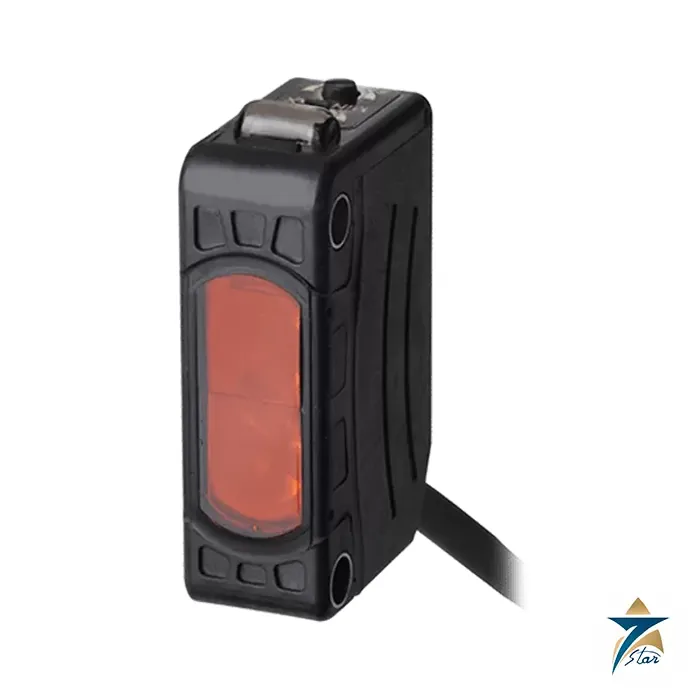
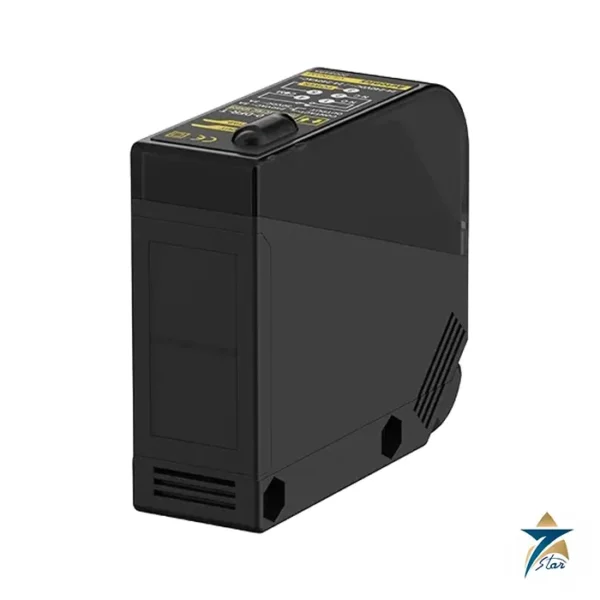
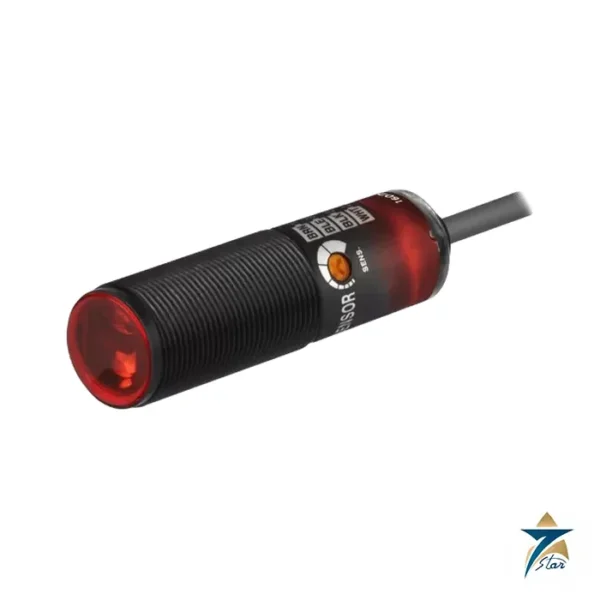
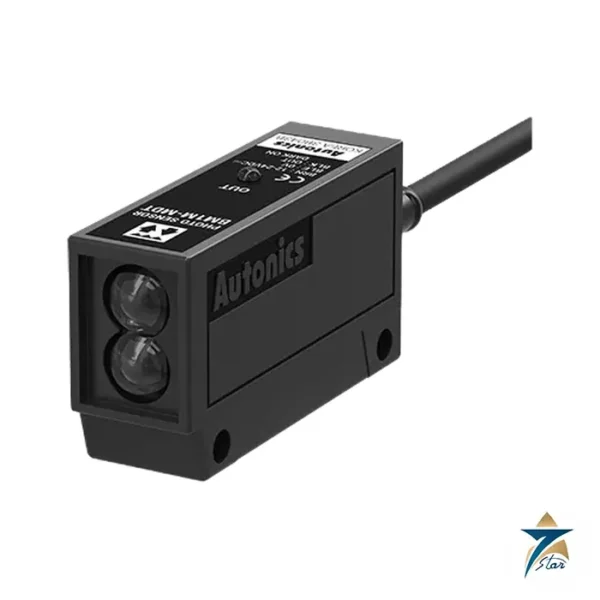
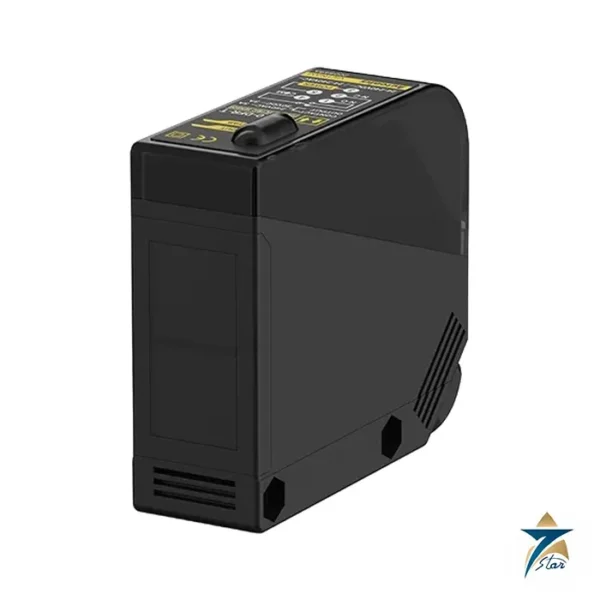
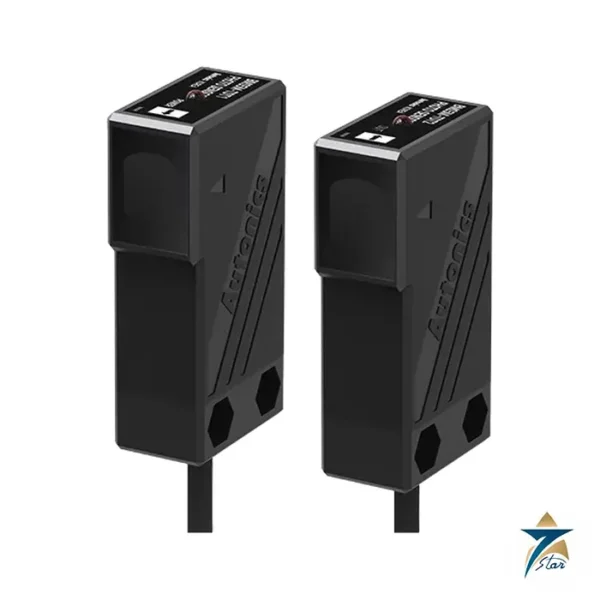
The Autonics BJ3M-PDT is a compact rectangular polarized retroreflective photoelectric sensor from the Autonics BJ series. It runs on 12 to 24 VDC, switches an NPN open collector output and detects opaque objects up to 3 m away when it is paired with the MS-2A reflector that is supplied in the box. Because a single housing contains both the red light emitter and the receiver, only one cable run and one mounting point are needed, which makes this model a practical choice for conveyors, gates and packaging lines where there is no room for a separate emitter and receiver.
A polarizing filter in front of the optics lets the sensor ignore shiny surfaces that would fool an ordinary retroreflective unit. Only light that has been rotated by the corner-cube prisms of the reflector is accepted, so a metal can or a shrink-wrapped pallet passing in front of the beam does not return a false signal. Seven Star LLC is an independent supplier serving Oman and the GCC. We can quote this exact code for maintenance stock or for new machine builds.
Key features of the Autonics BJ3M-PDT
- 3 m detection range measured against the supplied MS-2A reflector, with a polarizing filter for glossy targets.
- Red visible light spot, which makes alignment easy because the beam can be seen on the reflector.
- Sensitivity adjuster plus a Light ON or Dark ON selector, both set with the small screwdriver included in the package.
- Mutual interference prevention, so neighbouring sensors on adjacent lanes do not trigger one another.
- Stability indicator (green) and operation indicator (red) on top of the housing for quick checks without a meter.
- Reverse power protection and an output short-circuit overcurrent protection circuit.
- IP65 housing with a 3-wire, 2 m cable of 3.5 mm diameter, ready to wire to a PLC input card.
Autonics BJ3M-PDT technical specifications
| Parameter |
Value |
| Model |
Autonics BJ3M-PDT (NPN output, cable type) |
| Sensing type |
Polarized retroreflective |
| Sensing distance |
3 m with reflector MS-2A |
| Minimum sensing target |
Opaque object of 75 mm diameter or larger |
| Light source |
Red LED |
| Power supply |
12 to 24 VDC, plus or minus 10 percent, ripple up to 10 percent |
| Current consumption |
30 mA or less |
| Control output |
NPN open collector, load up to 100 mA at 26.4 VDC |
| Residual voltage |
1 VDC or less for the NPN model |
| Response time |
1 ms or less |
| Operation mode |
Light ON or Dark ON, selected by adjuster |
| Ambient temperature |
-25 to 55 C, storage -40 to 70 C |
| Ambient humidity |
35 to 85 %RH without condensation |
| Protection rating |
IP65 (IEC) |
| Cable |
3 wires, 3.5 mm diameter, 2 m |
| Weight |
About 60 g unit, about 85 g packaged |
| Housing materials |
Case PC plus ABS, cap PC, lens PMMA, bracket SUS304 |
How BJ3M-PDT differs from other BJ variants
The BJ family covers through-beam, polarized retroreflective, diffuse, background-suppression and narrow-beam versions, and the model code tells them apart. The letters PDT in Autonics BJ3M-PDT mean polarized retroreflective, 12 to 24 VDC, transistor output. A through-beam BJ10M-TDT reaches 10 m but needs a separate emitter and receiver, and a diffuse BJ300-DDT sees a target at 300 mm without any reflector. The Autonics BJ3M-PDT sits in the middle: it needs only one cabling point, yet it reaches ten times further than the 300 mm diffuse type.
A suffix letter P after the part number selects PNP output instead of NPN, and the C suffix selects the M8 connector version. Specify the plain code if you want the NPN cable type with a 2 m lead, which is the configuration described on this page.
Typical applications in Oman and the GCC
Retroreflective sensors of this size are a common sight on case-packing lines at beverage and food plants in the Sultanate, where the reflector can be glued to a guard rail on the far side of the conveyor. In water treatment works the same unit is used to confirm that a sludge scraper or travelling bridge has reached the end of its stroke, because the polarizing filter keeps wet stainless surfaces from causing trouble.
Manufacturing sites use it for door and gate monitoring, for counting cartons at palletizers and for detecting the presence of containers on turntables. In utility substations and oil and gas yards, small machine guards and sliding covers on skids are often fitted with this kind of sensor to feed an interlock input, as long as the area is non-hazardous. The 3 m range is enough for most of those jobs without the cost of a through-beam pair.
Selection and compatibility notes
Check the loop before you select Autonics BJ3M-PDT. The NPN output sinks current, so it suits PLC input cards with a common positive supply; if your controller expects sourcing signals, ask us about the PNP version instead. The load must stay under 100 mA, and an inductive load such as a small relay coil needs a diode or varistor across it, as the manual reminds users.
The reflector is part of the sensing system. The MS-2A supplied with the sensor sets the 3 m rating. Larger reflectors from the MS series increase the reach, and reflective tape from the MST series is an alternative on curved or irregular backgrounds, though the achievable distance with tape differs and should be proven on site. Small objects below 75 mm diameter may slip through the beam, so choose a different sensing type if you must detect very small parts.
Installation and commissioning
Mount the sensor with its bracket using the supplied M3 bolts and nuts and tighten with a torque of about 0.5 N m. Keep the reflector at least 0.1 m from the sensor face and aim the red spot at the middle of the reflector. Keep the cable away from power lines and drive cables to avoid induced noise, and do not bend it sharply near the housing.
For commissioning, turn the sensitivity adjuster from minimum until the operation indicator lights with a clear path, note that position, then turn it onward until the indicator goes out with the beam blocked. Set the adjuster midway between the two points. The stability indicator should be steady green. Wait half a second after power-up before using the output, and if separate supplies are used for sensor and load, energize the sensor first. Test with the real product before releasing the machine.
Maintenance and troubleshooting
Wipe the lens and the reflector with a dry cloth; water or organic solvents are not recommended for cleaning. Dust and condensation on the reflector are the most frequent causes of nuisance faults, so include it in routine cleaning rounds. If the green stability indicator starts to flicker, the received light margin has dropped, and cleaning or realigning normally restores it.
Do not wire or open the sensor while power is applied. If a sensor is replaced, set the Light ON and Dark ON selector to match the old unit before releasing the line. Keep a spare of this code on the shelf for critical lines: the Autonics BJ3M-PDT is a quick swap because the bracket pattern and wire colours are the same.
Ordering notes and related items
When you request a quotation for Autonics BJ3M-PDT, mention whether you need the NPN or PNP version and whether a spare reflector or an additional bracket is required. Related accessories in the same range include MS series reflectors, MST retroreflective tape, a second type of mounting bracket and M8 connector cables for the connector version of the family.
We can also quote the through-beam BJ10M-TDT, diffuse BJ series sensors and other Autonics sensing products if your project needs several types.
Related items you may also need: Autonics PR18-8DN M18 Inductive Proximity Sensor 8 mm | Autonics E40S6-2500-6-L-5 Rotary Encoder Incremental | Autonics BEN5M-MFR Retroreflective Photoelectric Sensor 5 m | All Autonics products.
Points to confirm for the Autonics BJ3M-PDT
- If the Autonics BJ3M-PDT is a like-for-like replacement, read the full code from the installed nameplate and compare it with this page.
- For each Autonics BJ3M-PDT request we confirm the exact code, new or surplus condition and lead time in writing.
- Dimensions, ratings and connection data for the Autonics BJ3M-PDT are in the datasheet attached to this page.
- The Autonics BJ3M-PDT belongs to our photoelectric sensors range and can be delivered to Muscat, Sohar, Duqm and other GCC locations.
Documents and quotation
The manufacturer publishes a product manual that covers Autonics BJ3M-PDT, and the PDF is attached to this page for download so your engineers can check wiring, ratings and dimensions before ordering. Please send your RFQ with the part number and the quantity you need, plus the delivery site, and our team will reply with availability and lead time.
Other Models in the BJ Range
Seven Star LLC supplies models from the BJ range in Oman and the GCC. Compare the related models below and request a quote for the one that matches your application.

 Automation & Control
 Electrical & Power
 Fittings & Valves
 Sensors & Transmitters
 Emergency Power
 Analyzer Systems
 Metering Systems
 Motors, Pumps & Turbines
 Fire & Gas Systems
 Welding
 Portable Test & Measurement
 Compressor & Cooling
 Bearings & Power Transmission
 Filtration
 Safety & PPE
 Material Handling & Lifting Equipment
 Non-Destructive Testing (NDT)

Reviews
There are no reviews yet.