- Automation & ControlView all 3,151 products
- Automation Accessories
- AC Drives
- PLC & I/O Cards
- Industrial Communications
- Vibration Monitoring
- Controllers & Data Acquisition
- Isolator & Barrier
- Safety Switches & Guard Locking
- Encoders
- Motor Soft Starters
- CCTV & Security
- Pneumatic Cylinders
- HMI Displays
- Servo Drives
- Industrial Computers
- Machine Vision
- Automation Software
- Robotics
Brand: Bürkert
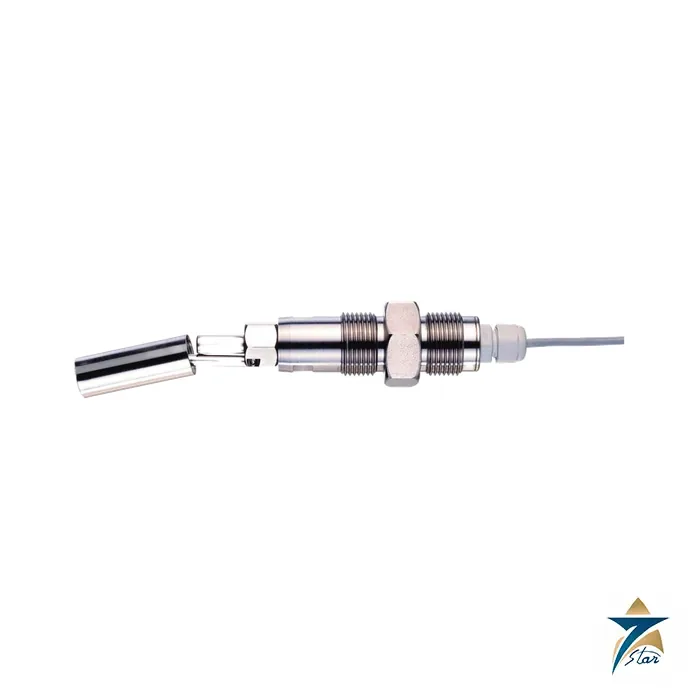
Bürkert 438159 Type 8181 Stainless Float Level Switch G1/8
Description
Overview
Bürkert 438159 is a compact float level switch, the stainless steel, vertically mounted G1/8 version of the Bürkert Type 8181 with 300 mm connection leads. A reed contact inside the stem is operated by a magnetic float that rides on the liquid surface, so the switch gives a clean dry-contact signal when the level reaches the chosen height. There are no electronics, no supply voltage and no settings, which is why this class of device is a common fit for tanks, sumps, day tanks and small vessels in which a simple high or low alarm is enough. Seven Star LLC is an independent supplier serving Oman and the GCC.
Why choose the stainless vertical version
Compared with polypropylene, the stainless steel float and stem of 438159 accept temperatures between minus 40 and plus 120 degrees C and pressure up to 10 bar in the vertical mounting position. That combination makes it useful on warm condensate tanks, hot water buffers, lubricating oil reservoirs and light chemicals compatible with 1.4301 steel. The vertical variant carries a retaining ring in the same stainless steel, and the G1/8 thread keeps the fitting small enough for narrow tank walls.
Specification table for Bürkert 438159
| Feature | Specification |
|---|---|
| Article number | 438159 |
| Type | 8181 float level switch, reed contact |
| Mounting position | vertical |
| Process connection | G1/8 |
| Wetted material | stainless steel 1.4301/304 stem, float and retaining ring |
| Switching function | normally closed or normally open, depending on how the float is oriented |
| Switching point | at a tilt of 7 degrees plus or minus 3 degrees, about 8.5 mm plus or minus 3 mm |
| Float density | approximately 0.7 |
| Switching voltage and current | maximum 48 V AC/DC, maximum 0.5 A |
| Breaking power | 50 VA AC/DC |
| Contact resistance | maximum 150 milliohm |
| Insulation resistance | minimum 10 megohm |
| Process temperature | minus 40 to plus 120 degrees C |
| Process pressure, vertical | maximum 10 bar |
| Electrical connection | leads, 300 mm, minimum 0.25 mm2 |
| Degree of protection | IP65 |
| Vibration and shock | 20 G for the stainless steel version |
How 438159 differs from other Type 8181 variants
The ordering chart lists eight standard codes. Both polypropylene versions, 438132 vertical and 438141 horizontal with G1/4, are limited to minus 10 to plus 80 degrees C and 1 bar. The stainless horizontal version 438150 shares the G1/8 thread and leads but allows only 5 bar in the horizontal position. The four cable variants, 438496 to 438505, use a G3/4 thread and a 5 m shielded cable. Bürkert 438159 is therefore the high-pressure, short-lead, small-thread choice in the family.
Applications
Float switches are everywhere in utilities: overflow protection on storage tanks, dry-run protection for pumps, low-level alarms on lube oil reservoirs, and refill control on make-up tanks for cooling circuits. Because the contact is a passive reed, it can be wired straight into a PLC digital input, a relay or an alarm annunciator without conditioning. The 0.5 A limit and 48 V ceiling make it right for control-voltage circuits but not for direct mains loads.
Selection hints
Match the material with the liquid: stainless 1.4301 handles water, oils and many mild fluids but not chlorides at high temperature, for which 1.4435 is available on request. Check the density, since the float density of about 0.7 means the liquid should be heavier than that. A float switch needs a calm surface, so mount it away from inlets or place a stilling tube around it. Verify the contact logic by turning the float, and test with a multimeter before wiring.
How the reed float switch works
Inside the stem there is a sealed glass reed contact, and the float carries a permanent magnet. When the liquid level moves the float up or down along the stem, the magnetic field passes the reed and closes or opens the contact. The data sheet gives the switching point as a tilt of 7 degrees plus or minus 3 degrees, which corresponds to a travel of roughly 8.5 mm plus or minus 3 mm, so the switching height is repeatable but not a precision measurement. For a multi-point alarm, install several switches at different heights, one for low-low, one for low and one for high.
Electrical rules for long contact life
A reed contact is a delicate component compared with a relay. Keep the switched current below the 0.5 A limit and the voltage below 48 V, and remember that the breaking power of 50 VA is a limit for the product of voltage and current. For a capacitive or lamp load, add a series resistor to limit inrush current. For an inductive load such as a relay coil or a solenoid, fit a flywheel diode or varistor. The insulation resistance of at least 10 megohm and the IP65 protection mean the leads can be routed in a damp location, though a junction box is still required to protect the connection joint.
Installation
Screw the switch into the tank thread with sealant suitable for the media, tighten with a wrench on the hexagon and not by turning the stem, and leave room for the float to swing freely. Connect the two leads in series with the load, observing the 0.5 A limit, and add a suppression diode if the load is inductive, because arcing shortens the life of a reed contact.
Service life
With no moving parts apart from the float, maintenance consists of cleaning deposits from the stem and checking that the float slides freely and that the leads are intact. Replace the switch if the contact sticks, which is usually a sign of overload.
Ordering Bürkert 438159
Please mention the liquid, temperature, pressure and the desired switching function so we can confirm the right mounting orientation. We can also quote related Type 8181 codes with other threads or with cable.
Related items you may also need: Bürkert 221602 Type 6213 Servo-Assisted 2/2-Way Solenoid Valve | Bürkert Type 6026 Direct-Acting 2/2-Way Plunger Solenoid Valve | Bürkert Type 8681 Control Head for Hygienic Process Valves | All Bürkert products.
Documents and quotation
The manufacturer data sheet for Type 8181 is attached, with dimensions, materials and the ordering chart. To obtain a quotation, send an RFQ with the part number Bürkert 438159, the quantity and your delivery location in Oman or the GCC, and we will reply with availability and lead time.
Datasheets & Documents
- Datasheet Bürkert 438159 Type 8181 Stainless Float Level Switch G1/8 Datasheet Download
Reviews (0)
How would you rate this product? Cancel reply
About brand
Bürkert is a German family-owned maker of fluid control systems, headquartered in Ingelfingen, Baden-Württemberg. Christian Bürkert founded the company in 1946, and it is known for solenoid valves, process and control valves, flow and analytical sensors, and mass flow controllers. Its products serve water treatment, hygienic processing, gas handling and laboratory applications.
Seven Star LLC lists Bürkert valves and valve automation devices and supplies Bürkert solenoid valves and spare parts to plants in Oman as an independent supplier.
Bürkert company profile
| Founded | 1946, by Christian Bürkert |
|---|---|
| Headquarters | Ingelfingen, Germany |
| Ownership | Family-owned |
| Product families | Solenoid valves, angle seat process valves, positioners, flow meters, mass flow controllers |
Bürkert types listed on this page
Two types are listed. Type 6026 is a direct-acting 2/2-way plunger solenoid valve, with a stainless steel bellows that separates the medium from the coil, and as a direct-acting valve it switches without needing a pressure difference. Type 8681 is the Bürkert control head that mounts on top of hygienic process valves to pilot the actuator and report valve position to the control system. Control heads of this kind are common in food, beverage and pharmaceutical plants in the GCC.
Ordering Bürkert valves: what we need
The type number alone is not enough. Send the identification number from the label, or else the type with orifice, port connection, body and seal material, coil voltage and frequency, circuit function and pressure range. For a Type 8681 control head add the communication variant and the make and model of the process valve it sits on.
Facts checked against Bürkert's published company history, October 2026.
Browse Bürkert products by category: Solenoid Valve, Control Valves.
FAQ
Questions about the Bürkert 438159 Type 8181 Stainless Float Level
Answers from our engineering team on installation, compatibility and integration.
01What is Bürkert 438159?
Bürkert 438159 is a Type 8181 float level switch in stainless steel, vertical mounting, G1/8 thread and 300 mm leads, with a reed contact output.
02What can 438159 switch electrically?
The 438159 reed contact switches up to 48 V AC/DC and 0.5 A with 50 VA breaking power, so use it on control circuits and relays.
03What pressure and temperature does Bürkert 438159 allow?
The stainless steel version works from minus 40 to plus 120 degrees C and up to 10 bar in the vertical position.
04How is 438159 different from 438150?
Both are stainless with G1/8 and 300 mm leads; 438150 is for horizontal mounting and is limited to 5 bar, while this one is vertical to 10 bar.
05Does Bürkert 438159 need a power supply?
No. It is a passive magnetic float with a reed contact, so only the switched circuit needs wiring.


Reviews
There are no reviews yet.