- Automation & ControlView all 3,134 products
- Automation Accessories
- AC Drives
- PLC & I/O Cards
- Industrial Communications
- Vibration Monitoring
- Controllers & Data Acquisition
- Isolator & Barrier
- Safety Switches & Guard Locking
- Encoders
- Motor Soft Starters
- CCTV & Security
- Pneumatic Cylinders
- HMI Displays
- Servo Drives
- Industrial Computers
- Machine Vision
- Automation Software
- Robotics
Brand: Autonics
Autonics PS12-4DN Rectangular Inductive Proximity Sensor NPN
Description
Overview
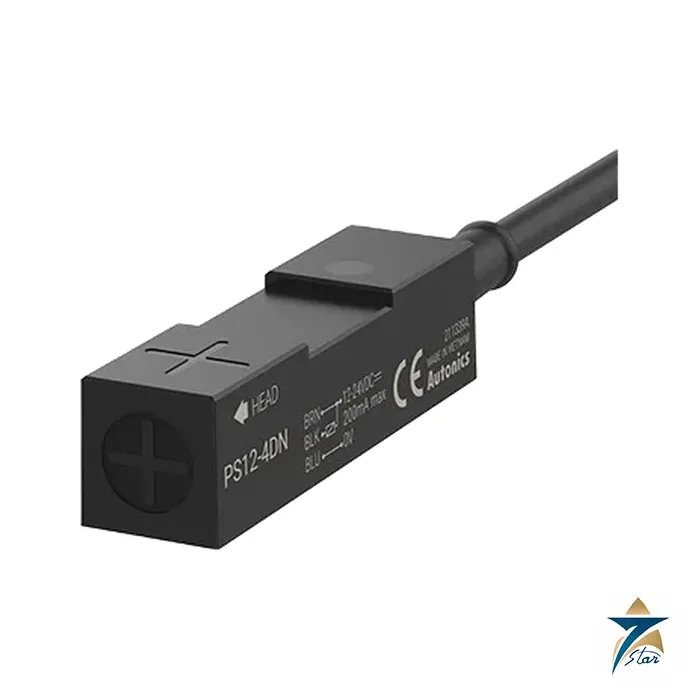
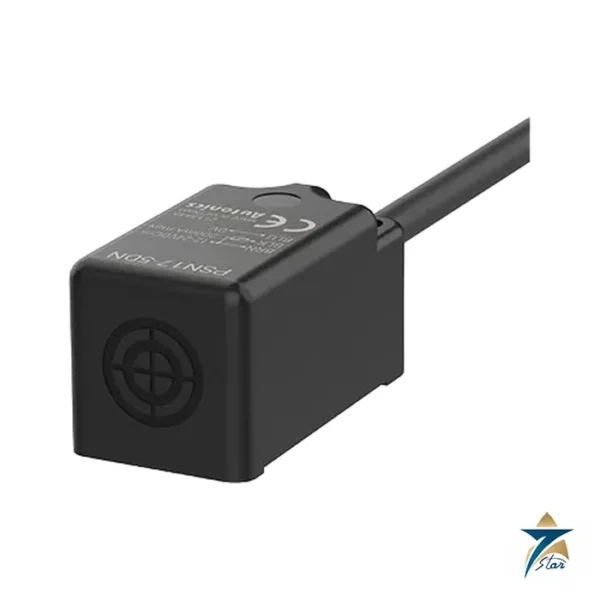
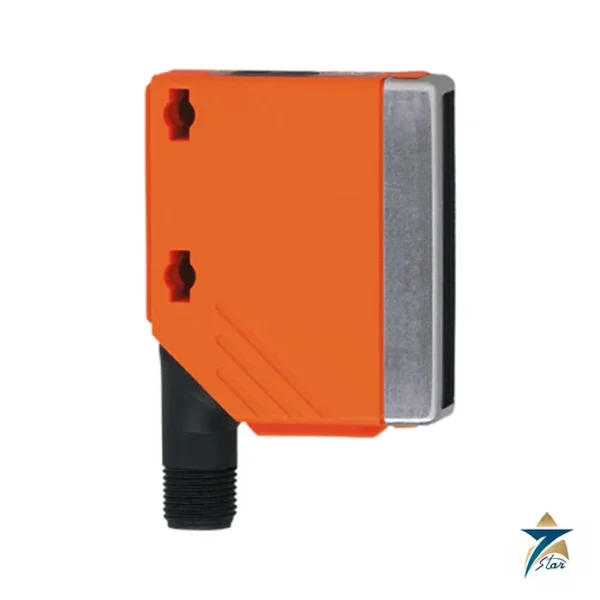
When a cylindrical barrel will not fit, the rectangular Autonics PS12-4DN does. It is an inductive proximity sensor in a 12 mm square plastic housing, rated for 4 mm sensing distance, supplied with 12 to 24 V DC and fitted with an NPN normally open output. Seven Star LLC is an independent supplier serving Oman and the GCC. The values below are from the PS series DC 3-wire instruction manual.
The flat body with a mounting hole pattern and a tap hole is meant for screwing onto a flat surface, such as the side of a slide, a fixture or a thin bracket, without a threaded barrel and nuts. That makes it a favourite on pick-and-place units, small gantries and fixtures where space is measured in millimetres.
Specification table for Autonics PS12-4DN
| Item | Data |
|---|---|
| Sensing side length | 12 mm |
| Sensing distance | 4 mm |
| Setting distance | 0 to 2.8 mm |
| Standard target | Iron 12 x 12 x 1 mm |
| Response frequency | 500 Hz |
| Hysteresis | 10 percent of sensing distance or less |
| Supply | 12 to 24 V DC, operating range 10 to 30 V DC |
| Current consumption | 10 mA or less |
| Control output | NPN normally open, up to 200 mA |
| Residual voltage | 1.5 V or less |
| Protections | Surge, output over-current, reverse polarity |
| Dielectric strength | 1,500 V AC for one minute |
| Ambient temperature | -25 to 70 C |
| Protection rating | IP67 |
| Case material | Heat-resistant ABS |
| Cable | 4 mm, 3-wire, 2 m, AWG 22 |
| Weight | About 62 g, about 77 g with packing |
What the code PS12-4DN contains
- PS: rectangular (square-head) inductive proximity sensor
- 12: side length of the sensing head in millimetres
- 4: sensing distance, 4 mm
- D: 12 to 24 V DC supply
- N: NPN output, normally open (N2 is NPN normally closed, P is PNP normally open, P2 is PNP normally closed)
- No suffix: standard type; U would be the upper-side type with the sensing face on top
Standard type or upper-side type
This code is the standard type, which senses at the front face. The U versions in the same series move the sensing face to the upper side for installations where the sensor is mounted from below or the target passes across the top. Because the PS12-4DN carries no U, the sensing face points along the length of the body. If you are replacing a damaged sensor, compare the sensing direction on the old part, since mounting orientation decides which of the two you need.
How PS12-4DN differs from PS08 and PS50 relatives
The PS08-2.5D version is 8 mm wide, senses 2.5 mm, switches at 1 kHz, but is limited to 100 mA output and has a 1 m cable of 2.5 mm. The PS50-30D is a 50 mm block with a 30 mm range, a 50 Hz response and a weight of about 220 g. The PS12-4D sits between them with 4 mm, 500 Hz and about 62 g, and it is the only one of the three with a 4 mm cable and an ABS housing.
Installing the Autonics PS12-4DN
Mount the Autonics PS12-4DN with two M3 screws into the tap holes, using the bracket if needed. The manual gives a tightening torque of 0.49 N m for the 12 mm bracket screws, and it is easy to strip the plastic if you exceed it. Keep sensors at least 24 mm apart, both face to face and side by side.
Work to a gap of about 2.8 mm, which is 70 percent of the nominal range. Wire brown to plus, blue to 0 V and black to the load or input. Wait 0.8 seconds after power-up before using the output, and do not pull the 4 mm cable with 30 N or more.
Choosing a rectangular sensor
Rectangular proximity sensors save room in depth: the Autonics PS12-4DN body is only about 12 mm square in section, and because it does not need a nut and a threaded barrel it can be fixed with two small screws on a machined flat. Compared with an M12 cylindrical sensor the footprint on the mounting plate is larger, but the height above the plate is lower, which is useful under guards and inside narrow slots. In addition the flat sides make it easy to align the sensing face parallel to the target path.
Plastic housings are lighter than brass barrels, so the 62 g weight puts little load on a moving carriage. On the other hand a plastic body is less tolerant of impact and chemical splash, so use a metal housing sensor if the location has solvent spray, hot chips or frequent knocks. Within general machine tool, assembly and packaging duties the ABS body is an ordinary and widely used choice.
Because induction sensors respond to ferrous metal best, always specify the target material when asking for a replacement. A stainless steel flag will switch at a shorter distance than a mild steel flag, and an aluminium flag gives a shorter distance again, so the real gap should be proven on the machine.
Typical applications
In Oman and the GCC the PS12 type is found on pneumatic grippers, rotary indexers, small conveyor transfer units and packaging fixtures, usually detecting a steel flag on the moving part. It is not intended for areas with explosive or flammable gas, nor for strong vibration or heat above 70 C. The 500 Hz response allows rather fast cycles, up to a few hundred detections per second.
Maintenance
Wipe the plastic housing with a dry cloth. Do not use thinners or solvents, which can attack the ABS body. Inspect the cable at the point where it leaves the body, since the 4 mm lead is the weak point on moving equipment. If you see intermittent signals on a moving carriage, replace the whole sensor rather than splicing the cable.
Ordering and selection
State the exact output type when ordering the Autonics PS12-4DN. For a sinking PLC input choose NPN, for a sourcing input choose PNP, and for normally closed logic choose the N2 or P2 version. A 24 V DC rail that is Class 2 and isolated is required by the manual. The sensors are sold without brackets, so check the mounting hole pattern against your fixture.
Related items you may also need: Autonics PR18-8DN M18 Inductive Proximity Sensor 8 mm | Autonics E40S6-2500-6-L-5 Rotary Encoder Incremental | Omron E2E-X2E1 M12 Proximity Sensor | All Autonics products.
Documents and quotation
The PS series instruction manual is attached as a datasheet. To obtain a quotation, send an RFQ to Seven Star LLC giving the part number PS12-4DN, the quantity and the delivery location, and we will reply with stock and lead time for Oman and the GCC.
Datasheets & Documents
- Datasheet Autonics PS12-4DN Rectangular Inductive Proximity Sensor NPN Datasheet Download
Reviews (0)
How would you rate this product? Cancel reply
About brand
Autonics is a South Korean maker of sensors and controllers, founded in 1977 as a small engineering business making controllers for looms. It took the Autonics name in 1988 and opened a new corporate headquarters in Busan in 2014. Autonics makes proximity and photoelectric sensors, rotary encoders, temperature controllers, counters, timers and stepper motor systems, with factories in Busan and Yangsan.
Seven Star LLC lists the Autonics E40S6-2500-6-L-5 incremental rotary encoder and supplies Autonics sensors and control devices in Oman and the GCC.
Autonics company profile
| Founded | 1977, South Korea |
|---|---|
| Current name | Autonics, since 1988 |
| Headquarters | Busan, South Korea |
| Factories | Busan and Yangsan |
| Product families | E40 and E50 rotary encoders, PR proximity sensors, BJ photoelectric sensors, TK temperature controllers |
Milestones
- 1977: The company is founded.
- 1988: Renamed Autonics Corporation.
- 2014: Opens its Busan headquarters.
Reading the Autonics E40S encoder code
E40S is the 40 mm diameter shaft-type incremental encoder, and the 6 that follows is the 6 mm shaft. 2500 is the resolution in pulses per revolution. The next 6 means six output signals: A, B and Z with their inverted signals. L is a line driver output and the final 5 is a 5 V DC supply. The same 40 mm body is made in hollow shaft form as the E40H and E40HB series.
Where Autonics encoders are used
Servo and spindle feedback, conveyor length measurement, packaging and printing machines.
Ordering Autonics encoders: what we need
Send the complete model string from the label. If it is worn off, give the body and shaft diameter, pulses per revolution, output type, supply voltage and cable or connector style.
Facts checked against Autonics corporate profiles, October 2026.
Browse Autonics products by category: Encoders.
FAQ
Questions about the Autonics PS12-4DN Rectangular Inductive Proximity
Answers from our engineering team on installation, compatibility and integration.
01What shape is the Autonics PS12-4DN?
It is a rectangular inductive sensor with a 12 mm square sensing head in a heat-resistant ABS housing, with a tap hole for screw mounting.
02What is the output type of PS12-4DN?
The output is NPN normally open, rated up to 200 mA with a residual voltage of 1.5 V or less and surge, short-circuit and reverse polarity protection.
03How fast can the PS12-4DN switch?
Its average response frequency is 500 Hz, which is half of the 1 kHz of the smaller PS08 and ten times the 50 Hz of the PS50.
04What is the standard target for PS12-4DN?
The 4 mm sensing distance is stated for an iron plate of 12 x 12 x 1 mm; other metals give a shorter distance.
05How tight should the bracket screws of PS12-4DN be?
The manual lists 0.49 N m for the 12 mm bracket screws, so use a light torque and avoid stripping the plastic.


Reviews
There are no reviews yet.