- Automation & ControlView all 3,051 products
- Automation Accessories
- AC Drives
- PLC & I/O Cards
- Industrial Communications
- Vibration Monitoring
- Isolator & Barrier
- Controllers & Data Acquisition
- Safety Switches & Guard Locking
- Motor Soft Starters
- Encoders
- CCTV & Security
- Pneumatic Cylinders
- HMI Displays
- Servo Drives
- Industrial Computers
- Machine Vision
- Automation Software
- Robotics
Brand: Autonics
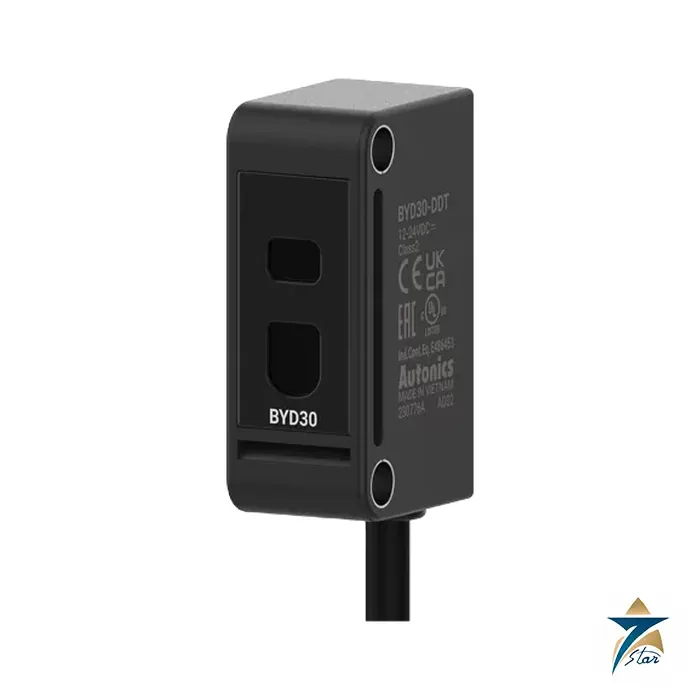
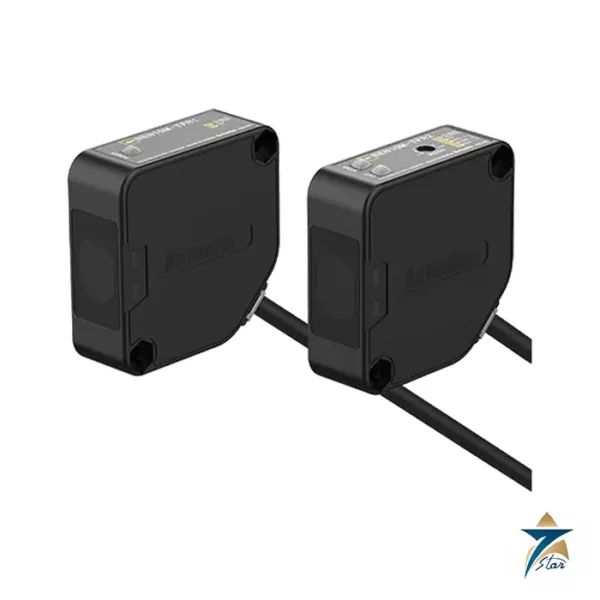
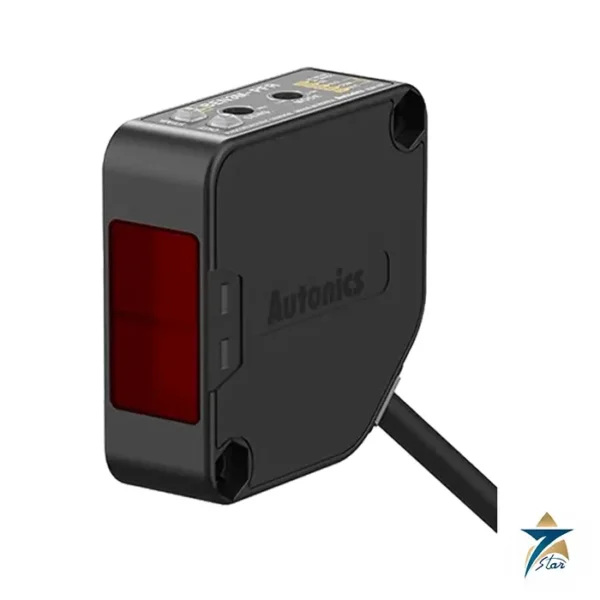
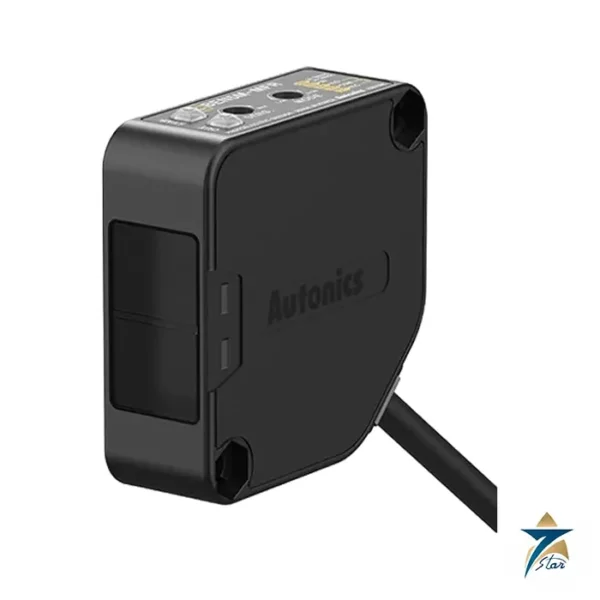
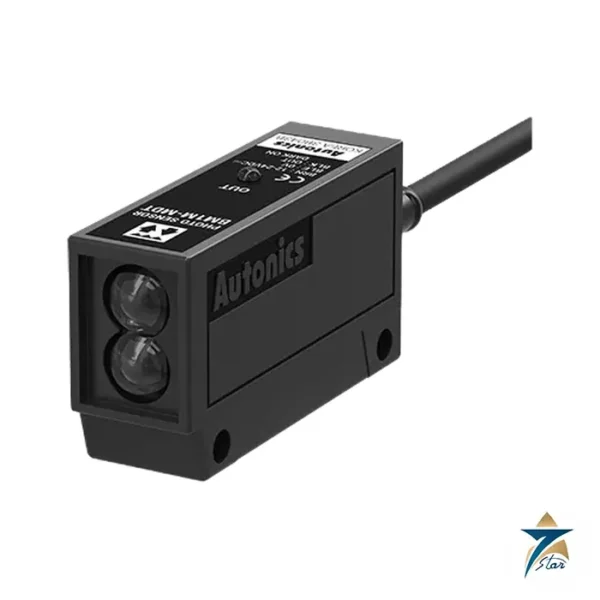
Autonics BYD30-DDT Compact Convergent Photoelectric Sensor
Description
Overview
Where a diffuse sensor reads the wrong thing because a background wall or a machine panel lies behind the target, a convergent reflective sensor solves the problem by looking only at a narrow zone. The Autonics BYD30-DDT is such a sensor: a compact BYD series unit that detects objects between 10 and 30 mm in front of its lens, ignores what lies beyond, and delivers an NPN open collector output on 12 to 24 V DC. Its body is among the smallest in the Autonics photoelectric range. Seven Star LLC is an independent supplier serving Oman and the GCC.
Reading Autonics BYD30-DDT
BYD is the compact family. The number 30 states the upper end of the sensing window in millimetres. The first D after the dash indicates that the sensor is a reflective type, here convergent, the second D is the 12 to 24 V DC supply, and T denotes a transistor output. No further letters appear, so the connection is a cable, the output is NPN, and the operation indicator is on the front of the housing, not on the top, and no built-in timer is fitted.
Technical data for Autonics BYD30-DDT
| Parameter | Value |
|---|---|
| Sensing type | Convergent reflective |
| Sensing window | 10 to 30 mm, plus or minus 10 percent |
| Test target | Non-glossy white paper 50 x 50 mm |
| Hysteresis | 10 percent of sensing distance or less |
| Response | Operation 3 ms or less, return 100 ms or less |
| Light source | Infrared |
| Operation mode | Light ON |
| Supply | 12 to 24 V DC, plus or minus 10 percent |
| Consumption | 35 mA or less |
| Output | NPN open collector, 26.4 V DC, 50 mA maximum, residual 1 V or less |
| Protection circuits | Reverse power and output short overcurrent |
| Ambient | minus 20 to plus 65 degrees C |
| Protection rating | IP64 (front indicator model) |
| Cable | 3.5 mm, 3-wire, 2 m, AWG 26 |
| Housing | PC case and sensing part, brass sleeve |
| Weight | about 38 g, about 75 g packaged |
How the Autonics BYD30-DDT differs from other BYD variants
The BYD3M-TDT through-beam type reaches 3 m, detects objects of 6 mm diameter and responds in 1 ms, but it is a two-piece set and works in Dark ON mode. The BYD100-DDT diffuse type reaches 100 mm, has a sensitivity adjuster and a hysteresis of 25 percent. The Autonics BYD30-DDT instead has a fixed window, 10 to 30 mm, a hysteresis of only 10 percent, and no adjuster to turn. A neighbouring convergent model has a window of 10 to 50 mm, and a further convergent version adds a built-in OFF delay timer of 0.1 to 2 seconds. Choose the Autonics BYD30-DDT when the target distance is short and stable.
Where the convergent principle helps
The narrow detection zone is ideal for small parts at a fixed feed position: components in a vibratory bowl, labels passing a guide, blister pack position, or the presence of a tray in a test fixture. Because background objects farther than 30 mm are ignored, the sensor can sit close to machine panels without false triggering. Within Omani electronics assembly, packaging and laboratory automation, small sensors like this are mounted on compact frames, and the 38 g body keeps the load on moving heads low.
Installation notes
The sensor includes a bracket with a 10 degree tilt element in the drawings, and the 3.5 mm cable emerges from the rear. The light spot hits the target at a fixed convergence distance, so it is important to place the target within the window and not too close to the lens. Follow the wiring: brown to positive, blue to 0 V, and black to the load on the NPN side. The load current is limited to 50 mA for reflective types, which is enough for a PLC input or a small relay but not for solenoids.
Setting and testing
There is no sensitivity adjuster on this type, so setting consists of placing the sensor correctly. Present a target at 20 mm and watch the red operation indicator on the front face; it should light, because the mode is Light ON. Slide the target away until the indicator goes out beyond about 30 mm, and confirm that the background does not cause a signal. A colour or surface change will move the edge of the window, so verify with the real product, especially with dark or glossy materials.
Typical wiring on a PLC input
With an NPN output the load is switched to 0 V, so the black wire connects to the PLC input of a sourcing type that is common to the positive supply, or to one side of a relay coil whose other side goes to plus. In a typical panel, 24 V DC from a shared supply feeds the brown and blue wires, and the output reads logic low when the sensor is active. The 50 mA limit for a convergent sensor means that a standard interface relay with a coil current of about 20 to 40 mA is possible, but an indicator lamp plus relay may exceed it. The reverse polarity and short circuit protections guard the sensor during commissioning, though a sustained short is still a wiring fault that has to be removed. Keep the cable tied back so that it cannot be dragged by moving parts, and label it with the code Autonics BYD30-DDT at the panel end, so that spare parts can be ordered correctly later.
When two convergent sensors are mounted close together and look at the same target area, test for crosstalk by blocking one at a time. Mount them with a little angle between their axes, or separate them by a few centimetres, to remove any interference.
Care of the Autonics BYD30-DDT
Keep the lens free of dust, adhesive and fingerprints with a dry cloth. The housing is rated IP64, which resists splashing but not jets, so install it away from washdown. Check the cable at the exit point for fatigue when the sensor sits on a moving axis. If the output chatters, reduce the vibration of the bracket or check for stray light of strong intensity, as ambient sunlight above 11,000 lx can disturb the receiver.
The return time of up to 100 ms should be kept in mind for fast sequences, because the output drops out more slowly than it picks up. Pace the PLC logic accordingly.
Related items you may also need: Autonics E40S6-2500-6-L-5 Rotary Encoder Incremental | SICK WTB250-2P2441 Background Suppression Sensor | Pepperl+Fuchs RL31-54/73c/136 Retroreflective Sensor, 9 m | All Autonics products.
Documents and quotation
The BYD series product manual that covers the Autonics BYD30-DDT is attached to this page with ordering codes, wiring diagrams and dimensions. Send an RFQ with the part number Autonics BYD30-DDT, quantity and delivery location in Oman or the GCC.
Datasheets & Documents
- Datasheet Autonics BYD30-DDT Compact Convergent Photoelectric Sensor Datasheet Download
Reviews (0)
How would you rate this product? Cancel reply
About brand
Autonics is a South Korean maker of sensors and controllers, founded in 1977 as a small engineering business making controllers for looms. It took the Autonics name in 1988 and opened a new corporate headquarters in Busan in 2014. Autonics makes proximity and photoelectric sensors, rotary encoders, temperature controllers, counters, timers and stepper motor systems, with factories in Busan and Yangsan.
Seven Star LLC lists the Autonics E40S6-2500-6-L-5 incremental rotary encoder and supplies Autonics sensors and control devices in Oman and the GCC.
Autonics company profile
| Founded | 1977, South Korea |
|---|---|
| Current name | Autonics, since 1988 |
| Headquarters | Busan, South Korea |
| Factories | Busan and Yangsan |
| Product families | E40 and E50 rotary encoders, PR proximity sensors, BJ photoelectric sensors, TK temperature controllers |
Milestones
- 1977: The company is founded.
- 1988: Renamed Autonics Corporation.
- 2014: Opens its Busan headquarters.
Reading the Autonics E40S encoder code
E40S is the 40 mm diameter shaft-type incremental encoder, and the 6 that follows is the 6 mm shaft. 2500 is the resolution in pulses per revolution. The next 6 means six output signals: A, B and Z with their inverted signals. L is a line driver output and the final 5 is a 5 V DC supply. The same 40 mm body is made in hollow shaft form as the E40H and E40HB series.
Where Autonics encoders are used
Servo and spindle feedback, conveyor length measurement, packaging and printing machines.
Ordering Autonics encoders: what we need
Send the complete model string from the label. If it is worn off, give the body and shaft diameter, pulses per revolution, output type, supply voltage and cable or connector style.
Facts checked against Autonics corporate profiles, October 2026.
Browse Autonics products by category: Encoders.
FAQ
Questions about the Autonics BYD30-DDT Compact Convergent Photoelectric
Answers from our engineering team on installation, compatibility and integration.
01What is the detection window of the Autonics BYD30-DDT?
It is a convergent reflective sensor that detects between 10 and 30 mm, plus or minus 10 percent, using a 50 x 50 mm white paper test target.
02Is the Autonics BYD30-DDT NPN or PNP?
It has an NPN open collector output, limited to 50 mA for reflective types, from a 12 to 24 V DC supply.
03Does the Autonics BYD30-DDT have a sensitivity adjuster?
No, the convergent type has a fixed sensing window and no adjuster; setting is done by positioning the sensor and target.
04What is the protection rating of the Autonics BYD30-DDT?
The front operation indicator convergent model carries an IP64 rating, with an ambient range of minus 20 to plus 65 degrees C.
05How heavy is the Autonics BYD30-DDT?
The manual gives about 38 g for the sensor and about 75 g with its packaging, including the 2 m cable.


Reviews
There are no reviews yet.