National Instruments cRIO-9023 CompactRIO Real-Time Controller

Description

Overview

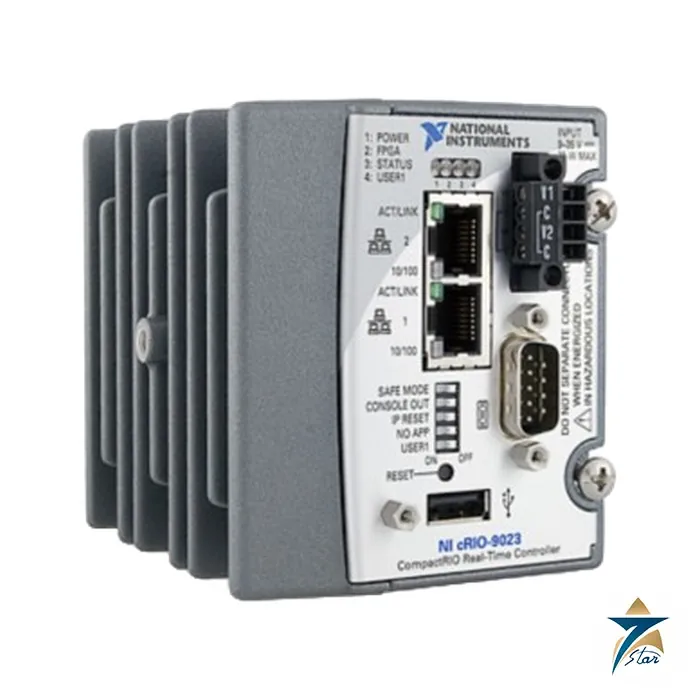
The National Instruments cRIO-9023 is an intelligent real-time embedded controller for the CompactRIO platform. It combines a 533 MHz Freescale MPC8347 real-time processor, 256 MB of DRAM and 2 GB of nonvolatile storage with two Ethernet ports, an RS-232 serial port and a USB port, and it mounts on a reconfigurable CompactRIO chassis that holds C Series I/O modules. NI documents the device in a combined user manual and specification sheet, which is the source for every figure on this page.

Seven Star LLC is an independent supplier serving Oman and the GCC. When you ask us for the National Instruments cRIO-9023 we quote the exact model and keep the quotation tied to the manufacturer documentation.

Role of the National Instruments cRIO-9023 in a CompactRIO system

A CompactRIO system divides tasks between the real-time controller and the FPGA in the chassis. The controller runs the deterministic LabVIEW Real-Time application, handles networking and data logging, and talks to the host computer, while the FPGA handles fast I/O. The controller is therefore the brain of a machine monitor, a test cell or a data acquisition cabinet. Because it is rated for -40 to 70 degrees Celsius and for Class I Division 2 and Zone 2 hazardous locations when installed as instructed, it is also a candidate for process skids and remote stations.

Key capabilities

  • 533 MHz Freescale MPC8347 real-time processor.
  • 256 MB DRAM and 2 GB nonvolatile memory.
  • Two RJ-45 Ethernet ports, 10BaseT and 100BaseTX, auto-negotiated, IEEE 802.3.
  • RS-232 DTE serial port from 600 bps to 230,400 bps.
  • One USB port at up to 480 Mb/s and 500 mA for mass-storage devices formatted with FAT16 or FAT32.
  • Wide supply window of 9 to 35 VDC at power-up and 6 to 35 VDC afterwards.
  • IP20 rating, 609 g weight and a panel or wall mounting design.

Specification table for National Instruments cRIO-9023

Parameter Value
Real-time processor 533 MHz Freescale MPC8347
DRAM 256 MB
Nonvolatile memory 2 GB
Ethernet 2 ports, 10 Mbps and 100 Mbps, up to 100 m per segment
Serial port RS-232 DTE, 5 to 8 data bits, 1, 1.5 or 2 stop bits, RTS/CTS, XON/XOFF or DTR/DSR flow control
USB 480 Mb/s, 500 mA maximum
Real-time clock accuracy 200 ppm, 35 ppm at 25 degrees Celsius
Recommended supply 55 W secondary, 35 VDC maximum
Power consumption 17 W alone, 35 W when supplying eight C Series modules
Supply voltage 9 to 35 V at power-up, 6 to 35 V afterwards
Terminal wiring 0.33 to 2.1 square mm, 22 to 14 AWG, one wire per terminal
Weight 609 g
Operating temperature -40 to 70 degrees Celsius
Storage temperature -40 to 85 degrees Celsius
Operating humidity 10 to 90 percent RH, non-condensing
Operating vibration 5 grms random and 5 g sinusoidal, 10 to 500 Hz
Operating shock 30 g for 11 ms and 50 g for 3 ms
Maximum altitude 5,000 m

How National Instruments cRIO-9023 treats its two Ethernet ports

Although the cRIO-9023 offers two RJ-45 connectors, they are not interchangeable. Port 1 is used to configure the controller and to communicate with the host computer and it can obtain an address by DHCP. Port 2 can only be used after you assign a static IP address with Measurement and Automation Explorer, and the manual states that you cannot configure the controller through port 2 and cannot use DHCP on it. This arrangement lets one port serve an engineering network and the other a separate device network.

Typical applications in oil and gas, utilities and industry

Engineers in Oman and the GCC use CompactRIO controllers for machinery protection test benches, pump and compressor condition monitoring, power quality recorders and process data loggers. The Ethernet connections allow deployment inside plant networks, the RS-232 port can connect a display or a legacy instrument, and the USB port can store logged files. For water and wastewater, the controller can run supervisory logic in a pump station and report to a central system. For manufacturing, it can acquire sensor data and run control loops at determinate rates.

Selection and compatibility notes for National Instruments cRIO-9023

Choose a reconfigurable chassis with the number of slots that matches your C Series modules, and confirm that the module mix is supported by the controller and the installed software. The controller must be powered from a Class 2 or listed limited power source, or installed in a suitably rated metal enclosure. Allow for the 17 W controller load plus the C Series modules when you size the supply. Consult the NI documentation for the software versions that support this model before planning an upgrade.

Installation and hazardous location notes

The manual describes the device as suitable for Class I Division 2 Groups A, B, C and D, T4, Class I Zone 2 AEx nA IIC T4 and Ex nA IIC T4 hazardous locations and nonhazardous locations only. For Division 2 and Zone 2 service the system has to be installed in an enclosure as instructed, power must be switched off before connecting or removing the controller, and component substitution may impair suitability. To meet the shock and vibration figures, the controller must be panel or wall mounted, ferrules must be fitted to terminal wires, the power cable needs strain relief and tie wraps must secure the Ethernet and power cables. Torque terminal screws to 0.2 to 0.25 N m.

Maintenance

If you need to clean the controller, wipe it with a dry towel. Check the screw flanges and terminals during routine shutdowns, review logged temperature and supply conditions, and keep a backup of the deployed application so that a replacement National Instruments cRIO-9023 can be loaded rapidly. Avoid overwriting the nonvolatile drive with frequent small writes; NI provides guidance on nonvolatile memory life.

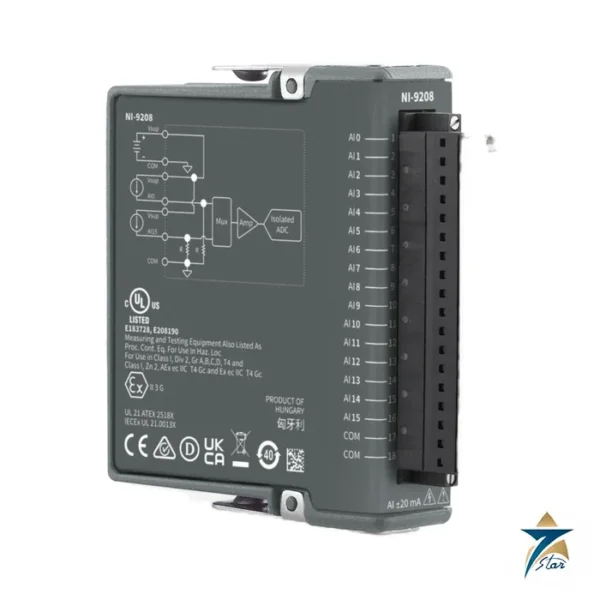
Related items you may also need: NI-9208 16-Channel Current Input Module | C Series 4-20 mA | NI cRIO-9053 CompactRIO Real-Time Controller | NI cRIO-9045 CompactRIO Controller | 8-Slot, Kintex-7 FPGA | All National Instruments products.

Documents and quotation

The manufacturer user manual and specifications document for the cRIO-9023 is supplied with this page and includes the safety guidelines, dimensions, wiring and specification tables. To obtain a quotation, send an RFQ with National Instruments cRIO-9023, the required quantity, the chassis and C Series modules that will accompany it, and your delivery location in Oman or the GCC.

Datasheets & Documents
  • PDF Datasheet National Instruments cRIO-9023 CompactRIO Real-Time Controller Datasheet Download
Reviews (0)

Reviews

There are no reviews yet.

How would you rate this product?

It takes about 10 seconds — just tap a star. Your email is never published.

About brand

National Instruments (NI) is an American maker of test, measurement and data acquisition systems, founded in 1976 in Austin, Texas, by James Truchard, Jeff Kodosky and Bill Nowlin. NI is known for the LabVIEW graphical programming environment and for modular hardware such as CompactDAQ, CompactRIO and PXI. Emerson completed its acquisition of NI in 2023, and NI now operates as Emerson's Test & Measurement business.

Seven Star LLC sources and supplies NI CompactRIO controllers and related hardware for monitoring and control projects in Oman and the GCC.

National Instruments company profile

Founded 1976, Austin, Texas
Founders James Truchard, Jeff Kodosky, Bill Nowlin
Ownership Emerson, since 2023
Software LabVIEW
Product families CompactDAQ, CompactRIO, PXI modular instruments, USB and PCIe DAQ devices

Milestones

  • 1976: NI is founded in Austin.
  • 1986: LabVIEW is introduced.
  • 2023: Emerson completes its acquisition of NI.

NI CompactRIO controllers listed

Two controllers are on this page, the cRIO-9035 and the cRIO-9053. Both run the NI Linux Real-Time operating system. NI describes the cRIO-9053 as a four-slot controller with a 1.33 GHz dual-core Intel Atom processor and an Artix-7 50T FPGA, with I/O reached through NI-DAQmx drivers or the LabVIEW FPGA Module. The cRIO-9035 is a different model with its own slot count and FPGA, so the two are not interchangeable without a check of the application.

Ordering NI hardware: what we need

Send the model name (for example cRIO-9053) and the NI part number from the label, which looks like 78xxxx-01. List the C Series modules that will sit in the chassis, and say which software versions the project uses, because driver support depends on the controller generation. For a replacement, a photo of the label avoids confusion between similar model numbers.

Facts checked against NI and Emerson published histories, October 2026.

FAQ

Questions about the National Instruments cRIO-9023 CompactRIO Real-Time

Answers from our engineering team on installation, compatibility and integration.

01What processor and memory does the National Instruments cRIO-9023 have?
It has a 533 MHz Freescale MPC8347 real-time processor, 256 MB of DRAM and 2 GB of nonvolatile memory, as listed in the NI specifications.
02What power supply does the cRIO-9023 need?
The supply must provide 9 to 35 V at power-up and 6 to 35 V afterwards; NI recommends a 55 W secondary supply, 35 VDC maximum, and lists 17 W consumption.
03Can the cRIO-9023 be used in hazardous locations?
The manual states suitability for Class I Division 2 Groups A to D T4 and Class I Zone 2 AEx nA IIC T4 locations when installed as instructed in an enclosure.
04What is the difference between Ethernet port 1 and port 2 on the cRIO-9023?
Port 1 configures the controller and supports DHCP, while port 2 needs a static IP address and cannot be used to configure the controller.
05What operating temperature range does the cRIO-9023 support?
It is specified for -40 to 70 degrees Celsius operating, with IP20 protection, 10 to 90 percent RH and vibration of 5 grms from 10 to 500 Hz.