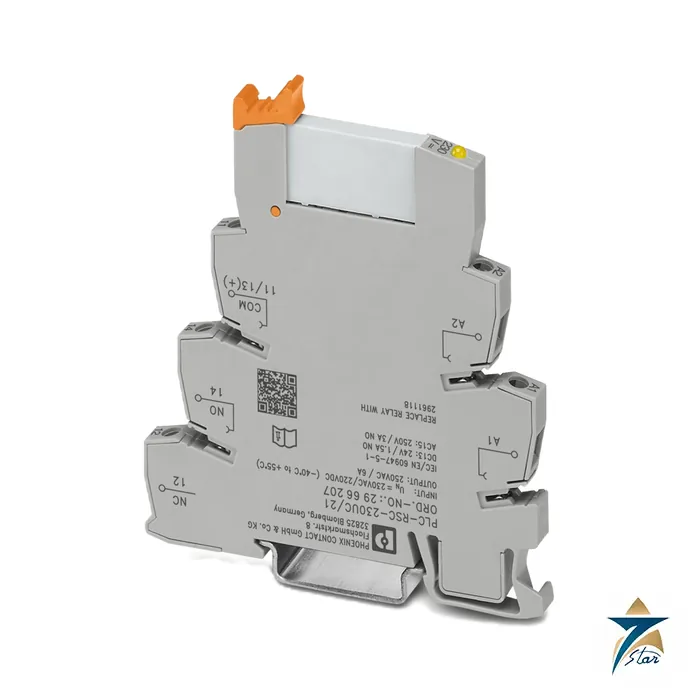
PLC-RSC-230UC/21 relay module, 1 changeover contact, 230 V UC coil
The PLC-RSC-230UC/21 (item number 2966207) is an ultra-slim pluggable relay module from the PLC-INTERFACE family with a coil that accepts 230 V AC or 220 V DC and one changeover contact for 6 A. At just 6.2 mm wide it is one of the narrowest ways to turn a mains-voltage control signal into an isolated switching contact in a control cabinet. Seven Star LLC supplies the PLC-RSC-230UC/21 in Oman and the GCC as an independent supplier in Muscat, and the data below are taken from the manufacturer technical data for this item.
Reading the PLC-RSC-230UC/21 code
- PLC-RSC: PLC-INTERFACE relay module, screw connection.
- 230UC: universal coil voltage, 230 V AC or 220 V DC (UC = AC and DC).
- 21: one changeover contact.
PLC-RSC-230UC/21 technical specifications
| Parameter |
Specification |
| Manufacturer / part number |
Phoenix Contact PLC-RSC-230UC/21, item no. 2966207 |
| Product type |
Relay module, PLC-INTERFACE family, universal application |
| Nominal input voltage |
230 V AC / 220 V DC |
| Input voltage range |
179.4 … 264.5 V AC; 171.6 … 253 V DC at 20 °C |
| Coil behaviour |
Monostable; typical input current 3.2 mA at 230 V AC (3 mA at 220 V DC); response time 7 ms, release time 15 ms |
| Protective circuit |
Bridge rectifier; yellow LED operating display |
| Contact |
1 changeover contact, AgSnO, single contact |
| Switching voltage |
250 V AC/DC maximum; 5 V (100 mA) minimum |
| Continuous current / inrush |
6 A; inrush 10 A for 4 s; output fuse 4 A gL/gG NEOZED |
| Breaking capacity (ohmic) |
up to 140 W at 24 V DC; 20 W at 48 V DC; 1,500 VA at 250 V AC |
| Switching capacity |
2 A at 24 V DC13; 3 A at 230 V AC15; 0.1 A at 220 V DC13 |
| Mechanical life |
2 x 10⁷ cycles |
| Insulation |
Rated insulation voltage 250 V, impulse withstand 6 kV, test voltage 4 kV AC winding/contact; overvoltage category III, pollution degree 3 |
| Ambient temperature |
-40 °C … +55 °C; storage -40 … +85 °C |
| Connection |
Screw terminal M3, 0.14 … 2.5 mm² (AWG 26 … 14), strip length 8 mm, torque 0.6 … 0.8 Nm |
| Dimensions / weight |
6.2 x 80 x 94 mm (W x H x D); about 39 g |
| Approvals / tests listed |
CE, UKCA, shipbuilding approval TAE0000196, corrosive gas test ISA-S71.04 G3 harsh group, IEC 60947-5-1 |
How the PLC-RSC-230UC/21 differs from the 24 V DC types
Many cabinet signals are 230 V AC: the output of a legacy relay panel, an auxiliary contact from switchgear, or a control signal from a motor starter. Using a 24 V module would need an additional interposing relay. The PLC-RSC-230UC/21 takes the mains-level signal directly into a bridge-rectified coil input, drawing only about 3 mA, and presents an isolated changeover contact to the PLC or to the load. The contact material is AgSnO rather than the AgNi of the 24 V DC two-contact type, and the data quotes a 10 A inrush for four seconds. Compared with the 24 V PLC-RSC-24DC/21-21 the 230 V version has one contact instead of two and a narrower 6.2 mm body.
Voltage separation and divider plates
Because the PLC-RSC-230UC/21 is often used on circuits at mains voltage, the manufacturer notes that the divider plate PLC-ATP must be fitted for voltages above 250 V (L1, L2, L3) between identical terminal blocks of adjacent modules, with potential bridging by FBST 8-PLC or FBST 500 bridges. Mixed-voltage rows should keep the 230 V modules grouped and separated from 24 V modules.
Contact loading and protection
The data for the PLC-RSC-230UC/21 gives a 6 A limiting continuous current, 10 A inrush for four seconds, 4 A gL/gG NEOZED as the output fuse and 200 A conditional short-circuit current. In ohmic DC duty the breaking capacity is 140 W at 24 V DC but only 40 W at 220 V DC, so the module should not be used to break larger DC loads at high voltage. For inductive duty the data lists 3 A at 24, 120 and 230 V AC15, 2 A at 24 V DC13, 0.2 A at 110 V DC13 and 0.1 A at 220 V DC13. The minimum switching level is 5 V at 100 mA. A short-circuit-protective fuse on the output side prevents contact welding in a fault.
Selection checklist
- Coil source: 230 V AC or 220 V DC, within the stated input range.
- Load: up to 6 A at 250 V, remembering DC breaking capacity is much lower than AC.
- Maximum ambient temperature of 55 °C for this variant.
- Need for divider plates, bridges and marking accessories.
- Sibling variants: PLC-RSC-120UC/21 and PLC-RSC-24UC/21 for other coil voltages, PLC-RSC-230UC/21-21 for two contacts.
Installation and maintenance
Mount the PLC-RSC-230UC/21 on a DIN rail in rows with zero spacing, wire the coil and contact terminals with the stated torque, and fit the plates where required. The plug-in relay can be replaced without rewiring the base. Keep a note of the real switching duty so that replacement can be planned from the mechanical life figure and the contact loading, and remember that the module is electromechanical, so contact wear is greater with inductive DC loads.
Typical applications in Oman and the GCC
Typical uses are signal interfacing in switchgear and motor control centres, repeating 230 V status contacts to a PLC, switching small lamps and horns, and linking 230 V control circuits to 24 V logic in utility, water, power and building cabinets. In hot, dusty plant rooms the module should sit inside a properly rated enclosure; the manufacturer lists the ISA-S71.04 G3 harsh-environment gas test for the product.
Information to send with an RFQ
- Full type designation or item number and quantity
- Coil voltage and type (AC or DC) and source
- Load voltage, current and type (AC, DC, inductive, lamp)
- Number of contacts needed and accessories (divider plates, bridges, markers)
- Ambient conditions and approvals
- Delivery location
Documents and quotation
Send the part number PLC-RSC-230UC/21 or item number 2966207 and Seven Star LLC will confirm the documents available. Provide quantity and delivery location when you request a quotation.
Other Models in the Pc Plc Rsc Range
Seven Star LLC supplies models from the Pc Plc Rsc range in Oman and the GCC. Compare the related models below and request a quote for the one that matches your application.































Reviews
There are no reviews yet.