A four-point resistivity meter for judging corrosion risk and concrete quality
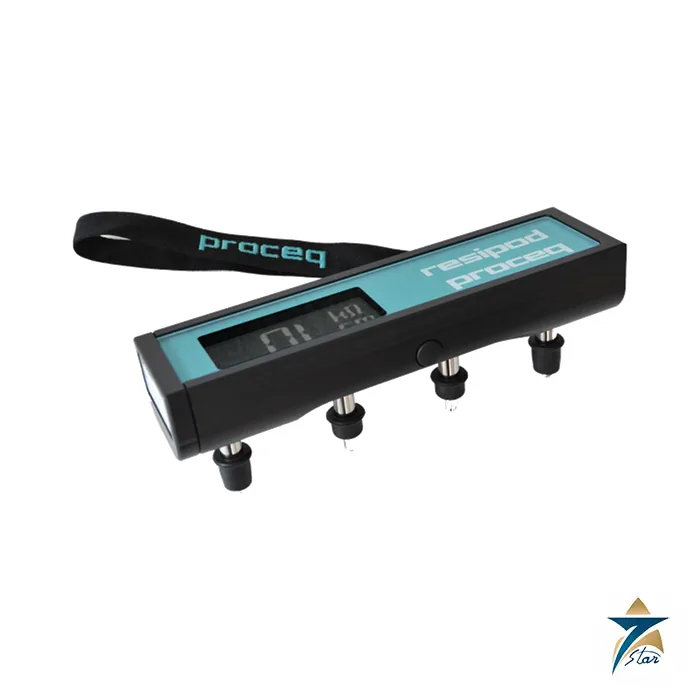
The Resipod measures the electrical resistivity of concrete at the surface. It works on the Wenner principle: a current is injected through the two outer probes and the potential is read across the two inner probes, so that resistivity is calculated as 2 pi times probe spacing times voltage divided by current and displayed in kOhm-cm. Resistivity is a way of judging how easily chloride-bearing water and current can move through the concrete, which is why it is used alongside half-cell and cover measurements.
The meter is one hand-held body of 197 x 53 x 69.7 mm and 318 g with four probes at a spacing of 50 mm or 38 mm (1.5 inch). It measures from 1 to about 1000 kOhm-cm with an accuracy of plus or minus 0.2 kOhm-cm or 1 %, whichever is greater, in the 200 uA range. A pixel LCD shows the result, a current indicator warns of poor contact and 500 values can be stored and sent to a PC through USB.
Design highlights
- Wenner four-point measurement of surface resistivity
- Probe spacing 50 mm or 38 mm (1.5 inch)
- Current flow indication and poor-contact warning
- Hold, save and delete functions with memory for about 500 values
- ResipodLink PC software with variable contact spacing
- Bulk resistivity and geometric accessory versions
- More than 50 hours of autonomy
Technical specifications
| Parameter |
Specification |
| Principle |
Wenner four-point resistivity, rho = 2 pi a V / I |
| Measured quantity |
Electrical resistivity in kOhm-cm |
| Measurement range |
1 kOhm-cm to about 1000 kOhm-cm, depending on probe spacing |
| Accuracy at 200 uA |
+/- 0.2 kOhm-cm or +/- 1 %, whichever is greater |
| Accuracy at 50 uA |
+/- 0.3 kOhm-cm or +/- 2 %, whichever is greater |
| Accuracy below 50 uA |
+/- 2 kOhm-cm or +/- 5 %, whichever is greater |
| Measuring frequency |
40 Hz |
| Probe spacing |
50 mm (standard) or 38 mm (1.5 inch) |
| Display |
Pixel graphic LCD with current and battery indication |
| Memory |
Non-volatile, about 500 measured values |
| Connection |
USB type B, 5 V, 100 mA |
| Autonomy |
More than 50 hours |
| Dimensions / weight |
197 x 53 x 69.7 mm / 318 g |
| Operating temperature |
0 to 50°C |
| Storage temperature |
-10 to 70°C |
| Warranty |
24 months electronics, 6 months mechanical |
Resipod variants and spare parts
The operating instructions list six complete units; each includes a test strip, foam contact pads, charger with USB cable, software, carrying strap, documentation and case.
| Code position |
Options |
| 381 10 000 |
Resipod, 50 mm probe spacing |
| 381 20 000 |
Resipod, 38 mm (1.5 inch) probe spacing |
| 381 30 000 / 381 40 000 |
Resipod Bulk Resistivity, 50 mm or 38 mm, with the bulk resistivity accessory |
| 381 50 000 / 381 60 000 |
Resipod Geometric, 50 mm or 38 mm, with the geometric accessory |
| Accessories |
Variable spacing probe 381 01 094; Resipod stand 381 01 089; replacement foam pads 381 01 043 S; bulk contact pads 381 01 092 S; test strip 381 01 038 |
Installation and operating notes
Moisten the foam contact pads, press the four probes onto the cleaned surface and read when the current indicator shows a stable value. The range indicator shows whether the 200 uA or the 10 to 50 uA range is active.
Reinforcement affects the reading. The manual recommends keeping bars out of the direct line under the probe and, where rebar spacing allows, taking readings across the bars with a probe span of 3 times the spacing, which is 150 mm for the 50 mm model and 114 mm for the 38 mm model. Where the bars are too close, take several readings and move the probe a few mm between them.
Record the concrete temperature. The manual notes that resistivity falls as temperature rises, by about 3 % per degree Celsius for saturated concrete and 5 % for dry concrete, and that moisture state, carbonation and aggregate size also matter. Check the instrument with the supplied test strip, which gives 16 kOhm-cm for the 50 mm model and 12 kOhm-cm for the 38 mm model in the upper row.
Durability assessment of concrete structures
Resistivity mapping is used on bridge decks, car parks, jetties, tunnels and coastal buildings to find zones where reinforcement corrosion is likely to be active or where concrete is of low density. In the hot, saline conditions of the Gulf the readings help to prioritise coring and half-cell testing.
Interpreting the numbers needs reference values and the moisture condition of the structure, which the manual leaves to the engineer. The meter does not give a corrosion rate on its own. General guidance.
Information to send with an RFQ for the Proceq Resipod
Send these details to quote the correct Resipod.
- Probe spacing, 50 mm or 38 mm
- Standard, bulk resistivity or geometric version
- Variable spacing probe, stand and spare pads
- Calibration certificate requirement
Related items and documents
Proceq also lists the Profometer PM8000 rebar detector for cover mapping on the same structures. More field test instruments sit in the portable test and measurement category. The datasheet can be downloaded from this page. Seven Star LLC prepares a quotation for Resipod after receiving the model and accessories needed.
Calibration and field notes
Concrete resistivity is relevant in the region because many structures are exposed to chlorides from seawater, saline groundwater and salty soil, which drive reinforcement corrosion. Surface resistivity surveys help engineers judge the corrosion risk and the quality of concrete in bridges, marine structures, car parks and foundations. Wet the probes and the concrete surface as described in the manual, and avoid taking readings directly over reinforcement bars, which can lower the readings.
Check the instrument with the supplied test strip before each series of measurements, and record the results.
Record the moisture condition of the concrete with each survey, because resistivity depends strongly on moisture, and compare results only between surveys made under similar conditions. Clean the probes after use and store the instrument in its case.
Frequently asked questions
What does the Resipod measure?
The electrical resistivity of concrete in kOhm-cm, using the Wenner four-point principle.
What probe spacings are offered?
50 mm and 38 mm (1.5 inch).
What measuring range applies?
1 kOhm-cm to about 1000 kOhm-cm depending on probe spacing.
How much data can it store?
About 500 measured values in non-volatile memory.
How is it powered?
By a rechargeable battery charged over USB type B, with more than 50 hours of autonomy.










Reviews
There are no reviews yet.