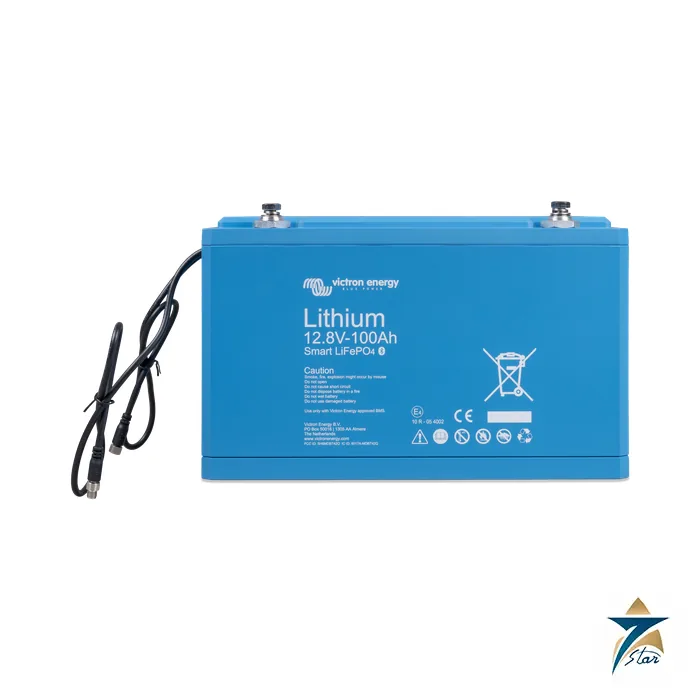
The Victron Lithium Battery Smart 12.8 V is a lithium iron phosphate (LiFePO4) battery with Bluetooth, sold in 12.8 V sizes from 50 to 330 Ah and in 25.6 V sizes of 100 and 200 Ah. It replaces lead-acid banks in solar, telecom, marine and vehicle systems, and batteries can be wired in series, parallel or series-parallel for 12, 24 or 48 V systems with up to 20 batteries per BMS, which gives up to 84 kWh at 12 V.
LiFePO4 chemistry for deep daily cycling and partial charge
Victron points out that lead-acid batteries suffer sulfation when they are left partly charged, while an LFP battery does not need a full charge and tolerates partial-state operation. Round-trip efficiency is stated as 92 percent against about 80 percent for lead-acid, and the datasheet quotes savings of up to 70 percent in space and weight. Cycle life to 80 percent remaining capacity is 2500 cycles at 80 percent depth of discharge, 3000 at 70 percent and 5000 at 50 percent.
Each battery has integrated cell balancing and cell monitoring, with cables daisy-chained to a battery management system. Victron offers six BMS models for different applications. The BMS gives a pre-alarm when a cell falls below 3.1 V, disconnects the load below 2.8 V and stops charging above 3.75 V or at unsafe temperatures. Bluetooth shows cell voltages, temperature and alarm status in the VictronConnect app.
Technical specifications
| Parameter |
Specification |
| Chemistry |
Lithium iron phosphate (LiFePO4); 12.8 V = 4 cells, 25.6 V = 8 cells in series |
| Round trip efficiency |
92 percent |
| Cycle life (to 80 percent capacity) |
2500 cycles at 80 percent DoD; 3000 at 70 percent; 5000 at 50 percent |
| Capacity loss |
Below 1 percent per 100 cycles at 25 degrees C, 100 percent DoD |
| Operating temperature |
Discharge -20 to +50 degrees C; charge +5 to +50 degrees C; storage -45 to +70 degrees C |
| Charge voltage |
14 V / 28 V to 14.4 V / 28.8 V (14.2 V / 28.4 V recommended); float 13.5 V / 27 V |
| End of discharge voltage |
11.2 V (12.8 V models); 22.4 V (25.6 V models) |
| Protection class |
IP22 |
| BMS connection |
Male and female cable with M8 circular connector, 50 cm; up to 20 batteries per BMS (up to 5 BMS in parallel per release notes) |
| Terminals |
M8 threaded inserts (M10 on 12.8/330) |
| Standards |
Cells to UL1973, IEC62619 and UL9540A as printed; EN 60335-1, EN-IEC 62368-1, IEC 61427-1; EMC EN-IEC 61000-6-3; automotive ECE R10-6 |
Selecting a model and the BMS
A battery does not work alone: a BMS must be selected from Victron six options in the battery manual, and a charger or inverter charger must be configured with a lithium profile. Check the maximum continuous discharge current against the inverter size, and the recommended currents in the datasheet, which are about 1C for discharge and 0.5C to 0.6C for charge. Mounting: the batteries can lie on their sides, but terminals must not face down, and the 12.8/330 must stay upright. Compatible Victron inverters on the site include the MultiPlus-II 48/5000/70-50; see also UPS and batteries.
Lithium Battery Smart models
| Model |
Capacity at 25 degrees C |
Energy |
Weight |
Dimensions (h x w x d) |
| 12.8/50 |
50 Ah |
640 Wh |
7 kg |
199 x 188 x 147 mm |
| 12.8/100 |
100 Ah |
1280 Wh |
14 kg |
197 x 321 x 152 mm |
| 12.8/160 |
160 Ah |
2048 Wh |
18 kg |
237 x 321 x 152 mm |
| 12.8/180 |
180 Ah |
2304 Wh |
18 kg |
237 x 321 x 152 mm |
| 12.8/200 |
200 Ah |
2560 Wh |
20 kg |
237 x 321 x 152 mm |
| 12.8/330 |
330 Ah |
4220 Wh |
29 kg |
265 x 359 x 206 mm |
| 25.6/100 |
100 Ah |
2560 Wh |
28 kg |
197 x 650 x 163 mm |
| 25.6/200 |
200 Ah |
5120 Wh |
39 kg |
237 x 650 x 163 mm |
Installing the battery bank
Plan the bank layout before the batteries arrive on site. Place them in a clean, dry enclosure or equipment room, since the IP22 protection class is meant for indoor or sheltered use rather than open exposure to rain or blown sand. Follow the orientation rules from the selection notes above: side mounting is acceptable for most sizes, terminals never face down, and the 12.8/330 stays upright. Leave room around each battery so that the BMS cables with their M8 circular connectors can be routed without sharp bends or strain.
When batteries are connected in series, parallel or series-parallel, use cables of equal length and cross-section for each string so that current shares evenly. Tighten the terminal bolts to the torque given in the Victron manual; a loose lug on a high-current battery is a common cause of local heating. Install suitable DC fusing or a breaker between the bank and the inverter or load, sized according to the manual and your system design.
Commissioning with the BMS and charger
Connect the BMS cables in a daisy chain as described in the manual and confirm that the chosen BMS can switch the loads and chargers in your system. Set the charger or inverter charger to a lithium profile using the charge and float voltages from the specification table, with 14.2 V or 28.4 V as the recommended absorption setting. Then open VictronConnect over Bluetooth on each battery and check that cell voltages are close together and that no alarm is shown before the bank is put into service.
A first full charge under supervision is a sensible step: watch for even cell voltages as the bank approaches the end of charge, and confirm that the BMS stops charging at the expected point if a cell reaches its upper limit.
Heat and dust in Gulf installations
Charging is permitted between +5 and +50 degrees C, and discharge up to +50 degrees C. In Oman a shipping container, rooftop cabinet or vehicle compartment can exceed that in summer if it has no shading or ventilation. Keep the battery space shaded and ventilated, or air-conditioned for telecom and critical sites, so that the BMS does not interrupt charging on hot afternoons. Warm conditions also shorten the life of most battery chemistries, so a cooler room protects the cycle-life figures quoted in the datasheet.
Fine dust can collect on the battery tops and around the terminals. Keep enclosures closed, clean the batteries with power isolated where required, and check that cable entries to the cabinet are sealed against sand.
Ongoing checks
Use the Bluetooth data during routine visits to compare cell voltages and temperatures between batteries in the bank; a battery that drifts away from the others is worth investigating early. Re-check terminal tightness periodically, inspect the BMS cables for damage, and review the charger settings after any firmware update or equipment replacement so the lithium profile is still applied.
Documents and quotation
The Victron Lithium Battery Smart datasheet is attached to this page; the manual and BMS datasheets are on the Victron product page. Seven Star LLC is an independent supplier in Muscat. Send the exact model name, the system voltage and the battery type, and we will quote against Victron data.







Reviews
There are no reviews yet.