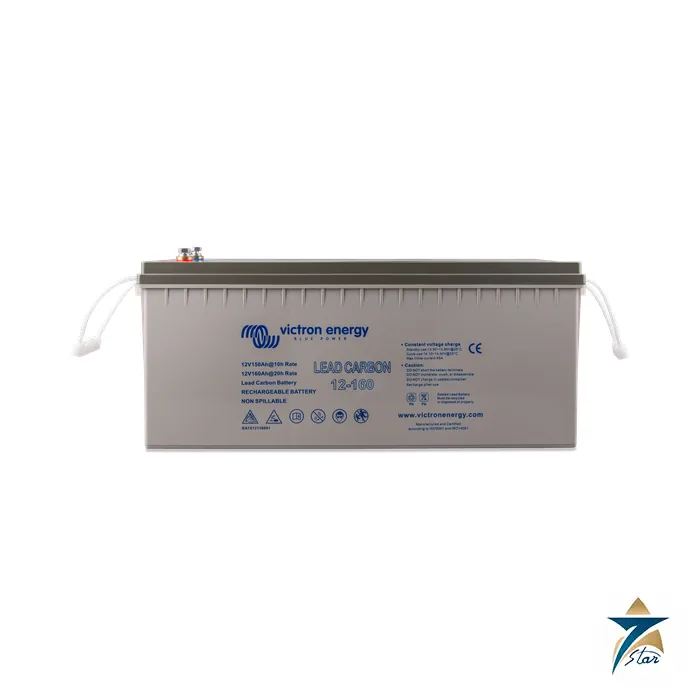
The Victron Lead Carbon Battery 12V 160Ah (BAT612116081) is a sealed VRLA battery whose negative plate uses a lead-carbon composite instead of plain lead. It is built for systems that cycle often or sit in partial state of charge, such as off-grid solar, telecom and backup banks, and it is available in two sizes: 106 Ah (BAT612110081) and 160 Ah.
Why lead carbon: less sulfation in partial state of charge
The Victron datasheet explains the common failure modes of flat plate VRLA batteries under intensive cycling: softening of the positive active material, corrosion of the positive grid and sulfation of the negative plate when left at low charge. Replacing the active material of the negative plate with a lead-carbon composite reduces sulfation and improves charge acceptance, so cycling performance rises and a lower charge voltage can be used, which means higher efficiency and less grid corrosion.
Victron states test results of at least 500 cycles at 100 percent depth of discharge, and notes that some manufacturers claim up to 2000 cycles at 90 percent DoD which Victron has not been able to confirm. That honest statement is useful when comparing quotations: ask for the test conditions behind any cycle-life claim.
Technical specifications
| Parameter |
Specification |
| Article number / model |
BAT612116081, 12 V / 160 Ah |
| Capacity (to 10.8 V) |
138 Ah at C5, 150 Ah at C10, 160 Ah at C20 |
| Dimensions (l x w x h) |
532 x 207 x 226 mm |
| Weight |
55 kg |
| Cold cranking (CCA at 0 degrees F) / reserve capacity at 80 degrees F |
600 / 290 |
| Terminals |
M8 insert |
| Cycle life |
At least 500 cycles at 100 percent DoD; 1000 at 60 percent DoD; 1400 at 40 percent DoD (0.2C20 test conditions in datasheet) |
| Recommended charge voltage |
Absorption 14.1 to 14.4 V; float 13.5 to 13.8 V; storage 13.2 to 13.5 V |
| Standards / conformity |
Declaration of conformity and ISO 9001 certificate published by Victron |
Selection and installation notes
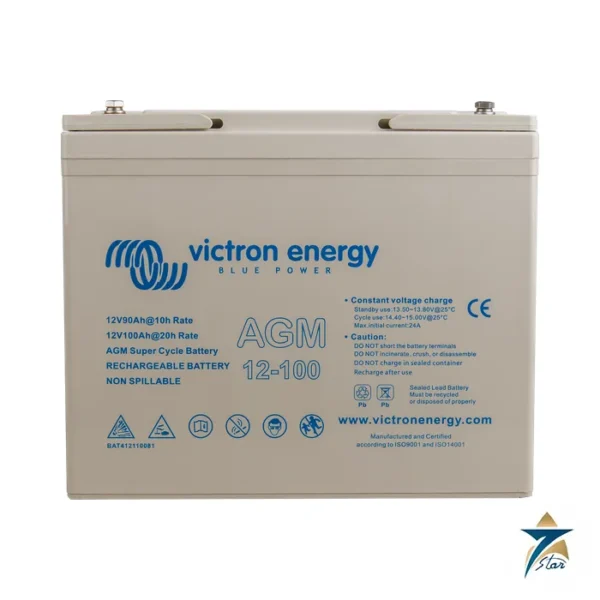
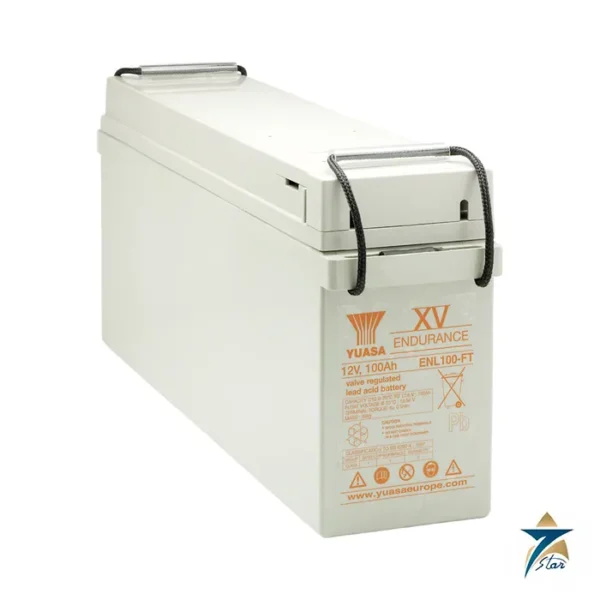
Charge to the recommended voltages and set the charger for lead-carbon or the nearest Victron profile. A VRLA battery needs temperature compensation where the ambient temperature changes a lot, so use a temperature sensor with the charger. At 55 kg, plan the shelf and lifting. For comparison with an AGM option already listed see the Yuasa ENL100-12 12V 108Ah AGM Battery, or the other units under UPS and batteries.
The datasheet also explains why recharge time matters. Victron notes that a lead-acid battery should ideally be charged at a rate not exceeding 0.2C, and that the bulk phase should be followed by about eight hours of absorption charge. Higher current and higher voltage shorten the recharge but cost service life through heat and faster corrosion of the positive plate. A lead-carbon negative plate accepts charge better, but the same discipline applies: size the charger or solar controller so the battery is not left at a low state of charge for long periods, and compare any cycle-life claim with the real discharge pattern of the site.
Lead Carbon Battery sizes
| Article |
Voltage |
Capacity C5 / C10 / C20 |
Dimensions |
Weight |
CCA / reserve capacity |
| BAT612110081 |
12 V |
92 / 100 / 106 Ah |
410 x 172 x 225 mm |
36 kg |
500 / 170 |
| BAT612116081 |
12 V |
138 / 150 / 160 Ah |
532 x 207 x 226 mm |
55 kg |
600 / 290 |
Typical applications for the 160 Ah lead carbon battery
The lead-carbon design is aimed at duty where a conventional flat plate VRLA battery struggles: banks that are discharged and recharged frequently, and banks that spend long periods between full charges. Off-grid solar is the clearest example, because the battery is charged during the day, discharged at night, and may not reach full charge for several days in poor weather. Telecom sites and backup banks are the other applications Victron names. In each case the improved charge acceptance of the lead-carbon negative plate helps the battery recover more of its capacity in the charging window available, and the reduced sulfation helps it tolerate the time spent below full charge. For a bank that floats at full charge almost all the time and is rarely discharged, the advantage of lead carbon is smaller, and the choice should be made on the actual operating pattern of the site.
Choosing between the 106 Ah and 160 Ah sizes
The two sizes share the same chemistry and charge recommendations, so the choice comes down to capacity, footprint and handling. The 160 Ah unit gives more stored energy per battery, which means fewer parallel strings for a given bank capacity and fewer interconnections to check. The 106 Ah unit is smaller and lighter, which can make it the better fit for compact cabinets or where batteries must be lifted by hand. Compare the dimensions in the size table with the shelf or rack, and remember that space is also needed around the terminals for cabling and inspection. When a bank is built from several batteries, use units of the same size and article number, and avoid mixing new batteries with older ones in the same string.
Installation and commissioning considerations
Before the bank is connected, confirm that the charger, inverter-charger or solar controller can be set to the absorption, float and storage voltages given in the specification table, and that the absorption time can be configured to match the datasheet guidance. Check the M8 terminal connections for correct torque according to the cable lug and site practice, and keep the terminals clean and covered. Plan the battery location so that the batteries share a similar temperature, since a bank with hot and cold units ages unevenly. After installation, record the initial voltages and the charger settings, and repeat the check after the first full charge cycle. These records make it much easier to judge later whether the bank is ageing normally or whether a setting needs adjustment.
How to specify your RFQ
To quote accurately we need the article number BAT612116081 or BAT612110081, the number of batteries, and the delivery point. Tell us the system voltage and how the bank will be arranged in series and parallel, and describe the application: solar, telecom, backup or another cycling duty. If you are replacing an existing bank, a photo of the old battery label and a note on the charger model help us check that the charge settings and the physical size are suitable before we reply.
Documents and quotation
The Victron Lead Carbon battery datasheet is attached to this page. Seven Star LLC is an independent supplier in Muscat. Send the exact model name, the system voltage and the battery type, and we will quote against Victron data.









Reviews
There are no reviews yet.