- Automation & ControlView all 2,897 products
- Automation Accessories
- AC Drives
- PLC & I/O Cards
- Industrial Communications
- Vibration Monitoring
- Controllers & Data Acquisition
- Isolator & Barrier
- Safety Switches & Guard Locking
- Motor Soft Starters
- CCTV & Security
- Encoders
- Pneumatic Cylinders
- HMI Displays
- Servo Drives
- Industrial Computers
- Machine Vision
- Automation Software
- Robotics
Brand: WIKA
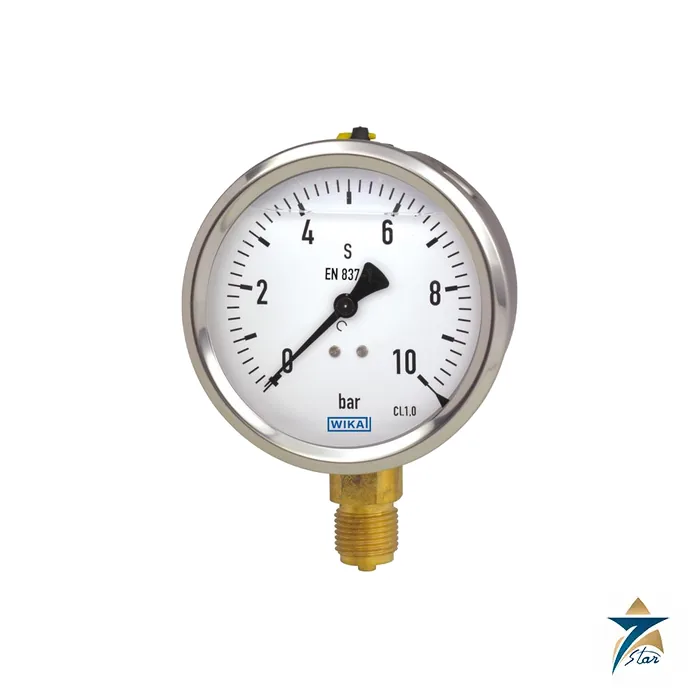
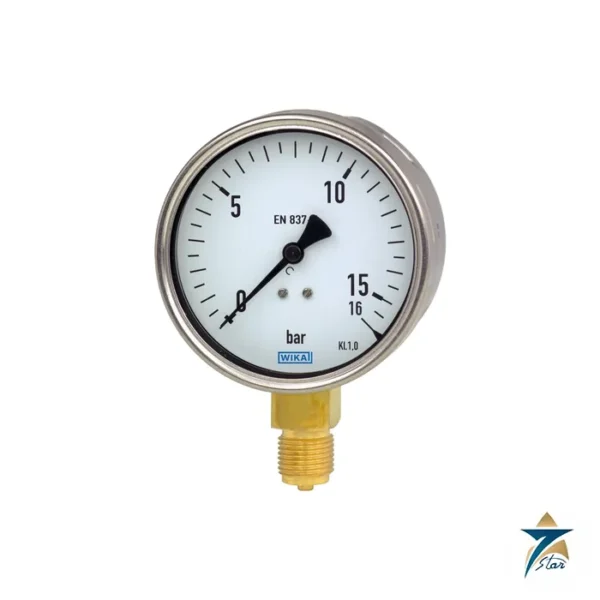
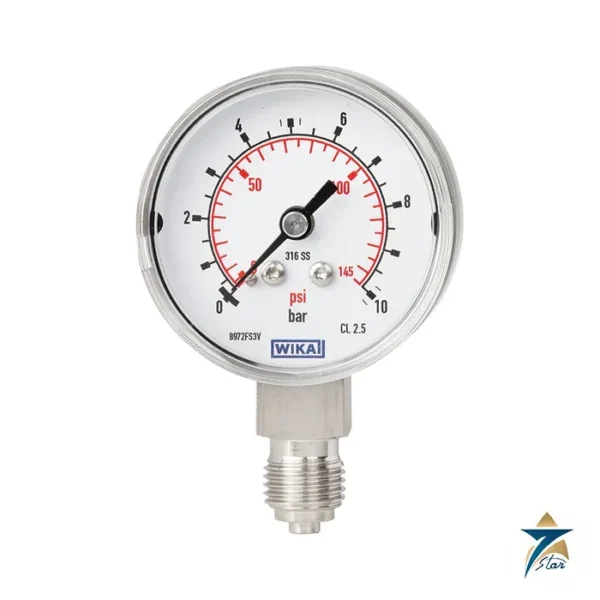
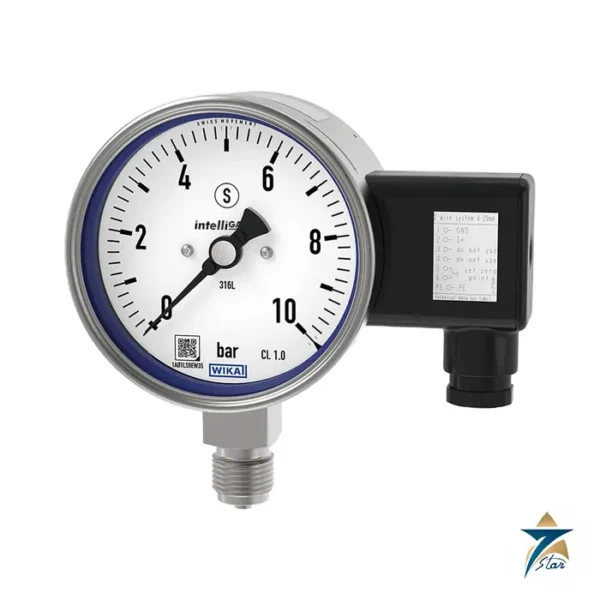
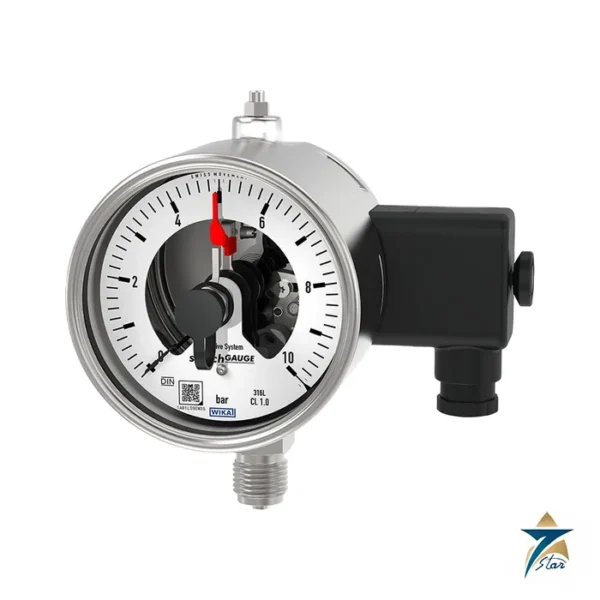
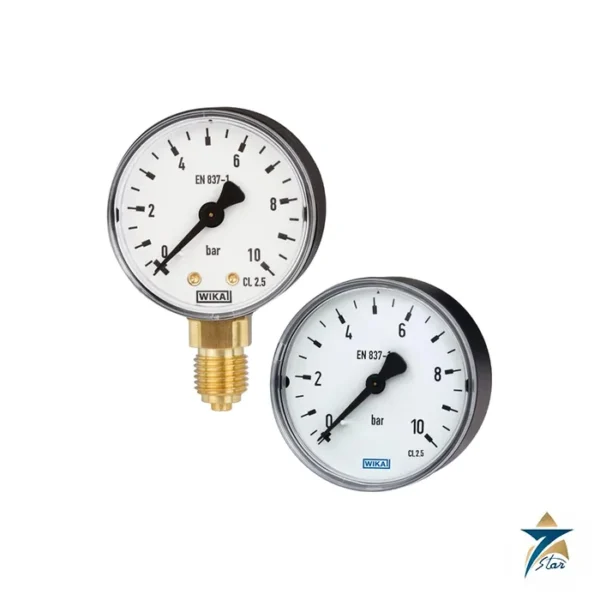
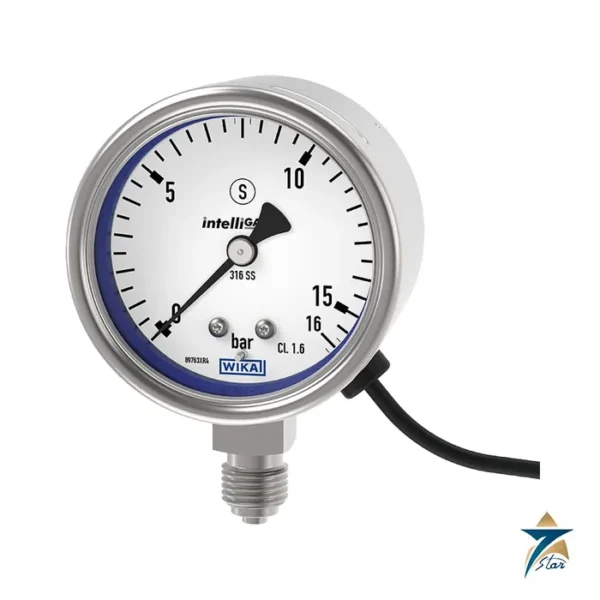
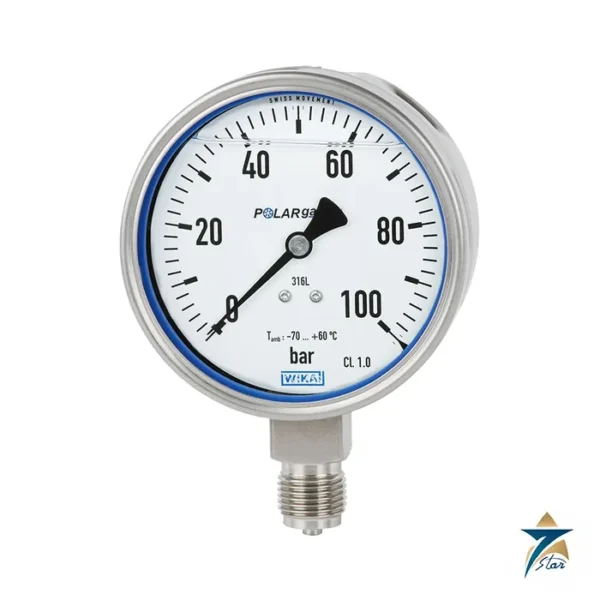
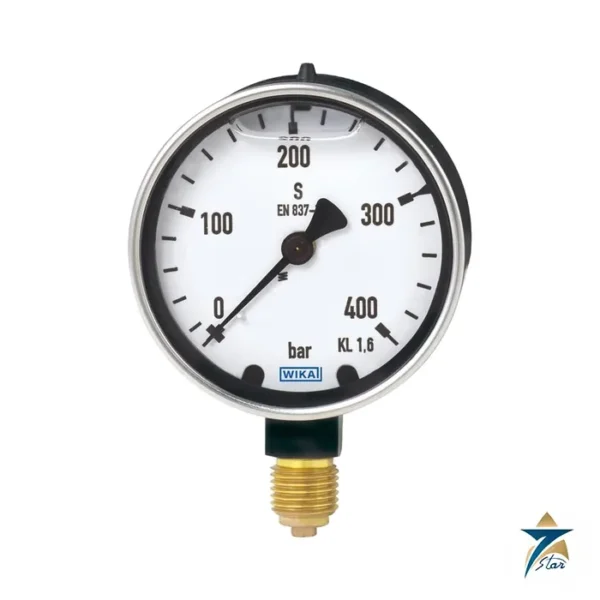
WIKA 213.53 Liquid-Filled Bourdon Tube Pressure Gauge
Description
Overview
The WIKA 213.53 is a liquid-filled mechanical Bourdon tube pressure gauge that combines a stainless steel case with wetted parts in copper alloy. WIKA builds and qualifies the instrument to EN 837-1 and ASME B40.100, and the case filling damps the measuring element and movement so that the pointer stays readable at measuring points with fast load cycles, pulsation and vibration. That combination has made the gauge one of the most widely installed general-purpose liquid-filled gauges on pumps, compressors, hydraulic power units and skid-mounted packages around the world.
Seven Star LLC supplies the WIKA 213.53 to contractors, OEMs, utilities and plant maintenance teams in the Sultanate of Oman and across the GCC, with engineering support in Muscat. We help buyers choose the right nominal size, scale range, filling and connection, and we combine the gauge with siphons, snubbers, gauge valves and calibration certificates where a project specification calls for them.
Operating Principle
As general engineering background, a Bourdon tube is a curved tube with an oval cross-section that is sealed at its tip. When pressure enters the tube it tries to straighten, and the small tip movement is passed through a link to a geared movement that rotates the pointer across the dial. In the WIKA 213.53 the measuring element is a C-type or helical Bourdon tube. According to the datasheet, NS 50 instruments use copper alloy tubes up to 600 bar and stainless steel 316L tubes above that, while NS 63 and NS 100 instruments use copper alloy up to 400 bar and 316L above 400 bar.
The glycerine, glycerine-water or silicone oil filling surrounds the movement and slows down rapid pointer swings caused by pump pulsation or machine vibration. It also lubricates the gear train and reduces wear, which is why a liquid-filled gauge usually outlasts a dry gauge on a vibrating compressor or hydraulic press. The WIKA 213.53 has a blow-out device so that, in the event of a failure, overpressure can escape from the case, and a filling plug that can be vented and resealed for internal pressure compensation.
Engineering Design of the WIKA 213.53
The case of the WIKA 213.53 is natural-finish stainless steel closed with a stainless steel crimp ring, and the window is crystal-clear plastic or laminated safety glass. NS 50 and NS 63 versions meet safety level S2 per EN 837-1 and NS 100 versions meet safety level S1, both with a blow-out device positioned at 12 o’clock. Ingress protection is IP65, and the movement and process connection are copper alloy, which suits water, air, oil and other media that will not attack copper alloy parts.
Connection locations are lower mount (radial) for all sizes, centre back mount for NS 50 and NS 63, and lower back mount for NS 100. For panel work, back-mount gauges can be supplied with a stainless steel panel mounting flange, a polished flange, a triangular profile ring with bracket (NS 63) or a surface mounting flange. Process threads include G ⅛ B, G ¼ B, G ½ B, M12 x 1.5 and M20 x 1.5 per EN 837-1, R ¼ and R ½ per ISO 7, and ¼ NPT or ½ NPT, with optional copper alloy restrictors of 0.5 mm or 0.3 mm.
Key Features
The main reasons engineers specify the WIKA 213.53 for dynamic duty are summarised below.
- The liquid-filled stainless steel case gives very good vibration and shock resistance at pumps, compressors and hydraulic systems.
- Three nominal sizes, 50, 63 and 100 mm, cover compact OEM skids as well as larger, easier-to-read process indicators.
- Accuracy is class 1.0 per EN 837-1 for NS 100 and class 1.6 for NS 50 and NS 63, with matching ASME B40.100 grades.
- Scale ranges extend from 0–0.6 bar up to 0–1,000 bar, with vacuum and compound ranges from −1 bar.
- Units can be bar, psi, kg/cm², kPa or MPa, and an optional refrigerant temperature scale such as R 717 is available.
- Glycerine, glycerine-water mixture or silicone oil filling can be selected to suit ambient temperature and scale range.
- A blow-out device and resealable vent plug are fitted as standard, and optional 2-times overload safety is available on suitable ranges.
- Type approval for shipbuilding is noted by WIKA, with DNV listed among the optional approvals in the datasheet.
Industrial Applications
In Oman the WIKA 213.53 is a common choice for booster pump sets in commercial buildings, fire water and irrigation pump skids, compressed air plants, hydraulic power packs on cranes and presses, and the lubrication and cooling circuits of diesel generators. District cooling plants and chilled water systems in Muscat, Duqm and Salalah also use the WIKA 213.53 on pump discharge headers where pulsation would make a dry gauge difficult to read. Marine and port workshops in Sohar and Duqm value the robust case for shipboard and dockside equipment.
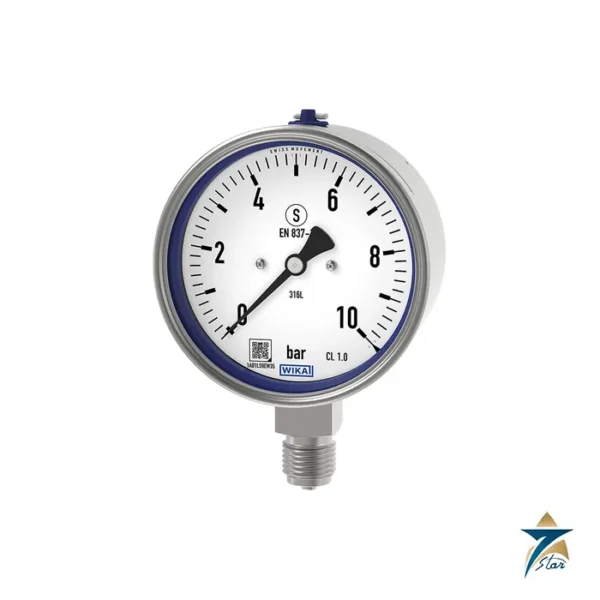
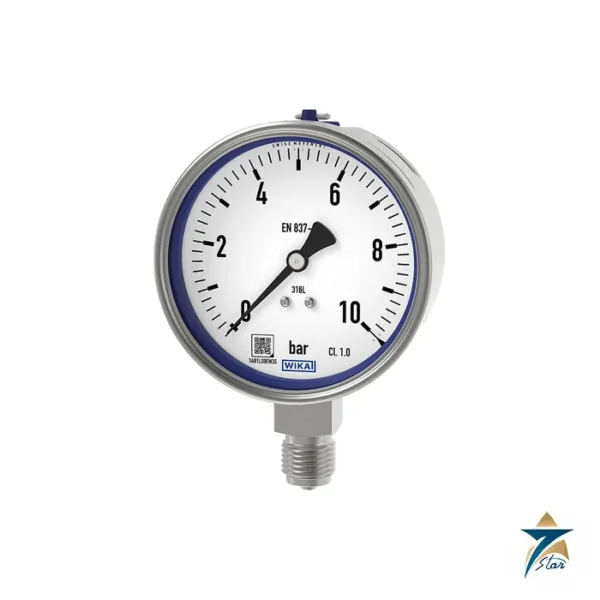
Because the wetted parts are copper alloy, the WIKA 213.53 is intended for gaseous and liquid media that are not highly viscous or crystallising and will not attack copper alloy. For sour, chloride-rich or aggressive process media, our engineers in Muscat will usually propose an all-stainless gauge such as the WIKA 232.50 Stainless Steel Bourdon Tube Pressure Gauge or the safety-pattern WIKA 232.30 instead, or a diaphragm seal such as the WIKA 990.27 Diaphragm Seal. Seven Star LLC supplies the WIKA 213.53 with engineering support, so maintenance teams across the GCC can standardise spare gauges and replace units quickly.
Technical Specifications
The following WIKA 213.53 data is taken from WIKA data sheet PM 02.12; please confirm the final configuration against the datasheet when ordering.
| Parameter | Specification |
|---|---|
| Model | WIKA 213.53 (special design: model 213.57) |
| Standards | EN 837-1, ASME B40.100 |
| Nominal size | 50 mm [2"], 63 mm [2½"], 100 mm [4"] |
| Connection location | Lower mount; centre back mount (NS 50, 63); lower back mount (NS 100) |
| Accuracy | Class 1.6 (NS 50, 63); class 1.0 (NS 100) per EN 837-1 |
| Scale ranges | 0–0.6 bar to 0–1,000 bar; vacuum and compound ranges |
| Case and ring | Stainless steel, crimp ring; safety level S2 (NS 50, 63) or S1 (NS 100) |
| Case filling | Glycerine, glycerine-water mixture (up to 2.5 bar ranges), silicone oil |
| Wetted parts | Copper alloy connection; copper alloy or 316L Bourdon tube depending on range |
| Process connection | G ⅛ B to G ½ B, M12 x 1.5, M20 x 1.5, R ¼, R ½, ¼ NPT, ½ NPT |
| Medium temperature | Glycerine: −20 to +100 °C; silicone oil: −40 to +100 °C |
| Ambient temperature | Glycerine: −20 to +60 °C; silicone oil: −40 to +60 °C |
| Temperature error | Max. ±0.4% per 10 °C of full scale value |
| Ingress protection | IP65 per IEC/EN 60529 |
| Weight (lower mount) | NS 50: 0.15 kg; NS 63: 0.21 kg |
Selection and Installation Notes
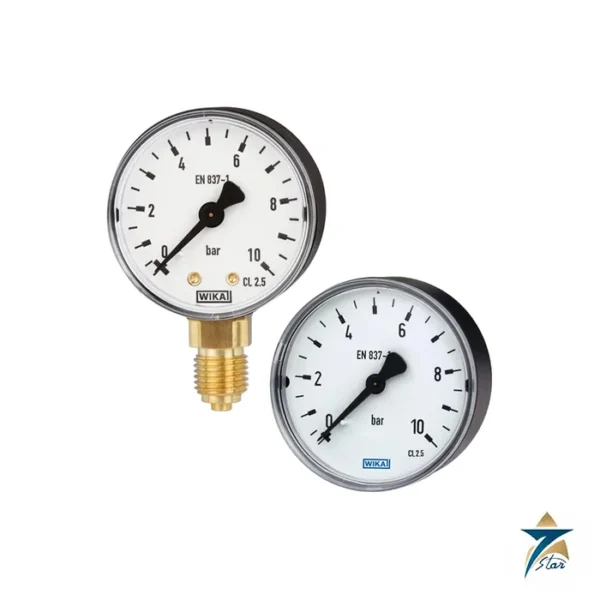
As general guidance, choose a scale range so that the normal operating pressure sits in the middle third of the dial; for NS 50 and NS 63 the datasheet limits steady pressure to three quarters of full scale and fluctuating pressure to two thirds, while NS 100 accepts full scale steady and 0.9 times full scale fluctuating. Use silicone oil filling where low ambient temperature or wide temperature swings are expected, and add a restrictor or snubber on reciprocating pumps. Where the WIKA 213.53 would be over-specified, for example low-pressure HVAC duty without heavy vibration, the dry WIKA 111.10 Bourdon Tube Pressure Gauge, Copper Alloy, Lower Mount is a lower-cost alternative.
How to Order
To order the WIKA 213.53, send Seven Star LLC your required nominal size, scale range and unit, connection size and location, filling and any certificate requirement, and our instrumentation team will prepare a formal quotation. Download the WIKA data sheet PM 02.12 from this page for full dimensions, then contact our Muscat office for availability, lead time and technical support anywhere in Oman and the GCC.
Related buying guide: Pressure gauge and thermometer supplier in Oman: choosing gauges for HVAC and process lines.
Datasheets & Documents
- Datasheet WIKA Data Sheet PM 02.12, Model 213.53 (manufacturer datasheet) Download
Reviews (0)
How would you rate this product? Cancel reply
About brand
WIKA is the German manufacturer of pressure, temperature, level and flow instruments, best known for its pressure gauges. Alexander Wiegand and Philipp Kachel founded it on 2 January 1946 in Klingenberg am Main, Bavaria. The name comes from the first two letters of their surnames. WIKA is still run by the Wiegand family and is headquartered in Klingenberg.
Seven Star LLC is an independent supplier in Muscat. We list WIKA pressure gauges, diaphragm seals, transmitters, switches, thermometers and thermowells, and supply them to plants, contractors and panel builders in Oman and the GCC by model and order code.
WIKA company profile
| Established | 2 January 1946, Klingenberg am Main, Germany, by Alexander Wiegand and Philipp Kachel |
|---|---|
| First products | Mechanical pressure and temperature gauges |
| Ownership | Family-owned; managed by Alexander Wiegand, grandson of the founder, since 1996 |
| Product families | Pressure gauges, diaphragm seals, pressure transmitters and switches, thermometers, RTDs, thermocouples, thermowells, calibration equipment, level and flow instruments |
Milestones
- 1946: Alexander Wiegand and Philipp Kachel found the company in Klingenberg am Main on 2 January; pressure gauge production starts at the end of the year. The name WIKA comes from the first letters of their surnames.
- 1951: Konrad Wiegand, the founder's son, takes over management.
- 1967: Ursula Wiegand leads the company after her husband's death.
- 1986: The company is reunited with the Kachel thermometer factory, which Philipp Kachel had set up after leaving in 1956.
- 1994: Certification to DIN ISO 9001.
- 1996: Alexander Wiegand, the founder's grandson, becomes head of the company.
WIKA products we list
| Family | Models | Typical use |
|---|---|---|
| Bourdon tube pressure gauges | 111.10, 111.12, 212.20, 213.53, 232.50, 233.50, 232.30/233.30 safety pattern | HVAC and utilities (111 series) to process plants (23x series in stainless steel) |
| Diaphragm and differential pressure gauges | 432.50, 732.51, 700.01, DPGT43 | Low pressures, viscous or dirty media, and filter differential pressure |
| Diaphragm seals | 990.10, 990.27 | Separating the gauge from corrosive, hot or clogging media |
| Transmitters, switches and test gauges | A-10, UPT-20, PSM01, CPG1500 | 4-20 mA pressure signals, switching, and precision calibration checks |
| Thermometers | TG54, Model 55, A52, 73 gas-actuated | Local temperature indication on pipes, vessels and HVAC |
| Temperature sensors and thermowells | TR10, TR12-B, TR33, TC10-B, TW10 flanged, TW15 threaded | RTD and thermocouple measurement in process lines |
The WIKA model number tells you the build. In 232.50, the first digit 2 means stainless steel wetted parts, the second digit 3 means a liquid-fillable case, and ".50" is the case style. The 111 series uses copper alloy wetted parts and suits water and air. Where the medium is corrosive, very hot or would block the gauge, a diaphragm seal such as the 990.27 keeps it away from the Bourdon tube. For temperature, a thermowell like the TW10 lets you remove the sensor without opening the process.
Where WIKA instruments are used
In Oman and the GCC, WIKA gauges, transmitters and thermometers are used in oil and gas, refining and petrochemical plants, power and desalination, water networks, district cooling and HVAC, and on skids and machines from OEMs.
Ordering WIKA instruments: what we need
Send the model, dial size (for example 63, 100 or 160 mm), range and unit, connection size and position (lower or back mount), accuracy class and whether liquid filling is needed. For diaphragm seals and thermowells, add the process connection, materials and insertion length.
Facts checked against WIKA company history, October 2026.
Browse WIKA products by category: Pressure Instrumentation, Temperature Instrumentation.
FAQ
Questions about the WIKA 213.53 Liquid-Filled Bourdon Tube Pressure
Answers from our engineering team on installation, compatibility and integration.
01What is the WIKA 213.53 used for?
The WIKA 213.53 is a liquid-filled Bourdon tube pressure gauge for measuring points with high dynamic pressure loads and vibration, such as pumps, compressors, hydraulics and shipbuilding. It suits gaseous and liquid media that are not highly viscous or crystallising and will not attack copper alloy parts.
02Which sizes and scale ranges are available for the WIKA 213.53?
WIKA offers the 213.53 in nominal sizes 50, 63 and 100 mm. Scale ranges run from 0 to 0.6 bar up to 0 to 1,000 bar, with vacuum and compound ranges and units in bar, psi, kg/cm2, kPa or MPa.
03What accuracy does the WIKA 213.53 have?
Per data sheet PM 02.12, NS 100 instruments are class 1.0 per EN 837-1 (ASME B40.100 grade 1A) and NS 50 and NS 63 instruments are class 1.6. The temperature error is at most 0.4% of full scale per 10 degrees C deviation from 20 degrees C.
04Can the WIKA 213.53 be used with seawater or sour media?
The wetted parts are copper alloy, so the gauge is not intended for media that attack copper alloy. For aggressive or sour service, Seven Star LLC normally recommends an all-stainless gauge such as the WIKA 232.30 or 232.50, or a WIKA diaphragm seal.
05Does Seven Star LLC supply the WIKA 213.53 in Oman?
Yes. Seven Star LLC supplies the WIKA 213.53 in Oman and across the GCC, with engineering support in Muscat. Send us the size, range, connection and filling you need and we will prepare a quotation with the WIKA datasheet.


Reviews
There are no reviews yet.