- Automation & ControlView all 3,063 products
- Automation Accessories
- AC Drives
- PLC & I/O Cards
- Industrial Communications
- Vibration Monitoring
- Isolator & Barrier
- Controllers & Data Acquisition
- Safety Switches & Guard Locking
- Motor Soft Starters
- Encoders
- CCTV & Security
- Pneumatic Cylinders
- HMI Displays
- Servo Drives
- Industrial Computers
- Machine Vision
- Automation Software
- Robotics
















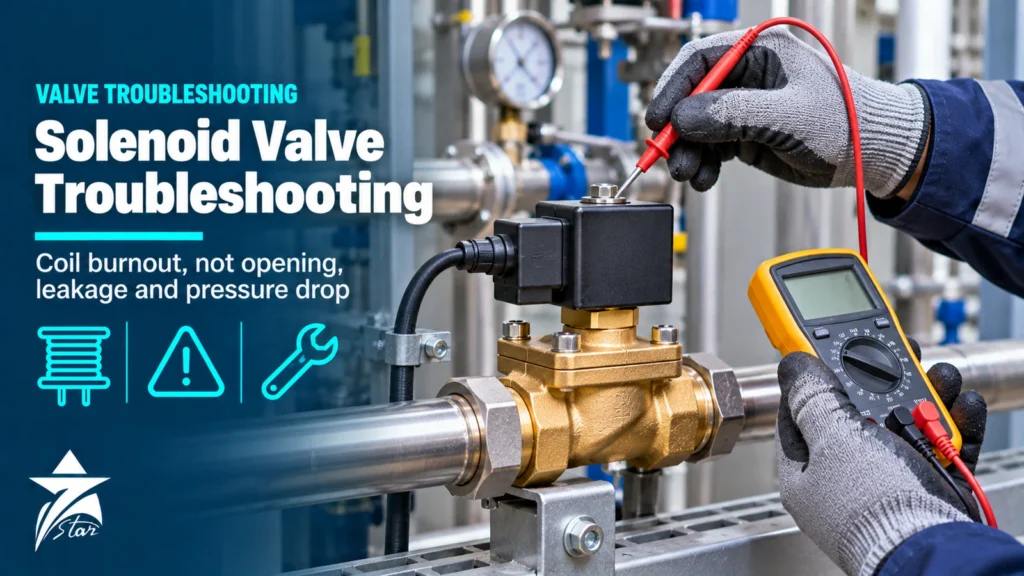
Solenoid valves are simple devices, but when one stops working it can halt a cooling water line, a burner, a dosing skid or a whole pneumatic machine. Most failures fall into a small number of patterns: the coil is burnt or not receiving the right voltage, the valve does not have enough pressure differential to open, dirt is holding the plunger or diaphragm, or the seals are not compatible with the fluid or temperature. This solenoid valve troubleshooting guide walks through each symptom, the checks that find the cause, and the changes that stop it from happening again.
How a Solenoid Valve Works: The Basics You Need for Diagnosis
When current flows through the coil, the magnetic field pulls a ferromagnetic plunger, also called the armature or core. In a direct acting valve the plunger opens the orifice directly, so the valve works from zero pressure but is limited in size and pressure. In a pilot operated or servo assisted valve the plunger only opens a small pilot orifice; the line pressure then moves a diaphragm or piston that opens the main orifice. Pilot operated valves need a minimum pressure difference between inlet and outlet to work. Semi direct or assisted lift valves combine both principles and can work from zero differential with a stronger coil. Knowing which type is installed is the first step in any diagnosis. Our solenoid valve selection guide explains the types in more detail.
Solenoid Valve Troubleshooting Table by Symptom
| Symptom | Most likely causes | First checks |
|---|---|---|
| Valve does not open when energised | No voltage, wrong voltage, burnt coil, insufficient differential pressure, dirt, wrong flow direction | Measure voltage at the coil, test magnetism, check inlet and outlet pressure, check arrow on the body |
| Valve does not close when de-energised | Residual voltage, dirt under the seat, damaged diaphragm, blocked bleed orifice, manual override left on | Remove power and listen, check manual operator, inspect diaphragm and bleed hole |
| Coil burns out repeatedly | Over voltage, AC coil with plunger stuck, high ambient temperature, wrong coil class, water ingress | Compare nameplate and supply, check plunger travel, check IP rating and connector seal |
| Internal leakage across the seat | Debris, worn or swollen seal, wrong seal material, back pressure from downstream | Inspect seat and seal, check fluid compatibility, check for reverse pressure |
| Humming, buzzing or chatter | AC coil with missing shading ring, low voltage, pressure fluctuating near minimum differential | Check shading ring, measure voltage under load, check supply pressure stability |
| Water hammer on closing | Fast closing valve on long pipe, high velocity | Use slow closing valve, add arrestor, reduce velocity |
| External leakage | Loose armature tube, damaged body gasket, corroded body | Tighten to torque, replace gasket kit, review body material |
Coil Burnout: Causes and Prevention
A burnt coil is often a symptom, not the root cause. AC coils draw a high inrush current when the plunger is away from the stop and fall to a much lower holding current once the plunger is seated. If dirt, a bent tube or a missing part prevents the plunger from completing its stroke, the coil continues to draw high current and overheats within minutes. DC coils do not have this inrush effect, which is why they are more tolerant of a stuck plunger but are usually less powerful for the same size.
- Check the supply voltage at the coil terminals with the valve energised. Most coils tolerate about plus 10 and minus 15 percent of nominal voltage.
- Never energise a coil when it is removed from the armature tube; without the iron circuit it will overheat quickly.
- Confirm the coil insulation class, for example class F or H, against ambient and fluid temperature. Hot fluid and hot sun together can exceed the rating in Oman.
- Check that the connector gasket is in place and the cable gland is tight. Water ingress causes short circuits and corrosion.
- Make sure the coil is rated for continuous duty if the valve is held open for long periods.
- For hazardous areas, replace a coil only with the same certified type, such as Ex mb or Ex d, so the certification of the assembly remains valid.
A quick test is to hold a steel screwdriver near the top of the energised coil. A strong magnetic pull shows that the coil is working; if there is none, measure the coil resistance and compare it with the manufacturer value. An open circuit or a very low resistance indicates a failed coil.
Valve Not Opening: Minimum Pressure Differential
This is the most common reason why a new pilot operated valve seems faulty. Pilot operated valves need a pressure difference, typically 0.1 to 0.5 bar depending on the model, to lift the diaphragm or piston. If the valve is installed at the end of a gravity fed tank, on a low pressure return line, or upstream of a fully open outlet with almost no back pressure, the differential may be too small. The coil clicks, but the main orifice stays closed or opens only partly.
- Measure inlet and outlet pressure with the valve energised and compare the difference with the minimum stated on the data sheet.
- If the differential is too low, choose a direct acting or assisted lift valve that works from 0 bar.
- Check that the valve is not oversized. A large valve on a small flow may not develop enough differential across the diaphragm and may chatter.
- Check the maximum opening pressure differential too. A valve with a coil that is too weak for the line pressure will not open at all at high pressure.
Dirt, Scale and Blocked Pilot Orifices
Solenoid valves have small pilot and bleed orifices that block easily. Sand, pipe scale, welding debris, PTFE tape and hard water deposits are frequent causes of valves that stick open, stick closed or leak. Fit a strainer upstream, typically with a 100 to 500 micron mesh depending on the valve, and flush new pipework before installing the valve. When cleaning, follow the manufacturer instructions, keep parts in order, and never enlarge the pilot or bleed orifice, because that changes the opening and closing behaviour.
Seat Leakage and Seal Compatibility
Seal material must match the fluid and temperature. NBR is common for water, air and light oils; EPDM suits hot water and steam but not oil; FKM handles fuels, oils and many chemicals at higher temperatures; PTFE is used for aggressive chemicals. A seal attacked by the wrong fluid swells, hardens or cracks and the valve begins to leak. Leakage can also come from reverse pressure: most solenoid valves are designed to seal in one direction only, so if downstream pressure becomes higher than upstream pressure, the valve can be lifted open. A check valve or a different valve design is then needed. Our article on valve leak testing standards explains how seat leakage is measured.
Noise, Chatter and Water Hammer
A humming AC coil usually means the plunger is not seating fully, often because of a missing or cracked shading ring, dirt on the plunger face or low voltage. Chatter, where the valve opens and closes rapidly, often occurs when the supply pressure is close to the minimum differential or when the valve is oversized. Water hammer is caused by fast closure on long liquid lines. Slow closing servo valves, smaller line velocities and water hammer arrestors reduce the pressure surge.
Electrical Solenoid Valve Troubleshooting Step by Step
- Confirm the control signal is present: check the PLC output, relay or timer and the fuse.
- Measure voltage at the coil connector, not only at the panel. Long cable runs on 24 V DC can cause a large voltage drop.
- Check the coil nameplate for voltage, frequency, power and duty, and compare with the supply.
- Measure the coil resistance and insulation to earth with the supply isolated.
- Check for leakage current from triac or solid state outputs, which can keep a low power valve partly energised after switch off.
- Check that surge suppression is fitted on DC coils so that switching spikes do not damage outputs.
Solenoid Valve Troubleshooting on Pneumatic Valves
Pneumatic 3/2 and 5/2 directional valves have their own failure patterns. Many are internally piloted and need a minimum supply pressure, often around 1.5 to 2.5 bar, to shift the spool. Contaminated or overlubricated air causes sticky spools, and blocked exhaust silencers slow the actuator or prevent it from reversing. Check the air preparation unit, drain the filter, and confirm the pilot supply before replacing the valve. For valve actuators, also check the NAMUR solenoid and the actuator itself, as explained in our guide to pneumatic actuator sizing.
Gas, Steam and Safety Shutoff Valves
Gas safety shutoff valves and double solenoid valves on burner trains have additional requirements. They are certified to standards such as EN 161, and a valve proving system checks their tightness before each start. A failed proving test must be treated as a safety warning, not a nuisance trip. Steam solenoid valves need PTFE or special seals and must be rated for the steam temperature. Our burner gas train guide explains the safety logic around these valves.
Preventive Maintenance to Reduce Solenoid Valve Troubleshooting
| Interval | Task |
|---|---|
| Monthly | Check for external leaks, abnormal noise and coil temperature; clean strainers in dirty service |
| Every 6 months | Check connector seals, cable glands and voltage at the coil; test operation on critical valves |
| Yearly or by duty count | Inspect seals, diaphragm and plunger; fit a spare parts kit where wear is visible |
| After any repair | Test opening and closing at minimum and maximum operating pressure |
Good records make solenoid valve troubleshooting quicker. Keep spare coils and repair kits for critical valves, and record the full valve code, coil code and voltage so that replacements are correct the first time.
Selected Solenoid Valves and Coils in Our Catalog
The table below lists a selection of solenoid valves, coils and related components from our catalog.
| Product | Type | Typical use |
|---|---|---|
| Danfoss EV220B 15-50 | Servo operated 2/2 way valve | Water, oil and air lines |
| Danfoss EV210B 8 | Direct operated 2/2 way valve | Low pressure and zero differential duty |
| Danfoss EV225B 20 | Servo operated steam valve | Steam and hot water |
| Danfoss BG024DS 24 V DC coil | Clip on IP67 coil | Replacement coils |
| ASCO 8210G100 | Brass piston valve | General service water and air |
| ASCO 551 Series NAMUR | NAMUR pilot valve | Pneumatic valve actuators |
| Bürkert Type 6026 | Direct acting plunger valve | Small orifices and fast response |
| Parker Lucifer 341N01 NAMUR | NAMUR pilot valve | Actuator control |
| SAMSON Type 3969 | Intrinsically safe NAMUR valve | Hazardous areas |
| Norgren V51B517A-A2000 | 5/2 way pneumatic valve | Cylinder control |
| Festo VUVG-L14-M52-MT-G18-1H2L-F1A | 5/2 way valve | Machine pneumatics |
| DUNGS DMV-D 507/11 | Double gas safety valve | Burner gas trains |
Browse more in our solenoid valves category. To get a quotation for a replacement valve, coil or repair kit, send the full valve and coil codes, voltage, fluid, pressure range and connection size through our quote request form or to [email protected].
Sourcing Solenoid Valves and Spares in Oman Through Seven Star LLC
Seven Star LLC is an independent supplier in Oman of solenoid valves, replacement coils, repair kits, NAMUR pilot valves, pneumatic directional valves and gas safety valves. We quote products from manufacturers such as Danfoss, ASCO, Parker, Bürkert, SAMSON, Norgren, Festo and DUNGS. Valve type, seal material, coil voltage, hazardous area certification and lead time are confirmed against the manufacturer data at quotation, which makes solenoid valve troubleshooting faster when a like for like replacement is needed.
Frequently asked questions
Why does my solenoid valve click but not open?
The coil is working, but the valve may lack the minimum pressure differential needed by a pilot operated design, the pilot orifice may be blocked, or the diaphragm may be damaged. Measure inlet and outlet pressure and compare with the data sheet before replacing parts.
Why do solenoid coils keep burning out?
Common causes are over voltage, a stuck plunger on an AC coil that keeps drawing inrush current, high ambient or fluid temperature, water ingress through the connector, or energising the coil when removed from the valve.
What is minimum pressure differential on a solenoid valve?
It is the smallest pressure difference between inlet and outlet that a pilot operated valve needs to open and stay open. Values of 0.1 to 0.5 bar are typical. Direct acting and assisted lift valves can work from zero differential.
Why does a solenoid valve leak when closed?
Debris on the seat, a worn or chemically attacked seal, a damaged diaphragm or reverse pressure from downstream can all cause internal leakage. Check seal compatibility with the fluid and fit a strainer upstream.
How can I test a solenoid coil?
Check for magnetism with a steel tool while energised, measure the voltage at the coil connector, and measure the coil resistance and insulation with power isolated. Compare the readings with the manufacturer data.
Who supplies solenoid valves and replacement coils in Oman?
Seven Star LLC is an independent supplier in Oman that quotes solenoid valves, coils, repair kits and NAMUR valves from manufacturers such as Danfoss, ASCO, Parker and Bürkert. Send your requirements through the quote request form or to [email protected].
Was this guide helpful?One click helps us write better guides for engineers.
Thank you! Glad it helped. Need this equipment for your project? Request a quotation
Thank you. We will use this to improve the guide.