- Automation & ControlView all 1,920 products
- AC Drives
- PLC & I/O Cards
- Industrial Communications
- Vibration Monitoring
- Automation Accessories
- Controllers & Data Acquisition
- Isolator & Barrier
- CCTV & Security
- Safety Switches & Guard Locking
- Encoders
- HMI Displays
- Industrial Computers
- Motor Soft Starters
- Servo Drives
- Pneumatic Cylinders
- Machine Vision
- Automation Software
- Robotics





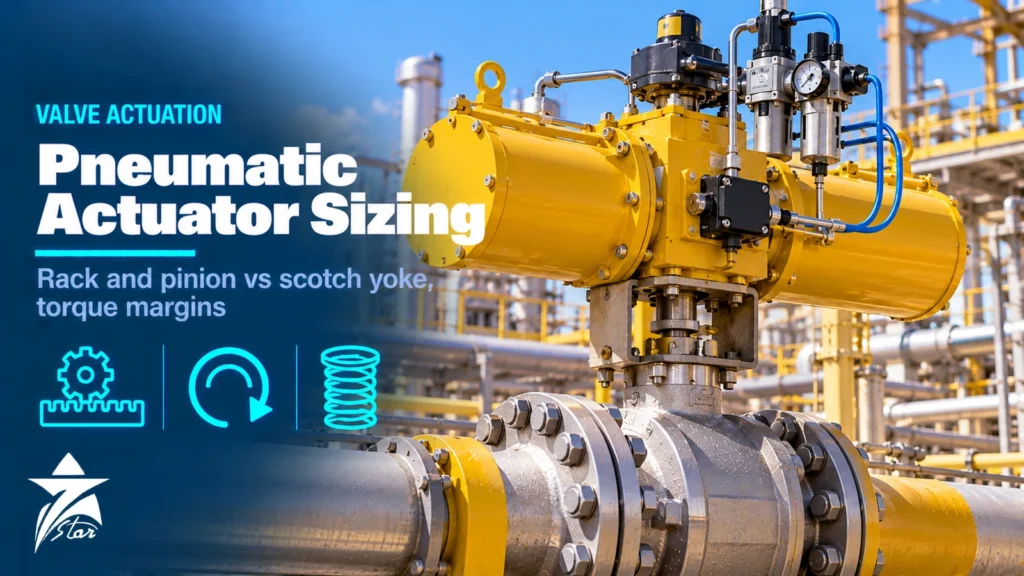
Quarter-turn valves fail to open or close in service far more often because of a badly sized actuator than because of a faulty valve. An undersized unit stalls at breakaway when the seats have dried out or the line pressure is high; an oversized unit can twist a stem past its rated torque or slam a valve shut. Pneumatic actuator sizing is the process of matching the actuator’s output curve to the valve’s torque demand at every point of the stroke, at the lowest air pressure the plant will ever supply. This guide compares rack and pinion and scotch yoke designs, explains spring return and double acting operation, and walks through torque margins, data collection and the mistakes that cause most field failures.
Valve Torque: What the Actuator Has to Overcome
A quarter-turn valve does not need the same torque throughout its travel. Manufacturers publish torque values at specific points, and an actuator must exceed each of them with margin. The common terms are:
- Break to open (BTO): torque needed to unseat the closure member from the closed position. It is usually the highest value for ball and plug valves.
- Run to open / run to close (RTO, RTC): torque while the ball or disc is moving mid-stroke, normally lower than breakaway.
- End to open (ETO): torque at the fully open position; on butterfly valves dynamic torque from flow can peak near the open end.
- Break to close (BTC) and end to close (ETC): torque to leave the open position and to drive the closure member fully into the seat.
- MAST (maximum allowable stem torque): the strength limit of the valve stem and drive train. Actuator output must never exceed it.
Valve torque rises with differential pressure across the closed valve, seat material (metal seats demand more than PTFE), media (dry gas, slurries and crystallising fluids increase friction), temperature and the time the valve sits without moving. Always use the valve manufacturer’s torque data for the actual pressure class and seat, not a generic table.
Rack and Pinion vs Scotch Yoke Actuators
Both designs convert the linear motion of a piston into rotation, but the way they do it gives them very different torque curves.
Rack and pinion
Two opposed pistons with toothed racks turn a central pinion. Torque output is essentially constant across the 90° stroke because the lever arm (the pinion radius) does not change. Rack and pinion actuators are compact, standardised and cost-effective, and they dominate small and medium valves, typically up to a few thousand N·m of output.
Scotch yoke
A piston drives a yoke through a sliding pin. The effective lever arm is longest at the ends of travel and shortest at mid-stroke, so torque follows a U-shaped curve: highest at 0° and 90°, lowest around 45°. That suits ball and plug valves, whose peak demand is at breakaway and seating. Scotch yoke units cover large valves and high torques well beyond typical rack and pinion ranges, and are common on pipeline and ESD valves. Canted yoke designs shift the curve to put even more torque at the start of stroke.
| Feature | Rack and pinion | Scotch yoke |
|---|---|---|
| Torque curve | Flat across the stroke | U-shaped, highest at ends |
| Typical size range | Small to medium valves | Medium to very large valves |
| Best fit | Butterfly, small ball and plug valves, utility service | Large ball and plug valves, pipeline, ESD service |
| Footprint | Compact, symmetrical | Larger, often with separate spring module |
| Mounting | ISO 5211 flange, NAMUR VDI/VDE 3845 accessory interface | ISO 5211 flange, heavier brackets and adaptors |
| Spring-return option | Springs inside the end caps | Separate spring cartridge |
| Mid-stroke torque | Same as end torque | Lower, check against RTO/RTC on butterfly valves |
Spring Return vs Double Acting
A double-acting actuator uses air to drive both directions. Torque is the same each way and the actuator is smaller for a given output, but on loss of air it stays where it is unless an accumulator or a separate fail-safe arrangement is added.
A spring-return (single-acting) actuator uses air to compress springs in one direction and the springs drive the return stroke. It gives a defined fail position (fail-closed or fail-open) on loss of air or signal, which is why emergency shutdown and many utility valves use it. The design has a catch: torque is not equal at both ends.
- Air stroke: air must overcome the valve and the springs. Output is highest at the start (air start) and falls as springs compress (air end).
- Spring stroke: torque is highest at spring start, when springs are compressed, and lowest at spring end, when they are most relaxed.
- Critical points: for a fail-close ball valve, spring end must exceed the end-to-close (seating) torque, and air start must exceed break to open plus the spring preload already accounted for in the manufacturer’s tables.
Spring sets are chosen to match the available supply pressure. Fitting stronger springs than the air pressure can overcome leaves the valve unable to complete its air stroke; weaker springs reduce fail-safe torque.
Torque Margins and Safety Factors
No standard fixes a single safety factor for every case, so specifications and manufacturers set their own. A common approach adds a margin of roughly 25–50 % over the published valve torque for clean liquid or gas service, and more for slurries, dirty or dry gas, crystallising media, infrequent operation or metal-seated valves. Valves that sit for months between strokes, such as ESD and isolation valves, deserve the higher end of the range because breakaway torque grows with time static.
The margin applies at the minimum guaranteed air supply, not the nominal one. If the instrument air header can sag to 4 bar during a compressor trip, size the actuator at 4 bar. At the same time, check the maximum output at the highest possible supply pressure against MAST; a large oversized actuator on a small stem is a frequent cause of sheared stems and broken keys.
Data to Collect Before Sizing
- Valve type, size, pressure class and seat material (soft or metal).
- Valve torque values BTO, RTO, ETO, BTC, RTC, ETC from the valve manufacturer, and the MAST.
- Maximum differential pressure across the closed valve in both directions if bidirectional.
- Media, temperature range, cleanliness and operating frequency.
- Air supply: minimum, normal and maximum pressure at the valve, and instrument air quality.
- Required fail action (fail-close, fail-open, fail-last) and stroke time limits, especially for ESD or anti-surge duty.
- Mounting: ISO 5211 flange size (for example F07, F10, F12), drive type (square, double-D or key) and stem dimensions.
- Accessories: solenoid valve, limit switch box, positioner, quick-exhaust valve, manual override.
- Environment: ambient temperature range, hazardous area classification, coastal or offshore exposure.
Pneumatic Actuator Sizing Example Logic
Consider a fail-close, soft-seated ball valve with a manufacturer BTO of 400 N·m, ETC of 300 N·m and a MAST of 1,200 N·m, in clean gas service with a minimum air supply of 4.5 bar. Applying a 30 % margin gives targets of 520 N·m at air start and 390 N·m at spring end. From the actuator manufacturer’s spring-return table, select the smallest model and spring set where, at 4.5 bar, air start torque exceeds 520 N·m and spring end torque exceeds 390 N·m. Then confirm that air start at the maximum supply pressure, say 7 bar, stays below 1,200 N·m. These figures illustrate the method only; real values come from the valve and actuator datasheets.
Stroke Time, Air Consumption and Accessories
Large actuators need large air volumes. A standard 1/4-inch solenoid valve may take many seconds to fill or vent a big scotch yoke cylinder. When the process requires fast closure, specify solenoid valves with adequate flow coefficient, quick-exhaust valves close to the actuator ports and larger tubing. Conversely, a butterfly valve on a long liquid line may need slowed closing, using flow-control valves in the exhaust, to avoid water hammer.
For modulating duty, add a positioner and check that the actuator has low hysteresis; our control valve selection and sizing guide covers how characteristics and Cv interact with actuator choice. If no instrument air is available or remote sites run on solar power, compare against the options in our electric valve actuator selection guide.
Installation and GCC Conditions
- Mount with the correct ISO 5211 adaptor and check that the coupling has no backlash; play in the drive causes partial closure and seat damage.
- Set the travel stops at both ends so the ball or disc is exactly aligned; overtravel on butterfly valves damages the seat.
- Fit breathers or a spring-chamber purge so that dust and humid air are not drawn into spring-return actuators during each stroke. In coastal Gulf sites, moist salty air entering the spring chamber corrodes springs over time.
- Select seals rated for the temperature range: actuator housings in direct sun can reach well above 50 °C ambient. Standard nitrile seals have upper limits that vary by manufacturer; high-temperature or low-temperature seal kits are available for many ranges.
- Specify coatings suitable for the environment, such as epoxy or polyurethane systems for coastal and offshore service, and stainless fasteners.
- For hazardous areas, the actuator itself is mechanical, but solenoids, limit switches and positioners need correct Ex certification.
Common Sizing and Selection Mistakes
- Sizing at nominal air pressure instead of minimum.
- Using rack and pinion torque at one point and assuming it applies through the stroke on a spring-return unit.
- Ignoring the spring-end value on fail-close valves, so the valve does not seat fully on air loss.
- Applying the same margin to a dirty-service metal-seated valve as to a clean water butterfly valve.
- Oversizing without checking MAST.
- Replacing an actuator with a different brand without confirming flange size, drive orientation and rotation direction.
Pneumatic Actuator Sizing Checklist
- Valve torque data at every stroke point and MAST obtained from the valve manufacturer
- Margin chosen for service, cleanliness and operating frequency
- Minimum and maximum air supply pressure confirmed
- Fail action and stroke time defined
- Rack and pinion or scotch yoke chosen to fit the torque curve
- Spring set verified at spring end and air start
- ISO 5211 flange and drive dimensions matched
- Solenoid, positioner, limit switches and Ex ratings specified
Pneumatic Actuators We Supply
These examples cover rack and pinion, scotch yoke, diaphragm and piston actuators.
| Product | Type | Where it fits |
|---|---|---|
| Air Torque DRSC00060U A-Version Pneumatic Rack and Pinion Actuator | Rack and pinion actuator | Ball and butterfly valves. |
| Air Torque DRSC00300S Stainless Steel Pneumatic Actuator | Stainless steel rack and pinion actuator | Corrosive and offshore environments. |
| Biffi ALGA Pneumatic Quarter-Turn Actuator | Quarter-turn pneumatic actuator | Process valves. |
| Rotork GP/GH Scotch Yoke Pneumatic and Hydraulic Valve Actuator | Scotch yoke actuator | Large quarter-turn valves and shutdown service. |
| SAMSON Type 3271 Pneumatic Diaphragm Actuator | Diaphragm actuator | Control valves. |
| Masoneilan Type 51/52/53 Pneumatic Piston Actuators | Piston actuator | Control valves needing high thrust. |
Send the valve torque, supply pressure, fail action and mounting through our quote request form.
Sourcing Pneumatic Actuators Through Seven Star LLC
Seven Star LLC supplies valve actuators, solenoid valves and related valve accessories on request for projects and maintenance in Oman and the GCC. We help with selection and with cross-checking model codes, spring sets and mounting dimensions; availability and lead time are confirmed at quotation.
Send us the valve torque data or the existing actuator nameplate, your air supply pressure and the required fail action, and we will quote a correctly sized pneumatic actuator package.
Frequently asked questions
What safety factor should I use when sizing a pneumatic actuator?
There is no single universal value. Many specifications use around 25–50 % above the valve manufacturer's torque for clean service and higher margins for slurries, dry gas, metal seats or valves that operate rarely. Always apply the margin at the minimum air supply pressure.
When is a scotch yoke actuator better than rack and pinion?
Scotch yoke actuators deliver their highest torque at the ends of the stroke, matching the breakaway and seating demand of large ball and plug valves. They are preferred for large valves and high torques. Rack and pinion units are more compact and economical for small and medium valves where flat torque output is adequate.
Why does a spring-return actuator need checking at spring end?
Spring torque is lowest when the springs are most relaxed, at the end of the spring stroke. That is exactly where a fail-close valve needs torque to seat. If spring-end torque is below the valve's end-to-close torque, the valve may not shut tightly on loss of air.
What is MAST and why does it matter?
MAST is the maximum allowable stem torque that the valve stem and drive can carry without damage. An actuator sized with too much margin, or run at high supply pressure, can exceed it and shear the stem or key. Check maximum actuator output against MAST at the highest possible air pressure.
What does ISO 5211 define for actuators?
ISO 5211 standardises the flange dimensions and drive interfaces between part-turn actuators and valves, using flange codes such as F05, F07 and F10. It allows actuators from different manufacturers to mount on valves with matching interfaces, though drive shape and size must still be confirmed.
Can I use a double-acting actuator for a fail-safe valve?
Only with an additional arrangement such as an air accumulator and suitable valves to drive it to the safe position on air loss. Where a guaranteed fail position is required, a spring-return actuator is the simpler and more common choice.
Was this guide helpful?One click helps us write better guides for engineers.
Thank you! Glad it helped. Need this equipment for your project? Request a quotation
Thank you. We will use this to improve the guide.