- Industrial Communications
- AC Drives
- Vibration Monitoring
- PLC & I/O Cards
- Automation Accessories
- Controllers & Data Acquisition
- CCTV & Security
- Encoders
- Industrial Computers
- Safety Switches & Guard Locking
- HMI Displays
- Motor Soft Starters
- Isolator & Barrier
- Pneumatic Cylinders
- Servo Drives
- Automation Software
- Robotics
- Machine Vision
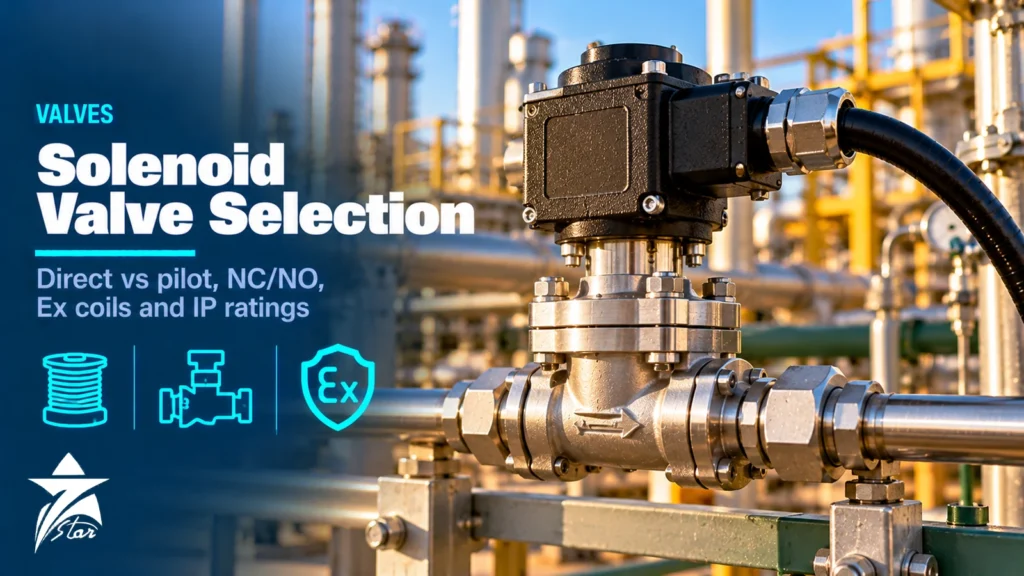
Solenoid valves look like commodity items – a small body, a coil and a connector – but most failures come from a handful of selection errors: a pilot-operated valve installed where there is no pressure differential, a seal material that swells in the fluid, an AC coil that burns out, or a coil certified for an ambient temperature lower than a Gulf summer. Good solenoid valve selection means checking the operating principle, function, pressure range, materials, coil and enclosure against the real application. This guide walks through direct-acting versus pilot-operated designs, NC and NO functions, 3/2 and 5/2 valves for actuators, body and seal materials, coils and Ex protection, IP ratings, and the installation and troubleshooting points that keep them reliable.
How a Solenoid Valve Works
A solenoid valve converts an electrical signal into a mechanical movement. When the coil is energised, its magnetic field pulls a ferromagnetic plunger (armature) inside a sealed tube. The plunger either opens the main orifice directly or opens a small pilot orifice that lets line pressure do the work. When the coil is de-energised, a spring returns the plunger. Because the coil only has to move a light plunger against a spring and the fluid pressure, the force available – and therefore the orifice size and pressure it can handle – is limited. That limitation is the reason three different operating principles exist.
Direct-Acting, Pilot-Operated and Semi-Direct Designs
Direct-Acting
The plunger seals directly on the main orifice. The valve operates from zero differential pressure up to its maximum operating pressure differential (MOPD), so it works on vacuum, gravity feeds and low-pressure systems. The trade-off is small orifices and modest flow for a given coil size; larger orifices need much stronger coils. Direct-acting valves are common for instrument air, analyser sample lines, small dosing and pilot duties.
Pilot-Operated (Servo-Assisted)
The coil opens a small pilot orifice; line pressure acting on a diaphragm or piston then opens the main orifice. This allows large flows and high pressures with a small coil, but the valve needs a minimum pressure differential across it to open fully and stay open. The minimum is set by the manufacturer – often a fraction of a bar – and is listed on the datasheet. Below it, the valve may not open, may close partly, or may chatter. Pilot valves also need reasonably clean fluid because the small pilot and bleed holes block easily.
Semi-Direct (Assisted Lift)
Here the plunger is mechanically linked to the diaphragm. At low pressure it lifts the diaphragm directly; at higher pressure the pilot action takes over. These valves work from zero differential and still handle moderate flows, making them a good choice for tanks, gravity lines and circuits where pressure varies widely, at the cost of a larger coil than a pure pilot valve.
Solenoid Valve Selection by Operating Principle
| Feature | Direct-acting | Pilot-operated | Semi-direct |
|---|---|---|---|
| Minimum pressure differential | Zero | Required (per datasheet) | Zero |
| Flow capacity for coil size | Low | High | Medium |
| Pressure range | Limited by coil force and orifice | High | Medium |
| Fluid cleanliness sensitivity | Low | High (pilot and bleed holes) | Medium |
| Response | Fast | Slower, depends on pressure and size | Medium |
| Typical uses | Instrument air, sample lines, pilot duty, vacuum | Water, air, oil and gas lines with steady pressure | Tanks, gravity feeds, variable pressure systems |
Valve Functions: NC, NO, 3/2, 5/2
The function describes the number of ports, the number of positions and what happens when power is lost:
- 2/2 normally closed (NC): closed when de-energised. The usual choice where loss of power must stop flow, such as fuel supply or dosing.
- 2/2 normally open (NO): open when de-energised. Used where loss of power must keep flow going, such as cooling water, or where the valve is energised only briefly to stop flow.
- 3/2: three ports, two positions; typically pressurises and vents a single-acting (spring-return) actuator or cylinder. In safety service, de-energising vents the actuator so it moves to its fail position.
- 5/2 and 5/3: five ports for double-acting actuators and pneumatic cylinders; the 5/3 adds a centre position (all closed, all vented or pressure to both sides).
- Bistable (latching): holds position after a short pulse, reducing power consumption on solar or battery-powered sites.
For mounting directly on quarter-turn valve actuators, NAMUR-interface valves to VDI/VDE 3845 bolt straight onto the actuator air ports without tubing. Choose the fail-safe function from the process safety requirement first, then the valve function that delivers it.
Body and Seal Materials
Body material is chosen for the fluid and environment: brass for water, air, light oils and inert gases; stainless steel (typically 316 or equivalent) for corrosive media, food and water treatment chemicals, coastal and offshore environments and sour service; aluminium or engineered plastics for pneumatic pilot valves and some chemical duties. For potable water, check that the brass grade is resistant to dezincification and that the materials hold the required drinking water approvals.
The seal is the more frequent failure point. As a general guide:
- NBR (nitrile): air, water, mineral oils and fuels at moderate temperatures; poor resistance to ozone and some chemicals.
- EPDM: hot water, low-pressure steam within the manufacturer’s limit, many water treatment chemicals; swells badly in mineral oils and hydrocarbons.
- FKM (Viton-type): oils, fuels, many solvents and acids at higher temperatures; not suited to hot water or steam in many grades.
- PTFE and PTFE-based seals: aggressive chemicals and higher temperatures, often combined with stainless bodies; may need specific valve designs.
Always confirm compatibility against the manufacturer’s chemical resistance table for the actual fluid, concentration and temperature.
Coils, Power and Duty
Coil selection affects reliability as much as the valve body:
- Voltage and type: common ratings are 24 V DC, 110/120 V AC and 220/230 V AC. AC coils draw a high inrush current until the plunger seats; if the plunger sticks open because of dirt or excessive pressure, the AC coil overheats and burns out. DC coils draw constant current and are not affected in the same way.
- Duty cycle: industrial coils are normally rated for continuous duty (100% ED); check this for valves that stay energised for long periods.
- Insulation class: Class F and Class H insulation give margin for continuous energisation at high ambient temperatures.
- Power and heat: higher coil power gives a higher MOPD but more heat. Low-power coils are available for PLC outputs and intrinsically safe circuits, usually with smaller orifices or pilot designs.
- Connection: DIN-style connectors (EN 175301-803), flying leads, terminal boxes or cable glands; the connector and gasket are part of the enclosure rating.
Hazardous Areas and IP Ratings
In classified areas, the coil must carry ATEX or IECEx certification suitable for the zone, gas group and temperature class. Common protection concepts are encapsulation (Ex m), flameproof enclosure (Ex d), increased safety terminal boxes (Ex e) combined with encapsulated coils, and intrinsic safety (Ex i) for low-power pilot valves fed through barriers or isolators. The temperature class depends on the coil surface temperature at the maximum certified ambient, so a valve that is T4 at a lower ambient may not hold that class, or may not be certified at all, at the higher ambient a Gulf site needs. Check the certificate’s ambient range and the special conditions of use. Our hazardous area classification guide explains zones, gas groups and temperature classes in more detail.
Ingress protection follows IEC 60529. IP65 suits most indoor plant areas; outdoor, washdown and coastal locations typically need IP66 or IP67, with the correct cable gland and connector gasket fitted – a missing gasket defeats the rating.
Sizing: Flow Coefficient and Pressure
Solenoid valves are sized by flow coefficient, not by port size. Manufacturers state Kv (m³/h of water at 1 bar pressure drop) or Cv (US gpm of water at 1 psi); Cv is approximately 1.156 × Kv. For liquids, the basic relation is Q = Kv × √(ΔP / SG), with Q in m³/h, ΔP in bar and SG the specific gravity. Gases need the manufacturer’s gas sizing method because of compressibility. Then check three pressure limits: the MOPD at your coil voltage, the maximum static pressure of the body, and – for pilot valves – the minimum differential at the lowest operating flow.
Installation Best Practice
- Fit a strainer upstream, especially for pilot-operated valves, and flush pipework before installation.
- Install with the coil upright unless the manufacturer permits other orientations; a coil pointing downward collects debris in the plunger tube.
- Follow the flow arrow; reversed installation can hold a pilot valve open or damage the diaphragm.
- Fast-closing valves on liquid lines can cause water hammer; consider slow-closing designs on larger liquid valves.
- Do not use the coil or plunger tube as a spanner point; tighten with the body flats.
- Use suppression on DC coils switched by PLC transistor outputs, either integrated in the connector or in the panel.
Troubleshooting Common Faults
- Valve does not open: check voltage at the coil, MOPD exceeded, minimum differential not reached on a pilot valve, or a blocked pilot orifice.
- Valve does not close: debris on the seat, blocked bleed hole in the diaphragm, damaged spring, or manual override left engaged.
- Burnt coil: wrong voltage, AC coil with a jammed plunger, excessive ambient temperature or missing heat dissipation.
- Leaking seat: swollen or hardened seals from chemical incompatibility or overtemperature.
- Humming or chattering: low voltage, dirt between the plunger and core, or a damaged shading ring on AC valves.
GCC Conditions
Outdoor solenoid valves in Oman and the Gulf combine high ambient temperature, direct solar gain, dust and, on the coast, salt-laden humidity. Shade the valve where possible, choose coils certified for the real maximum ambient, prefer stainless steel bodies and plunger tubes on coastal and offshore sites, and specify IP66 or IP67 with proper glands. On sour gas facilities, valves in contact with process gas or fuel gas need materials compatible with H2S, and many operators require SIL-capable solenoid valves for de-energise-to-trip safety functions.
Solenoid Valve Selection Checklist
- Fluid, temperature, minimum and maximum pressure differential
- Operating principle: direct, pilot or semi-direct
- Function: 2/2 NC or NO, 3/2, 5/2, 5/3, bistable, NAMUR mounting
- Flow coefficient (Kv or Cv) and port size
- Body and seal materials checked for compatibility
- Coil voltage, AC or DC, power, duty and insulation class
- Hazardous area certification, temperature class and certified ambient range
- IP rating, connector type and cable gland
- Safety function and SIL requirement where applicable
- Existing model code from the nameplate for replacements
Solenoid Valves We Supply
The operating principle is the first thing to match. The examples below cover direct-acting, pilot-operated, NAMUR and gas safety valves, so you can see how each principle from this guide looks in a real product range.
| Product | Type | Where it fits |
|---|---|---|
| Bürkert Type 6026 Direct-Acting 2/2-Way Plunger Solenoid Valve | Direct-acting 2/2-way plunger valve | Small orifices and low or zero pressure differential, where a pilot-operated valve would not open. |
| SMC VX2 Series Direct-Operated 2-Port Solenoid Valve (CAS006-1) | Direct-operated 2-port valve | Air, water and oil service on machines and utility lines. |
| ASCO 8210 Series General Service Solenoid Valve | Pilot-operated general service valve | Water, air and light oil lines with enough pressure differential to operate the pilot. |
| Danfoss EV220B 15-50 Servo-Operated Solenoid Valve | Servo-operated 2/2-way valve | Larger water and neutral media lines from DN 15 to DN 50. |
| ASCO 551 Series NAMUR Pilot Solenoid Valve | NAMUR pilot valve | Mounted directly on the pneumatic actuator of a quarter-turn process valve. |
| DUNGS DMV-D 5125/11 ECO Gas Double Solenoid Valve | Double solenoid valve for gas | Burner gas trains, where two automatic shut-off valves in series are required. |
For a replacement, the full catalogue number on the valve body and the coil voltage are usually enough. For a new duty, send the medium, pressure range, temperature, port size and hazardous-area requirement through our quote request form.
Sourcing Solenoid Valves Through Seven Star LLC
Seven Star LLC supplies solenoid valves, replacement coils and related automation accessories on request from manufacturers such as ASCO, Bürkert, Parker and Danfoss. We help with selection and cross-checking model codes, coil voltages and certification against your existing nameplates. Availability and lead time are confirmed at quotation.
Send us the solenoid valve nameplate photo, model code or RFQ with fluid, pressure, voltage and area classification, and we will prepare a matched quotation.
Frequently asked questions
Why does my pilot-operated solenoid valve not open?
Pilot-operated valves need a minimum pressure differential across the valve to lift the diaphragm or piston. On gravity feeds, vacuum or very low-pressure lines, use a direct-acting or semi-direct valve instead. Also check for a blocked pilot orifice and correct coil voltage.
Should I choose a normally closed or normally open solenoid valve?
Choose from the required state on loss of power. A normally closed valve stops flow when de-energised, which suits fuel and dosing lines; a normally open valve keeps flow going, which suits cooling or services that must continue during a power failure.
Why do AC solenoid coils burn out?
AC coils draw a high inrush current until the plunger is fully seated. If dirt, excessive pressure or damage stops the plunger from seating, the high current continues and overheats the coil. Wrong supply voltage and high ambient temperature are other common causes.
What is MOPD on a solenoid valve?
MOPD is the maximum operating pressure differential against which the valve can open or close reliably with its specified coil. It depends on orifice size, coil power and voltage type, and is usually lower for AC or low-power coils.
Which Ex protection types are used for solenoid valves?
Common concepts include encapsulation (Ex m), flameproof enclosures (Ex d), increased safety terminal boxes (Ex e) and intrinsic safety (Ex i) for low-power pilot valves. The certificate states the zone, gas group, temperature class and permitted ambient temperature range.
What is the difference between a 3/2 and 5/2 solenoid valve?
A 3/2 valve has three ports and is used to pressurise and vent a single-acting, spring-return actuator. A 5/2 valve has five ports and drives a double-acting actuator or cylinder in both directions.
Was this guide helpful?One click helps us write better guides for engineers.
Thank you! Glad it helped. Need this equipment for your project? Request a quotation
Thank you. We will use this to improve the guide.