- Automation & ControlView all 3,046 products
- Automation Accessories
- AC Drives
- PLC & I/O Cards
- Industrial Communications
- Vibration Monitoring
- Isolator & Barrier
- Controllers & Data Acquisition
- Safety Switches & Guard Locking
- Motor Soft Starters
- Encoders
- CCTV & Security
- Pneumatic Cylinders
- HMI Displays
- Servo Drives
- Industrial Computers
- Machine Vision
- Automation Software
- Robotics
















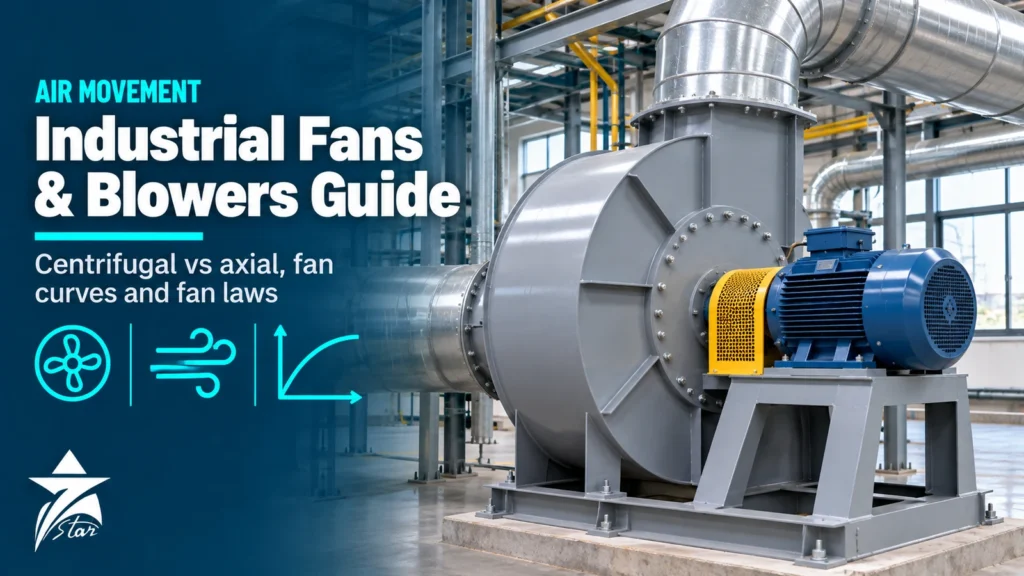
Fans and blowers move air for ventilation, cooling, combustion, drying, dust collection and smoke control. They are among the largest electricity users on many sites, and in Oman they often run in ambient temperatures above 45 degrees Celsius with dust in the air. Choosing the right industrial fan is therefore a question of both reliability and running cost. This guide explains the main fan types, how to read a fan curve, how the fan laws predict performance at different speeds, and what changes when the air is hot or the fan must operate in a smoke or explosive atmosphere.
Fans vs Blowers: What Is the Difference?
The terms are often used loosely, but a common engineering distinction is based on pressure. Fans move large volumes of air at relatively low pressure, typically below about 1,500 to 2,000 Pa. Blowers produce higher pressures, from a few thousand pascals to over 20,000 Pa, and are used for combustion air, pneumatic conveying, aeration and process air. Above that range, compressors take over. Knowing which side of this line your duty falls on narrows the choice quickly.
Main Industrial Fan Types and Where They Fit
| Type | Pressure range | Typical applications |
|---|---|---|
| Propeller and plate axial fans | Very low | Wall and roof extraction, condenser cooling, general ventilation |
| Tube axial and vane axial fans | Low to medium | Ducted ventilation, tunnels, car parks, smoke extract |
| Mixed flow in-line fans | Low to medium | Duct systems where compact size and low noise matter |
| Forward curved centrifugal | Low to medium | Air handling units, fan coil units, cabinet fans |
| Backward curved and airfoil centrifugal | Medium to high | HVAC supply and extract, process ventilation, high efficiency duty |
| Radial blade centrifugal | Medium to high | Dust laden air, material handling, abrasive or sticky particles |
| Radial blowers and high pressure blowers | High | Combustion air, drying, conveying, air knives |
Backward curved and airfoil impellers usually give the highest efficiency and a non overloading power curve, which means the motor cannot be overloaded if system resistance drops. Forward curved impellers are compact and quiet at low pressure, but their power keeps rising with flow. Radial blades are less efficient but tolerate dust and are easy to clean, which is why they are common in dust collection and process fans.
Reading an Industrial Fan Curve and the System Curve
A fan curve shows the pressure the fan develops at each flow rate at a given speed, often together with power, efficiency and noise. The system curve shows the pressure needed to push air through the ducts, filters, dampers and coils, and it rises roughly with the square of the flow. The operating point is where the two curves cross. Select the fan so that this point sits near its peak efficiency and away from the stall region on the left of the curve, where airflow becomes unstable, noise rises and blades can be damaged.
- Check whether the curve shows static pressure or total pressure, and calculate the system resistance on the same basis.
- Include the pressure drop of filters at their dirty condition, not only when new.
- Allow for system effect losses caused by bends or transitions close to the fan inlet or outlet.
- Avoid large safety margins, which push the fan to throttled operation and waste energy.
The Fan Laws in Practice
The fan laws predict how a given fan behaves when its speed changes, assuming the same air density and system.
| Quantity | Relationship to speed | Effect of 20 percent speed reduction |
|---|---|---|
| Airflow | Proportional to speed | Flow falls to 80 percent |
| Pressure | Proportional to speed squared | Pressure falls to 64 percent |
| Power | Proportional to speed cubed | Power falls to about 51 percent |
The cube law is why variable speed control saves so much energy on fans with variable demand. Reducing speed by only 20 percent roughly halves the power, which is far more efficient than closing a damper. Our guides to VFD selection for hot climates and soft starters versus VFDs explain how to choose the drive, while motor efficiency classes covers the IE2, IE3 and IE4 motors that drive most fans.
Correcting for Hot Air and Altitude
Fan catalogues are usually based on standard air with a density of about 1.2 kg per cubic metre at 20 degrees Celsius at sea level. Hot air is lighter: at 50 degrees Celsius the density falls to about 1.09 kg per cubic metre, and at 200 degrees Celsius it is roughly 0.75. A fan moves the same volume of air regardless of density, but the pressure it develops and the power it absorbs fall in proportion to density. Two practical consequences follow.
- Convert the required system pressure to standard density before selecting from a catalogue, or the fan will be undersized for the hot duty.
- Size the motor for the cold start condition, when the air is denser and the fan absorbs more power, unless the fan is started with a damper closed or on a drive.
- Check the maximum continuous gas temperature for the impeller, bearings and motor, and specify cooling wheels or shaft seals for hot process gas.
Smoke Extract Fans
Fans used for smoke and heat exhaust must keep running during a fire. In Europe and many GCC projects they are tested to EN 12101-3, which classifies fans by temperature and time, for example F200 for 200 degrees Celsius for 120 minutes, F300 for 300 degrees Celsius for 60 minutes and F400 for 400 degrees Celsius for 120 minutes. Car park jet fans and tunnel fans often carry these ratings. Civil defence requirements and the project fire strategy decide the class, and the motor, cabling and controls must match it.
Fans for Hazardous Areas and Corrosive Gas
Where flammable gas, vapour or dust may be present, the fan must be designed so that neither the motor nor the moving parts can ignite the atmosphere. This means ATEX or IECEx certified motors, non sparking material combinations between the impeller and the casing, such as aluminium against steel or brass liners, and controlled clearances. Fans for fume cupboards, battery rooms, chemical scrubbers and wastewater plants may need coated steel, stainless steel or plastic construction to resist corrosive gas.
Industrial Fan Efficiency, Noise and Vibration
Fan efficiency is regulated in several markets. The European ErP regulation sets minimum efficiency grades for fans driven by motors from 125 W to 500 kW, and AMCA in North America uses fan efficiency ratings that compare the selected operating point with the ideal. Electronically commutated motors are common on smaller fans and combine high efficiency with built in speed control. Noise data is usually given as sound power by octave band; inlet and outlet silencers, acoustic cabinets and lower tip speeds reduce noise where people work. Impellers should be balanced to ISO 14694 or ISO 21940 grades, and vibration checked at commissioning and during routine maintenance.
Belt Drive vs Direct Drive
| Drive | Advantages | Limitations |
|---|---|---|
| Direct drive | Fewer parts, no belt losses, compact, low maintenance | Speed fixed by the motor unless a drive is fitted |
| Belt drive | Speed easily changed by pulleys, motor kept out of hot air | Belt losses and wear, regular tensioning needed |
| Direct drive with VFD or EC motor | Precise speed control and high efficiency | Higher initial cost, drive must suit ambient temperature |
Specifying an Industrial Fan for Quotation
- Airflow in cubic metres per hour or per second at the operating condition.
- Static or total pressure required, with the system pressure drop calculation if available.
- Gas type, temperature, density, dust load and any corrosive components.
- Installation type: ducted, roof, wall, in-line, cabinet or free standing.
- Power supply and preferred motor efficiency class, speed control method and starter.
- Hazardous area classification, smoke extract class or other certification needed.
- Noise limits and available space, including inlet and outlet connection sizes.
Maintenance for Long Industrial Fan Life
Most fan failures begin with bearings, belts or imbalance caused by dirt build up on the impeller. Clean impellers regularly in dusty locations, check belt tension and alignment, lubricate bearings according to the manufacturer schedule, and monitor vibration so that problems are caught early. Our article on electric motor failure causes explains the motor checks that complete a fan maintenance routine.
Selected Fans and Blowers in Our Catalog
The table below lists a selection of fans and blowers from our catalog.
| Product | Type | Typical use |
|---|---|---|
| Greenheck AX | High performance axial fan | Ducted ventilation |
| Greenheck IP | Radial wheel centrifugal fan | Process air and dust |
| Greenheck GreenJet GJX | Car park jet fan | Car park ventilation |
| Greenheck CUBE | Centrifugal roof upblast exhaust fan | Kitchen and roof exhaust |
| Soler & Palau CVHT F400 | Smoke extract cabinet fan | Fire and smoke control |
| Soler & Palau CVTT-15/15 | Belt driven cabinet fan | Air handling and extraction |
| Soler & Palau TD-2000/315 SILENT | Acoustic mixed flow duct fan | Quiet ducted extract |
| Vortice A-E 636 T | Axial plate fan | Wall extraction |
| Vortice LINEO 200 ES | Mixed flow in-line fan | Duct ventilation |
| Elektror HRD | High pressure radial blower | Combustion and process air |
| Elektror S-HE | High efficiency centrifugal blower | Conveying and drying |
| Greenheck FPB | Direct drive pressure blower | Process and burner air |
Browse more in our industrial fans and blowers category. To get a quotation, send the airflow, pressure, gas temperature, installation type and power supply through our quote request form or to [email protected].
Sourcing Fans and Blowers in Oman Through Seven Star LLC
Seven Star LLC is an independent supplier in Oman of axial, centrifugal, mixed flow, roof, smoke extract and jet fans, high pressure blowers and fan motors and drives. We quote products from manufacturers such as Greenheck, Soler and Palau, Vortice and Elektror, together with silencers, dampers, variable frequency drives and spare parts. Performance, temperature class, hazardous area rating and lead time are confirmed against the manufacturer data at quotation.
Frequently asked questions
What is the difference between a fan and a blower?
Fans move large volumes of air at low pressure, generally below about 1,500 to 2,000 Pa, while blowers produce higher pressures for combustion air, conveying, drying and process air. Compressors are used for even higher pressures.
When should I choose a centrifugal fan instead of an axial fan?
Centrifugal fans suit higher pressures, ducted systems with filters and coils, and dusty air. Axial fans are better for high airflow at low pressure, such as wall and roof extraction, tunnels and car parks.
How much energy does reducing fan speed save?
According to the fan laws, power is proportional to the cube of speed. Reducing speed by 20 percent cuts the absorbed power to about half, which is why variable frequency drives are widely used on fans with variable demand.
How does hot air affect fan performance?
Hot air has lower density, so a fan develops less pressure and absorbs less power while moving the same volume. The system pressure must be corrected to standard density before selecting a fan, and the motor sized for the colder start up condition.
What do smoke extract fan classes such as F300 and F400 mean?
Under EN 12101-3, the class states the temperature and duration the fan can survive. F300 means 300 degrees Celsius for 60 minutes and F400 means 400 degrees Celsius for 120 minutes. The project fire strategy sets the required class.
Who supplies industrial fans and blowers in Oman?
Seven Star LLC is an independent supplier in Oman that quotes axial, centrifugal, smoke extract and jet fans and high pressure blowers from manufacturers such as Greenheck, Soler and Palau, Vortice and Elektror. Send your requirements through the quote request form or to [email protected].
Was this guide helpful?One click helps us write better guides for engineers.
Thank you! Glad it helped. Need this equipment for your project? Request a quotation
Thank you. We will use this to improve the guide.