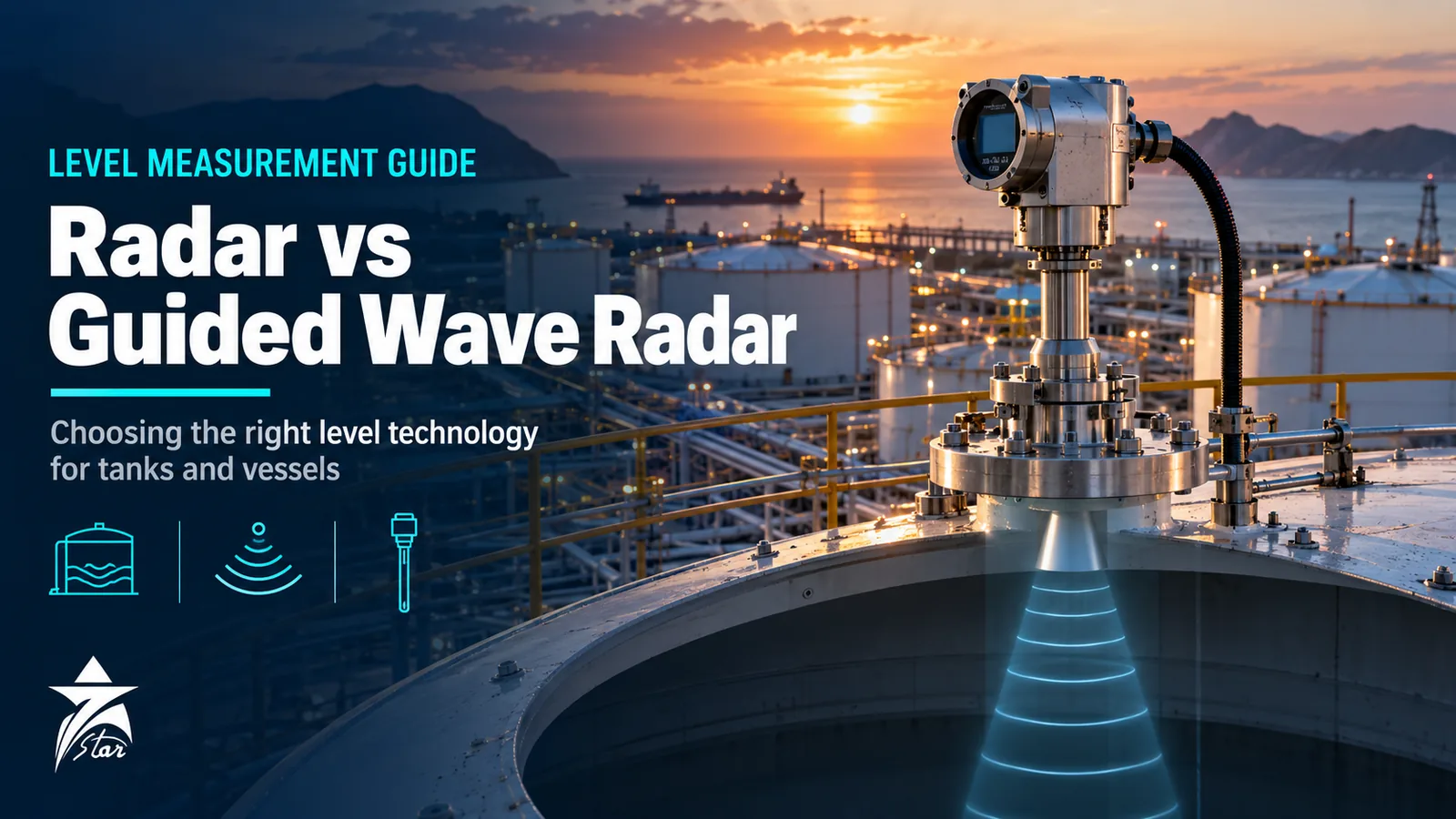
Radar Level Transmitter Selection: Non-Contact Radar vs Guided Wave Radar vs Vibrating Switches for Oman’s Tanks and Vessels
Choosing a radar level transmitter used to be a simple decision: pick a horn antenna, mount it on the tank roof and accept a few centimetres of uncertainty. That is no longer the case. Modern 80 GHz non-contact radar, guided wave radar (GWR), magnetostrictive gauges and hydrostatic transmitters each solve a different measurement problem, and choosing the wrong one is one of the most common reasons a level loop ends up in manual mode within its first year of operation.
This guide walks through how each technology works, where it performs best, where it fails, and how to match it to the tanks, separators, sumps and silos found across Oman’s oil and gas, refining, desalination and utility sites. Every product referenced is available through Seven Star LLC.
Why Level Measurement Deserves More Engineering Attention
Level is the variable most often tied directly to safety and money at the same time. An overfilled crude tank is a loss-of-containment event; an underfilled pump suction is a damaged pump; an inaccurate interface level in a three-phase separator sends oil into the produced-water system. API 2350 treats overfill prevention on atmospheric storage tanks as a management system, not just an instrument, and most operators in Oman now expect an independent high-high level switch in addition to the continuous gauge on every critical tank.
At the same time, level measurement is sensitive to conditions that engineers rarely control: vapour space composition, foam, turbulence, internal obstructions, deposits on the sensor and changes in product density. The right technology is the one whose measuring principle is least affected by the specific conditions in your vessel.
The Five Technologies Compared
| Technology | Measuring principle | Best suited for | Main limitations | Examples in our range |
|---|---|---|---|---|
| Non-contact radar (80 GHz FMCW) | Microwave signal reflected from the product surface | Storage tanks, reactors, silos, tanks with agitators or internals | Heavy foam can absorb the signal; needs a clear line of sight | VEGAPULS 6X, VEGAPULS 64, VEGAPULS C21, Micropilot FMR20, Micropilot FMR60 |
| Guided wave radar (TDR) | Microwave pulse travels along a rod or cable probe | Low-dielectric liquids, interface, small chambers and bypasses, high pressure and temperature | Probe contact with product; build-up and long cable probes need care | VEGAFLEX 81, VEGAFLEX 86, Levelflex FMP51, Levelflex FMP54, Rosemount 5300 |
| Magnetostrictive | Float position detected along a waveguide | High-accuracy inventory, interface in clean liquids | Moving float; unsuitable for viscous or dirty service | ABB K-TEK AT100 |
| Hydrostatic / DP | Pressure of the liquid column | Closed or open vessels with stable density, sumps, wells | Reading shifts if density changes | VEGABAR 82, Rosemount 3051SAL |
| Vibrating fork / capacitive switch | Change in frequency or capacitance when covered | High-high, low-low alarms, pump dry-run protection | Point measurement only | VEGASWING 61, VEGASWING 63, VEGAPOINT 21, Rosemount 2140 |
Non-Contact Radar: Why 80 GHz Changed the Market
Non-contact radar sends a frequency-modulated continuous-wave (FMCW) signal towards the product surface and calculates distance from the frequency difference of the returning echo. Older instruments operated around 6 GHz and 26 GHz, which meant wide beam angles and large antennas. At 80 GHz, the same antenna size produces a much narrower beam, typically only a few degrees wide.
That narrow beam is the real advantage. It lets the signal pass between agitator blades, heating coils, ladders and nozzle welds that would have produced false echoes with a lower-frequency instrument. It also allows smaller process connections, which matters when retrofitting existing tanks where cutting a new large nozzle is not an option.
The VEGAPULS 6X is a good example of the current generation: one instrument platform configured for liquids or bulk solids, with accuracy in the millimetre range under reference conditions and a SIL-capable version for safety loops. For simpler duties such as water tanks, lift stations and chemical day tanks, compact sensors like the VEGAPULS C21 or the Endress+Hauser Micropilot FMR20 cover the requirement at a much lower installed cost.
Where non-contact radar struggles
- Dense foam. Light foam is usually tolerated, but thick, wet foam can absorb enough energy to weaken the echo. Guided wave radar is often the better answer here.
- Stilling wells with poor design. Radar can measure very well inside a stilling well, but only if the well is smooth, continuous and correctly sized. Slots, weld seams and diameter changes create false echoes.
- Very low dielectric products at long range. Liquefied gases and some light hydrocarbons return a weaker signal. Modern 80 GHz instruments handle most of these, but the application should always be checked against the manufacturer’s dielectric and range data.
Guided Wave Radar: The Workhorse for Process Vessels
Guided wave radar sends a low-energy microwave pulse down a rod, cable or coaxial probe. Because the energy is concentrated along the probe rather than spread across the vessel, the returning signal is strong even from low-dielectric liquids, and the instrument is largely unaffected by vapour, turbulence, foam and internal obstructions.
GWR has two capabilities that make it the default choice in many separators and knock-out drums:
- Interface measurement. Part of the pulse reflects from the upper liquid surface and part continues to the interface between, for example, hydrocarbon and water. A single instrument can report both the total level and the interface level, which is exactly what a three-phase separator needs.
- Chamber and bypass mounting. GWR is the natural replacement for displacer-type level instruments in external cages. The VEGAFLEX 86 is designed for high-temperature and high-pressure service such as steam drums and hot hydrocarbon vessels, while the Levelflex FMP51 and Rosemount 5300 are widely used across general process duties.
The trade-off is contact with the process. Heavy, sticky or crystallising products can build up on the probe, and long cable probes in tall tanks need to be anchored or weighted so they do not move with turbulence. When replacing a displacer, confirm the chamber’s internal diameter and the probe’s centring requirements before ordering.
Magnetostrictive and Hydrostatic: When They Still Make Sense
Radar has not made every other technology obsolete. Magnetostrictive transmitters such as the ABB K-TEK AT100 remain a strong choice for high-accuracy inventory and clean-liquid interface measurement, especially where a float and guide pipe already exist. They are less suitable for viscous, waxy or dirty service, where the float can stick.
Hydrostatic and differential-pressure level is still the simplest and most robust solution for many sumps, wells, open channels and closed vessels with a known, stable density. The VEGABAR 82 with its ceramic measuring cell is well suited to abrasive and aggressive media. The weakness of any pressure-based level measurement is density: if the product composition or temperature changes significantly, the level reading shifts with it. That is why hydrostatic level is rarely the right answer for mixed hydrocarbon service.
Point Level Switches: The Independent Layer
Continuous level and point level protection do different jobs, and a good design treats them separately. A vibrating fork switch such as the VEGASWING 61 or Rosemount 2140 detects whether it is covered or uncovered, with no calibration and almost no sensitivity to density, foam or conductivity. That makes it the preferred device for:
- High-high level alarms and overfill trips that must be independent of the continuous gauge
- Low-low level and pump dry-run protection
- Chute and hopper blockage detection in bulk solids handling
For safety-related functions, specify an instrument with the required SIL qualification and plan proof testing from the start. Many vibrating switches support a remote proof test that avoids physically raising the tank level.
Matching the Technology to Common Applications in Oman
| Application | Typical recommendation | Why |
|---|---|---|
| Crude and product storage tanks (e.g. export and storage terminals) | 80 GHz non-contact radar plus independent vibrating fork for high-high | Long range, no contact, reliable in large tanks with internals |
| Three-phase separators and knock-out drums | Guided wave radar in a chamber, with interface output | Reports total level and oil-water interface from one instrument |
| Steam drums and hot condensate vessels | High-temperature GWR (e.g. VEGAFLEX 86) or DP with remote seals | Handles pressure, temperature and changing steam density |
| Desalination brine and product water tanks | Compact 80 GHz radar | Low cost, no contact with corrosive brine, simple setup |
| Wastewater lift stations and sumps | Compact radar or hydrostatic transmitter, plus float or fork backup | Turbulence and foam tolerance, simple maintenance |
| Chemical dosing day tanks | Compact radar | Narrow beam fits small tanks, no wetted parts in the chemical |
Environmental Factors Specific to Omani Sites
Oman’s operating environment adds three considerations that are easy to miss on a datasheet:
- Solar heating of transmitter housings. Summer air temperatures above 45 °C, combined with direct sun on a tank roof, can push electronics well beyond ambient. Sun shades and verified maximum ambient ratings are worth specifying up front.
- Dust and sand. Choose housings with suitable ingress protection and keep cable entries sealed. For non-contact radar, antenna encapsulation or a flushing connection helps on dusty bulk solids duties.
- Remote and unmanned locations. Many wellhead and pipeline sites are visited infrequently. Instruments with good diagnostics, echo-curve logging and Bluetooth or HART access for commissioning reduce the number of trips needed to diagnose a fault.
A Practical Selection Checklist
- Define the product: liquid or solid, dielectric constant, density stability, viscosity, and tendency to foam, build up or crystallise.
- Define the vessel: height, internals, agitators, nozzles available, and whether a stilling well or external chamber exists.
- Define the process conditions: operating and design pressure and temperature, vapour composition, turbulence.
- Decide whether you need interface measurement, not just total level.
- Separate the continuous measurement from the safety function, and specify the point switch and its SIL requirement independently.
- Confirm hazardous-area certification, communication protocol (HART, Profibus PA, Foundation Fieldbus or Modbus) and power requirements.
- Plan commissioning: who will map false echoes, verify the empty and full calibration, and record the baseline echo curve.
Why Source Level Instrumentation Through Seven Star LLC
Seven Star LLC supplies level instrumentation from VEGA, Endress+Hauser, Emerson and ABB to operators, EPC contractors and maintenance teams across Oman. Our engineers review the application data before an order is placed, so the instrument that arrives on site matches the vessel it is going into, not just the tag description on the requisition. You can browse the full level instrumentation range or, if your application also involves flow, read our guide on how to choose the right flow meter for industrial applications.
Send your level datasheet or tag list to Seven Star LLC and our team will confirm the right technology, process connection and certification before you commit to an order.
More Blog