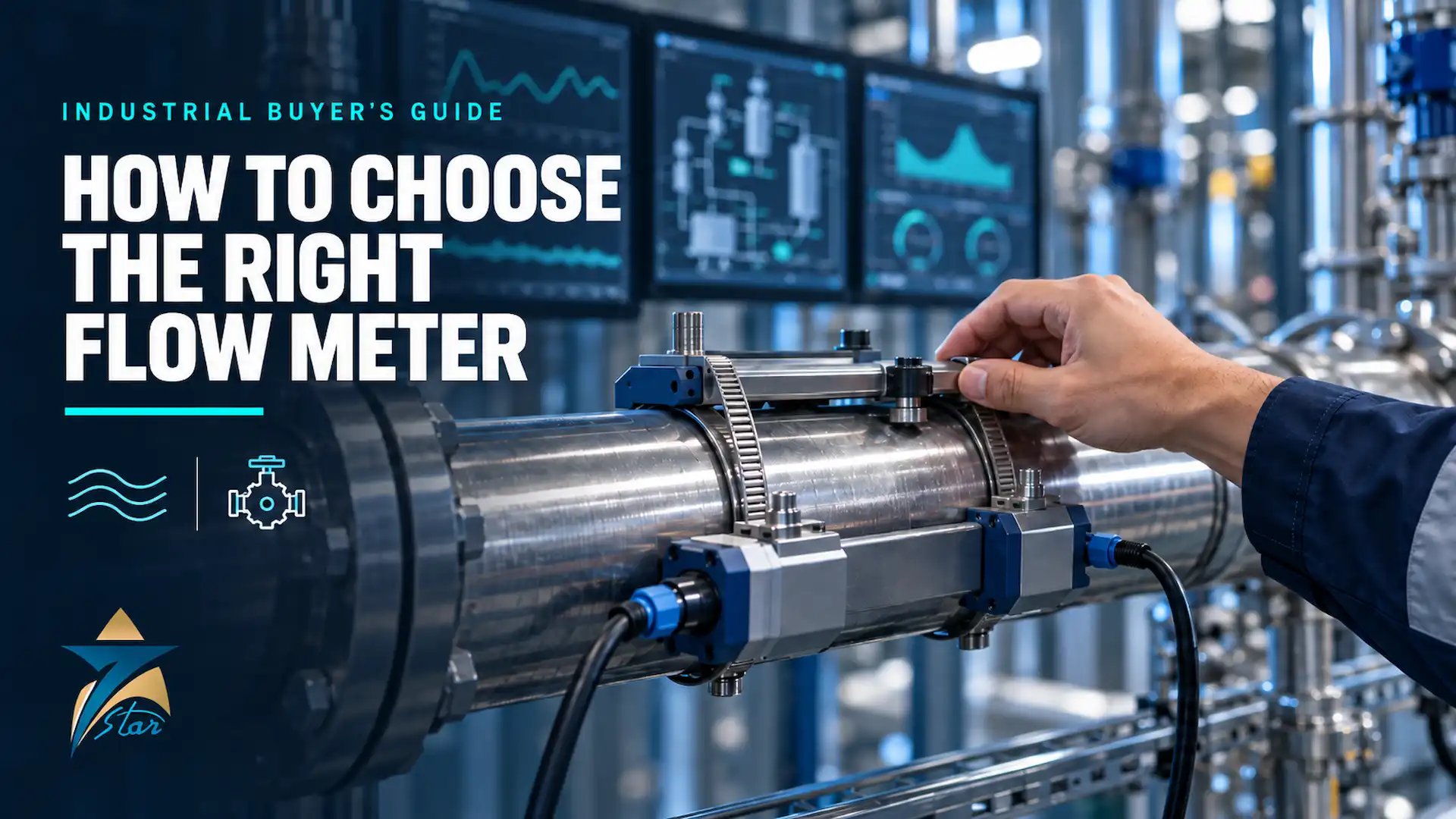
How to Choose the Right Flow Meter for Industrial Applications
Choosing the wrong flow meter is one of the most expensive mistakes an industrial buyer can make. A misapplied meter does not just give a slightly noisy reading — it produces silently inaccurate custody-transfer numbers, triggers nuisance shutdowns, and forces an expensive re-engineering job six months after installation, once the pipe has already been welded and the process is running.
In Oman’s oil & gas, water, and manufacturing sectors, flow measurement decisions are rarely simple. A meter that performs perfectly on clean water in a lab datasheet can fail within weeks on a slurry line, a high-viscosity crude stream, or a pipe with only three diameters of straight run available. This guide breaks down how to choose flow meter technology the way a process engineer actually should — by working backward from fluid properties, accuracy requirements, and installation constraints, not by picking whatever is cheapest on a quotation.
Flow meters rarely work in isolation. They typically feed flow computers for custody-transfer calculation, report into automation and control systems for process loops, and sit alongside pressure and temperature transmitters for full process visibility. Selecting the meter without considering this wider instrumentation chain is one of the most common and costly errors in industrial procurement.
Flow Meter Comparison: Technology, Accuracy, and Best Fit
Before going into detail, here is how the five main industrial flow measurement technologies compare on the criteria that actually drive a purchasing decision.
| Technology | Typical Accuracy | Best For | Limitation |
|---|---|---|---|
| Ultrasonic (clamp-on) | ±1–2% of reading | Large pipelines, non-intrusive retrofit, clean liquids | Accuracy drops on aerated or heavily lined pipes |
| Electromagnetic | ±0.5% of reading | Conductive fluids — water, wastewater, chemicals | Cannot measure hydrocarbons or non-conductive fluids |
| Coriolis (mass) | ±0.1–0.2% of reading | Custody transfer, high-value fluids, multi-parameter data | Higher upfront cost; size limits on very large lines |
| Turbine | ±0.25–0.5% of reading | Clean liquids, stable flow, petroleum products | Moving parts wear; needs straight-run pipe upstream |
| Differential Pressure (orifice/DP) | ±1–2% of reading | Established, standardized custody applications | Permanent pressure loss; narrower turndown ratio |
These figures are typical ranges under good installation conditions — actual performance always depends on correct sizing, upstream/downstream straight-pipe length, and fluid conditions specific to your process.
Ultrasonic Flow Meters
Ultrasonic meters measure velocity using the transit-time difference of sound waves traveling with and against the flow. Clamp-on transit-time models, such as the pFlow range Seven Star supplies as an authorized representative for Gentos, are installed on the outside of the pipe — no cutting, no process shutdown, no wetted-part wear. This makes them the practical first choice for retrofitting flow measurement onto existing lines in water networks and large-diameter industrial pipework where an intrusive meter would mean days of downtime.
The trade-off is that accuracy depends heavily on pipe condition: heavy scaling, air entrainment, or non-uniform wall thickness can push errors beyond the ±1–2% typical spec. For custody-transfer-grade accuracy, multipath ultrasonic meters (using 4–8 acoustic paths instead of one) narrow this considerably and are increasingly accepted for gas and liquid custody applications.
Electromagnetic Flow Meters
Electromagnetic (magmeter) technology applies Faraday’s law: a conductive fluid moving through a magnetic field generates a voltage proportional to velocity. Because there are no moving parts and no obstruction in the flow path, magmeters are the standard choice for water and wastewater treatment, chemical dosing lines, and slurries with suspended solids that would foul or erode a mechanical meter.
The hard limitation: the fluid must be electrically conductive (typically above 5 microsiemens/cm). This rules magmeters out for hydrocarbons, demineralized water, and most gases — a mistake seen often enough on refinery and oilfield sites that it is worth stating plainly here.
Coriolis Flow Meters
Coriolis meters measure mass flow directly by detecting the twist induced in a vibrating tube as fluid passes through it — and as a side effect, they simultaneously output density and, indirectly, temperature. This makes them the preferred technology for custody transfer of high-value liquids (crude blending, LPG loading, chemical batching) where ±0.1–0.2% accuracy justifies the higher capital cost. Because they measure mass rather than volume, Coriolis meters are also immune to errors from pressure and temperature-driven density changes that affect volumetric technologies.
Turbine Flow Meters
Turbine meters use a mechanical rotor whose spin rate is proportional to flow velocity. They remain widely used for clean liquid hydrocarbons and fiscal metering of refined petroleum products, offering good repeatability at a lower cost than Coriolis. The catch is mechanical wear: bearings degrade over time, especially with any particulate content, and accuracy depends on adequate straight-pipe runs (typically 10 diameters upstream, 5 downstream) to condition the flow profile before it reaches the rotor.
Differential Pressure (Orifice) Meters
DP flow measurement — typically an orifice plate, venturi, or flow nozzle paired with a differential pressure transmitter — remains the most standardized flow technology in the industry, governed by well-established sizing standards (ISO 5167, AGA 3). Its main advantage is decades of proven reliability and a large base of process engineers who know how to size and maintain it. Its main disadvantage is permanent pressure loss across the primary element and a comparatively narrow turndown ratio, meaning accuracy suffers outside a fairly tight flow range. DP meters typically integrate directly with flow computers for volume and energy calculation.
Five Engineering Factors That Actually Decide the Right Meter
1. Fluid Properties
Conductivity rules magmeters in or out. Viscosity above roughly 10 cP starts to affect turbine and vortex accuracy. Suspended solids or bubbles degrade ultrasonic signal quality. Corrosive or abrasive media dictate wetted-material selection (Hastelloy, PTFE liners, tantalum) regardless of which measurement principle is chosen.
2. Operating Conditions
High pressure and high temperature narrow the field to meters rated for those conditions in their pressure-retaining housing, not just their sensing element. Pulsating flow (common downstream of reciprocating pumps) can defeat turbine and vortex meters unless a pulsation dampener is added upstream.
3. Required Accuracy Class
Custody transfer and fiscal metering (oil and gas export, LPG loading) typically require ±0.1–0.25% and therefore point toward Coriolis or multipath ultrasonic. Internal process monitoring can often tolerate ±1–2%, which opens the field to lower-cost clamp-on ultrasonic or DP technology.
4. Installation Constraints
Available straight-pipe run is usually the deciding factor engineers overlook until the meter is already on order. Clamp-on ultrasonic needs the least (as little as 5–10 diameters with a multipath sensor); turbine and orifice plates need considerably more. If the process area has no room for a straight run, that constraint alone can eliminate half the technologies in the comparison table above.
5. Total Lifecycle Cost
Purchase price is the smallest part of the real cost. Factor in calibration interval and cost, spare-part lead time, mean time between failures for moving-part designs, and the cost of process downtime required to remove an intrusive meter for service. A clamp-on ultrasonic meter with a slightly lower base accuracy can still deliver a better five-year total cost of ownership than a turbine meter that needs annual bearing replacement.
Where This Plays Out in Oman
Oman’s industrial base makes almost every one of these trade-offs a live issue. Upstream oil and gas operations need fiscal-grade Coriolis or multipath ultrasonic metering for custody transfer and production allocation. Desalination and municipal water networks — expanding under Oman Vision 2040’s water security targets — lean on electromagnetic and clamp-on ultrasonic meters for both conductive potable water and treated effluent. Petrochemical and refining sites in Sohar and Duqm combine DP metering on legacy lines with newer Coriolis installations wherever fiscal accuracy or multi-parameter data (mass, density, temperature) is required from a single device.
Common Selection Mistakes
- Sizing the meter to the pipe diameter instead of the actual flow velocity range, which wrecks turndown performance
- Specifying a magmeter for a hydrocarbon or demineralized-water application where it physically cannot function
- Ignoring upstream/downstream straight-pipe requirements, then blaming the meter for poor accuracy
- Choosing on unit price alone without pricing in calibration, spares, and downtime over a 5–10 year horizon
- Skipping a proper application review with an experienced supplier before placing the order
Why the Supplier Matters as Much as the Meter
Every technology above performs exactly as well as its application engineering. Seven Star LLC works through this selection process directly with process engineers and procurement teams in Oman, drawing on its authorized-representative relationships — including pFlow (Gentos) ultrasonic flow meters and flow computer integration — to size the meter correctly the first time, confirm installation constraints on site, and keep spare parts and calibration support available locally rather than routed through an overseas distributor with multi-week lead times.
Procurement Checklist
- Document the fluid: conductivity, viscosity, solids content, temperature and pressure range
- Define the required accuracy class based on whether this is fiscal/custody or process monitoring
- Measure available straight-pipe run upstream and downstream of the proposed install point
- Confirm output/communication compatibility with existing flow computers or control systems
- Request total cost of ownership over 5–10 years, not just unit price
- Verify local calibration and spare-parts support before signing off
Conclusion
There is no single best flow meter — only the meter that correctly matches your fluid, your accuracy requirement, your installation constraints, and your total cost of ownership. Working through the comparison and the five engineering factors above before specifying anything will save far more in avoided rework than it costs in engineering time up front.
For a technical application review and sourcing support on ultrasonic, electromagnetic, Coriolis, turbine, or DP flow meters in Oman, contact Seven Star LLC to size the right solution for your process before you order.
More Blog