- Automation & ControlView all 2,082 products
- AC Drives
- Automation Accessories
- PLC & I/O Cards
- Industrial Communications
- Vibration Monitoring
- Controllers & Data Acquisition
- Isolator & Barrier
- CCTV & Security
- Safety Switches & Guard Locking
- Encoders
- HMI Displays
- Motor Soft Starters
- Pneumatic Cylinders
- Industrial Computers
- Servo Drives
- Machine Vision
- Automation Software
- Robotics
















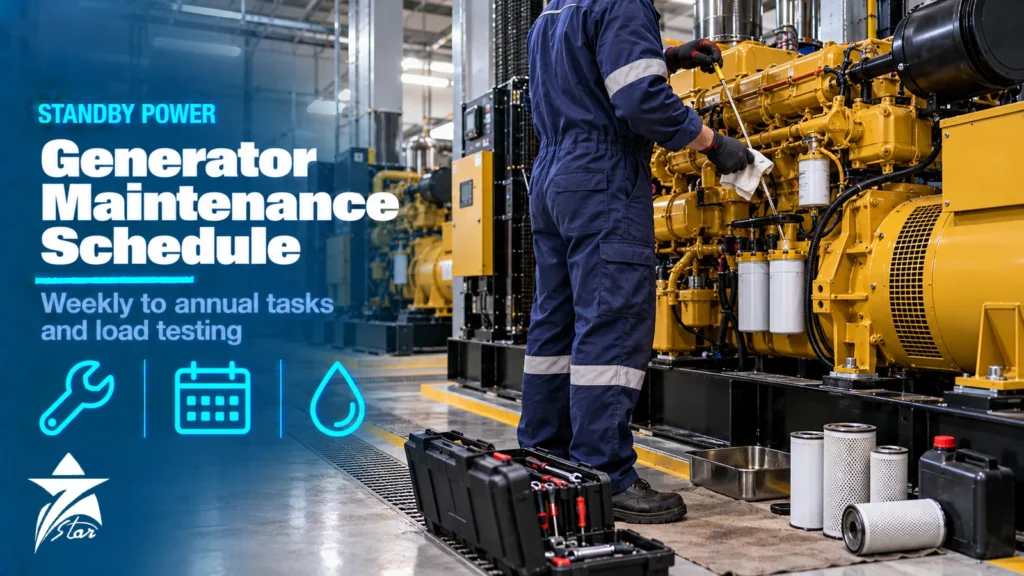
A standby generator is judged on one event: the moment the utility supply fails. Sets that crank but will not start, start but shut down on high temperature, or carry load for ten minutes before the fuel filters block are almost always the result of gaps in routine care rather than design faults. A sound diesel generator maintenance schedule combines short, frequent inspections with hour-based and calendar-based servicing, regular running under real load, and a spare parts holding that matches how critical the set is. This guide sets out a practical schedule, explains the checks that catch the common failures, and lists the critical spares worth keeping for sets operating in hot, dusty GCC conditions.
Why Standby Sets Fail When They Are Needed
Standby engines run few hours, so wear is rarely the problem. Their enemies are time, temperature and idleness. Batteries lose capacity, especially in hot enclosures. Diesel fuel ages, collects water and supports microbial growth. Coolant inhibitors deplete. Rubber hoses and belts harden. Sets that are only ever run off-load build up unburned fuel and carbon in the exhaust, a condition known as wet stacking. The schedule below is designed around these mechanisms, not around running hours alone.
- Starting system: weak or sulphated batteries, loose or corroded terminals, failed battery chargers and worn starter motors are frequently cited by service organisations as the leading cause of failure to start.
- Fuel system: water, sludge and microbial contamination block filters and damage injectors.
- Cooling system: radiators packed with dust, slipping fan belts, low coolant and failed thermostats cause high-temperature shutdowns under load.
- Controls and transfer: unnoticed alarms, wrong controller settings and transfer switch faults stop a healthy engine from picking up load.
Daily and Weekly Inspections
Where a set is in standby, a short weekly walk-round by site staff is the foundation of reliability. On prime-power sets running continuously, the same checks are made every shift or every day.
- Controller in automatic mode, no active or unacknowledged alarms, and the event log reviewed.
- Battery charger output normal; battery voltage and electrolyte level (on flooded batteries) checked.
- Engine oil and coolant levels; no leaks under the set or in the bund.
- Fuel level in day tank and bulk tank; water drained from separators and tank sumps.
- Coolant heater working on sets fitted with jacket water heating.
- Air filter restriction indicator not in the red zone; canopy louvres and radiator face free of sand and debris.
- Belts, hoses and exhaust supports visually intact; no exhaust leaks or soot staining.
A Typical Diesel Generator Maintenance Schedule by Hours and Calendar
Intervals vary by engine model, oil specification and duty, so the manufacturer’s operation and maintenance manual always governs. The table summarises a typical pattern for industrial diesel sets; for standby units the calendar interval normally arrives long before the hour interval.
| Interval | Typical tasks |
|---|---|
| Weekly | Walk-round inspection, battery and charger checks, fluid levels, drain water separators, review controller alarms |
| Monthly | Run under load for at least 30 minutes, record operating parameters, check belt tension and air filter restriction, test transfer operation where permitted |
| Every 250–500 h or 6–12 months | Change engine oil and oil filters, replace fuel filters, take oil and coolant samples, clean or replace air filter elements as indicated, check coolant inhibitor concentration |
| Annually | Full service, load bank test if site load is insufficient, inspect and tighten electrical connections, alternator insulation resistance, check governor and AVR response, calibrate protective devices |
| Every 2–3 years | Replace coolant (unless an extended-life coolant schedule applies), replace hoses and belts on condition, test or replace batteries according to their condition and age |
| Major intervals (hours set by manufacturer) | Valve clearance adjustment, injector testing or replacement, turbocharger inspection, top-end and in-frame overhaul for prime-power sets |
Running Under Load: Exercise and Load Bank Testing
Starting a standby set and letting it idle for ten minutes does more harm than good. The engine never reaches full operating temperature, condensation forms in the crankcase and exhaust, and fuel dilutes the oil. Exercise runs should carry real load or a load bank.
NFPA 110, widely referenced for emergency and standby power systems, requires monthly exercise of diesel sets for at least 30 minutes either at a load of not less than 30% of the nameplate kW rating or at a load that achieves the manufacturer’s recommended minimum exhaust gas temperature. Where the monthly runs cannot meet that, an annual supplemental load bank test is required, in recent editions arranged as 50% of nameplate for 30 minutes followed by 75% for 60 minutes. Level 1 systems also need a longer-duration test at least every 36 months. Check the edition your client or authority adopts; many GCC owners use NFPA 110 or a company standard derived from it.
Record voltage, frequency, current per phase, oil pressure, coolant temperature, exhaust temperature where available, and battery voltage during cranking. Trends in these readings reveal a weakening battery or a cooling problem long before a failure.
Fuel Quality and Storage
Diesel stored for months is a common root cause of failures during long outages. Water enters through tank breathing and condensation, especially where hot days and cooler nights alternate, and microbial growth forms at the fuel-water interface. Biodiesel blends are more prone to oxidation and water uptake than straight petroleum diesel.
- Drain water from tank sumps and water separators on a fixed schedule.
- Sample bulk fuel at least annually and test for water, sediment and microbial contamination against the purchase specification, such as ASTM D975 or EN 590.
- Consider a fuel polishing system for large standby tanks that turn over slowly.
- Keep tank breathers fitted with desiccant or particulate filters in dusty locations.
- Use the filter ratings the engine manufacturer specifies; modern common-rail injection systems need fine primary and secondary filtration.
Cooling and Air Intake in Hot, Dusty Sites
In Oman and the GCC the cooling package works close to its limit for much of the year. Fine sand coats radiator cores and cuts heat rejection, so a set that ran comfortably in winter shuts down on high temperature in July. Clean radiators from the fan side outwards with low-pressure air or water, inspect fins for damage, and check that canopy doors and seals are intact so that hot air does not recirculate.
Air filters load quickly during sandstorms. Replace elements when the restriction indicator says so rather than on a fixed date, use the correct heavy-duty or two-stage filter elements, and inspect pre-cleaners and dust ejector valves. A split element or a missing seal lets abrasive dust straight into the cylinders and can wear an engine out in a short time.
Oil, Coolant and Alternator Condition Checks
Scheduled sampling adds diagnostic value to every service. Oil analysis shows fuel dilution, soot loading, glycol contamination from a leaking cooler or liner seal, and wear metals that point to bearings, liners or the turbocharger. Coolant analysis confirms freeze and boil protection, inhibitor level and pH, and flags contamination by oil or combustion gases.
- Alternator insulation resistance measured and trended at the annual service, temperature-corrected for comparison.
- Alternator bearing condition checked by noise, temperature or vibration measurement.
- AVR and governor response checked during a load step and settings recorded.
- Terminations, breakers and transfer switch contacts inspected, with thermography under load where possible using portable test and measurement instruments.
- Controller firmware, setpoints and protection settings backed up after every change.
Critical Spare Parts for Diesel Generators
The right spares holding depends on how critical the set is, how far the site is from the nearest supply point, and how many identical units are installed. Group spares into service consumables, fast-failing items and insurance spares.
| Category | Typical items | Reason to hold on site |
|---|---|---|
| Service consumables | Oil, fuel and air filters, water separator elements, engine oil, coolant, gaskets and O-rings for filter housings | Needed at every service; shortages delay routine work |
| Starting system | Batteries, battery charger, starter motor, starter relay or solenoid | Most common cause of failure to start |
| Cooling and belts | Fan and alternator belts, radiator hoses, thermostats, coolant pump seal kit | Rubber parts age quickly in high temperatures |
| Fuel and governing | Fuel lift pump, injectors, fuel solenoid or actuator, magnetic speed pickup | A single failure stops the engine |
| Electrical and controls | AVR, rotating diode set, controller or display module, key sensors (oil pressure, coolant temperature) | Electronics fail without warning and can have long lead times |
| Insurance spares (critical or remote sets) | Turbocharger, coolant pump assembly, complete set of injectors | Long lead time and high consequence of failure |
When older engines or controllers are involved, some electronic parts may be discontinued; the approach in our guide to sourcing obsolete automation parts applies equally to legacy generator controllers and governors.
Identify parts correctly
Record the engine serial number, engine model and arrangement or build number, alternator model and serial number, AVR type, and controller model and firmware for every set. Part numbers for filters, belts and sensors often change between builds of the same engine model, and the serial number is what allows a supplier to confirm the right item.
Common Maintenance Mistakes
- Running standby sets off-load for short periods and calling it exercise.
- Changing oil on hours only, when a standby set may need it annually regardless of hours.
- Leaving batteries in service until they fail instead of testing capacity or internal resistance.
- Ignoring the radiator until the first high-temperature shutdown of the summer.
- Buying filters by appearance rather than by verified part number and micron rating.
- Not recording parameters, so slow deterioration goes unnoticed.
Diesel Generator Maintenance Schedule Checklist
- Manufacturer’s maintenance manual available for each engine, alternator and controller.
- Asset register with serial numbers, arrangement numbers and controller details.
- Weekly inspection sheet in use and reviewed.
- Monthly loaded run recorded with key parameters.
- Annual load bank test arranged where site load is below the minimum.
- Oil, coolant and fuel sampling on a fixed schedule.
- Battery testing and replacement plan.
- Critical spares list agreed, held and reordered when used.
Generator Parts and Controllers We Supply
These examples cover parts that maintenance schedules most often need.
| Product | Type | Where it fits |
|---|---|---|
| Cummins 3937025 Fuel Injection Pump | Fuel injection pump | Engine overhaul. |
| Cummins 3283330 Starter Motor | Starter motor | Engine starting. |
| Spare part 4011502 Single head gasket set (Cummins) | Head gasket set | Engine overhaul. |
| Cummins 300-6314-01 PowerCommand Display-Control Assembly | Control assembly | Generator control panel. |
| STAMFORD MX321 Automatic Voltage Regulator (AVR), 3-Phase Sensing | Alternator AVR | Alternator voltage regulation. |
| ComAp InteliLite 4 AMF 25 Single Gen-Set Controller | Genset controller | Automatic start and protection. |
Send the engine model and serial number, or the part numbers, through our quote request form.
Sourcing Diesel Generator Spare Parts Through Seven Star LLC
Seven Star LLC supplies diesel generator spare parts, filters, controllers and complete diesel generator sets on request for industrial, utility and oil and gas users across Oman and the GCC. We help cross-check part numbers against engine serial and arrangement numbers and suggest equivalents where an item is superseded. Availability and lead time are confirmed at quotation.
Send us the engine and alternator nameplate details with your spares list or maintenance kit requirement, and we will return a checked, itemised quotation.
Frequently asked questions
How often should a standby diesel generator be serviced?
Most manufacturers specify oil, filter and general servicing at a fixed number of running hours or at a calendar interval, commonly 6 to 12 months, whichever comes first. Standby sets run few hours, so the calendar interval usually governs. Weekly inspections and monthly loaded runs are needed in between.
How long should a generator be run during monthly testing?
NFPA 110 calls for monthly exercise of at least 30 minutes, either at a minimum of 30% of the nameplate kW rating or at a load that reaches the manufacturer's recommended minimum exhaust temperature. Running off-load for short periods should be avoided because it causes wet stacking and oil dilution.
What is wet stacking?
Wet stacking is the accumulation of unburned fuel, soot and oil in the exhaust system of a diesel engine that runs for long periods at light load. The engine does not reach a high enough temperature to burn the fuel completely. Loaded running or load bank testing is used to clear it and prevent it.
Why do generator batteries fail so often?
Starting batteries degrade with time and temperature, and hot enclosures in the GCC accelerate that ageing. Faulty chargers, loose terminals and corrosion add to the problem. Regular voltage checks, capacity or internal resistance testing and planned replacement reduce failures to start.
Which generator spare parts should be kept on site?
At a minimum, keep service filters and fluids, belts and hoses, batteries and a charger, and key sensors. Critical or remote sets justify insurance spares such as a starter motor, AVR, fuel actuator, injectors and possibly a turbocharger. The holding should reflect criticality, distance to supply and the number of identical sets.
How do I order the right generator spare parts?
Provide the engine model, engine serial number and arrangement or build number, plus the alternator and controller model and serial numbers. Parts often differ between builds of the same engine model. Photos of the nameplates and the old part numbers help suppliers confirm the correct items.
Was this guide helpful?One click helps us write better guides for engineers.
Thank you! Glad it helped. Need this equipment for your project? Request a quotation
Thank you. We will use this to improve the guide.