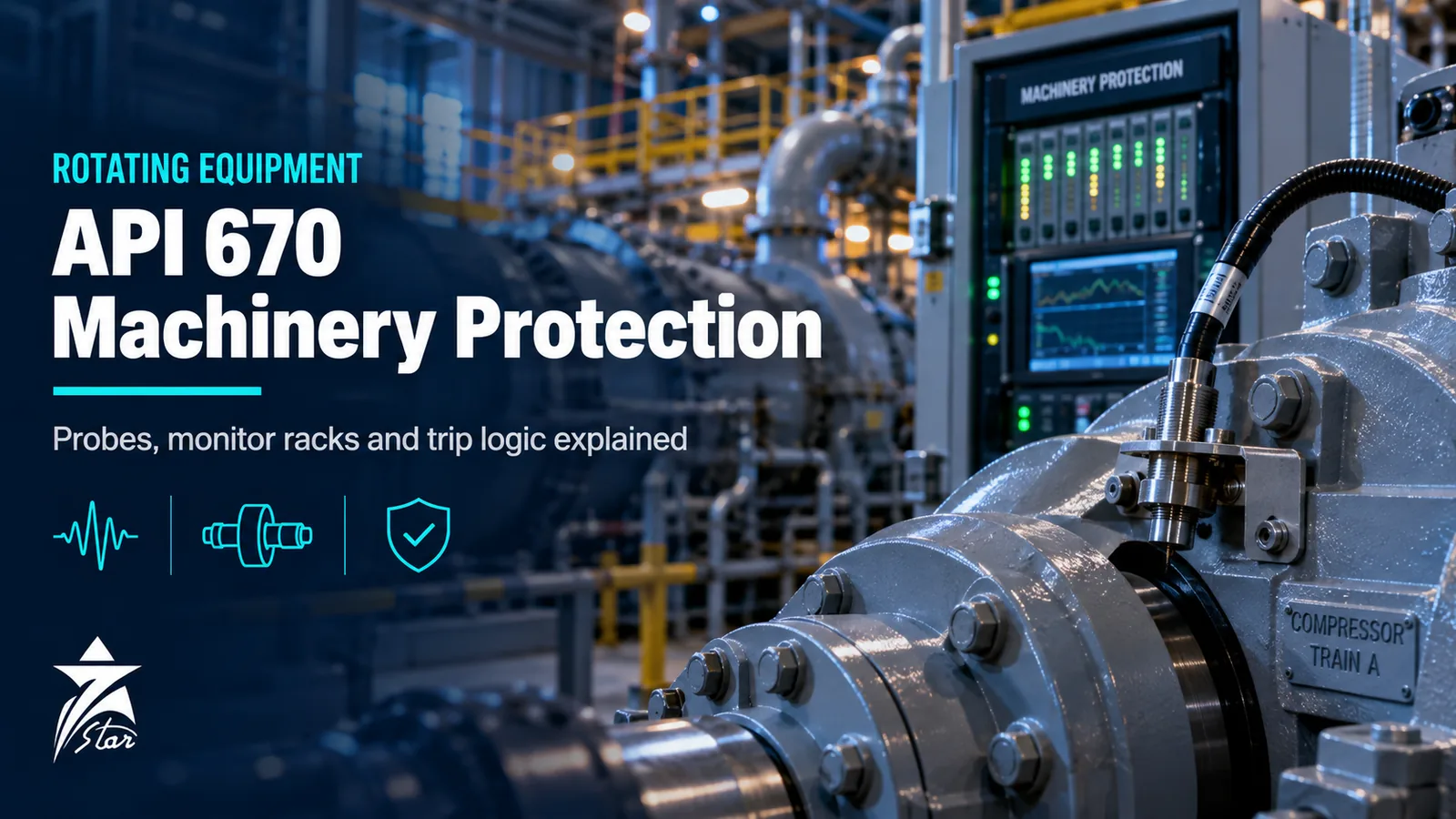
API 670 Machinery Protection Systems Explained: Proximity Probes, Monitor Racks and Trip Logic for Critical Rotating Equipment
Gas compressors, steam and gas turbines, large pumps and generators are the machines that stop a plant when they stop. They are also the machines where a bearing or thrust failure can escalate from a vibration alarm to catastrophic damage in seconds. An API 670 machinery protection system exists to catch that escalation early and, when necessary, trip the machine before damage spreads.
This guide explains what API 670 actually requires, how the sensors, monitors and relays fit together, where engineers commonly make mistakes, and how the main platforms in Seven Star LLC’s range, including Bently Nevada 3500, Shinkawa VM-5 and Brüel & Kjær Vibro systems, are applied on real machinery trains in Oman.
What API 670 Covers
API Standard 670 defines the minimum requirements for a machinery protection system: the transducers, the monitoring system, the relays and the interfaces to the control and safety systems. It applies mainly to critical, usually unspared, rotating machinery in petroleum, chemical and gas industry service. The standard covers:
- Radial shaft vibration measured with non-contacting proximity probes
- Axial position (thrust) of the rotor relative to the thrust bearing
- Casing vibration using accelerometers or velocity sensors
- Speed and overspeed detection
- Phase reference using a once-per-turn Keyphasor signal
- Temperature of bearings and other critical points
- Reciprocating compressor measurements such as rod drop and crosshead vibration
It also sets expectations for sensor interchangeability, accuracy over temperature, system self-checking, alarm and shutdown logic, and documentation. The practical effect is that an API 670 system from any major vendor is built from well-defined, testable components.
The Signal Chain: From Shaft to Relay
Proximity probes and drivers
Radial vibration and thrust position on fluid-film bearing machines are measured with eddy-current proximity probes. The probe tip sits a small distance from the shaft surface, and a driver (Proximitor in Bently Nevada terminology) produces a voltage proportional to the gap. The industry-standard 8 mm system produces 200 mV per mil (7.87 V/mm) of gap change.
The probe, the extension cable and the driver are calibrated as one system of a defined electrical length, typically 5 m or 9 m. Mixing lengths, cutting cables or replacing one component with a different series is a frequent cause of calibration errors after maintenance. The Bently Nevada 3300 XL 8 mm proximity transducer system is the most widely installed example and is specified to meet API 670 requirements for interchangeability and linearity.
Keyphasor reference
A dedicated probe observing a notch or projection on the shaft generates a once-per-revolution pulse. That pulse gives rotor speed and, more importantly, the phase reference needed for balancing, orbit plots and diagnostics. Without a Keyphasor, a protection system can still trip on high amplitude, but engineers lose most of the diagnostic information needed to understand why.
Casing measurements
Machines with rolling-element bearings, and gearboxes or pumps where shaft-relative measurement is not practical, are monitored with seismic sensors mounted on the casing. Velocity transducers such as the Bently Nevada 330500 Velomitor, and accelerometers such as Brüel & Kjær Vibro’s AS-062 and AS-063 series, are common choices.
The monitor rack
Signals from all transducers go to a rack of monitor modules that compare each measurement with alert and danger setpoints, drive relays and send data to the DCS, the safety system and condition monitoring software.
| Function | Typical sensor | Bently Nevada 3500 module | Shinkawa VM-5 equivalent |
|---|---|---|---|
| Radial vibration | 8 mm proximity probe | 3500/42M Proximitor Seismic Monitor or 3500/40M | VM-5K dual vibration monitor |
| Axial (thrust) position | 8 mm proximity probe | 3500/45 Position Monitor | VM-5T thrust position monitor |
| Phase reference and speed | Proximity probe on a notch | 3500/25 Keyphasor Module | VM-5P phase marker, VM-5S tachometer |
| Bearing temperature | RTD or thermocouple | 3500/60 Temperature Monitor | VM-5F temperature monitor |
| Relay outputs | n/a | 3500/32M (4 channels) or 3500/33 (16 channels) | VM-5Y relay modules |
| Power supply and communication | n/a | 3500/15 power supply, 3500/22M Transient Data Interface | VM-5Z power supply, VM-53 communication module |
Alarm and Trip Logic: Where Protection Is Won or Lost
A protection system is only as good as its logic. API 670 and good engineering practice point to several principles:
- Two setpoint levels. An alert (alarm) setpoint warns operators; a danger setpoint drives the trip. Setpoints should come from the machine manufacturer’s data and the machine’s own baseline, not from a generic table.
- Voting for trips. A single faulty probe should not trip a compressor train. Radial vibration trips are commonly configured so that both probes at a bearing (X and Y) must exceed the danger level, or so that a danger reading combined with a confirming alert on another channel is required. Axial position trips often use two probes in a two-out-of-two arrangement.
- Not OK handling. Every channel continuously checks its own transducer. A probe that fails open or short should raise a Not OK alarm and, depending on the philosophy, inhibit that channel from voting rather than causing a trip.
- Trip multiply during start-up. Machines pass through critical speeds during start-up where vibration temporarily rises. Trip multiply raises setpoints for a controlled period so the machine can reach operating speed without a nuisance trip.
- Time delays. Short delays filter electrical spikes, but they must be much shorter than the time it takes for damage to develop. Thrust failures in particular can progress very quickly.
Protection Is Not the Same as Condition Monitoring
A protection system answers one question: is the machine in immediate danger? Condition monitoring answers another: how is the machine’s health changing, and what should we plan for? Most modern racks do both, by streaming waveform data to diagnostic software, but the two functions should be designed with their own priorities.
For balance-of-plant equipment such as cooling tower fans, auxiliary pumps and motors that do not justify a permanently wired rack, wireless sensors like the Bently Nevada Ranger Pro and portable analyzers such as the SCOUT100-EX, VIBXPERT II and Fluke 810 extend coverage at a fraction of the cost.
Comparing the Main Platforms
Bently Nevada 3500
The Bently Nevada 3500 system is the reference platform for API 670 protection on large turbomachinery and is installed across many gas processing, LNG and power plants in the region. Its modular rack, wide monitor range, triple-modular-redundant options and integration with System 1 diagnostic software make it the default choice on many new-build compressor trains. The large installed base also means operators often need spare modules for existing racks, a common request we support.
Shinkawa VM-5
Shinkawa’s VM-5 series is a compact rack-based monitoring system widely supplied with Japanese-built compressors, turbines and pumps. Operators frequently inherit Shinkawa systems as part of an OEM package and need exact-match monitor, relay and power supply modules along with VK and VL series sensors. See, for example, the Shinkawa VM-5W1 instrumentation rack.
Brüel & Kjær Vibro
Brüel & Kjær Vibro’s VIBROCONTROL family ranges from single-channel monitors such as the VC-920 to multi-channel systems like the VIBROCONTROL 1000, and rack-based systems built from SM-610 monitoring modules, PS-610 power supplies and CI-620 communication interfaces. These are common on pumps, fans, motors and smaller turbomachinery, and on packages from European OEMs.
Maintenance Mistakes That Undermine Protection
- Mismatched probe systems. Replacing a probe, cable or driver with a different series or length without recalibrating the loop.
- Incorrect gap voltage. Probes installed without verifying the gap voltage against the linear range, leaving no margin for shaft movement.
- Bypassed channels left bypassed. Channels bypassed for maintenance and never returned to service.
- Setpoints never reviewed. Setpoints copied from commissioning a decade ago and never adjusted after overhauls or process changes.
- No functional testing. Relay outputs and trip paths not proof-tested end to end, from the probe to the machine’s shutdown valve or breaker.
- Obsolete spares. Critical rack modules with no local spare, leaving a machine either unprotected or shut down while a replacement is shipped.
Why This Matters in Oman
Oman’s gas compression, LNG, refining and power generation assets depend heavily on large rotating machines that run continuously in high ambient temperatures and dusty conditions. Many of these trains are in remote locations where waiting weeks for a replacement monitor module is not an acceptable risk. Keeping an audited list of installed rack modules, probe part numbers and system lengths, and holding critical spares locally, is one of the most cost-effective reliability measures a site can take.
Procurement Checklist for Machinery Protection Spares and Upgrades
- Record the exact part number of every installed module, including firmware or revision where visible.
- For probes, record the probe part number, case thread, total system length, extension cable part number and driver part number together.
- Confirm whether the machine OEM requires identical replacements under warranty or maintenance agreements.
- For upgrades, confirm compatibility with the existing rack, communication interface to the DCS and any SIS interface.
- Identify single points of failure, such as the rack power supply and relay modules, and hold at least one spare of each.
- Plan loop checks and trip tests as part of any replacement work.
Sourcing Machinery Protection Equipment Through Seven Star LLC
Seven Star LLC supplies Bently Nevada, Shinkawa and Brüel & Kjær machinery protection hardware, sensors and spares, together with portable vibration analysis tools. Browse our vibration monitoring range or send us your installed-base list for a spares review.
Share the module list or probe part numbers for your compressor or turbine train, and Seven Star LLC will confirm availability, compatibility and lead time for each item.
More Blog