- Automation & ControlView all 2,083 products
- AC Drives
- Automation Accessories
- PLC & I/O Cards
- Industrial Communications
- Vibration Monitoring
- Controllers & Data Acquisition
- Isolator & Barrier
- CCTV & Security
- Safety Switches & Guard Locking
- Encoders
- HMI Displays
- Motor Soft Starters
- Pneumatic Cylinders
- Industrial Computers
- Servo Drives
- Machine Vision
- Automation Software
- Robotics



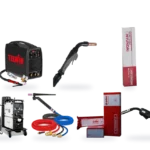






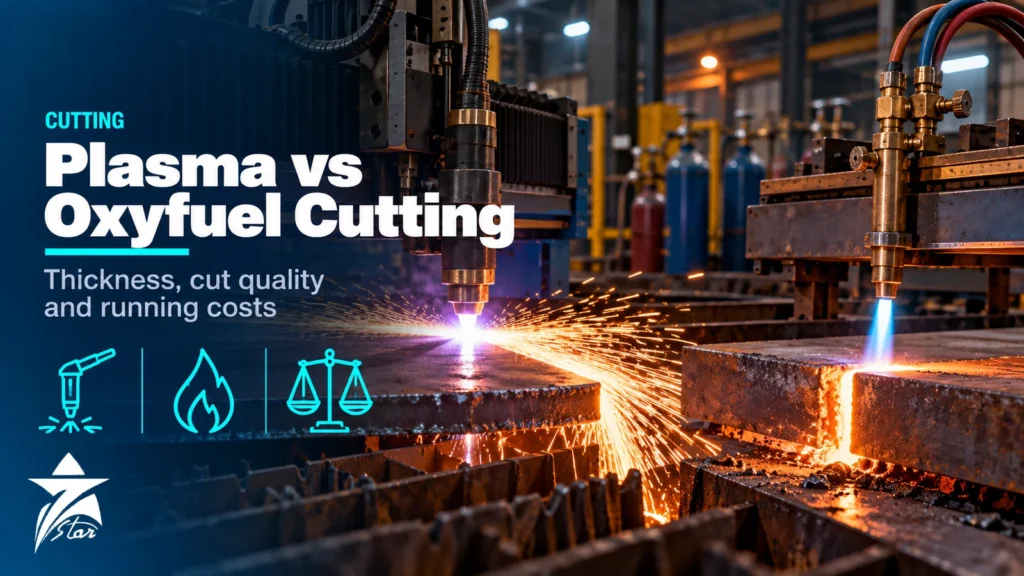
Every fabrication shop and maintenance crew eventually faces the same decision when replacing or adding cutting capacity: buy another oxy-fuel set or move to plasma. The answer to plasma vs oxyfuel cutting is rarely one or the other for the whole shop. It depends on the metals you cut, the thickness mix, how the edge will be used afterwards, where the work happens and how much grinding you are prepared to pay for. This guide compares the two processes the way a workshop engineer would: how each one cuts, the thickness ranges where each makes sense, edge quality and heat-affected zone, the real cost drivers, the safety hazards specific to each, and what to specify when you request equipment.
How Oxy-Fuel Cutting Works
Oxy-fuel cutting is a chemical process, not a melting process. A preheat flame of fuel gas and oxygen raises the steel surface to its ignition temperature, a bright red heat well below the melting point. A jet of high-purity oxygen is then directed at the hot spot, the iron oxidises rapidly in an exothermic reaction, and the molten oxide is blown out of the kerf. The reaction itself supplies much of the heat, which is why oxy-fuel can cut very thick sections with modest equipment.
That chemistry also defines its limits. The process only works when the metal ignites below its melting point and its oxide melts at a lower temperature than the base metal and flows freely. Carbon and low-alloy steels meet these conditions; stainless steel, aluminium, copper and cast iron do not, because they form refractory oxides or melt before they burn. Fuel gas choice (acetylene, propane, propylene or natural gas) affects preheat time, piercing speed and running cost, while the cutting oxygen purity strongly affects speed and edge quality.
How Plasma Cutting Works
A plasma cutter passes a gas through a constricted nozzle and strikes an electric arc between an electrode in the torch and the workpiece. The arc ionises the gas into plasma, an extremely hot, high-velocity jet that melts the metal and blows it out of the kerf. Because the process melts rather than burns, it cuts any electrically conductive metal: carbon steel, stainless steel, aluminium, copper alloys and more.
Plasma gas selection matters:
- Compressed air is the standard for handheld and general-purpose systems and works acceptably on all common metals.
- Oxygen plasma on mechanised systems gives the best edge on carbon steel, with less dross and a more weldable edge.
- Nitrogen and argon-hydrogen mixtures are used for stainless steel and aluminium where edge appearance and oxidation matter.
Consumables (electrode, nozzle, swirl ring, retaining cap and shield) wear with every arc start and every minute of cutting, and their condition largely decides cut quality.
Plasma vs Oxyfuel Cutting: Side-by-Side Comparison
| Factor | Plasma | Oxy-fuel |
|---|---|---|
| Cutting principle | Melting by electric arc and plasma jet | Oxidation of iron by oxygen jet after preheat |
| Metals | Any electrically conductive metal | Carbon and low-alloy steel only |
| Typical sweet spot | Thin sheet up to roughly 25–50 mm, depending on amperage | Medium to very thick carbon steel, from roughly 25 mm upwards |
| Maximum thickness | Limited by system amperage; manufacturers rate pierce and severance capacity | Very high; large tips cut sections hundreds of millimetres thick |
| Speed on thin and medium plate | Much faster | Slow; preheat time dominates |
| Kerf width | Narrower | Wider |
| Heat-affected zone | Narrower | Wider |
| Edge angle | Slight bevel, often a few degrees, worse on one side | Square on thick plate when tip, speed and height are correct |
| Distortion on thin sheet | Low | High |
| Utilities | Electrical supply and clean, dry compressed air or gases | Oxygen and fuel gas cylinders or bulk supply; no electricity needed |
| Portability | Needs power; generators or engine-driven units on site | Fully portable; works anywhere cylinders can go |
| Multiple torches on one gantry | Possible but costly (one power source per torch) | Common and economical on thick plate |
| Capital cost | Higher | Lower |
The thickness boundaries above are typical rather than fixed. A high-amperage mechanised plasma system moves the crossover upward, while a well-tuned multi-torch oxy-fuel gantry remains hard to beat on thick structural plate.
Thickness Ranges and Rated Capacity
Plasma manufacturers usually publish three figures for a power source, and confusing them is a common purchasing mistake:
- Recommended or production cut capacity: the thickness the system cuts at a useful speed with good quality, day after day.
- Maximum cut or pierce capacity: the thickest plate it can pierce from the middle of a sheet.
- Severance capacity: the thickest plate it can separate from an edge start at very low speed, with poor quality. Treat this as an emergency figure, not a design figure.
Size the plasma system on the production figure for the thickness you cut most often, then check that the severance figure covers the occasional thick part. For oxy-fuel, the limiting factors are tip size, oxygen flow and pressure available from your supply, and whether preheat can be maintained through the full thickness.
Cut Quality, Edge Condition and What Happens After Cutting
ISO 9013 classifies thermal cuts by perpendicularity or angularity tolerance and by surface roughness, giving buyers and fabricators a common language for specifying edge quality. In practice, three edge issues drive the choice:
- Bevel and squareness. Plasma edges carry a small bevel; with a standard swirl direction one side of the cut is squarer than the other, so direction of travel matters for the part being kept. Oxy-fuel produces square edges on thick plate when set correctly.
- Dross. Both processes leave dross when speed, current or height are wrong. Low-speed dross on plasma and slag adhering to oxy-fuel cuts both cost grinding time.
- Weldability of the edge. Edges that will be welded directly need to be free of oxide, dross and hardened layers. Air or nitrogen plasma on carbon steel can leave a nitrogen-affected surface that may cause porosity, so many fabricators grind such edges or use oxygen plasma. Oxy-fuel edges on hardenable steels can develop a hard surface layer that needs grinding or preheat consideration before welding.
For pipe end preparation, dedicated pipe cutting and bevelling machines give repeatable bevel angles and root faces, and many use either an oxy-fuel or a plasma torch on a guided carriage instead of freehand cutting.
Operating Cost Drivers
Purchase price is only a small part of the decision. The cost per metre of finished edge depends on:
- Cutting speed and therefore labour time per part, where plasma has a large advantage on thin and medium plate.
- Consumables: plasma electrodes and nozzles versus oxy-fuel tips, both strongly affected by operator technique and pierce count.
- Gases: cutting oxygen and fuel gas for oxy-fuel; compressed air, oxygen or specialty gases for plasma.
- Electricity, including generator fuel on remote sites.
- Secondary operations: grinding of dross, bevel correction and edge cleaning before welding.
- Scrap from distortion on thin sheet, which oxy-fuel causes more readily.
Track consumable life and grinding hours for a few weeks before a purchase decision; those numbers usually settle the argument better than catalogue cut speeds.
Safety: Different Processes, Different Hazards
Oxy-fuel hazards
- Flashback and backfire: fit flashback arrestors and non-return valves at the regulator and torch, and follow ISO 5175 or the equivalent national standard for safety devices.
- Acetylene must not be used at pressures above about 1 bar (15 psig) because it becomes unstable.
- Oil and grease near oxygen fittings can ignite violently; keep regulators, hoses and hands clean.
- Cylinders must be secured upright, protected from heat and transported with caps fitted.
- Hoses should be inspected for cuts and burns and replaced, never taped.
Plasma hazards
- High open-circuit voltage: never change consumables with the system energised, and keep torch leads intact.
- Intense ultraviolet radiation; high-amperage systems can also produce noise levels that require hearing protection.
- Fumes, especially from stainless steel and coated material, call for extraction, downdraft or water tables, and suitable respiratory protection.
Lens shade depends on process and current. OSHA’s table sets minimum shade 8 for plasma cutting below 300 A, rising to 9 and 10 at higher currents, and minimum shades of 3 to 5 for oxygen cutting depending on plate thickness; ANSI Z49.1 and AWS guidance recommend one shade darker for gas cutting. Choose welding helmets and face protection that cover the full current range your operators use.
GCC Site Conditions
Field work in Oman and the GCC changes the balance in several ways. Plasma quality and consumable life depend on clean, dry compressed air, and coastal humidity plus fine dust quickly load air lines with water and particles; a refrigerated or desiccant dryer and a coalescing filter ahead of the plasma unit are not optional. Power sources and compressors installed in direct sun at high ambient temperatures may derate, so shading and ventilation matter. Oxy-fuel cylinders, particularly acetylene, must be stored shaded and ventilated, away from heat sources, with storage separation between oxygen and fuel gas. On remote pipeline and well-site work without reliable power, oxy-fuel remains the simplest option, although engine-driven welder-generators can power smaller plasma units.
Specifying Cutting Equipment
Before requesting quotations for plasma cutting systems or oxy-fuel cutting equipment, gather:
- Metals to be cut and the thickness distribution (most frequent, maximum, occasional).
- Handheld, portable track-guided or CNC mechanised operation.
- Required edge quality and whether edges are welded without grinding.
- Available power supply (voltage, phase, generator capacity) and compressed air quality.
- Fuel gas preference and supply method for oxy-fuel (cylinders, manifolds or bulk).
- Torch lead length, duty cycle and environment (shop, open yard, offshore, confined space).
- Existing torch, regulator and consumable part numbers if matching current equipment.
Common Mistakes
- Buying a plasma system on its severance rating and then cutting production thickness at that limit.
- Running plasma on wet compressed air and blaming the consumables.
- Using worn plasma nozzles until the arc gouges, ruining both edge and electrode.
- Wrong oxy-fuel tip size or dirty tips causing wide kerfs and slag.
- Attempting to cut stainless steel or aluminium with standard oxy-fuel equipment.
- Neglecting fume extraction because the work is outdoors.
Plasma vs Oxyfuel Cutting Decision Checklist
- Mostly non-ferrous or stainless material: plasma.
- Mostly carbon steel under about 25 mm with high volume: plasma, usually mechanised.
- Mostly carbon steel over about 50 mm, or many identical thick parts: oxy-fuel, often multi-torch.
- Remote work without power: oxy-fuel, or plasma on an engine-driven supply.
- Edges to be welded without grinding: oxygen plasma or properly set oxy-fuel, verified by trial cuts.
- Mixed work: keep both; they complement rather than replace each other.
Cutting Equipment We Supply
These examples cover plasma and oxy-fuel cutting.
| Product | Type | Where it fits |
|---|---|---|
| Hypertherm Powermax45 SYNC Plasma Cutting System | Portable plasma cutting system | Thin plate. |
| Hypertherm Powermax105 SYNC Plasma Cutting System | Plasma cutting system | Thicker plate. |
| Hypertherm XPR300 X-Definition Mechanized Plasma Cutting System | Mechanized plasma cutting system | CNC cutting tables. |
| Koike Aronson IK-12 Beetle Portable Oxy-Fuel Cutting Machine | Portable oxy-fuel cutting machine | Straight cuts and bevels. |
| GCE X511 Original 0767691 Oxy-Fuel Cutting Torch | Oxy-fuel cutting torch | Manual cutting. |
| GCE SAFE-GUARD-5 Flashback Arrestor | Flashback arrestor | Gas safety on oxy-fuel equipment. |
Send the material, thickness and cutting volume through our quote request form.
Sourcing Plasma and Oxy-Fuel Cutting Equipment Through Seven Star LLC
Seven Star LLC supplies plasma power sources, torches and consumables, oxy-fuel torches, regulators, flashback arrestors and hoses, and guided cutting and bevelling machines on request for workshops and site teams across Oman and the GCC. We help with selection and with cross-checking consumable and torch part numbers against your existing equipment; availability and lead time are confirmed at quotation.
Comparing plasma and oxy-fuel for your next project? Send us your material and thickness range, the nameplate of your current cutter or your consumable part numbers, and we will return a matched RFQ response for plasma or oxy-fuel cutting equipment.
Frequently asked questions
Can oxy-fuel cut stainless steel or aluminium?
No, not in normal practice. Oxy-fuel cutting relies on the metal burning in oxygen and its oxide flowing out of the kerf, and stainless steel and aluminium form refractory oxides that block the reaction. Plasma is the usual thermal process for these metals.
At what thickness is oxy-fuel better than plasma?
There is no single figure; it depends on plasma amperage and the oxy-fuel set-up. As a typical guide, plasma is faster on carbon steel up to roughly 25 mm and often up to about 50 mm on high-current systems, while oxy-fuel becomes more economical on thicker plate, especially with several torches on one gantry.
Why does a plasma cut have a bevel on one side?
The plasma gas swirls through the nozzle, so the arc removes metal slightly unevenly across the kerf. One side is squarer than the other, which is why the direction of travel should keep the good side on the finished part. Worn consumables and wrong torch height increase the bevel.
What is the difference between plasma cut capacity and severance capacity?
Production or recommended capacity is the thickness the system cuts at practical speed with acceptable quality. Severance capacity is the maximum thickness it can separate from an edge start at very low speed with poor quality. Size equipment on the production figure.
Can plasma-cut edges be welded without grinding?
Sometimes, if the edge is clean, dross-free and the process is suitable. Air or nitrogen plasma on carbon steel can leave a nitrided surface that may cause weld porosity, so many fabricators grind or use oxygen plasma. Qualify the practice with trial welds under your WPS.
What shade lens is needed for plasma cutting?
OSHA sets a minimum shade 8 for plasma cutting below 300 A, shade 9 for 300–400 A and shade 10 for 400–800 A. Start darker and go lighter only as far as the minimum while keeping a clear view of the cut.
Was this guide helpful?One click helps us write better guides for engineers.
Thank you! Glad it helped. Need this equipment for your project? Request a quotation
Thank you. We will use this to improve the guide.