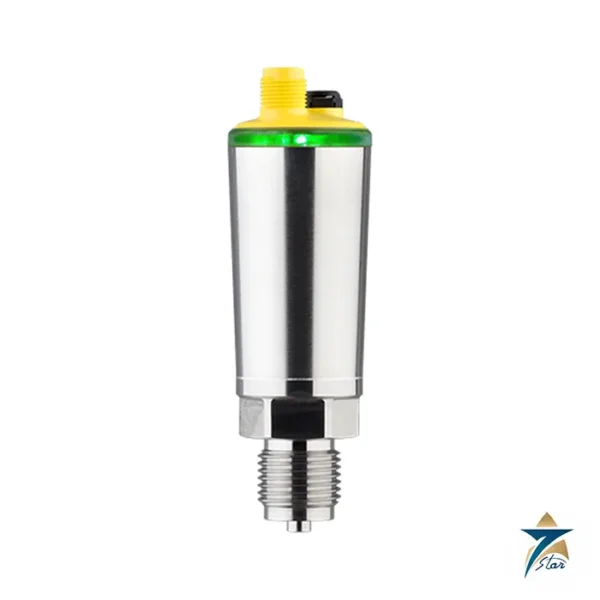
The display version of the metallic-cell range, up to 1000 bar
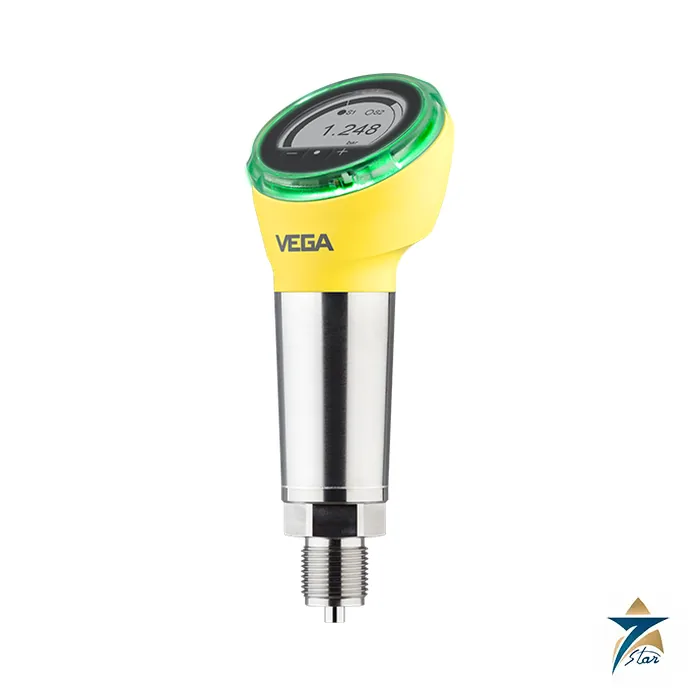
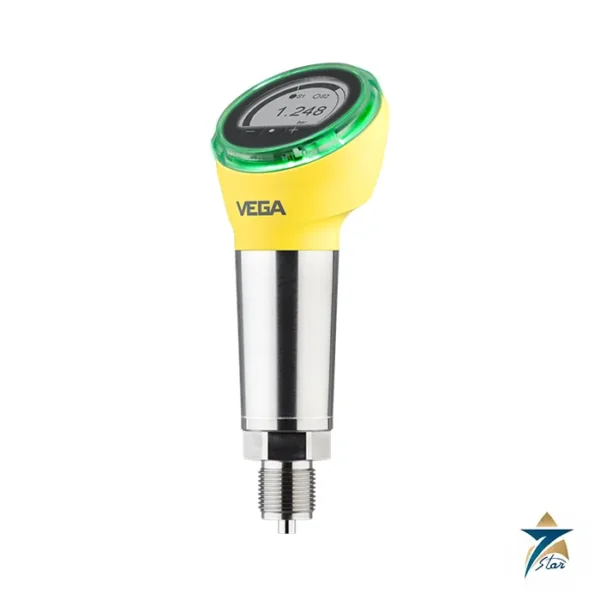
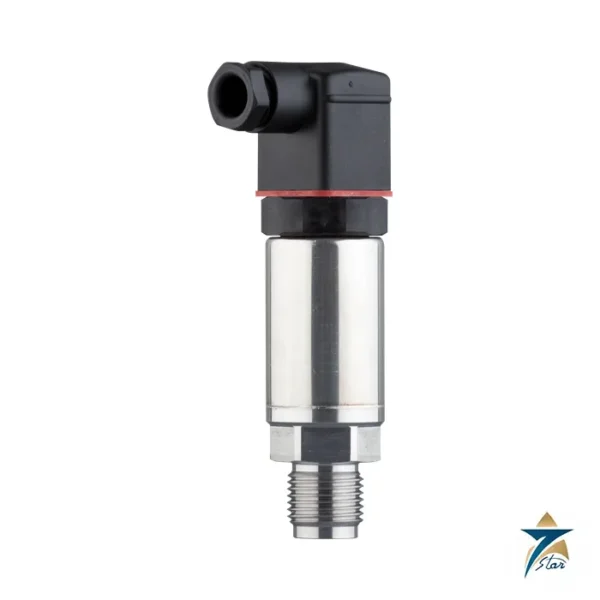
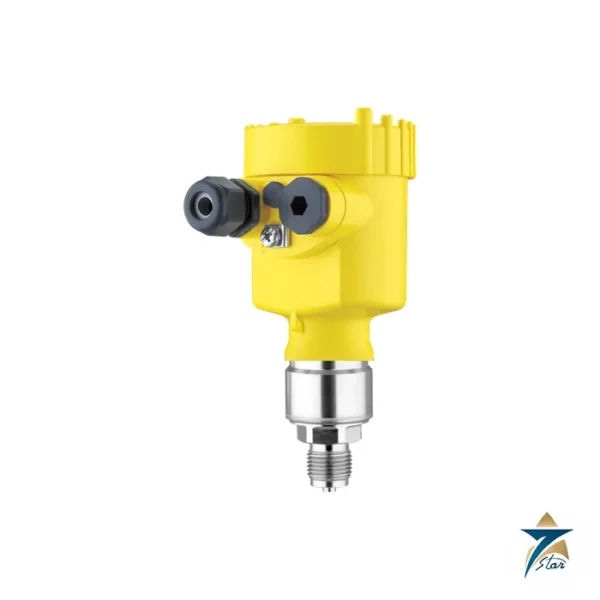
The VEGABAR 39 is the top of VEGA’s compact pressure range: a welded 316L metallic cell with synthetic-oil fill, ranges up to 1000 bar, deviation below 0.3 %, and an integrated display with on-site adjustment plus a 360° coloured status ring. Bluetooth 5.0 allows wireless setup and diagnostics, and an optional universal connection takes hygienic adapters. The sheet describes it as measuring gases, vapours and liquids, including aggressive ones, with high accuracy even where robustness and hygiene requirements are high, and it supports IO-Link communication in its three-wire version.
Technical specifications
| Parameter |
Specification |
| Type |
VEGABAR 39, pressure sensor with metallic cell, display and switching function |
| Measuring range |
-1…+1000 bar (-100 kPa…+100 MPa); smallest span 0.4 bar |
| Deviation |
< 0.3 % |
| Output signal |
Two-wire 4…20 mA; three-wire IO-Link, 4…20 mA and transistor |
| Process fitting |
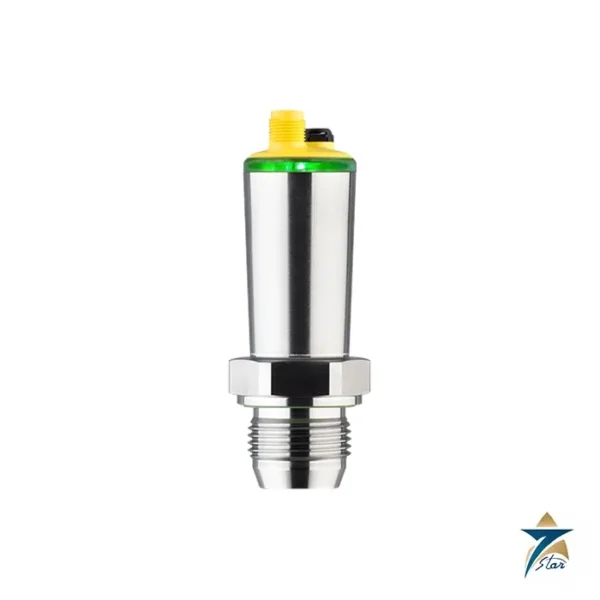
Thread from G¼, ¼ NPT; hygienic fittings |
| Process temperature |
-40…+130 °C; SIP +150 °C with brief vapour stratification |
| Ambient, storage, transport |
-40…+70 °C |
| Bluetooth |
Bluetooth 5.0, typically 25 m |
| Operating voltage |
12…35 V DC |
| Protection rating |
Up to IP66/IP67; up to Type 6P NEMA/UL 50E |
| Wetted parts, seals |
316L; Klingersil C-4400, EPDM or FKM by fitting |
| Housing |
Stainless steel 316L and plastic PBT |
High pressure with local indication
For hydraulic units, test benches and injection lines that run to several hundred bar, the 39 pairs the high range with a legible local display, which VEGA’s overview ties to the VDMA menu structure. The 10 series 19 reaches only 100 bar and has no display, while the ceramic 38 stops at 60 bar. Every VEGABAR 30 series sensor can be integrated through IO-Link, which the sheet cites as an easy integration path into control systems.
Specification pointers
Quote the pressure range with the unit and overload need, the process fitting and seal, and the connector type. The sensor has no Ex approval in the sheet itself: approvals including ATEX/IEC, c-UL-us, EAC and others are listed as available or applied for in the product information, so declare your hazardous-area requirement in the RFQ and confirm the marking with the manufacturer before ordering.
Because the metallic cell is completely welded, there is no elastomer in the pressure path, which is why the 39 and its 29 sibling are the ones to consider for aggressive products and for very high pressure. VEGA’s documentation notes that wetted parts and the process seal depend on the process fitting (Klingersil C-4400, EPDM or FKM), so the seal is chosen by fitting rather than by pressure range. Check overpressure and burst limits in the operating instructions for your range.
Selecting the right VEGABAR 39 configuration
Start the selection with the process rather than the catalogue. Establish the normal operating pressure, the highest pressure the line can reach during start-up or pump trips, and whether the medium is a gas, vapour or liquid. With those values in hand, choose a measuring range that keeps the normal reading well inside the span instead of at its upper edge, which gives better resolution on the local display and leaves headroom for transients. Then confirm the process fitting that matches the existing tapping point, and decide which seal material from the listed options suits the medium chemically.
The second decision is the electrical interface. The two-wire 4…20 mA version suits a conventional loop to a PLC or DCS analogue input, while the three-wire version adds IO-Link and a transistor output, which is useful where the sensor should also act as a local switch or where the plant already uses IO-Link masters. Choosing between them early avoids rewiring later.
Installation and commissioning guidance
- Mount the transmitter where the display can be read safely during rounds, and where the housing is not exposed to direct mechanical impact.
- On liquid lines, avoid tapping from the top of the pipe where gas can collect; on gas lines, avoid the bottom where condensate can settle.
- Tighten the process connection using the correct tool on the hexagon, never by turning the housing.
- Check the supply voltage at the terminals against the stated operating range before energising the loop.
- Use Bluetooth setup to enter the range and switching settings from a safe distance, then verify the reading against a reference gauge before handing over to operations.
- Record the final configuration so a replacement unit can be set up identically.
Operation in GCC plant conditions
Outdoor installations in Oman and the wider Gulf combine high ambient temperature, strong solar load, fine dust and, near the coast, humid salt-laden air. Keep the ambient figure on this page in mind when placing the sensor close to hot equipment or on uninsulated piping in direct sun; shading the instrument from direct sun helps keep the housing cooler. The stainless steel housing option is generally the better choice for coastal and washdown locations, while cable entries should face downward and be properly sealed so that dust and moisture cannot track into the electronics.
Where the process runs close to the upper process temperature, consider the length and routing of the impulse connection so that heat is not transferred directly to the sensor. For hygienic applications with steam cleaning, stay within the SIP figure stated in the specifications.
Routine checks and what to put in your RFQ
Periodic maintenance is mainly a matter of inspection: confirm the display and status ring show a healthy state, compare the reading with a calibrated reference at sensible intervals, and look for corrosion or leakage at the process fitting. Diagnostics over Bluetooth can help an instrument technician review the condition without opening the housing.
For a fast and accurate quotation, include the measuring range and unit, the process fitting, the preferred seal material, the output version (two-wire or three-wire with IO-Link), housing material, required protection rating, any hazardous-area or hygienic approval, the tag numbers and the quantity. If you are replacing an existing transmitter, a photo of its nameplate is the quickest way to match the order code.
Documents and quotation
The official VEGA VEGABAR 39 (two-wire 4…20 mA) specification sheet (57099-EN, version 230314) is attached to this page for download and covers the technical data, dimensions and wiring summarised above.
To order, send the required version, process data and quantity and we will quote it. We supply from Muscat as an independent company; further level instrumentation is available on this site. Check approvals, materials and the full order code with the maker before committing to a purchase.











Reviews
There are no reviews yet.