- Automation & ControlView all 1,608 products
- AC Drives
- Industrial Communications
- PLC & I/O Cards
- Vibration Monitoring
- Automation Accessories
- Controllers & Data Acquisition
- CCTV & Security
- Safety Switches & Guard Locking
- Encoders
- Industrial Computers
- Servo Drives
- Motor Soft Starters
- HMI Displays
- Pneumatic Cylinders
- Isolator & Barrier
- Automation Software
- Machine Vision
- Robotics
















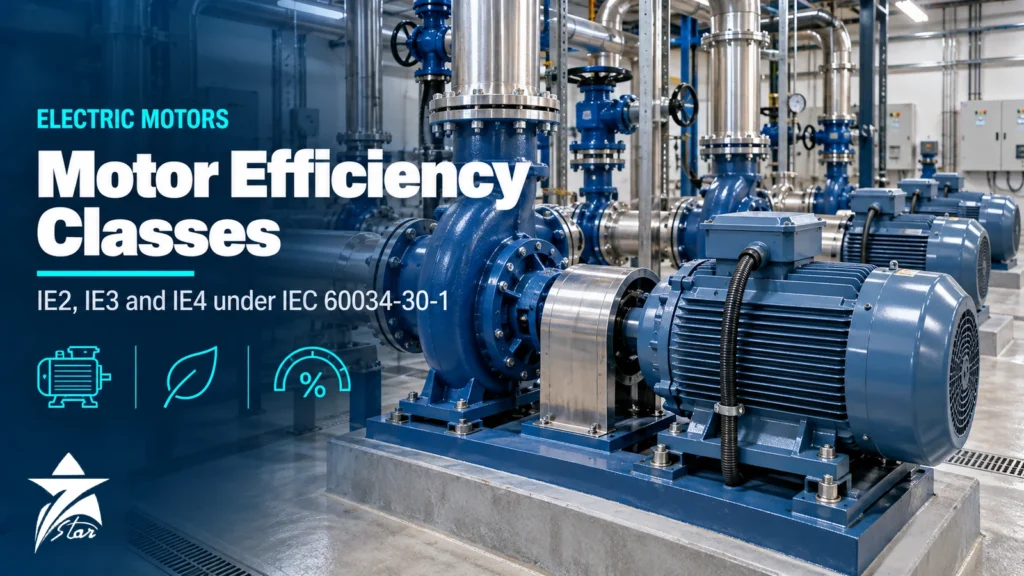
Electric motors drive most of the pumps, fans and compressors in an industrial plant, and over a typical service life the electricity they consume costs far more than the motor itself. Choosing the right efficiency level is therefore one of the simplest ways to cut operating cost. The international system of motor efficiency classes defined in IEC 60034-30-1 gives buyers a common language, from IE1 up to IE4, for comparing motors from any manufacturer. This guide explains what the classes mean, how the values compare, where regulations require them, and how to select motors for pumps and fans, including the effect of hot GCC conditions and variable speed drives.
What IEC 60034-30-1 Covers
IEC 60034-30-1 classifies the efficiency of line-operated AC motors, meaning motors designed to run directly from the supply rather than only from a converter. The current edition covers:
- Rated output from 0.12 kW to 1000 kW.
- 2, 4, 6 and 8 pole motors.
- Rated voltage from 50 V up to 1 kV, at 50 Hz and 60 Hz.
- Single-phase and three-phase motors, including those for continuous duty in ambient temperatures from -20 °C to +60 °C and altitudes up to 4000 m.
- Motors in increased-safety and flameproof designs, where the efficiency is still classified.
Exclusions include motors with 10 or more poles, multi-speed motors, motors made solely for converter operation, and motors fully integrated into a machine so that they cannot be tested separately. Efficiency is determined by the test methods of IEC 60034-2-1, and the IE class and nominal efficiency appear on the rating plate.
Motor Efficiency Classes Explained
- IE1 (standard efficiency): the baseline class, largely phased out for new motors in regulated markets.
- IE2 (high efficiency): still common in many regions and on motors used with variable speed drives under some regulations.
- IE3 (premium efficiency): the minimum for most new motors in the EU and many other markets.
- IE4 (super premium efficiency): required for some power ranges in the EU and increasingly used for long-running pumps and fans.
- IE5 (ultra premium efficiency): referenced in IEC TS 60034-30-2 for converter-fed motors such as synchronous reluctance and permanent magnet designs, rather than in IEC 60034-30-1 itself.
Minimum Efficiency Values Compared
The table shows the minimum nominal efficiencies for 4-pole, 50 Hz motors under IEC 60034-30-1. Differences of one or two percentage points look small, but at large ratings and long running hours they add up to significant energy savings.
| Rated output (kW) | IE1 (%) | IE2 (%) | IE3 (%) | IE4 (%) |
|---|---|---|---|---|
| 1.1 | 75.0 | 81.4 | 84.1 | 87.2 |
| 7.5 | 86.0 | 88.7 | 90.4 | 92.6 |
| 11 | 87.6 | 89.8 | 91.4 | 93.3 |
| 37 | 91.2 | 92.7 | 93.9 | 95.2 |
| 75 | 92.7 | 94.0 | 95.0 | 96.0 |
| 110 | 93.3 | 94.5 | 95.4 | 96.3 |
Note how the gap between classes is widest at small ratings. Moving a 1.1 kW motor from IE2 to IE4 cuts its losses by roughly a third; for a 110 kW motor, the losses fall from about 5.5% to 3.7% of input power. Because losses become heat, more efficient motors also tend to run cooler, which helps insulation and bearing life.
Regulations Driving Motor Efficiency Classes
Many countries set minimum energy performance standards for motors based on the IE classes. In the European Union, Regulation (EU) 2019/1781, as amended, requires IE3 for most three-phase motors from 0.75 kW to 1000 kW since July 2021, and IE4 for 2, 4 and 6 pole motors from 75 kW to 200 kW since July 2023, with exceptions such as brake motors and certain explosion-protected designs. The same regulation sets efficiency classes for variable speed drives.
Several GCC countries have introduced or are developing motor efficiency requirements through their national standards and energy efficiency programmes. The applicable class, scope and labelling or registration rules differ between countries and change over time, so check the current requirement with the relevant national authority or project specification before ordering motors for import.
Motor Selection for Pumps
Pumps are the largest single group of motor applications in water, oil and gas and process plants. Motor efficiency is only one part of the system; pump selection and control usually have a larger effect.
- Size to the duty point, not the catalogue maximum: a motor running at 50% load or less loses efficiency and power factor. Allow a sensible margin for the pump’s end-of-curve power and future impeller changes, but avoid stacking several safety factors.
- Choose the pump near its best efficiency point: a high-efficiency motor driving a pump that operates far from its BEP still wastes energy.
- Use a drive for variable flow: throttling a valve or recirculating flow wastes energy that speed control can save.
- Match speed and poles: 2-pole motors for high-head pumps, 4-pole for most general duties; a different pole number changes the pump’s whole operating curve.
- Check starting: the motor must accelerate the pump against its load torque on the available starting method.
Browse pumps and electric motors together when planning a replacement, because the motor frame, shaft and flange must match the pump coupling arrangement.
Motor Selection for Fans and Blowers
Fans, like centrifugal pumps, follow the affinity laws: flow is proportional to speed, pressure to the square of speed, and power to the cube of speed. Reducing speed by 20% reduces the theoretical power demand by about half. That is why AC drives often save more energy on fans and pumps than any upgrade in motor class, and why the combination of a drive and an IE3 or IE4 motor is common in HVAC, cooling tower and process ventilation applications.
Fans with high inertia, such as large induced-draft fans, need careful checking of acceleration time and motor thermal capacity during starting. Belt-driven fans need attention to belt tension and pulley alignment, because belt losses can outweigh the gain from a higher motor class.
Using High-Efficiency Motors with Variable Speed Drives
IE classes apply to sine-wave supply. When fed from a drive, a motor has additional losses due to harmonics in the output waveform, and its efficiency at reduced speed is lower than its nameplate value. IEC 60034-2-3 and IEC TS 60034-30-2 address converter-fed motors, and IEC 61800-9-2 defines efficiency classes for drives (IE0 to IE2) and complete power drive systems (IES0 to IES2).
- Confirm the motor is suitable for converter supply, particularly insulation for voltage peaks on longer cables.
- Consider insulated bearings or shaft grounding on larger motors to prevent bearing currents.
- Check cooling at low speed for self-ventilated motors driving constant-torque loads.
- Consider synchronous reluctance or permanent magnet motors where very high part-load efficiency is valuable.
Our guide to VFD selection in hot climates covers drive sizing, derating and motor protection in more detail.
Heat, Altitude and Starting Current in GCC Conditions
Under IEC 60034-1 a motor’s rated output normally applies at a coolant (ambient) temperature up to 40 °C and an altitude up to 1000 m. GCC sites regularly exceed 40 °C, and outdoor motors in direct sun or in poorly ventilated pump houses see even higher temperatures. For 45 or 50 °C ambient, either specify a motor rated for that temperature or apply the manufacturer’s derating factor, which may mean selecting the next frame size.
High-efficiency motors often have lower rotor resistance, which can raise locked-rotor current and slightly increase full-load speed. When upgrading from IE1 or IE2 to IE3 or IE4, check:
- Starting current against breaker, overload and fuse settings to avoid nuisance trips.
- Voltage dip on generator or weak supplies during direct-on-line starting.
- Pump or fan power at the slightly higher speed, which can offset part of the efficiency gain.
- Frame size, shaft height and mounting dimensions for direct replacement.
Life-Cycle Cost Thinking
Purchase price is a small share of a motor’s life-cycle cost for any motor running many hours per year. To compare options, estimate annual running hours, average load, electricity cost and expected life, then calculate the energy cost of each option from its efficiency at the actual load point. Motors running continuously on critical pumps and fans usually justify the highest practical class; motors running a few hours per week rarely do.
Rewind or Replace?
When a motor fails, the choice between rewinding and replacing deserves a quick calculation rather than a habit. A good-quality rewind carried out to recognised repair practice can retain the original efficiency, but a poor rewind, especially one where the stator core was overheated during stripping, can increase losses permanently. For older IE1 or unclassified motors, replacement with an IE3 or IE4 motor often pays back through energy savings, particularly on long-running duties. For large or special motors with long lead times, a rewind may still be the practical choice, and keeping a spare motor for critical pumps and fans avoids making the decision under time pressure.
Reading the Motor Nameplate
The rating plate holds most of the data needed to confirm efficiency and find a replacement. Look for the following items:
- IE class and nominal efficiency at full load, and on many motors at 75% and 50% load.
- Rated power, voltage, frequency, current, speed and power factor.
- Frame size, mounting arrangement (for example B3 foot or B5 flange) and degree of protection.
- Insulation class and the permitted ambient temperature and altitude, if different from the standard.
- Duty type, usually S1 for continuous running, and service factor where stated.
- Hazardous area marking for motors in classified zones.
Motor Selection Checklist
- Driven equipment, load torque and duty point.
- Required power with a justified margin, and actual expected load.
- Supply voltage, frequency, and starting method.
- Required IE class from regulation or project specification.
- Ambient temperature, altitude and enclosure protection (IP rating).
- Hazardous area requirements, if any.
- Converter operation, insulation and bearing protection needs.
- Frame size, mounting and shaft details for replacement.
Motors and Drives We Supply
These products cover the efficiency classes discussed above, plus a variable speed drive for duties where speed control saves more energy than a better motor.
| Product | Type | Where it fits |
|---|---|---|
| WEG W22 IE3 5.5kW 4P 132S Three-Phase Motor | IE3 three-phase motor | General pumps, fans and conveyors. |
| JIE JD Motor IE3 Three-Phase Asynchronous Motor | IE3 asynchronous motor | General industrial drives. |
| CEMP E3A/E4A Series Flameproof Motors Ex db IE3 IE4 | Flameproof IE3 and IE4 motors | Hazardous areas in oil, gas and chemical plants. |
| CEMP TerraMAX TC Series Motors TCN TCT TCE IE3 IE4 | IE3 and IE4 motors | Industrial drives where higher efficiency pays back. |
| ABB ACS580 General Purpose Variable Frequency Drive (VFD) | Variable frequency drive | Pumps and fans where the flow demand varies. |
For a replacement motor, send the nameplate, mounting and frame size. For a new duty, send the power, speed and site conditions through our quote request form.
Sourcing High-Efficiency Motors Through Seven Star LLC
Seven Star LLC supplies IE2, IE3 and IE4 motors and related motors, pumps and drives on request for industrial users in Oman and the GCC. We help with selection and cross-checking part numbers, frame sizes and nameplate data when replacing existing motors. Availability and lead time are confirmed at quotation.
Send a photo of the existing motor nameplate, or your motor datasheet and RFQ with kW, poles, voltage, mounting and IE class, and we will return a matched quotation.
Frequently asked questions
What is the difference between IE2, IE3 and IE4 motors?
They are efficiency classes defined in IEC 60034-30-1. IE2 is high efficiency, IE3 premium efficiency and IE4 super premium efficiency. Each step has higher minimum efficiency values for a given power and pole number; for example, a 4-pole 11 kW motor must reach 89.8% for IE2, 91.4% for IE3 and 93.3% for IE4.
Is IE3 mandatory?
In the European Union, IE3 has been the minimum for most three-phase motors from 0.75 to 1000 kW since July 2021, with IE4 required for 75 to 200 kW motors since July 2023. Other countries, including several in the GCC, have their own rules, so the requirement must be checked for each country and project.
Can an IE3 motor directly replace an IE1 or IE2 motor?
Usually, but check frame size, shaft and mounting dimensions, starting current and speed. High-efficiency motors can have higher locked-rotor current and slightly higher full-load speed, which may affect protection settings and the power drawn by pumps and fans.
Do IE classes apply to motors used with VFDs?
IE classes in IEC 60034-30-1 are measured on sine-wave supply. On a drive, extra harmonic losses occur. Converter-fed motors are addressed by IEC TS 60034-30-2, and drive and system efficiency classes are defined in IEC 61800-9-2.
How does ambient temperature affect motor rating?
IEC 60034-1 rates motors for ambient temperatures up to 40 °C and altitudes up to 1000 m unless otherwise stated. At higher temperatures, common in the GCC, the motor must be derated according to the manufacturer's data or specified for the actual ambient temperature.
Is a higher efficiency motor or a VFD better for saving energy on pumps?
For pumps and fans with variable demand, a drive usually saves more because power falls with the cube of speed. A higher efficiency motor saves energy at every operating point. The best results generally come from combining a correctly sized motor, a drive and a pump or fan selected near its best efficiency point.
Was this guide helpful?One click helps us write better guides for engineers.
Thank you! Glad it helped. Need this equipment for your project? Request a quotation
Thank you. We will use this to improve the guide.