- Automation & ControlView all 1,712 products
- AC Drives
- Industrial Communications
- PLC & I/O Cards
- Vibration Monitoring
- Automation Accessories
- Controllers & Data Acquisition
- CCTV & Security
- Safety Switches & Guard Locking
- Encoders
- Isolator & Barrier
- Industrial Computers
- Servo Drives
- Motor Soft Starters
- HMI Displays
- Pneumatic Cylinders
- Automation Software
- Machine Vision
- Robotics
















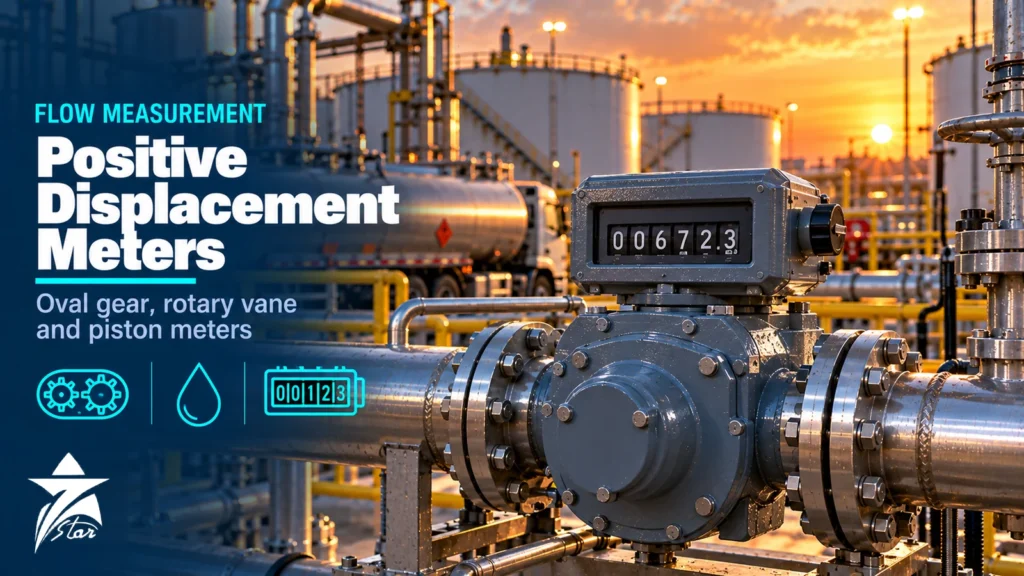
When the fluid is thick, the flow is low and the reading has to match a bill or a batch, many engineers still choose a meter that counts volume mechanically. A positive displacement flow meter traps fixed parcels of liquid between moving parts and the meter body, then counts how many parcels pass. Unlike velocity meters, it does not depend on the flow profile, and its accuracy usually improves as viscosity rises. That makes PD meters a natural choice for fuel oil, lube oil, hydraulic oil, bitumen, crude, chemical dosing and vehicle and marine fuelling. This guide compares the main designs, explains why viscosity helps rather than hurts, and covers accuracy, wear, filtration and installation.
How Positive Displacement Meters Measure Flow
Every PD meter has a measuring chamber of known volume and one or more moving elements, such as gears, vanes, pistons or lobes, that fill and empty that chamber as the liquid pushes through. Each revolution or stroke transfers a fixed volume from inlet to outlet. A register or pulse sensor counts the movements, so total volume equals the displaced volume per cycle multiplied by the number of cycles.
Because the measurement is mechanical, the meter is largely insensitive to upstream piping, swirl or Reynolds number. Straight-run requirements are minimal, which is useful on compact skids and dispensing systems.
The main error source is slippage: a small amount of liquid leaks through the clearances between the moving parts and the chamber without being counted. Slippage depends on clearance size, pressure drop across the meter and viscosity. It is the key to understanding both the strengths and limits of PD meters.
Main Types of PD Meters
Oval Gear
Two oval-shaped gears mesh and rotate as liquid flows, each half-turn sweeping a fixed volume between the gear and the chamber wall. Oval gear meters are compact, handle a wide viscosity range and are widely used for fuels, oils, chemicals and dosing. Magnets in the gears with a reed switch or Hall-effect sensor give a pulse output.
Rotary Vane
A rotor carrying sliding vanes turns inside a cylindrical housing. The vanes form measuring compartments that carry liquid from inlet to outlet. Rotary vane meters are a long-standing choice for refined petroleum products, truck loading and aviation fuel, and they are often used with mechanical registers, temperature compensation and ticket printers.
Oscillating and Reciprocating Piston
In an oscillating piston meter, a cylindrical piston orbits within a chamber, sweeping a fixed volume each cycle. These meters are common in water metering and for small flows of oils and chemicals. Reciprocating piston meters, with pistons moving back and forth in cylinders, are used on very low flows and high-accuracy dispensing.
Other Designs
Bi-rotor (helical or spur lobe) meters are used at larger capacities for crude and refined product custody service. Helical screw meters handle high-viscosity products with low pulsation. Nutating disc meters are mostly used for water.
Comparing the Main PD Designs
| Design | Typical liquids | Strengths | Watch points |
|---|---|---|---|
| Oval gear | Fuels, oils, chemicals, dosing | Compact, wide viscosity range, simple | Needs clean liquid; pulsating output at low speed |
| Rotary vane | Refined products, aviation fuel, LPG (special versions) | Proven in loading and custody systems; good low-flow behaviour | Vane and cam wear; larger and heavier |
| Oscillating piston | Water, light oils, chemicals | Good at low flows | Sensitive to solids; limited for high viscosity |
| Bi-rotor / helical | Crude, heavy oils, high capacity products | High capacity, low pulsation | Higher cost; strainer essential |
| Nutating disc | Water | Low cost | Limited accuracy and chemical range |
Why Viscosity Helps PD Meters
For most flow technologies, high viscosity is a problem. For PD meters, it is usually an advantage. Thicker liquid leaks through the clearances more slowly, so slippage falls and the meter’s accuracy and low-flow performance improve. That is why oval gear and screw meters are popular on heavy fuel oil, lube oil, glycols, resins and bitumen.
There are trade-offs:
- Pressure drop rises with viscosity. A meter sized for diesel may cause excessive pressure loss on heavy fuel oil, so manufacturers publish derating curves that reduce the maximum flow as viscosity increases.
- At very low viscosities, such as LPG, solvents, gasoline or hot water, slippage increases and accuracy at low flow may fall. Some manufacturers note reduced accuracy below a few centipoise; special clearances or calibrations are used for these liquids.
- Viscosity changes with temperature. Heated fuel lines need the meter rated for the operating temperature and, for custody use, temperature compensation of volume.
When the viscosity range is wide, ask the manufacturer for the accuracy and pressure drop at both ends of the range, not just at the reference condition.
Accuracy, Repeatability and Calibration
PD meters can offer very good repeatability and linearity, which is why they are used in custody transfer of liquid hydrocarbons. The relevant industry reference is API MPMS Chapter 5.2, Measurement of Liquid Hydrocarbons by Displacement Meters. In custody service, the meter is proven at operating conditions, and a meter factor corrects the registered volume. Larger installations use pipe or compact provers; smaller ones may use volumetric proving tanks or master meters.
Manufacturers’ accuracy statements depend on design, size, liquid and calibration, and some offer an enhanced accuracy option with a multi-point calibration on the actual liquid. When comparing quotations, check:
- The flow range over which the accuracy applies.
- The viscosity at which the meter was calibrated.
- Whether the figure is linearity, repeatability or both.
- The effect of temperature and pressure on the measuring chamber.
Wear and Its Effect on Accuracy
Because PD meters rely on tight clearances, wear directly affects accuracy. As gears, vanes, bearings and chamber walls wear, clearances open, slippage increases, and the meter begins to under-register, most noticeably at low flow.
- Abrasive particles are the main cause of wear. Sand, rust, catalyst fines and pipe scale shorten meter life dramatically.
- Running above maximum rated flow, or flushing gas through the meter at speed, accelerates bearing wear and can break gears.
- Hydraulic shock from fast-closing valves can damage rotors.
- Low-lubricity liquids such as solvents and some light products wear bearings faster than oils.
Tracking the meter factor at each proving gives early warning: a slow downward drift in registered volume usually points to increasing slippage. Plan rotor and bearing kits as spare parts for critical meters.
Installation Best Practice
- Filtration: install a strainer upstream, with mesh size as recommended by the meter manufacturer. A differential pressure gauge across the strainer shows when cleaning is due. Our filter housings category includes suitable housings.
- Air elimination: PD meters measure air as liquid. On tank unloading and truck systems, fit an air eliminator upstream so that the meter only sees liquid.
- Valve position: install control and shut-off valves downstream, so that the meter stays full and back pressure is maintained.
- Orientation: many PD meters are designed for horizontal shafts; check the manual for acceptable orientations.
- Start-up: fill lines slowly to avoid over-speed. Flush new pipework before installing the meter, or use a spool piece during flushing.
- Heat tracing: on heavy oils, trace and insulate the meter so the product does not solidify when flow stops.
- Pulsation: the output of some PD meters pulses at low speed; set the flow computer or batch controller filtering accordingly.
Registers, Outputs and Temperature Compensation
The measuring element only counts volume; the register decides how that count is used. Older loading systems often rely on mechanical registers with a gear train, a resettable counter and a ticket printer. These are robust and need no power, but they are harder to integrate with plant systems and cannot apply corrections electronically.
Electronic registers and pulse transmitters convert rotation into high-resolution pulses. A batch controller, rate totaliser or flow computer then handles presets, valve control, alarms and communication over Modbus or similar protocols. Dual pulse outputs with phase checking help detect missing pulses in custody service.
Temperature matters because liquid volume changes with temperature. A litre of fuel delivered on a hot afternoon contains less mass than a litre delivered at night. For custody and sales, volume is normally corrected to a reference temperature using the product’s expansion coefficients, either by a mechanical temperature compensator on the register or, more commonly today, by an electronic register with a temperature probe. For the system view of meters, provers and corrections, see our custody transfer metering system guide.
Common Faults and What They Usually Mean
- Meter stalls or will not turn: debris jammed between gears or vanes, or product solidified in a cold meter.
- Registers more than the tank received: air or vapour passing through the meter; check the air eliminator.
- Registers less than expected, worse at low flow: increased slippage from worn elements.
- Noisy operation or vibration: bearing wear, over-speed or cavitation from a blocked strainer.
- High pressure drop: viscosity higher than design, partially blocked strainer or undersized meter.
Typical Applications in Oman and the GCC
- Fuel and lube oil consumption monitoring on generators, boilers and marine engines.
- Truck and rail loading of refined products, often with batch controllers and temperature compensation.
- Chemical injection skids in oil and gas production, where small flows of inhibitors and demulsifiers must be measured.
- Bunkering and heavy fuel oil transfer, where high viscosity suits PD technology.
- Bitumen and asphalt handling at elevated temperatures.
For alternatives where PD is not ideal, such as large flows or very low viscosity liquids, Coriolis meters measure mass directly; see our Coriolis flow meter guide. Batch controllers and rate totalisers are listed in our indicators category.
Positive Displacement Flow Meter Selection Checklist
- Liquid name, with viscosity at minimum and maximum operating temperature
- Minimum, normal and maximum flow, and batch sizes if applicable
- Operating and design pressure, and acceptable pressure drop
- Solids content, filtration provision and air entrainment risk
- Required accuracy and whether custody or fiscal rules apply
- Register type: mechanical, electronic, pulse, 4–20 mA or batch controller
- Temperature compensation and need for a ticket printer
- Materials compatible with the liquid, including seals and rotor
- Hazardous area classification for electronic registers and sensors
- Spare rotor kits, bearings and seals for critical service
Positive Displacement Meters We Supply
These examples cover gear, oval gear and fuel meters for the duties discussed above.
| Product | Type | Where it fits |
|---|---|---|
| Titan Enterprises OG3 Oval Gear Flow Meter | Oval gear flow meter | Small flows of oils, fuels and viscous liquids. |
| KOBOLD DON-H High-Pressure Oval Gear Flow Meter, 400 bar | High-pressure oval gear meter | Hydraulic and high-pressure liquid lines up to 400 bar. |
| KRACHT VCM Gear Flow Meter | Gear flow meter | Viscous liquids, dosing and test benches. |
| Liquid Controls M-Series Positive Displacement Fuel Meters | PD fuel meter | Fuel dispensing, tanker loading and transfer. |
| Liquid Controls MA-Series LPG and Ammonia PD Meters | PD meter for LPG and ammonia | Liquefied gas transfer. |
| Liquid Controls LCR.iQ Electronic Fueling Register | Electronic register | Totalising and printing delivery tickets from a PD meter. |
Send the liquid, viscosity, flow range, pressure, temperature and required accuracy through our quote request form.
Sourcing Positive Displacement Flow Meters Through Seven Star LLC
Seven Star LLC supplies oval gear, rotary vane, piston and helical PD meters, registers, pulse transmitters and spare measuring element kits on request, from manufacturers such as Liquid Controls, Smith Meter, Bopp & Reuther, KRAL, Oval Corporation and Macnaught. The flowmeters category shows typical models. We help with selection and with cross-checking part numbers; availability and lead time are confirmed at quotation.
Send us the liquid, viscosity, flow range and pressure, or a nameplate photo of your existing meter, and we will return a matched quotation.
Frequently asked questions
Why are positive displacement meters good for viscous liquids?
Higher viscosity reduces slippage, the small amount of liquid that leaks through the clearances without being counted. As a result, accuracy and low-flow performance usually improve on oils and other thick liquids. The trade-off is higher pressure drop, so maximum flow is derated as viscosity rises.
Do PD meters need straight pipe runs?
PD meters measure mechanically and are largely insensitive to flow profile, so straight-run requirements are minimal. A strainer and, where air can enter, an air eliminator upstream are far more important. Valves are best placed downstream of the meter.
What causes a PD meter to lose accuracy over time?
Wear of gears, vanes, bearings and chamber walls opens the clearances and increases slippage, so the meter under-registers, especially at low flow. Abrasive particles, over-speed and hydraulic shock speed up wear. Tracking the meter factor at each proving shows the trend early.
Can a PD meter measure gasoline or LPG?
Yes, rotary vane and some other designs are widely used on refined products, and special versions exist for LPG. Very low viscosity increases slippage, so meters are built with suitable clearances and calibrated on the product. Air or vapour elimination is essential for accurate results.
What is the difference between oval gear and rotary vane meters?
Oval gear meters use two meshing gears and are compact, simple and suited to a wide viscosity range, including dosing and lube oil duties. Rotary vane meters use sliding vanes in a rotor and are a long-standing choice for fuel loading and custody of refined products. The best choice depends on liquid, flow and accuracy requirements.
How fine should the strainer be for a PD meter?
The mesh size should follow the meter manufacturer's recommendation, which depends on the meter clearances and liquid. Too coarse a mesh lets abrasive particles through; too fine a mesh raises pressure drop and blocks quickly on viscous products. Fit a differential pressure gauge across the strainer to judge cleaning intervals.
Was this guide helpful?One click helps us write better guides for engineers.
Thank you! Glad it helped. Need this equipment for your project? Request a quotation
Thank you. We will use this to improve the guide.