- Automation & ControlView all 2,796 products
- Automation Accessories
- AC Drives
- PLC & I/O Cards
- Industrial Communications
- Vibration Monitoring
- Controllers & Data Acquisition
- Isolator & Barrier
- Safety Switches & Guard Locking
- Motor Soft Starters
- CCTV & Security
- Encoders
- Pneumatic Cylinders
- HMI Displays
- Servo Drives
- Industrial Computers
- Machine Vision
- Automation Software
- Robotics

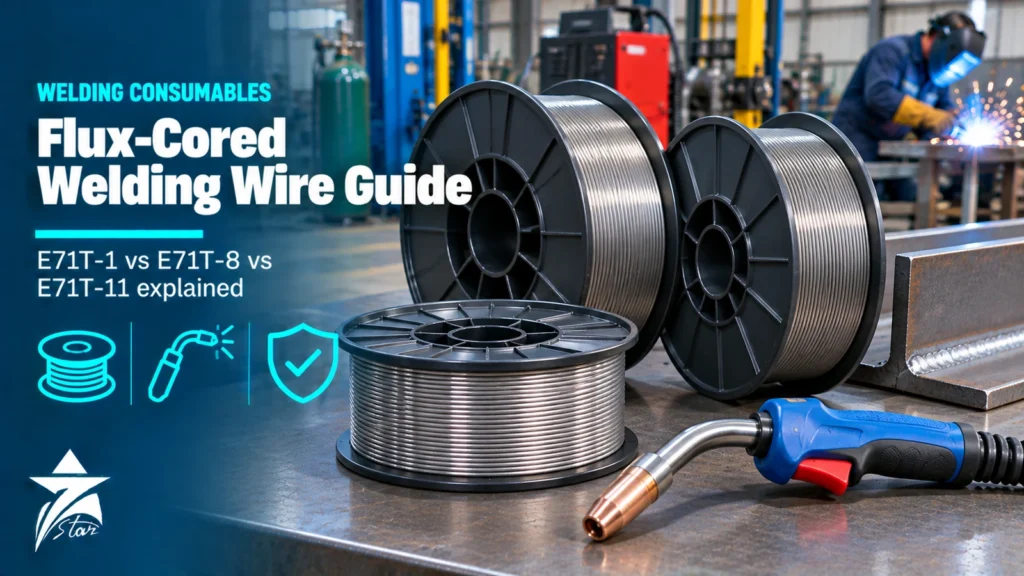
Flux-cored arc welding (FCAW) gives higher deposition rates than stick welding and handles mill scale, wind and positional work better than solid MIG wire. That is why it is used so widely on structural steel, tanks, pipelines and shipyard work. The choice of flux-cored welding wire decides whether you need a gas bottle, which polarity the machine must run, how the weld behaves out of position and whether the deposit meets impact toughness requirements. This guide explains how to read the AWS classification, compares the common E71T-1, E71T-8, E71T-11 and E71T-GS types with metal-cored wire, and covers stainless and alloy grades, parameters, storage and the defects welders see most often.
How Flux-Cored Welding Wire Works
A tubular wire is a steel sheath folded or drawn around a core of powdered flux, alloying elements and arc stabilisers. As the wire melts, the core produces slag that covers the bead, deoxidisers that clean the weld pool and, in self-shielded types, gases that protect the arc without an external gas supply. The wire is fed through a standard constant-voltage MIG power source and gun, so most shops can run it with the same equipment they use for solid wire, after changing the drive rolls and, for some types, the polarity.
- Gas-shielded wires (FCAW-G) use CO2 or an argon/CO2 mix together with the flux. They give the smoothest arc, low spatter and good mechanical properties.
- Self-shielded wires (FCAW-S) generate their own shielding from the core. No gas bottle is needed, so they suit site work, wind and remote locations.
- Metal-cored wires contain mostly metal powders and very little flux. They behave more like solid wire, with almost no slag and very high deposition.
Seamless wires, where the tube is closed by welding before drawing, pick up less moisture and can be copper coated. Folded wires have a seam and are more sensitive to humid storage, which matters in coastal climates.
Reading the AWS Classification
Carbon steel flux-cored welding wire is classified to AWS A5.20 (older system) or AWS A5.36 (newer, more detailed system). Low-alloy grades were covered by A5.29 and are now also in A5.36. A typical older designation such as E71T-1C H8 is read as follows:
| Part | Example | Meaning |
|---|---|---|
| E | E | Electrode |
| First digit | 7 | Minimum tensile strength in units of 10 ksi (70 ksi, about 490 MPa) |
| Second digit | 1 | Welding position: 0 = flat and horizontal only, 1 = all positions |
| T | T | Tubular (flux-cored) electrode |
| Usability number | -1 | Type of core, shielding and polarity (see the comparison table below) |
| Gas suffix | C or M | C = 100% CO2, M = argon-rich mix such as 75-80% Ar with CO2 |
| J (optional) | J | Impact toughness tested at a lower temperature than the standard requirement |
| H (optional) | H4, H8, H16 | Diffusible hydrogen limit in ml per 100 g of weld metal |
In AWS A5.36 the same wire may appear as E71T1-C1A0-CS1-H8, where the extra fields state the shielding gas, heat treatment condition, impact test temperature and weld metal composition. When a welding procedure specification (WPS) or the client specification names a classification, the replacement wire must carry the same classification, or a procedure qualification may be needed again.
E71T-1 vs E71T-8 vs E71T-11 vs E71T-GS vs Metal-Cored
| Type | Shielding | Polarity | Passes | Typical use |
|---|---|---|---|---|
| E71T-1C / -1M (rutile) | CO2 or Ar/CO2 | DCEP | Single and multipass | Structural steel, tanks, shipbuilding, general fabrication in all positions |
| E71T-5 (basic) | CO2 or Ar/CO2 | DCEP or DCEN | Multipass | Thick sections and crack-sensitive joints where higher toughness is needed |
| E71T-8 (self-shielded) | None | DCEN | Multipass | Field structural work, seismic connections, pipelines where impact toughness is specified |
| E71T-11 (self-shielded) | None | DCEN | Limited thickness, usually up to about 19 mm | General repair, light structural work, maintenance where toughness is not specified |
| E71T-GS (self-shielded) | None | DCEN | Single pass only | Thin sheet, galvanised steel and light repairs on small portable machines |
| E70C-6M (metal-cored) | Ar/CO2 | DCEP (some DCEN) | Single and multipass | Robotic and mechanised welding, fillets in flat and horizontal positions, high productivity |
The rutile E71T-1 types are the default for shop fabrication: the fast-freezing slag supports the pool in vertical-up and overhead positions, and the bead appearance is excellent. E71T-8 wires are chosen for site work when the design requires Charpy impact values, for example on building frames or offshore modules. E71T-11 and E71T-GS wires are easy to run but carry thickness or single-pass limits, so they should not replace an E71T-8 on a code job.
Gas-Shielded vs Self-Shielded: How to Choose
- Wind and location: gas shielding is blown away by drafts above about 8 km/h unless screens are used. Self-shielded wires work outdoors on pipelines, tank shells and steel erection.
- Toughness: gas-shielded rutile and basic wires generally give higher and more consistent impact values. Among self-shielded types, only grades such as E71T-8 with a J or low-temperature designation are used where toughness is specified.
- Polarity: most gas-shielded wires run DCEP; most self-shielded wires run DCEN. Running the wrong polarity causes poor penetration, porosity and heavy spatter.
- Fume: self-shielded wires produce more fume. Use local extraction or respiratory protection in confined spaces.
- Equipment: both need knurled drive rolls to avoid crushing the tube. Self-shielded wire on long feeders benefits from a push-pull or a short gun.
- Cost: self-shielded wire costs more per kilogram, but saves gas, regulators and bottle logistics on remote sites.
Stainless, Duplex, Nickel and Chrome-Moly Grades
Tubular wires are also made for stainless and alloy steels. They are classified to AWS A5.22 for stainless and A5.36 or A5.29 for low-alloy steel, and are popular because the slag gives good positional control and the deposition is higher than with TIG or stick.
| Classification | Base material | Typical application |
|---|---|---|
| E308LT1-1 / -4 | 304 and 304L stainless | Food, water and general stainless fabrication |
| E309LT1-1 / -4 | Carbon steel to stainless, clad steel | Dissimilar joints and buffer layers |
| E316LT1-1 / -4 | 316 and 316L stainless | Chemical, desalination and marine equipment |
| E2209T1-4 | 2205 duplex stainless | Seawater, oil and gas piping and pressure vessels |
| ENiCrFe3T0-4 / ENiCrMo3T0-4 | Nickel alloys, dissimilar metals | Overlays and joints between nickel alloys and steel |
| E91T1-B3C / E91T1-B91M | 2.25Cr-1Mo and P91 creep-resistant steel | Power plant and refinery high-temperature piping |
The suffix -1 means CO2 shielding and -4 means argon/CO2 mix. Stainless and nickel wires are sensitive to heat input and interpass temperature, and chrome-moly grades need preheat and post-weld heat treatment as specified in the WPS.
Parameters, Stickout and Technique
- Electrical stickout: gas-shielded wires typically run with 15-25 mm stickout; many self-shielded wires need 20-40 mm. Follow the manufacturer data sheet, because stickout changes current and penetration.
- Drag angle: flux-cored welding is a drag (pull) technique for most positions, at about 10-20 degrees, so the slag stays behind the pool.
- Vertical-up: use lower current and a slight weave with pauses at the toes. All-position rutile wires allow higher current vertical-up than stick electrodes.
- Wire diameter: 1.2 mm is the most common size for all-position work; 1.4-1.6 mm suits flat and horizontal fillets with higher deposition.
- Slag removal: remove slag completely between passes to avoid slag inclusions, and grind any undercut or trapped slag at the toes.
For root passes on pipe, many contractors still use TIG or a solid wire with modified short-circuit transfer and then fill and cap with tubular wire. Our orbital welding guide covers mechanised root and fill options for pipe.
Storage and Moisture Control
Moisture in the core of a flux-cored welding wire raises diffusible hydrogen and causes porosity and hydrogen cracking. In hot, humid coastal conditions this needs particular attention:
- Keep spools in their sealed packaging until use and store them in a dry, heated room away from the floor and outside walls.
- Return spools to a closed cabinet or bag at the end of each shift; do not leave them on the feeder overnight on open sites.
- Follow the manufacturer guidance on re-baking. Many tubular wires cannot be re-dried, and a damp spool should be scrapped for critical work.
- Choose H4 or H8 grades for high-strength steel, thick sections and restrained joints.
Common Defects and Their Causes
| Defect | Likely cause | Correction |
|---|---|---|
| Porosity | Damp wire, too short stickout on self-shielded wire, drafts on gas-shielded wire, wrong polarity | Dry storage, correct stickout, wind screens, check polarity |
| Wormtracks on the bead surface | Too much current or voltage, CO2 wire run on high-argon gas, contaminated surface | Reduce parameters, use the specified gas, clean the joint |
| Slag inclusions | Incomplete slag removal, push angle, low current on multipass welds | Clean between passes, use a drag angle, raise current |
| Lack of fusion | Low heat input, too fast travel, wire aimed ahead of the pool | Increase current, slow down, keep the arc on the leading edge of the pool |
| Burn-back and feeding problems | Smooth drive rolls, too much roll pressure, worn liner | Use knurled rolls, set correct pressure, replace the liner |
Tubular Wire Selection for Oman Fabrication and Site Work
Fabrication shops in Sohar, Duqm and Muscat mostly run E71T-1C or -1M rutile wire for structural steel and tanks, often on CO2 because it is easy to source. Field crews on pipelines, plant expansions and steel erection in open desert sites use self-shielded wire because wind makes gas shielding unreliable. Desalination, chemical and offshore projects add 316L, duplex and nickel grades. For any client specification such as Saudi Aramco, PDO or international codes like AWS D1.1 and ASME Section IX, check the approved consumable list and the WPS before changing the brand or classification of a flux-cored welding wire. For heavy cutting and bevel preparation before welding, see our guide on plasma vs oxyfuel cutting.
Selected Tubular Wires in Our Catalogue
The table below lists examples of tubular wires we can quote. Classifications are shown in the product names; confirm the exact grade, diameter and spool type against the WPS before ordering.
| Product | Type | Typical use |
|---|---|---|
| LongTeng E71T-1C gas-shielded wire | Rutile, CO2 | General all-position structural welding |
| Nippon Steel SF-1 E71T-1C seamless wire | Seamless rutile, CO2 | Shipbuilding and structural steel |
| KISWEL K-71TM E71T-1C/-1M | Rutile, CO2 or mix | Tanks, structures, fabrication |
| Böhler FOXcore 71 RC E71T-1 all-position wire | Rutile, all positions | Positional welding of carbon steel |
| KISWEL K-NGS E71T-GS self-shielded wire | Gasless, single pass | Thin sheet and site repairs |
| LongTeng E71T-GS wire for thin plate | Gasless, single pass | Light gauge and galvanised steel |
| Ador Automig MC 70C-6M metal-cored wire | Metal-cored, Ar/CO2 | Mechanised and robotic fillets |
| Elga Megafil 710 M E70C-6M seamless metal-cored wire | Seamless metal-cored | High-deposition fabrication |
| LongTeng E308LT1-1 stainless wire | Stainless 308L | 304 and 304L stainless |
| Selectarc FCW 316LP E316LT1-1/-4 all-position wire | Stainless 316L | Chemical and marine equipment |
| Böhler FOXcore 2209-T1 E2209T1-4 duplex wire | Duplex 2209 | 2205 duplex piping and vessels |
| Hyundai SC-91B3 E91T1-B3C chrome-moly wire | 2.25Cr-1Mo | High-temperature piping |
| Böhler FOXcore C 9 MV RC E91T1-B91M P91 wire | P91 creep-resistant | Power plant boiler piping |
| Selectarc FCW NI182 ENiCrFe3T0-4 nickel wire | Nickel alloy | Dissimilar joints and overlays |
Browse more in our tubular wire category. To get a quotation, send the AWS classification, diameter, spool weight, shielding gas, quantity and any approved consumable list, or the brand and grade you use now, through our quote request form or to [email protected].
Sourcing Flux-Cored Welding Wire in Oman Through Seven Star LLC
Seven Star LLC is an independent supplier in Oman of welding consumables for fabrication shops, contractors and maintenance teams, including gas-shielded, self-shielded, metal-cored, stainless, duplex, nickel and chrome-moly tubular wires. We quote products from manufacturers such as Lincoln Electric, KISWEL, Nippon Steel, Kobelco, Hyundai Welding, Selectarc, Böhler Welding, Elga and Ador, and can match the flux-cored welding wire named in an existing WPS. Classifications, certificates and lead time are confirmed against the manufacturer data at quotation.
Frequently asked questions
What is the difference between E71T-1 and E71T-11 wire?
E71T-1 is a gas-shielded rutile wire run on DCEP with CO2 or an argon mix, suitable for single and multipass welds in all positions. E71T-11 is a self-shielded wire run on DCEN without gas, easy to use outdoors but limited in plate thickness and not intended for jobs with impact toughness requirements.
Can I use self-shielded wire with shielding gas?
No. Self-shielded wires are designed to produce their own shielding, and adding gas changes the arc chemistry and can cause porosity and poor mechanical properties. Use a gas-shielded wire if a gas supply is available and wind is controlled.
Which polarity does tubular wire need?
Most gas-shielded wires run on DCEP (electrode positive) and most self-shielded wires run on DCEN (electrode negative). Always check the manufacturer data sheet, because a few wires are approved on both polarities.
What does the C or M at the end of E71T-1C or E71T-1M mean?
C means the wire was classified with 100% CO2 shielding gas and M means it was classified with an argon-rich mixture, usually 75-80% argon with the balance CO2. Many wires carry both designations.
Is metal-cored wire better than flux-cored wire?
Metal-cored wire gives higher deposition, very little slag and excellent results in mechanised flat and horizontal welding. Rutile tubular wire is easier for manual vertical and overhead work because the slag supports the pool. The best choice depends on position, joint and productivity.
Who supplies flux-cored welding wire in Oman?
Seven Star LLC is an independent supplier in Oman that quotes gas-shielded, self-shielded, metal-cored, stainless and alloy tubular wires from leading manufacturers. Send your requirements through the quote request form or to [email protected].
Was this guide helpful?One click helps us write better guides for engineers.
Thank you! Glad it helped. Need this equipment for your project? Request a quotation
Thank you. We will use this to improve the guide.