- Automation & ControlView all 2,775 products
- Automation Accessories
- AC Drives
- PLC & I/O Cards
- Industrial Communications
- Vibration Monitoring
- Controllers & Data Acquisition
- Isolator & Barrier
- Safety Switches & Guard Locking
- Motor Soft Starters
- CCTV & Security
- Encoders
- Pneumatic Cylinders
- HMI Displays
- Servo Drives
- Industrial Computers
- Machine Vision
- Automation Software
- Robotics


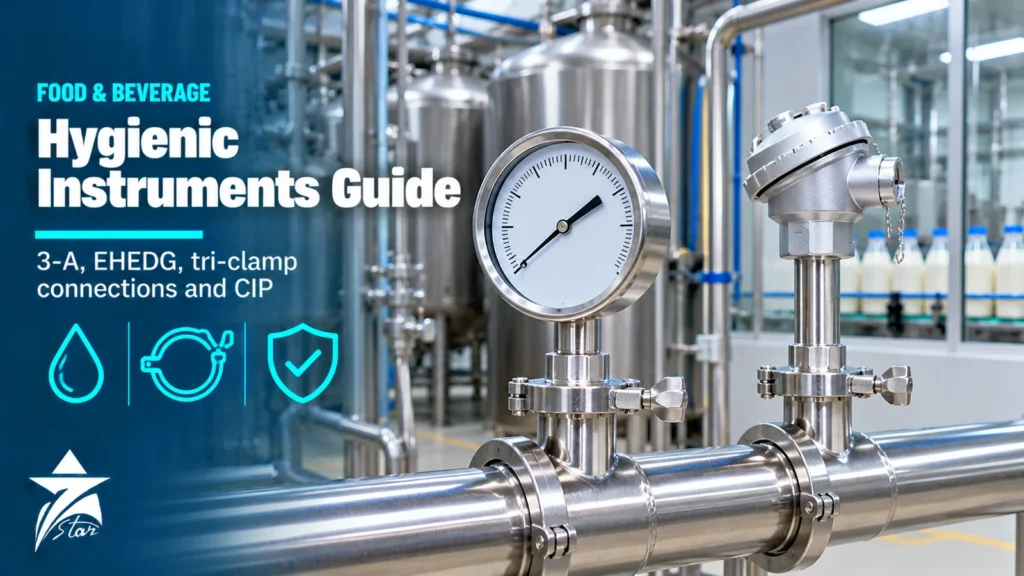
In a dairy, juice line, bottling plant or food factory, an instrument is not only a measuring device; it is part of the product-contact surface. A crevice behind a seal, a rough weld or a dead leg in a sensor fitting can hold product residue, survive cleaning and contaminate the next batch. Hygienic instruments are designed so that every wetted surface can be cleaned in place, drains freely and is made of food-safe materials. This guide explains the standards behind hygienic instruments, the process connections you will meet, what CIP and SIP do to sensors, and how to choose flow, pressure, temperature, level and analytical measurements for food and beverage plants.
What Makes an Instrument Hygienic
- Cleanable surfaces: smooth, non-porous product-contact surfaces, typically 316L stainless steel with a surface roughness of Ra ≤ 0.8 µm, often electropolished.
- No crevices or dead spaces: flush-mounted diaphragms and sensors, front-flush seals and fittings that leave no gaps where product can collect.
- Self-draining design: no pockets that hold liquid when the line is emptied, with installation positions defined by the manufacturer.
- Food-safe materials: elastomers and fill fluids that comply with FDA 21 CFR 177 and EU Regulation (EC) No 1935/2004; USP Class VI is often required in pharmaceutical plants.
- Resistance to cleaning: the sensor, seals and housing must survive repeated hot caustic and acid cleaning, steam sterilisation and high-pressure washdown.
3-A, EHEDG and Other Standards for Hygienic Instruments
| Standard or scheme | Origin | What it covers |
|---|---|---|
| 3-A Sanitary Standards | USA, dairy industry | Design and material criteria for equipment, sensors and fittings; the 3-A symbol is granted after third-party verification |
| EHEDG certification | Europe | Hygienic design guidelines and a laboratory cleanability test; equipment is classified, for example Type EL Class I for cleaning in place |
| FDA 21 CFR 177 | USA | Polymers and elastomers suitable for repeated food contact |
| Regulation (EC) No 1935/2004 | EU | General requirements for food-contact materials, with traceability |
| ASME BPE | USA, bioprocessing | Dimensions, surface finishes, welds and dead legs for pharmaceutical and biotech systems |
| IP69 (IEC 60529) / IP69K | International | Protection of housings against high-pressure, high-temperature washdown |
A product described as hygienic is not automatically certified. Ask for the 3-A or EHEDG certificate for the exact model and process connection, and for material declarations covering every wetted part and seal, because certification often applies only to specific connection and seal combinations.
Hygienic Process Connections
| Connection | Standard | Notes |
|---|---|---|
| Tri-Clamp (clamp ferrule) | ISO 2852, DIN 32676, ASME BPE | The most common quick-release connection; easy to dismantle, needs a hygienic gasket of the correct size |
| Dairy thread (milk pipe fitting) | DIN 11851 | Widely used in dairies; hygienic performance depends on the seal design |
| Varivent | GEA system | Flush, metal-stop connection with an O-ring; common on process lines and tanks |
| Aseptic connections | DIN 11864 | For aseptic and sterile processes with defined seal compression |
| SMS and other dairy unions | SMS 1145 and others | Found on older Scandinavian and dairy equipment |
| Hygienic weld-in adapters | Manufacturer systems | Welded into tank walls or pipes, then the sensor is fitted with a sealed adapter |
Match the connection to the existing pipework and fittings, and specify the pipe standard and size (DIN 11850, ISO 1127 or OD tube), because a 2 inch Tri-Clamp ferrule and a DN 50 clamp are not always interchangeable. Our article on orbital pipe welding explains how sanitary tubing is joined without crevices.
CIP and SIP: What Cleaning Does to Sensors
Cleaning in place (CIP) usually runs a pre-rinse, a hot caustic wash (often 1–2% sodium hydroxide at 75–85 °C), an intermediate rinse, an acid wash (for example 0.5–1% nitric acid at around 60–70 °C) and a final rinse. Sterilisation in place (SIP) exposes the line to saturated steam, typically 121–140 °C, for 20 to 60 minutes. Sanitary sensors must handle:
- Thermal shock when cold rinse water follows steam or hot caustic, which can cause temporary pressure readings or zero shifts in some sensors.
- Chemical attack on seals; EPDM, FKM and FFKM elastomers behave differently in caustic, acid, steam and fats.
- Temperature limits of the electronics in compact instruments; a remote electronics version may be needed on hot lines.
- High-pressure washdown of the exterior, which requires IP69-rated housings and cable glands, and smooth, sloped surfaces.
Conductivity sensors are often used on the CIP return line to detect the boundary between product, water, caustic and acid, so the CIP system can recover chemicals and minimise product loss.
Choosing Hygienic Instruments by Measurement
| Measurement | Typical technology | Hygienic points to check |
|---|---|---|
| Flow of milk, juice, beer and water | Electromagnetic flowmeter | Liner material (PFA), minimum conductivity, hygienic connections and self-draining installation |
| Mass flow, density and concentration (Brix, solids) | Coriolis flowmeter | Single straight tube for drainability, 316L or other alloys, density accuracy for recipe control |
| Pressure in tanks, filters and lines | Flush-diaphragm pressure transmitter | Food-grade fill fluid, thermal shock behaviour, diaphragm protection |
| Product temperature | RTD in hygienic thermowell or direct contact | Short response time, CIP/SIP resistance, calibration without opening the process |
| Tank level | Radar, guided radar or hydrostatic | Antenna design without crevices, foam and condensate, agitator and CIP spray balls |
| Overfill, dry run and pump protection | Vibrating fork level switch | Short hygienic fork, functional test and SIL capability where needed |
| pH, conductivity and turbidity | Analytical sensors in hygienic assemblies | Retractable assemblies for cleaning and calibration without stopping the line |
The temperature measurement principle is explained in our comparison of RTD vs thermocouple sensors, and transmitter options are covered in temperature transmitter selection.
Installation Rules for Hygienic Instruments
- Keep dead legs as short as possible; ASME BPE gives L/D ≤ 2 as a design target for branches and instrument tees.
- Mount sensors so they drain completely; follow the manufacturer recommendation for the angle of flowmeters and probes in horizontal lines.
- Install magnetic and Coriolis flowmeters where the pipe stays full, for example in a rising section, to avoid partially filled measurement.
- Use the correct gasket for each clamp size and avoid over-tightening, which pushes the gasket into the bore and creates a crevice.
- Record wetted materials, gaskets and certificates in the plant documentation so replacements stay consistent.
- Plan calibration access: removable thermowell inserts, quick-release connections and remote electronics simplify periodic checks.
Calibration and Maintenance in Hygienic Plants
Food safety plans built on HACCP treat pasteurisation temperature, holding time and sometimes flow as critical control points, so the instruments measuring them need documented calibration at defined intervals. Practical points that keep these sensors accurate and audit-ready:
- Choose temperature sensors with removable inserts or self-checking designs, so calibration does not require opening the product line.
- Verify magnetic and Coriolis flowmeters in situ with the manufacturer verification tool, and keep the reports with the HACCP records.
- Replace gaskets and O-rings on a fixed schedule rather than waiting for leaks; aged seals are a common source of crevices and contamination.
- Inspect flush diaphragms and pH glass after CIP for scratches, coating or damage, and clean them only with methods the manufacturer approves.
- Keep spare sensors with identical connections and materials, so a failed unit can be swapped quickly without changing the certified design.
A short spares list of the most critical sensors, with part numbers and seal materials, shortens downtime considerably when a sensor fails during production.
Food and Beverage Plants in Oman: Practical Points
Dairy, juice, bottled water, soft drink and food processing plants in Oman face high ambient temperatures, which add to the thermal load on compact electronics already exposed to hot CIP and steam. Washdown areas are humid, so stainless housings, sealed cable entries and protected connectors last longer than painted aluminium. Many plants run equipment from both European and American suppliers, so expect DIN 11851, Tri-Clamp and Varivent connections on the same site, and confirm the connection standard for every replacement instrument.
Hygienic Instruments We Supply
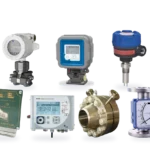
Examples of sanitary sensors and gauges in our catalog. Each link goes to the product page.
Browse more in our sensors and transmitters category. To get a quotation, send the measurement, product and CIP/SIP conditions, process connection and size, required certificates (3-A, EHEDG, FDA), wetted and seal materials and output signal, or the part number of the existing instrument, through our quote request form or to [email protected].
Sourcing Hygienic Instruments in Oman Through Seven Star LLC
Seven Star LLC is an independent supplier in Oman of hygienic instruments for dairy, beverage, bottled water, food and pharmaceutical plants. We quote flowmeters, pressure and temperature sensors, level transmitters and switches, and analytical sensors from manufacturers such as Endress+Hauser, JUMO, Micro Motion, Rosemount and KROHNE, and can match existing instruments by part number and connection standard. Certificates, materials and lead time are confirmed against the manufacturer data at quotation.
Frequently asked questions
What is the difference between 3-A and EHEDG?
3-A Sanitary Standards come from the US dairy industry and define design and material criteria, verified by a third party before the 3-A symbol is used. EHEDG is a European organisation whose certification includes a laboratory cleanability test. Many hygienic instruments carry both.
Is a Tri-Clamp connection always hygienic?
A Tri-Clamp connection can be hygienic when the ferrules, bore and gasket are matched and correctly tightened. A wrong gasket size or over-tightening can create a crevice or a step in the bore, so certification usually refers to specific connection and seal combinations.
What surface finish do hygienic instruments need?
Product-contact surfaces are typically 316L stainless steel with a roughness of Ra 0.8 µm or better, and often electropolished for pharmaceutical or aseptic duty.
Can hygienic instruments withstand SIP steam sterilisation?
Most are designed for it, typically with saturated steam at 121 to 140 °C, but the limits differ by model and seal material. Check the CIP and SIP ratings and, for compact instruments, the electronics temperature limit.
Which flowmeter is best for milk and juice?
Electromagnetic flowmeters are widely used for conductive liquids such as milk, juice and beer. Coriolis meters are chosen when mass flow, density or concentration such as Brix must also be measured.
Who supplies hygienic instruments in Oman?
Seven Star LLC is an independent supplier in Oman that quotes hygienic flowmeters, pressure, temperature, level and analytical instruments from leading manufacturers. Send your requirements through the quote request form or to [email protected].
Was this guide helpful?One click helps us write better guides for engineers.
Thank you! Glad it helped. Need this equipment for your project? Request a quotation
Thank you. We will use this to improve the guide.