- Automation & ControlView all 2,782 products
- Automation Accessories
- AC Drives
- PLC & I/O Cards
- Industrial Communications
- Vibration Monitoring
- Controllers & Data Acquisition
- Isolator & Barrier
- Safety Switches & Guard Locking
- Motor Soft Starters
- CCTV & Security
- Encoders
- Pneumatic Cylinders
- HMI Displays
- Servo Drives
- Industrial Computers
- Machine Vision
- Automation Software
- Robotics
















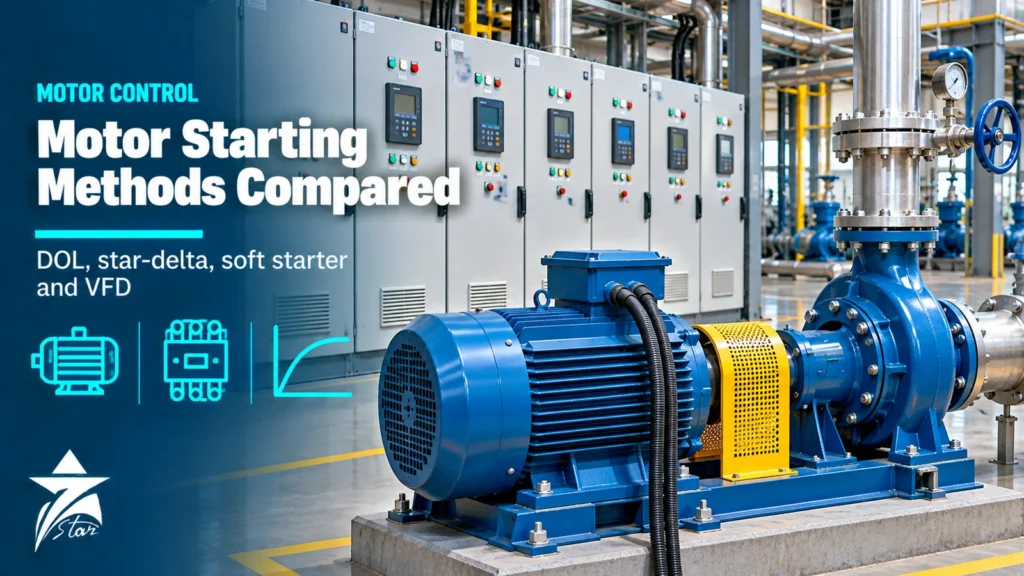
A three-phase induction motor connected straight to the supply draws a starting current of roughly six to eight times its full-load current. On a strong network that is acceptable; on a weak supply, a generator or a large motor it causes voltage dips, nuisance trips, mechanical shock and water hammer in pump systems. Choosing between the available motor starting methods is therefore a balance between supply capacity, the torque the load needs at standstill, how often the motor starts, and cost. This guide compares direct-on-line, star-delta, autotransformer, soft starter and variable frequency drive starting, and explains how to pick the right one.
Why Starting Current and Torque Matter
At standstill an induction motor behaves almost like a short-circuited transformer, so current is limited mainly by the winding impedance. The starting torque available at full voltage is typically 1.5 to 2.5 times rated torque, depending on the motor design. Every reduced-voltage method lowers the starting current, but because motor torque varies roughly with the square of the voltage, it also lowers starting torque. A method that halves the voltage reduces torque to about one quarter. The load must still be able to accelerate on that reduced torque, which is why the load type is the first thing to check when comparing motor starting methods.
Motor Starting Methods at a Glance
| Method | Starting current (x FLC) | Starting torque (x rated) | Relative cost | Typical use |
|---|---|---|---|---|
| Direct-on-line (DOL) | 6–8 | 1.5–2.5 | Lowest | Small motors, strong supply, high-inertia loads that need full torque |
| Star-delta | about 2–2.7 (one third of DOL) | about 0.5–0.8 (one third of DOL) | Low | Pumps, fans and compressors started unloaded, motors rated for delta running |
| Autotransformer | about 1.7–4 (tap dependent) | about 0.4–0.85 (tap dependent) | Medium to high | Large motors needing more torque than star-delta, older installations |
| Soft starter | about 2.5–4.5 (adjustable) | reduced, adjustable ramp | Medium | Pumps, fans, conveyors, compressors; smooth start and stop |
| Variable frequency drive (VFD) | about 1–1.5 | up to 1.5–2 at low speed | Highest | Speed control, energy saving, high torque at low current |
Values are typical for standard induction motors; the exact figures depend on the motor design, the load and the settings chosen.
Direct-On-Line Starting
A DOL starter connects the motor to full supply voltage through a contactor, with an overload relay or motor protection circuit breaker for protection. It is simple, cheap, compact and gives the highest starting torque. The drawbacks are the full inrush current, a torque shock on couplings, belts and gearboxes, and pressure surges in pump systems. Utilities and generator suppliers often set a maximum motor size for DOL starting; above that, a reduced-voltage method is needed. Correct contactor selection depends on the utilisation category, explained in our article on contactor utilisation categories and overload trip classes.
Star-Delta Starting
A star-delta starter uses three contactors and a timer. The motor starts with its windings connected in star, which applies 1/√3 (about 58%) of line voltage to each winding, so both line current and torque fall to about one third of the DOL values. After a set time the starter switches to delta for running. Points to check:
- The motor must have six terminals and be rated for the supply voltage in delta (for example 400 V delta on a 400 V network).
- The load torque during the star stage must stay below the reduced motor torque, so star-delta suits pumps and fans started with a closed valve or damper, and unloaded compressors.
- The changeover causes a current and torque transient; a dedicated star-delta timer with a short dead time (typically 40–60 ms) limits the effect.
- The overload relay is normally sized at about 58% of motor full-load current when fitted in the phase-winding circuit.
Autotransformer Starting
An autotransformer starter supplies the motor through transformer taps, commonly 50%, 65% and 80% of line voltage. Because the transformer also reduces the line current, the supply sees less current than with a simple series resistance for the same motor torque. The Korndorfer connection avoids an open transition during changeover. Autotransformer starters are robust and give more starting torque than star-delta, but they are large, heavy and expensive, so in new installations they have largely been replaced by soft starters and VFDs. They remain common on older large pumps and compressors.
Soft Starter Starting
A soft starter controls the motor voltage with pairs of thyristors (SCRs) in each phase, ramping voltage from an initial level to full voltage over an adjustable time. Many models use current limit control, holding starting current at a set value such as 3.5 x FLC. After the ramp, an internal or external bypass contactor carries the running current to remove thyristor heat losses. Key features:
- Smooth acceleration with adjustable ramp, initial torque and current limit.
- Soft stop, and on pump models a pump control algorithm that reduces water hammer when stopping.
- Built-in motor protection on most models: overload, phase loss, phase imbalance and underload.
- Two-phase or three-phase control; three-phase control gives a more balanced start on demanding loads.
- Inside-delta connection on some models, which reduces the required soft starter rating for six-terminal motors.
A soft starter does not change motor speed during running and cannot deliver more torque than the motor produces at the applied voltage, so very high-inertia or high breakaway-torque loads may still need a VFD.
Variable Frequency Drive Starting
A VFD rectifies the supply to DC and generates a variable frequency and voltage output. Starting at low frequency, the motor produces rated torque or more while drawing only about rated current, which makes the VFD the gentlest of all motor starting methods for both the supply and the mechanics. The VFD also allows continuous speed control, which saves energy on centrifugal pumps and fans because power falls roughly with the cube of speed. Costs to consider include the higher purchase price, harmonic currents on the supply, motor insulation stress from fast switching, cable length limits and the need for cooling. Hot-climate sizing is covered in our guide to variable frequency drive selection for hot climates, and the direct comparison is in soft starter vs VFD.
How to Choose Between Motor Starting Methods
| Situation | Usually suitable | Why |
|---|---|---|
| Small motor on a strong supply | DOL | Lowest cost and full torque |
| Centrifugal pump or fan, fixed speed | Star-delta or soft starter | Low starting torque need; soft starter also reduces water hammer |
| Pump or fan where flow changes | VFD | Speed control and energy saving |
| Conveyor or mixer started loaded | Soft starter with current limit, or VFD | Smooth acceleration, enough torque at start |
| Large motor on a generator or weak grid | Soft starter or VFD | Limits voltage dip and generator overload |
| Frequent starts per hour | VFD or suitably rated soft starter | Thermal rating for repeated starts |
| Hazardous area motor | Check certification of motor and starting method | Ex motors may have limits on VFD operation |
Always check the motor data plate, the load torque curve, the number of starts per hour and the supply short-circuit level. For generators, compare the starting kVA with the generator transient capability rather than its continuous rating.
Motor Starting Methods for Oman Installations
Ambient temperatures above 45 °C in many Omani sites reduce the current rating of soft starters and VFDs, so derating curves and panel ventilation must be checked. Remote pump stations and oil field sites often run on generators, where reduced starting current makes a soft starter or VFD essential for larger motors. Dust and humidity favour enclosures with suitable IP ratings and conformal-coated drive boards. Where a star-delta starter is replaced with a soft starter, keep the six motor cables available, because an inside-delta connection can reduce the size of the new unit.
Motor Starters and Drives We Supply
Examples of products in our catalog for each starting method. Each link goes to the product page.
Browse more in our motor soft starters category and contactors and overload relays category. To get a quotation, send the motor power, voltage, full-load current, load type, starts per hour and ambient temperature, or the part number of the existing starter, through our quote request form or to [email protected].
Sourcing Motor Starters and Drives in Oman Through Seven Star LLC
Seven Star LLC is an independent supplier in Oman of contactors, overload relays, motor protection circuit breakers, star-delta components, soft starters and variable frequency drives. We quote products from manufacturers such as Schneider Electric, ABB, Siemens, Danfoss, Allen-Bradley and Lovato, and can match existing starters and drives by part number for replacement or upgrade, including a change between motor starting methods. Ratings, derating and lead time are confirmed against the manufacturer data at quotation.
Frequently asked questions
Which motor starting method gives the lowest starting current?
A variable frequency drive gives the lowest starting current, typically around rated current, while still producing high torque. Soft starters and star-delta starters reduce current to roughly 2.5 to 4.5 times and about one third of DOL current respectively.
Up to what size can a motor be started direct-on-line?
There is no single limit. It depends on the supply short-circuit level, the voltage dip the network or generator can tolerate, and local utility rules. Small motors up to a few kilowatts are usually started DOL; larger motors often need a reduced-voltage method.
Can a soft starter replace a star-delta starter?
Yes, in most pump, fan and compressor applications. A soft starter gives a smoother start without the changeover transient, and inside-delta models can use the existing six motor cables to reduce the required rating.
Why does star-delta starting reduce torque?
In star connection each winding receives about 58% of line voltage. Because torque varies roughly with the square of voltage, starting torque falls to about one third of the direct-on-line value.
When should I choose a VFD instead of a soft starter?
Choose a VFD when speed must vary during running, when energy saving on pumps and fans matters, or when the load needs high torque at start with low current. A soft starter is simpler and cheaper when only starting and stopping need control.
Who supplies motor starters and VFDs in Oman?
Seven Star LLC is an independent supplier in Oman that quotes contactors, overload relays, soft starters and variable frequency drives from leading manufacturers. Send your requirements through the quote request form or to [email protected].
Was this guide helpful?One click helps us write better guides for engineers.
Thank you! Glad it helped. Need this equipment for your project? Request a quotation
Thank you. We will use this to improve the guide.