Brand:

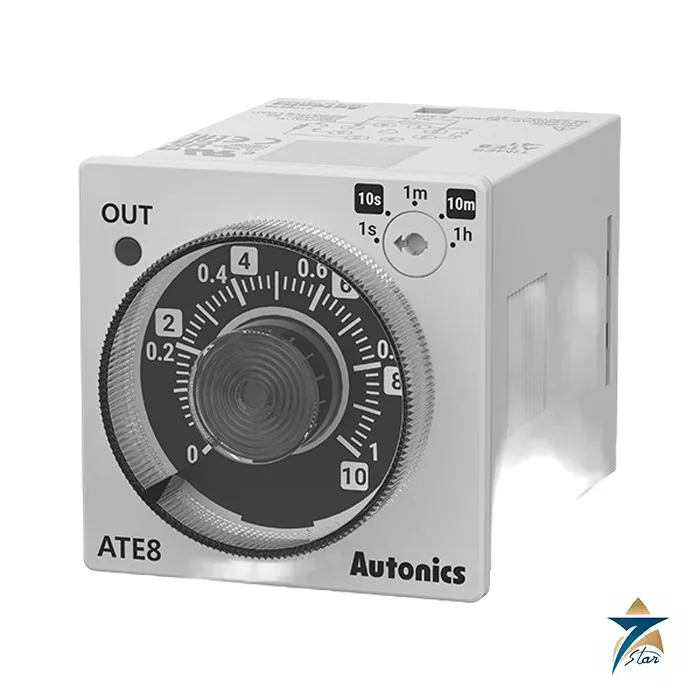
Autonics ATE8-41 Analog Power ON Delay Timer, 8-Pin Plug

Description

Overview

A dial, a range switch and a plug-in base: the Autonics ATE8-41 is the analog power ON delay timer that maintenance staff learn in minutes. It has an 8-pin plug, accepts 100 to 240 V AC or 24 to 240 V DC, offers five time ranges from 1 second up to 1 hour, and carries a time limit changeover contact plus an instantaneous contact. Seven Star LLC is an independent supplier serving Oman and the GCC. The values on this page are from the ATE8 instruction manual and apply to this code.

Timers like this one are used in motor start sequences, delayed pump starts, fan run-on, star-delta changeover and lighting or heater delays in control panels, where an inexpensive and visible time setting is preferred to a programmable relay.

Reading the code ATE8-41

Item Data
ATE Analog timer series
8 8-pin plug type
4 Supply 100 to 240 V AC 50/60 Hz or 24 to 240 V DC
1 Maximum time range set 1: 1 s, 10 s, 1 min, 10 min, 1 hour
No suffix Output of time limit 1c plus instantaneous 1a (D = time limit 2c; E = time limit 1c plus instantaneous 1c)

Autonics ATE8-41 data

Item Data
Function Power ON delay
Time operation Starts on power ON
Return time 200 ms or less
Time ranges 1 s / 10 s / 1 min / 10 min / 1 hour full scale
Supply 100 to 240 V AC 50/60 Hz, 24 to 240 V DC, 90 to 110 percent
Consumption AC 3.5 VA or less; DC 2 W or less
Output Relay: time limit SPDT 1c plus instantaneous SPST 1a
Contact capacity 250 V AC 3 A or 30 V DC 3 A, resistive
Relay life 5,000,000 mechanical; 100,000 electrical
Repeat error 0.3 percent plus or minus 10 ms or less
Setting error 10 percent plus or minus 50 ms or less
Voltage error 0.5 percent plus or minus 10 ms or less
Temperature error 2 percent plus or minus 10 ms or less
Dielectric strength 3,000 V AC for one minute
Ambient temperature -10 to 55 C
Protection IP40 front
Weight About 75 g, about 122.2 g packed

Choosing the time range

The last digit in the code selects the range set. This 1 version offers 1 second, 10 seconds, 1 minute, 10 minutes and 1 hour as the maximum of the dial, so a setting of 5 on the 10 minute range gives roughly five minutes. Codes with 3 give 3 s up to 3 h, codes with 6 give 6 s up to 6 h, and C gives 12 s, 12 min, 24 min, 12 h and 24 h. For most machine delays up to 10 minutes the code 1 is the best fit, because the dial is more readable on a lower range.

Remember the setting error of 10 percent plus or minus 50 ms: a dial setting is for orientation, not for precision, so use a stopwatch to check the actual delay on the machine.

How ATE8-41 differs from other ATE8 timers

The ATE8-41D has two time limit changeover contacts (2c) and no instantaneous contact. The ATE8-41E has a time limit 1c plus an instantaneous 1c instead of 1a. The ATE8-43, 46 and 4C versions have other time ranges. The supply is the same on all of these. The ATE8-41 uses the most common contact arrangement: one delayed changeover and one instantaneous normally open contact, which is often used as a self-holding or an indicator contact.

Contact behaviour

When power is applied to the Autonics ATE8-41, the instantaneous contact closes at once and the time limit starts. After the set time the time limit contact changes over and the output indicator lights. When power is removed, the contacts return within 200 ms, and the timer resets for the next cycle. If the time is set to zero, the time limit contact operates within 30 ms after the instantaneous contact.

Wiring the Autonics ATE8-41

The unit has an 8-pin plug that fits an 8-pin socket; check the pin diagram of the manual for supply and contact pins before wiring, because the 1c and 1a contacts are separate. The rating of 250 V AC 3 A or 30 V DC 3 A applies to resistive load, so use an interposing relay or contactor for motors, and add surge suppression across coils. Use the product with a supply within 90 to 110 percent of the rated voltage.

Accuracy and what affects it

The error figures of the Autonics ATE8-41 are split into four parts, and it helps to understand them when you set a critical delay. The repeat error of 0.3 percent plus or minus 10 ms describes how much the delay varies from cycle to cycle with nothing changed. The setting error of 10 percent plus or minus 50 ms describes the difference between the dial mark and the true delay. The voltage error of 0.5 percent plus or minus 10 ms describes the shift when the supply moves within its permitted range, and the temperature error of 2 percent plus or minus 10 ms the shift over the ambient range.

Taken together, the delay on a given machine is repeatable to better than one percent, but the dial scale may be off by up to ten percent. The practical method is to set the dial, time the delay with a stopwatch, correct the dial and then mark the final position with a paint dot. After that, the setting will repeat well, and a technician can see at once if it has been moved.

A timer is a poor choice if the delay must be accurate to better than a few percent over a large range, or if it must be changed often through a keypad. In that case a digital timer with a numeric display, or a PLC timer, is the better solution, while the analog timer remains the economical choice for simple fixed delays.

Applications in Oman and the GCC

Typical applications are delayed starting of pumps and fans to limit inrush, sequential start of conveyors, motor run-on after cooling demand, delayed alarm in utilities panels and heater warm-up delays. IP40 on the front is meant for panel mounting, not for exposed outdoor use. Keep the panel ambient below 55 C.

Related items you may also need: Autonics E40S6-2500-6-L-5 Rotary Encoder Incremental | Autonics PR18-8DN M18 Inductive Proximity Sensor 8 mm | NI cRIO-9053 CompactRIO Real-Time Controller | All Autonics products.

Documents and quotation

The ATE8 instruction manual is attached as a datasheet. Send an RFQ for ATE8-41 to Seven Star LLC with quantity and delivery location and we will confirm availability and lead time for Oman and the GCC.

Datasheets & Documents
  • PDF Datasheet Autonics ATE8-41 Analog Power ON Delay Timer, 8-Pin Plug Datasheet Download
Reviews (0)

Reviews

There are no reviews yet.

How would you rate this product?

It takes about 10 seconds — just tap a star. Your email is never published.

About brand

Autonics is a South Korean maker of sensors and controllers, founded in 1977 as a small engineering business making controllers for looms. It took the Autonics name in 1988 and opened a new corporate headquarters in Busan in 2014. Autonics makes proximity and photoelectric sensors, rotary encoders, temperature controllers, counters, timers and stepper motor systems, with factories in Busan and Yangsan.

Seven Star LLC lists the Autonics E40S6-2500-6-L-5 incremental rotary encoder and supplies Autonics sensors and control devices in Oman and the GCC.

Autonics company profile

Founded 1977, South Korea
Current name Autonics, since 1988
Headquarters Busan, South Korea
Factories Busan and Yangsan
Product families E40 and E50 rotary encoders, PR proximity sensors, BJ photoelectric sensors, TK temperature controllers

Milestones

  • 1977: The company is founded.
  • 1988: Renamed Autonics Corporation.
  • 2014: Opens its Busan headquarters.

Reading the Autonics E40S encoder code

E40S is the 40 mm diameter shaft-type incremental encoder, and the 6 that follows is the 6 mm shaft. 2500 is the resolution in pulses per revolution. The next 6 means six output signals: A, B and Z with their inverted signals. L is a line driver output and the final 5 is a 5 V DC supply. The same 40 mm body is made in hollow shaft form as the E40H and E40HB series.

Where Autonics encoders are used

Servo and spindle feedback, conveyor length measurement, packaging and printing machines.

Ordering Autonics encoders: what we need

Send the complete model string from the label. If it is worn off, give the body and shaft diameter, pulses per revolution, output type, supply voltage and cable or connector style.

Facts checked against Autonics corporate profiles, October 2026.

FAQ

Questions about the Autonics ATE8-41 Analog Power ON Delay Timer, 8-Pin

Answers from our engineering team on installation, compatibility and integration.

01What does ATE8-41 do?
It is a power ON delay analog timer: when power is applied the time limit runs, and after the set time the delayed contact changes over.
02What time ranges does Autonics ATE8-41 offer?
1 second, 10 seconds, 1 minute, 10 minutes and 1 hour as the full-scale choices of the dial.
03What contacts has ATE8-41?
One time limit changeover contact (1c) and one instantaneous contact (1a), each rated 250 V AC 3 A or 30 V DC 3 A resistive.
04What supply does the ATE8-41 accept?
100 to 240 V AC at 50/60 Hz or 24 to 240 V DC, within 90 to 110 percent of the rating.
05How accurate is the ATE8-41?
Repeat error is 0.3 percent plus or minus 10 ms, and setting error is 10 percent plus or minus 50 ms.