- Automation & ControlView all 3,122 products
- Automation Accessories
- AC Drives
- PLC & I/O Cards
- Industrial Communications
- Vibration Monitoring
- Isolator & Barrier
- Controllers & Data Acquisition
- Safety Switches & Guard Locking
- Encoders
- Motor Soft Starters
- CCTV & Security
- Pneumatic Cylinders
- HMI Displays
- Servo Drives
- Industrial Computers
- Machine Vision
- Automation Software
- Robotics
Brand: Autonics
Autonics TC4M-24R 72×72 PID Temperature Controller, 2 Alarms
Description
Overview
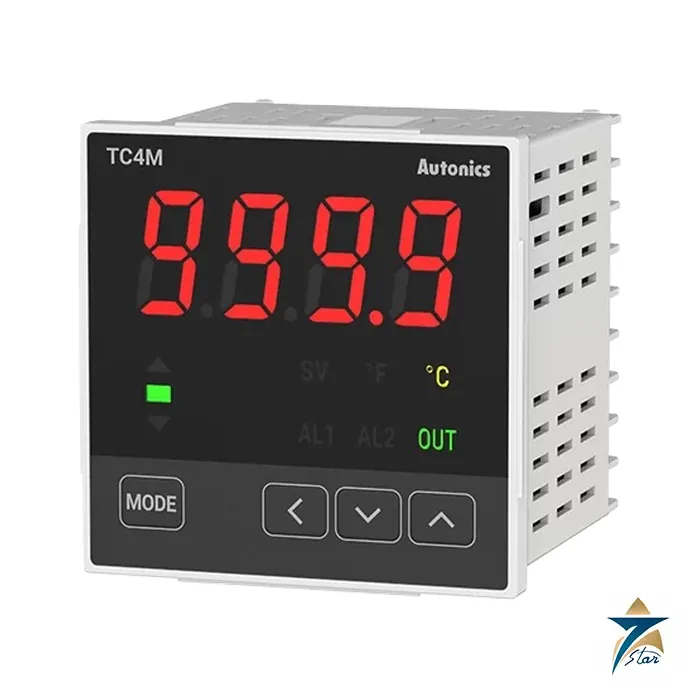
The Autonics TC4M-24R is a single-display PID temperature controller in the square 72 x 72 mm DIN format, with a relay output, an SSR drive output and two alarm relays, powered from 100 to 240 V AC. Seven Star LLC is an independent supplier serving Oman and the GCC. Its figures below are taken from the TC series instruction manual and apply to the M size with two alarms.
This is the controller of choice for ovens, heaters, water baths and small process skids where one process value is enough on the display and the operator does not need a second line showing the setpoint. A set of green deviation arrows tells at a glance whether the process is above, below or on target.
Reading the order code TC4M-24R
- TC: single display PID temperature controller series
- 4: four-digit display
- M: DIN size 72 x 72 mm
- 2: two alarm outputs
- 4: 100 to 240 V AC supply, 50/60 Hz
- R: control output of relay plus SSR drive (N would mean indicator only)
Technical specifications of Autonics TC4M-24R
| Item | Data |
|---|---|
| Display | Four-digit 7-segment LED, red, with green and yellow indicators |
| Power supply | 100 to 240 V AC 50/60 Hz, permissible 90 to 110 percent |
| Consumption | 5 VA or less |
| Sampling period | 100 ms |
| Inputs | Thermocouple K, J, L; RTD Cu50 and DPt100 |
| Control output relay | 250 V AC 3 A, 30 V DC 3 A, 1a |
| SSR drive output | 12 V DC plus or minus 2 V, 20 mA or less |
| Alarm outputs | Two relays, 250 V AC 1 A, 1a each |
| Control types | ON/OFF, P, PI, PD, PID; heating or cooling |
| Proportional band | 0.1 to 999.9 |
| Integral time | 0 to 9,999 s |
| Derivative time | 0 to 9,999 s |
| Control cycle | 0.5 to 120.0 s |
| Relay life | 5,000,000 mechanical, 200,000 electrical |
| Ambient temperature | -10 to 50 C |
| Weight | About 133 g, 204 g packed |
Input ranges
The manual lists the following working ranges: K thermocouple from minus 50 to 1,200 C, J thermocouple from minus 30 to 500 C, L thermocouple from minus 40 to 800 C, Cu50 ohm RTD from minus 50 to 200 C and DPt100 ohm RTD from minus 100 to 400 C, with a decimal point option for the RTD types. The display accuracy at room temperature is the greater of 0.5 percent of PV or 1 C, plus or minus one digit; outside room temperature it is 0.5 percent or 2 C.
For RTD sensors wire three leads of equal thickness and length, and for thermocouples use the matching compensating wire. The display flashes OPEN if the sensor is disconnected, and HHHH or LLLL when the process value is outside the range.
How TC4M-24R differs from other TC4 controllers
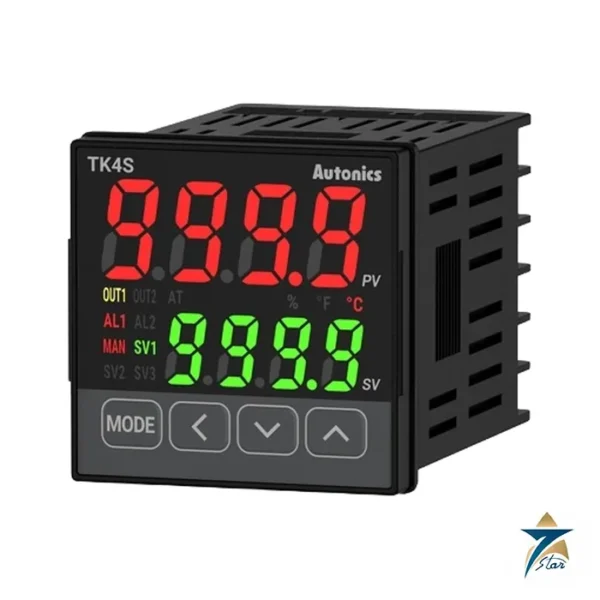
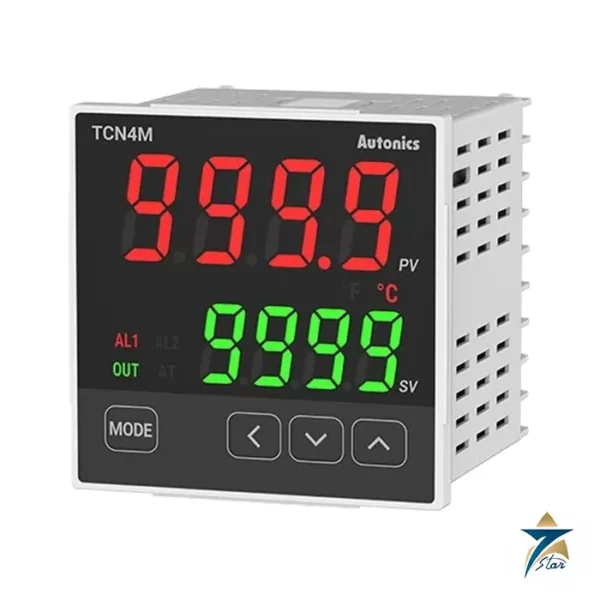
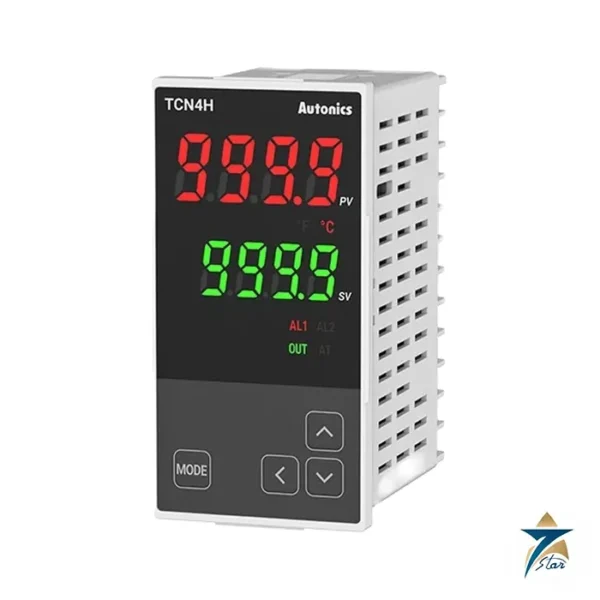
The TC4S is the 48 x 48 mm version at about 94 g, the TC4Y is 72 x 36 mm, the TC4W is 96 x 48 mm, the TC4H is 48 x 96 mm and the TC4L is 96 x 96 mm at about 155 g. The 72 x 72 mm unit here weighs about 133 g. Models with the digit 1 in the third position have one alarm, N has none, and the digit 2 in the supply position selects 24 V AC or 24 to 48 V DC. The TCN dual-display series adds a second line for the setpoint.
Installing the Autonics TC4M-24R
Slide the Autonics TC4M-24R into the panel cut-out and push the mounting bracket with a screwdriver until it grips. Use crimp terminals of the shape given in the manual, either wire ferrules, fork lugs or round lugs, with a width of between 3.0 and 5.8 mm. Install a power switch or circuit breaker where the operator can reach it, and keep the sensor leads away from power cables, or use a line filter or varistor and shielded sensor wire.
The permitted ambient range is -10 to 50 C without condensation; panels in direct sun or hot plant rooms in the Gulf summer may need ventilation or a shade.
Output choice: relay or SSR drive
The Autonics TC4M-24R offers two control outputs that share one function. The relay output switches up to 250 V AC at 3 A and is suited to small heaters, contactor coils and solenoid valves. The SSR drive output provides 12 V DC plus or minus 2 V at up to 20 mA and is meant to drive an external solid state relay, which allows a much faster switching cycle without wearing a mechanical contact. A relay has a rated electrical life of 200,000 operations at full load, so on a heater that cycles every ten seconds, the contacts are used up in about three weeks of continuous operation; a short cycle therefore calls for an SSR.
Choosing the control cycle is therefore a balance. A long cycle of 20 seconds or more with a relay gives a rough but acceptable result on large thermal masses such as oil baths, while a one or two second cycle on an SSR gives smooth control on small heaters. Set the proportional band as narrow as stable control allows, and let auto-tuning find the first values.
Alarm outputs add safety information. Alarm 1 and alarm 2 are set in the parameter menu, and each has its own relay rated at 250 V AC 1 A. Wire the over-temperature alarm to a separate circuit that opens the heater supply, and use the second alarm for a warning to the operator.
Tuning and operation
Start with auto-tuning to find P, I and D values for the load. The deviation arrows flash during auto-tuning once per second. For slow thermal loads such as air ovens, a longer control cycle is acceptable when driving a relay, but for an SSR drive a short cycle of a second or two gives smoother control and longer relay life. The parameters are held in non-volatile memory for about 10 years.
Typical uses in Oman and the GCC
Common uses are curing ovens, dryers, heated tanks for chemical dosing skids, sample conditioning panels and small heat treatment furnaces. The two alarm relays can signal over-temperature to a hooter and cut a heater contactor. This controller is not a safety limiter, so for processes where over-temperature causes hazard, add an independent limit device.
Related items you may also need: Autonics E40S6-2500-6-L-5 Rotary Encoder Incremental | Autonics PR18-8DN M18 Inductive Proximity Sensor 8 mm | Lovato LVM20A240 LVM20 Level Control Relay | All Autonics products.
Autonics TC4M-24R ordering checklist
- When the Autonics TC4M-24R replaces an installed unit, check the existing nameplate against the code on this page before ordering.
- Every enquiry for the Autonics TC4M-24R is answered with a written confirmation of the code, condition and expected lead time.
- Use the attached datasheet to check the Autonics TC4M-24R ratings, dimensions and connection details against your drawings.
- We supply the Autonics TC4M-24R as part of our controllers & data acquisition range to plants in Oman and the GCC.
- For critical duty, keeping one Autonics TC4M-24R as a site spare shortens downtime after a failure.
Documents and quotation
The TC series instruction manual is attached as the datasheet. Send an RFQ for Autonics TC4M-24R to Seven Star LLC with quantity and delivery location and we will confirm availability and lead time for Oman and the GCC.
Datasheets & Documents
- Datasheet Autonics TC4M-24R 72x72 PID Temperature Controller, 2 Alarms Datasheet Download
Reviews (0)
How would you rate this product? Cancel reply
About brand
Autonics is a South Korean maker of sensors and controllers, founded in 1977 as a small engineering business making controllers for looms. It took the Autonics name in 1988 and opened a new corporate headquarters in Busan in 2014. Autonics makes proximity and photoelectric sensors, rotary encoders, temperature controllers, counters, timers and stepper motor systems, with factories in Busan and Yangsan.
Seven Star LLC lists the Autonics E40S6-2500-6-L-5 incremental rotary encoder and supplies Autonics sensors and control devices in Oman and the GCC.
Autonics company profile
| Founded | 1977, South Korea |
|---|---|
| Current name | Autonics, since 1988 |
| Headquarters | Busan, South Korea |
| Factories | Busan and Yangsan |
| Product families | E40 and E50 rotary encoders, PR proximity sensors, BJ photoelectric sensors, TK temperature controllers |
Milestones
- 1977: The company is founded.
- 1988: Renamed Autonics Corporation.
- 2014: Opens its Busan headquarters.
Reading the Autonics E40S encoder code
E40S is the 40 mm diameter shaft-type incremental encoder, and the 6 that follows is the 6 mm shaft. 2500 is the resolution in pulses per revolution. The next 6 means six output signals: A, B and Z with their inverted signals. L is a line driver output and the final 5 is a 5 V DC supply. The same 40 mm body is made in hollow shaft form as the E40H and E40HB series.
Where Autonics encoders are used
Servo and spindle feedback, conveyor length measurement, packaging and printing machines.
Ordering Autonics encoders: what we need
Send the complete model string from the label. If it is worn off, give the body and shaft diameter, pulses per revolution, output type, supply voltage and cable or connector style.
Facts checked against Autonics corporate profiles, October 2026.
Browse Autonics products by category: Encoders.
FAQ
Questions about the Autonics TC4M-24R 72×72 PID Temperature Controller,
Answers from our engineering team on installation, compatibility and integration.
01What does TC4M-24R stand for?
TC4 is the four-digit single display series, M is 72 x 72 mm, 2 means two alarms, 4 means 100-240 V AC and R is relay plus SSR drive output.
02What sensors can the Autonics TC4M-24R read?
It accepts K, J and L thermocouples and Cu50 and DPt100 RTDs, with working ranges up to 1,200 C for K type.
03What is the output rating of TC4M-24R?
The control relay is 250 V AC 3 A or 30 V DC 3 A (1a), the SSR drive is 12 V DC at up to 20 mA, and each alarm relay is 250 V AC 1 A.
04Does TC4M-24R have a second display for setpoint?
No, it is a single-display unit; the dual display TCN series shows PV and SV together on separate lines.
05How is the TC4M-24R mounted?
It is a DIN 72 x 72 mm panel unit installed through a cut-out and held by a bracket pushed on with a screwdriver.


Reviews
There are no reviews yet.