Brand:

Meinberg LANTIME M450 DIN Rail NTP Time Server

Description

Overview

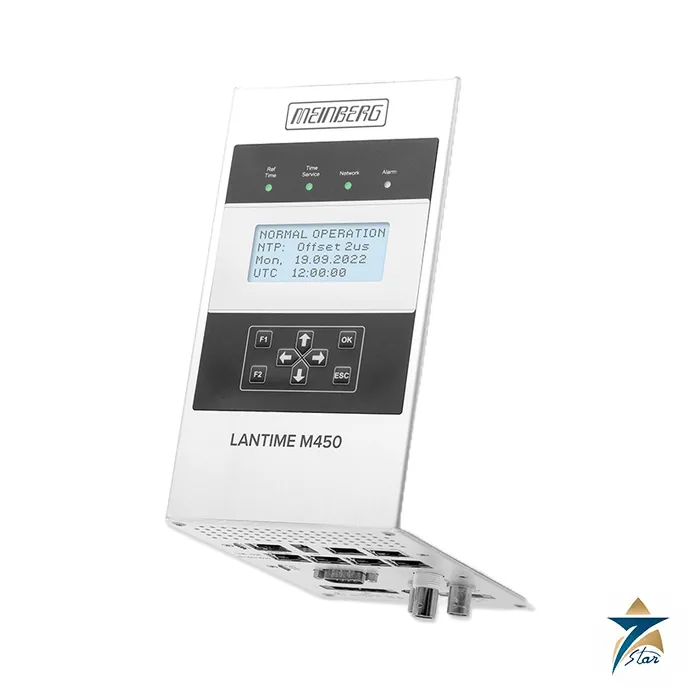
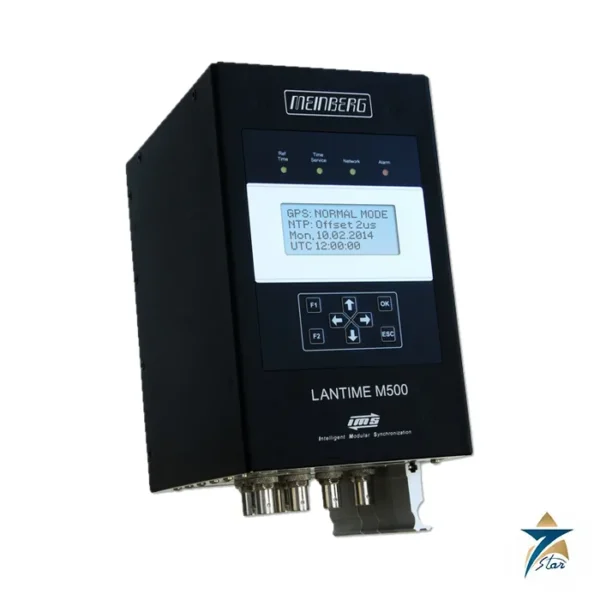
Substations, power plants and process control rooms usually keep their clocks in cabinets, not in racks, and the Meinberg LANTIME M450 is built for that habit. It is an NTP time server packed into a Fischer aluminium housing that clips onto a 35 mm DIN rail, with a built-in Meinberg reference receiver, a four-line LC display and eight push buttons. Seven Star LLC is an independent supplier serving Oman and the GCC. It delivers network time to PLCs, protection relays, SCADA servers and historians, and it can output pulses, frequencies and serial time strings when plant equipment needs more than NTP.

Reference sources available in the Meinberg LANTIME M450

The datasheet lists several reference options. GPS is a plain satellite receiver. GNS is a combined GPS, GLONASS, Galileo and BeiDou receiver. GNS-UC is a GPS and Galileo receiver with an up-converter for the Meinberg GPS antenna and converter. PZF is the DCF77 correlation receiver for central Europe, MSF is the long wave receiver for Great Britain, and TCR reads IRIG A/B, AFNOR or IEEE 1344 time codes. The MRS option combines several sources, such as GPS, PPS, 10 MHz and NTP, and switches between them by priority. Pick the one that matches your antenna site and accuracy needs.

Characteristics of Meinberg LANTIME M450 from the datasheet

Item Datasheet value
Housing Fischer aluminium, DIN mounting rail
Dimensions (W x H x D) 105 x 189 x 146 mm
Display LC display, 4 x 16 characters; eight push buttons
Status LEDs Four bicolour LEDs: reference time, time service, network link, alarm
Network ports 1 x 10/100/1000Base-T RJ45 and 1 x 1000Base-T SFP slot; optional 4 x RJ45 with LNE
NTP capacity Up to 25,000 requests per second
Frequency output 10 MHz via BNC, TTL into 50 ohm
Pulse output PPS, TTL, 200 ms pulse width; accuracy under plus or minus 50 ns with OCXO options
Serial interface One RS-232, baud rates 300 to 19200
Error relay 125 V DC or 140 V AC, 1 A, 30 W DC or 60 VA AC, response about 2 ms
Power supply 100 to 240 V AC or DC standard; 48 V DC low-voltage option (20 to 60 V)
Power consumption 30 W typical
Operating temperature 0 to 50 degrees C; storage minus 20 to plus 70 degrees C
Protocols NTP v2 to v4, SNTP, NTS, PRP, SNMP v1 to v3, SSH, HTTPS, syslog, IPv4 and IPv6

How the Meinberg LANTIME M450 differs from other LANTIME models

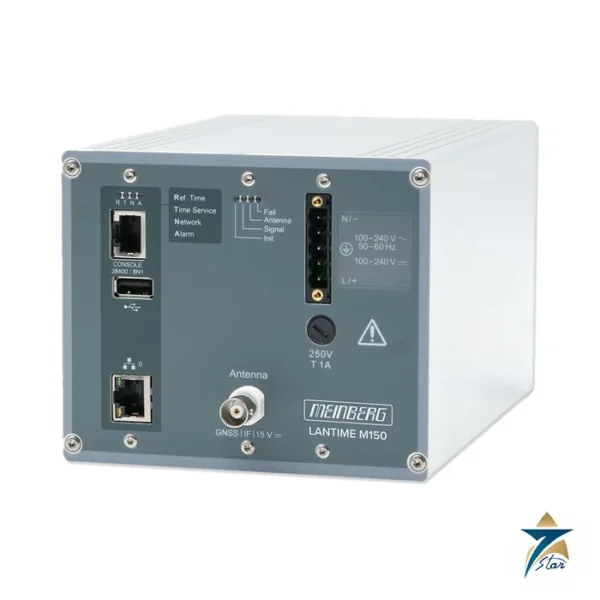
The compact M250 and the DIN rail M150 are entry-level systems, and the modular M500 and M1000 accept many more interface cards. The M450 sits between them for industrial cabinets: it keeps the rail format of the M150 but adds the LC display, the keypad, the SFP network slot, an alarm relay and a broader option range, with up to 6 network ports in a housing only 105 mm wide. Compared with rack models, its 30 W typical consumption and 0 to 50 degrees C range suit enclosed control panels rather than server rooms.

Applications in Oman and the GCC

Utilities across the region use IEC 61850 substations, SCADA masters and event recorders whose logs only make sense when every clock agrees. The Meinberg LANTIME M450 supports synchronisation of IEC 61850 devices through SNTP, and PRP for parallel redundant networks. Oil and gas control rooms, water treatment works, desalination plants and industrial automation systems benefit in the same way, since alarm sequences, protection events and batch records need a common time base that does not depend on an internet connection.

Security and management features

The server supports NTS in unicast client and server mode as of LTOS version 7.08, NTP symmetric keys with MD5, SHA-1 or AES-128-CMAC, and Autokey. The web interface uses HTTPS with TLS certificate management, with a REST API, SSH, a command line interface, syslog, SMTP and SNMP for integration with the monitoring system. A USB port allows firmware updates, backup and restore of configuration, copying of security keys and locking of the front keys.

Oscillator and holdover choices

The GPS version carries a TCXO oscillator as standard. When the satellite signal is jammed or lost, the oscillator decides how far the time drifts, and the datasheet notes options up to OCXO HQ for applications with stricter holdover needs. Pulse accuracy under plus or minus 50 ns is quoted for the OCXO SQ, HQ and DHQ options. Choose the oscillator according to how long a plant must keep time during antenna faults.
Choosing options for a cabinet installation

Because the housing is only 105 mm wide, a cabinet can hold the time server beside the network switch and the power supply, and the antenna cable is the only run that leaves the panel. Think about where the antenna can be installed with an unobstructed view of the sky, how long the cable must be, and whether the cable run needs surge protection at the building entry. If the cabinet already provides a 48 V DC bus, specify the low-voltage supply so that no mains conversion is needed. If the plant relies on legacy pulse or serial inputs, add the output options now, since they are factory fitted.
Installation and commissioning

Clip the housing on the rail, connect the supply, connect the antenna cable for the chosen receiver and place the antenna with a clear sky view. Set the network address from the keypad, then use the web interface for NTP, security and notification settings. Watch the reference LED until the receiver reports synchronisation, which can take some time on a cold start, and then point client devices to the server address.
Maintenance

Review the event log and syslog for reference losses, update firmware through the USB port when a new version is released, and test the error relay during shutdown periods. Inspect the antenna cable and surge protection at intervals.
Ordering notes for Meinberg LANTIME M450

State the reference receiver, the oscillator, the supply voltage and any output options when you request a quotation, because they define the final configuration. Antennas and cables are separate items.

Related items you may also need: Meinberg LANTIME M250 Compact NTP Time Server | Meinberg LANTIME M150 DIN-Rail NTP Time Server | Meinberg LANTIME M320/GPS/AD10 NTP Time Server | All Meinberg products.

Documents and quotation

The manufacturer datasheet for the Meinberg LANTIME M450 is attached to this page. Send your RFQ with the model, receiver option, oscillator, quantity and delivery location in Oman or the GCC.

Datasheets & Documents
  • PDF Datasheet Meinberg LANTIME M450 DIN Rail NTP Time Server Datasheet Download
Reviews (0)

Reviews

There are no reviews yet.

How would you rate this product?

It takes about 10 seconds — just tap a star. Your email is never published.

About brand

Meinberg is a German maker of time and frequency synchronisation products, founded in 1979 by the brothers Werner and Günter Meinberg in Bad Pyrmont. It began with DCF77 longwave radio clock receivers and now makes GPS and GNSS-referenced NTP and PTP time servers. Meinberg is family-owned and designs and manufactures its products in Bad Pyrmont.

Seven Star LLC sources and supplies Meinberg LANTIME time servers for utilities and networks in Oman, including the M1000 and M320 listed here.

Meinberg company profile

Founded 1979, Bad Pyrmont, Germany
Founders Werner and Günter Meinberg
Ownership Family-owned
Manufacturing Bad Pyrmont, Germany
Product families LANTIME M150, M250, M320, M500 and M1000 NTP/PTP time servers, IMS modular systems, GNSS and DCF77 receivers, PTP grandmaster clocks

Meinberg LANTIME models listed here

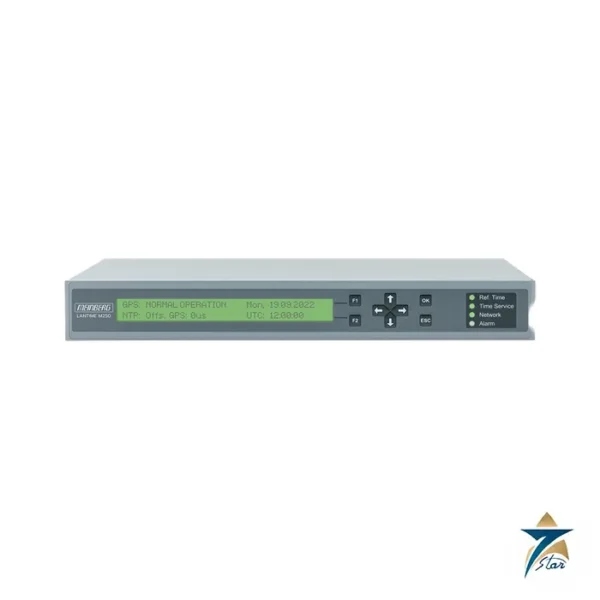
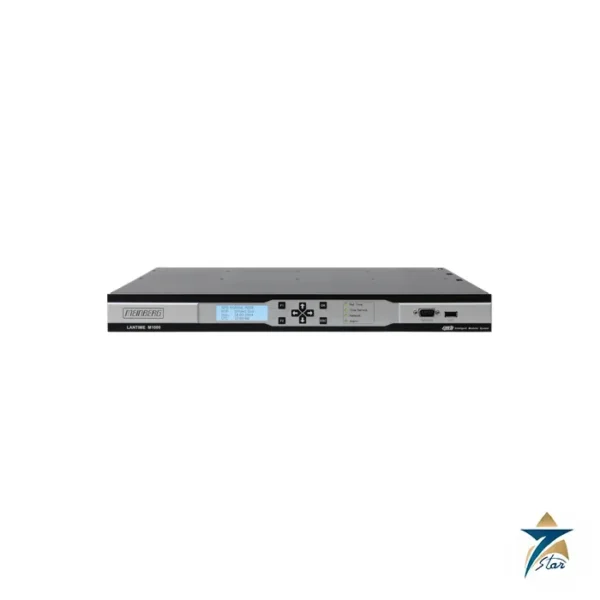
The LANTIME M320 is a 1U rackmount NTP time server. It works as a stratum 1 source with its own reference receiver, and Meinberg offers it with GPS, combined GNSS, DCF77 (PZF), MSF and IRIG time code references. The LANTIME M1000 is a 1U platform on the modular IMS system, with slots for up to two reference clocks, two power supplies and hot-pluggable I/O modules, plus PTP (IEEE 1588) and IEC 61850 time synchronization.

Meinberg products we list

Family Examples
Industrial Communications LANTIME M1000 Modular NTP/PTP Time Serve…, LANTIME M150 DIN-Rail NTP Time Server, LANTIME M250 Compact NTP Time Server, LANTIME M320/GPS/AD10 NTP Time Server, LANTIME M500 Modular DIN-Rail Time Server

Ordering a Meinberg time server: what we need

A Meinberg order code describes the build. In M320/GPS/AD10, GPS is the receiver and AD10 is the wide-range AC/DC power supply. Send the full code or serial number, the reference source, oscillator option, supply voltage, the outputs you need (PPS, 10 MHz, IRIG, extra LAN ports) and the antenna cable length. GCC utility projects often require redundant supplies.

Facts checked against Meinberg's own company history (meinbergglobal.com), October 2026.

FAQ

Questions about the Meinberg LANTIME M450 DIN Rail NTP Time Server

Answers from our engineering team on installation, compatibility and integration.

01What is the Meinberg LANTIME M450 used for?
It is a DIN rail NTP time server with an internal Meinberg reference clock that supplies accurate time to networks in substations, process control and industrial automation.
02Which reference sources can the Meinberg LANTIME M450 use?
Options in the datasheet are GPS, GNS multi-GNSS, GNS-UC, PZF, MSF, TCR time code and MRS multi reference source.
03What network interfaces does the Meinberg LANTIME M450 have?
It has one 10/100/1000Base-T RJ45 port and one 1000Base-T SFP slot, with optional four more RJ45 ports using the LNE module.
04How is the Meinberg LANTIME M450 powered?
The standard supply is 100 to 240 V AC or DC, with a 48 V DC option covering 20 to 60 V, and typical consumption is 30 W.
05What are the dimensions of the Meinberg LANTIME M450?
The aluminium DIN rail housing measures 105 x 189 x 146 mm (W x H x D) and works between 0 and 50 degrees C.