Brand:

Autonics TC4S-24R 48×48 Single Display PID Controller

Description

Overview

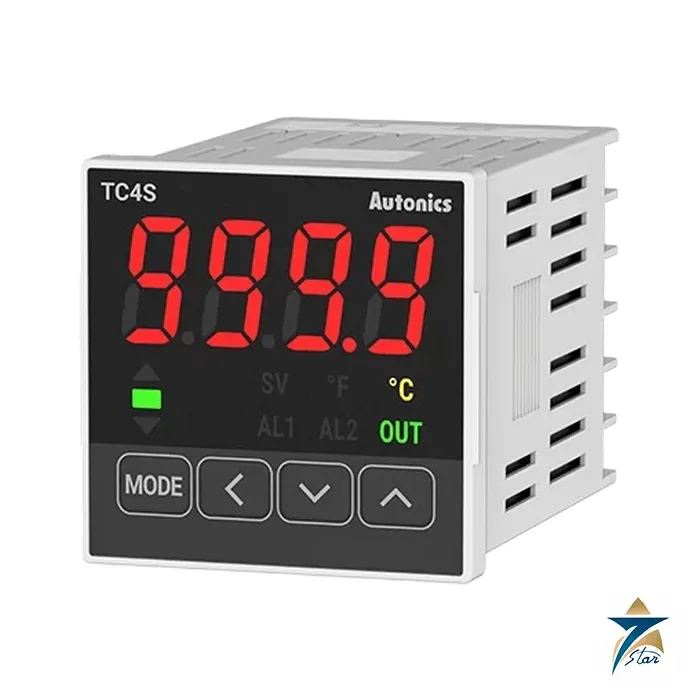
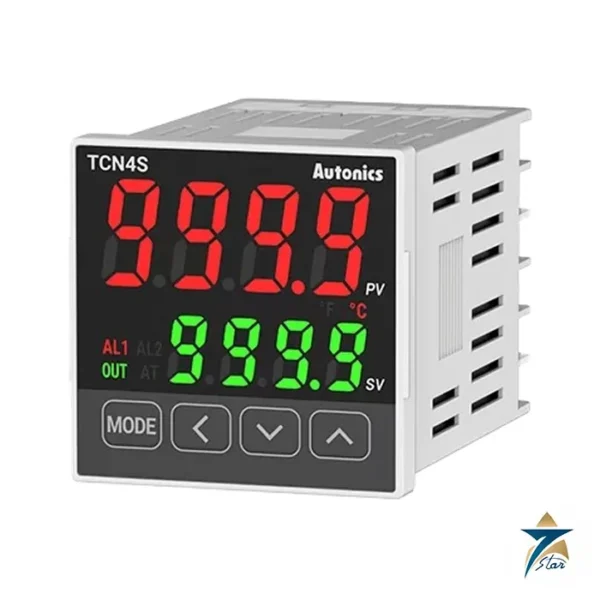
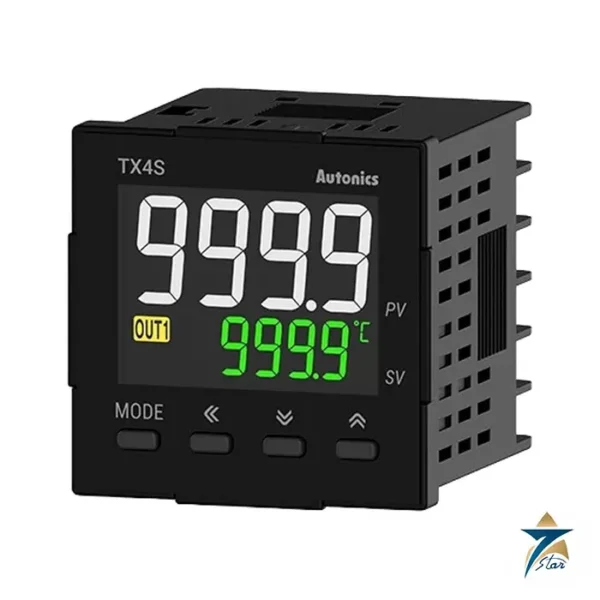
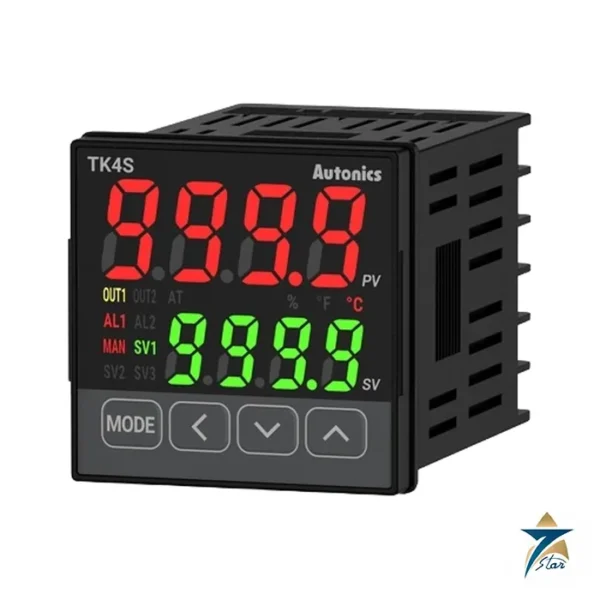
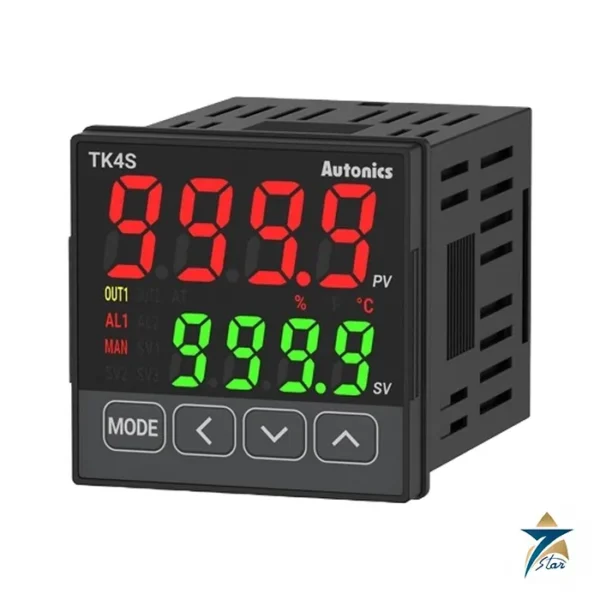
One display, one red number, three small arrows: the Autonics TC4S-24R keeps temperature control simple. It is the single display PID controller of the economical TC series in a 48 x 48 mm DIN case, powered from 100 to 240 V AC, with a relay and an SSR drive output and two alarm outputs. Instead of a second display for the setpoint, it shows the process value and uses deviation indicators to tell the operator at a glance whether the temperature is above, below or on target. Seven Star LLC is an independent supplier serving Oman and the GCC.

Reading the code Autonics TC4S-24R

TC4 is the four-digit single display series, and S stands for the 48 x 48 mm size. After the dash, 2 is the number of alarm outputs, 4 is the 100 to 240 V AC supply, and R is the control output of relay plus SSR drive. A code with N in the alarm position would have no alarm, 1 would give one alarm, and an N in the output position would make the unit an indicator without a control output.

Specifications of Autonics TC4S-24R

Item Data
Front size 48 x 48 mm, cut-out 45 mm square
Display Single red 7-segment LED with deviation indicators
Supply 100 to 240 V AC 50/60 Hz, 5 VA or less
Sampling period 100 ms
Control output Relay 250 V AC 3 A, 30 V DC 3 A, 1a, plus SSR drive 12 V DC plus or minus 2 V, up to 20 mA
Alarm outputs AL1 and AL2, relay 250 V AC 1 A, 1a
Inputs Thermocouples K, J, L; RTD Cu50, DPt100
Ranges K minus 50 to 1,200; J minus 30 to 500; L minus 40 to 800; Cu50 minus 50 to 200; DPt100 minus 100 to 400 degrees C
Control ON/OFF, P, PI, PD, PID; cycle 0.5 to 120.0 seconds
Mechanical relay life 5 million operations
Electrical relay life 200,000 (control) and 300,000 (alarm)
Dielectric strength 2,000 V AC for 1 minute
Ambient minus 10 to plus 50 degrees C
Weight about 94 g, about 141 g packaged

How the Autonics TC4S-24R differs from other TC4 variants

The TC4 range offers S, SP (11-pin plug, about 76 g), Y (72 x 36 mm, about 85 g), M, H, W and L sizes. The standard S has a 45 mm cut-out; the TC4Y needs 68 x 31.5 mm. In the output position N makes an indicator without control, while R adds both the relay and the SSR drive. The Autonics TC4S-24R has two alarms, but the 1 variant has one and the N variant none. Compared with the dual display TCN4S-24R, which weighs about 100 g, this unit saves about 6 g and one display, and it offers fewer thermocouple types: K, J and L, with J limited to 500 degrees C, against K, J, L, T, R and S on the TCN.

Using the deviation lights

Three LEDs show the deviation of the process value from the setpoint: the upward arrow lights when the temperature exceeds the setpoint by more than 2 degrees C, the square when it is within plus or minus 2 degrees C, and the downward arrow when it is more than 2 degrees C below. An operator can read the state of the process from several metres away without reading the digits, and an SV lamp tells when the display is showing the setting value instead of the measured value. The AL1 and AL2 lamps show the alarm outputs, and the OUT lamp shows the control output.

Applications in Oman and the GCC

This is a unit for straightforward heating jobs: sealing and shrink equipment, small ovens, heated tanks, laboratory baths, coffee, bakery and food service equipment, and simple extrusion. Single display controllers keep the panel uncluttered and cost less than dual display units. For equipment shipped to hot climates, check that the cabinet does not push the controller above its 50 degrees C limit.

Choosing between the TCN and TC series for the Autonics TC4S-24R

Both lines belong to the economical class, and both use the same 100 ms sampling period, ON/OFF to PID control types, proportional band from 0.1 to 999.9 degrees, integral and derivative times of 0 to 9,999 seconds and a manual reset of 0.0 to 100.0 percent. The decision usually comes down to the display and the input list. A technician who wants to read the setpoint at all times will prefer the dual display TCN, while a panel builder who values a clean front and a low cost chooses the single display TC and relies on the deviation lights. If the process needs T, R or S thermocouples, the TCN is needed, because the TC list stops at K, J and L.

The temperature range of J thermocouples is also different: 500 degrees C on this single display series compared with 800 degrees C on the dual display one, so check the process maximum before ordering. For furnaces beyond 1,200 degrees C neither series is suitable, and the premium TK range with B, R, S and C thermocouples should be chosen instead.

Once the model is chosen, write the complete code on the machine drawing together with the supply voltage, since a unit with the digit 2 for 24 V AC or 24 to 48 V DC looks the same as a mains unit from the front.

Installation

Cut a 45 mm square panel opening and push the controller in, then fasten the bracket in the arrow direction with a flathead screwdriver. Use crimp terminals of the specified shape for the screw terminals, run three equal-length leads for RTDs and keep sensor wiring away from power cables. Use the relay for contactors and small loads up to 3 A, or the SSR drive for solid state relays. Do not use the alarm contacts as the sole protection against over-temperature.

Operation and reset

The MODE key and the three arrow keys set the setpoint and parameters, and auto tuning is started from the parameters and flashes the AT lamp every second. If a setting error occurs, holding the left, up and down arrows for more than five seconds in run mode initialises parameters, which should be used with care. When the sensor is open, the display flashes OPEN and the control output follows the sensor error setting.

Accuracy and service notes

At room temperature the display accuracy is plus or minus 0.5 percent or 1 degree C, whichever is greater, plus one digit, and 1 degree C more if the decimal point 0.1 resolution is selected. For the L thermocouple and Cu50 RTD the figures are 2 degrees C. Parameters remain stored for about ten years. Replace the controller if the output relay begins to stick, and keep records of switching frequency to anticipate wear.

Related items you may also need: Autonics E40S6-2500-6-L-5 Rotary Encoder Incremental | SICK WTB27-3P2411 Background Suppression Sensor | Omron E3Z-R61 Photoelectric Sensor retro-reflective | All Autonics products.

Documents and quotation

The TC series product manual covering the Autonics TC4S-24R is attached with its ordering information, input ranges, wiring and dimensions. Send an RFQ with the part number Autonics TC4S-24R, quantity and delivery location in Oman or the GCC.

Other Models in the TC Range

Seven Star LLC supplies models from the TC range in Oman and the GCC. Compare the related models below and request a quote for the one that matches your application.

ModelCategory
Autonics TCN4S-24R 48×48 Dual Display PID ControllerPhotoelectric SensorsView details
Autonics TC4S-24R 48×48 Single Display PID ControllerPhotoelectric SensorsYou are viewing this model
Datasheets & Documents
  • PDF Datasheet Autonics TC4S-24R 48x48 Single Display PID Controller Datasheet Download
Reviews (0)

Reviews

There are no reviews yet.

How would you rate this product?

It takes about 10 seconds — just tap a star. Your email is never published.

About brand

Autonics is a South Korean maker of sensors and controllers, founded in 1977 as a small engineering business making controllers for looms. It took the Autonics name in 1988 and opened a new corporate headquarters in Busan in 2014. Autonics makes proximity and photoelectric sensors, rotary encoders, temperature controllers, counters, timers and stepper motor systems, with factories in Busan and Yangsan.

Seven Star LLC lists the Autonics E40S6-2500-6-L-5 incremental rotary encoder and supplies Autonics sensors and control devices in Oman and the GCC.

Autonics company profile

Founded 1977, South Korea
Current name Autonics, since 1988
Headquarters Busan, South Korea
Factories Busan and Yangsan
Product families E40 and E50 rotary encoders, PR proximity sensors, BJ photoelectric sensors, TK temperature controllers

Milestones

  • 1977: The company is founded.
  • 1988: Renamed Autonics Corporation.
  • 2014: Opens its Busan headquarters.

Reading the Autonics E40S encoder code

E40S is the 40 mm diameter shaft-type incremental encoder, and the 6 that follows is the 6 mm shaft. 2500 is the resolution in pulses per revolution. The next 6 means six output signals: A, B and Z with their inverted signals. L is a line driver output and the final 5 is a 5 V DC supply. The same 40 mm body is made in hollow shaft form as the E40H and E40HB series.

Where Autonics encoders are used

Servo and spindle feedback, conveyor length measurement, packaging and printing machines.

Ordering Autonics encoders: what we need

Send the complete model string from the label. If it is worn off, give the body and shaft diameter, pulses per revolution, output type, supply voltage and cable or connector style.

Facts checked against Autonics corporate profiles, October 2026.

FAQ

Questions about the Autonics TC4S-24R 48×48 Single Display PID

Answers from our engineering team on installation, compatibility and integration.

01What display does the Autonics TC4S-24R have?
It has a single red 7-segment display for the process value, with LED arrows showing whether the temperature is above, within or below plus or minus 2 degrees C of the setpoint.
02How many alarms does the Autonics TC4S-24R provide?
The digit 2 in the code gives two alarm outputs, each a relay rated 250 V AC 1 A, 1a.
03What control output does the Autonics TC4S-24R have?
R means a relay output rated 250 V AC 3 A together with an SSR drive output of 12 V DC plus or minus 2 V at up to 20 mA.
04Which sensors does the Autonics TC4S-24R accept?
Thermocouples K, J and L and RTDs Cu50 and DPt100, fewer than the TCN dual display series.
05What supply does the Autonics TC4S-24R need?
The digit 4 stands for 100 to 240 V AC at 50/60 Hz, with 5 VA or less consumption.