BR booster relay: compact volume booster for pneumatic actuators
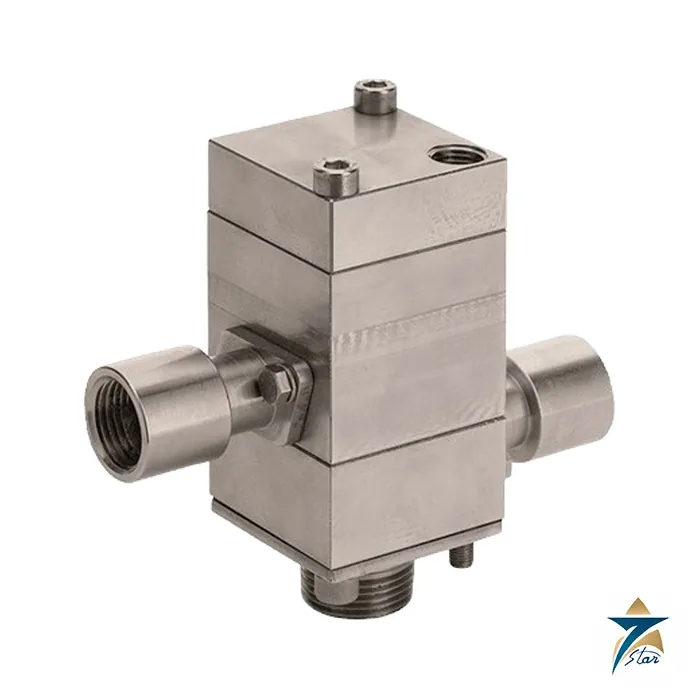
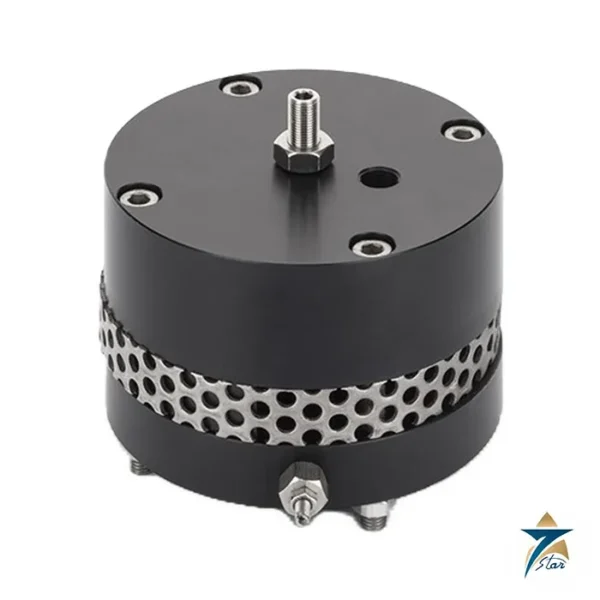
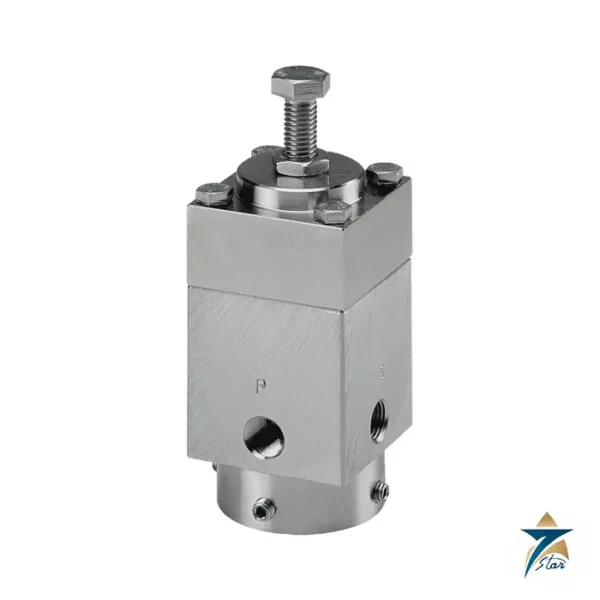
The IMI STI BR booster relay is a small, high-capacity pneumatic volume booster that sits between a valve positioner and an actuator. It amplifies the air flow of the positioner output, so a large actuator fills and vents faster than the positioner alone could manage, which shortens stroking time. A built-in stabilising bypass valve lets the commissioning engineer trade speed against loop stability. The BR is designed to be piloted by a digital-pneumatic valve controller, and the manual names the manufacturer FTC smart positioner as the intended pilot. Seven Star LLC supplies the BR in Oman and the GCC as an independent supplier in Muscat.
The BR uses a metal piston rather than a diaphragm, which gives it a robust internal construction and a long service life in the data sheet table (30 years expected lifetime). The body is available in stainless steel 316 or aluminium, with copper-free versions of both.
BR booster relay decoded model selection
The instruction manual presents the BR with a structured model code: BR – S – M – P – T – C – O. The available values are as follows.
| Field |
Available values |
| S: size |
08 = 1/2″ |
| M: material |
S0 stainless steel SS316; S1 stainless steel SS316 copper-free; A0 aluminium; A1 aluminium copper-free |
| P: painting |
00 not painted; 01 standard painting cycle (CVA.01); 99 customised painting |
| T: temperature range |
H = -20°C to +85°C; S = -20°C to +70°C; L = -40°C to +70°C; E = -55°C to +70°C; U = -60°C to +100°C |
| C: connections |
Four-digit code for pilot, supply, actuator and exhaust connections, for example 2CC5 |
| O: options |
As agreed with the manufacturer |
The manual lists two models as currently existing: BR-08-S0-00-H-2CC5 and BR-08-S0-00-S-2CC5 (part number 160670 for both), and BR-08-S0-00-L-2CC5 (part number 160671). Not every combination of the code is available, so a configuration check is needed.
BR technical specifications
| Parameter |
Specification |
| Manufacturer / part number |
IMI STI (Process Automation) / BR booster relay |
| Size |
1/2″ (08) |
| Body material |
Stainless steel 316 or aluminium; copper-free versions available |
| Gasket material |
NBR, Viton or fluorosilicone |
| Working pressure |
3 bar minimum, 7 bar maximum; design pressure 10 bar |
| Working temperature |
-20°C to +85°C standard; extended range -60°C to +100°C |
| Storage temperature |
-40°C to +95°C |
| Flow coefficient |
Cv inlet maximum 3.8; Cv outlet maximum 4.0 |
| Connections |
Pilot 1/4″; exhaust 3/4″; supply and actuator ports per connection code, listed in the product summary as 1/2″ NPT |
| Fluid |
Air or natural gas |
| Operation |
Automatic, with piston and adjustable stabilising bypass |
| Mounting |
Manifold mounting or piped |
| Expected lifetime |
30 years (per the manual) |
| Hazardous-area marking listed |
ATEX Ex h IIB/IIC T6/T5/T4 and Ex h IIIC T85°C/T100°C/T135°C Db; IECEx and UKEX equivalents |
The ATEX, IECEx and UKEX marking listed above is for the product type in the manual. Check the label on the unit you order against your area classification.
How the BR booster relay works
The pilot signal from the positioner acts on a piston inside the relay. When the piston moves, a shutter opens a high-flow path from the supply port to the actuator port, or from the actuator to the exhaust, in proportion to the pilot pressure. The relay therefore delivers a larger air flow than the positioner could pass directly, but with the same pressure that the positioner commands. A regulation screw opens the stabilising bypass, which feeds a controlled flow of pilot air to the output and lets the loop stay stable while retaining speed. The screw is lockable and cannot be ejected under pressure.
Boosters are usually added when the actuator volume is large, when stroking time is specified or when a quick response to a trip is needed. Tuning is a matter of closing the bypass screw first and opening it gradually while watching the valve travel for overshoot or oscillation.
Where the BR fits in the IMI STI accessory range
Within the same instrument-valve group the AV volume booster and UD derivative unit address related tasks, with the UD focused on exhaust amplification. The BR is the compact, metal-piston option with an integral bypass. It is intended for use with digital positioners such as the FasTrak, and with smart positioners generally. If the control system already uses a high-flow positioner such as the QuickTrak TM, no booster is normally required.
Selection and ordering checklist for the BR
- Body material: stainless steel 316 for offshore and corrosive atmospheres, aluminium for general use, and copper-free if the process requires it.
- Temperature code: choose the code that covers the lowest and highest ambient at the valve.
- Painting: none, standard cycle or a customer specification.
- Connection code and port threads, matching the actuator and supply tubing.
- Actuator type: single or double acting, and how many boosters the circuit needs.
- Supply pressure: it must remain between 3 and 7 bar.
- Gasket material for the temperature and fluid used.
- Hazardous area classification and label requirements.
Installation, adjustment and maintenance
Check the supply pressure against the design pressure before connecting. Use suitable fittings, deburr rigid pipe ends, flush the tubing with supply fluid and use non-hardening sealant on male threads only. The manual recommends 8 mm or 3/8″ tubing for pilot lines, and tubing larger than the port thread for supply and exhaust, to protect the high flow. Earthing is provided through the fixing screws or the pneumatic fittings; if neither gives an earth path, connect it directly.
During start-up check the air quality and leak-test the connections. Periodic inspection is mainly visual, and the user should keep a layer of dust off the surface because build-up affects cooling and surface temperature in a hazardous area. The manufacturer states that no special maintenance is needed in standard applications. Disassembly and repair are done by the manufacturer, so a failed relay is exchanged or returned instead of being rebuilt on site.
Typical BR applications in Oman and the GCC
Large pneumatic actuators on control valves in oil and gas, gas processing, power and desalination plants often need a booster to meet stroke-time requirements. Temperature codes down to -60°C are rarely needed locally, but the stainless steel body and copper-free option suit coastal humidity and salt, while the +85°C and +100°C ranges cover summer solar heating on skid-mounted accessories. The manufacturer cites offshore, sandstorm and low-temperature environments among suitable conditions.
Information to send with a BR request
- Part name BR booster relay, quantity and, if known, the full model code.
- Actuator make, size and volume, and its stroke-time requirement.
- Positioner model that will pilot the booster.
- Supply pressure, fluid and ambient temperature range.
- Material, painting and connection requirements.
- Hazardous area classification.
Documents and quotation
The IMI STI instruction manual 2074 for the BR booster relay is attached on this page, with the model selection code, technical data, certification table and part lists summarised above.
Send the part number, model code and quantity to Seven Star LLC and we will confirm lead time and any other available documents for the BR booster relay.
Other Models in the Sti Booster Range
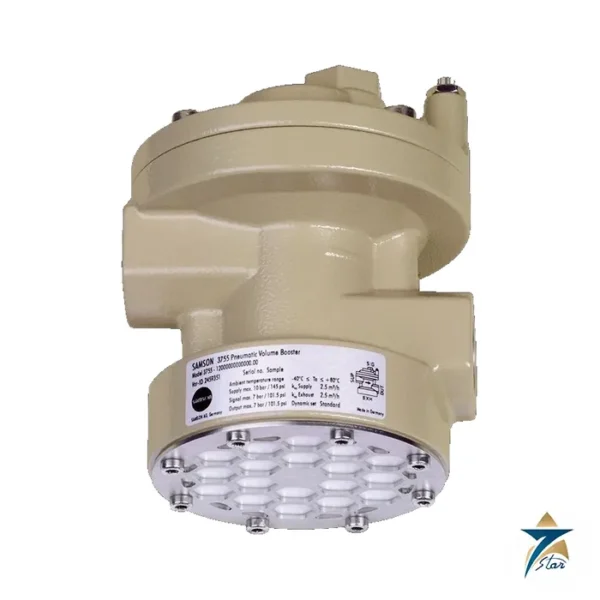
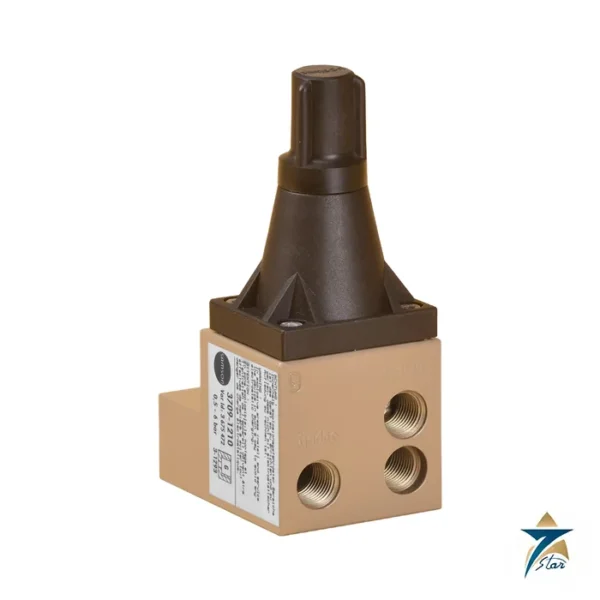
Seven Star LLC supplies models from the Sti Booster range in Oman and the GCC. Compare the related models below and request a quote for the one that matches your application.




















Reviews
There are no reviews yet.