IMI STI BD derivative booster for double acting actuators
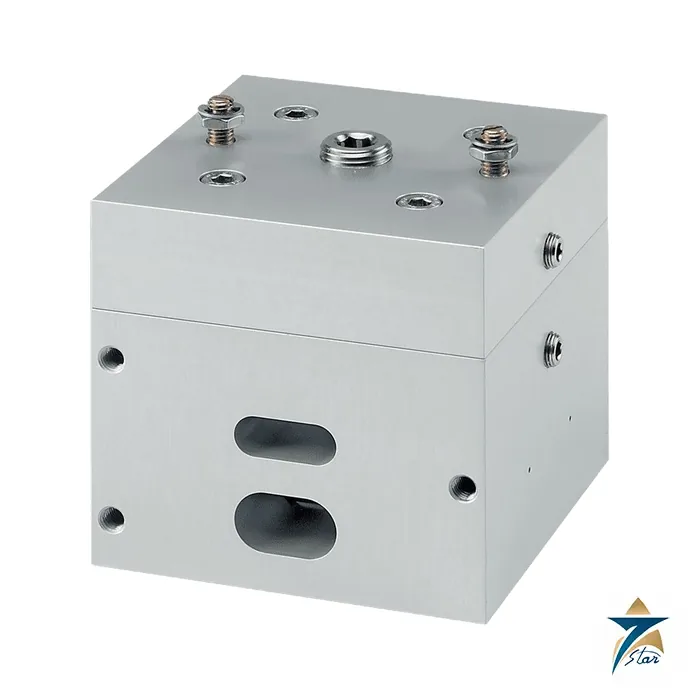
The IMI STI BD is a derivative booster used together with a positioner on a control valve to make a double acting pneumatic actuator stroke faster. Seven Star LLC supplies the IMI STI BD in Oman and the GCC as an independent supplier in Muscat, for plants where a standard positioner output is too slow for the actuator volume.
“BD” is the manufacturer’s model code for the Derivative Booster. The brochure does not give a coded ordering string, so the choices you confirm are the body material (anodised aluminium or stainless steel 316), the temperature range, and options such as a Cv limiter or a collectable exhaust. The BD mounts on a manifold face rather than on pipe fittings, which affects what you need to order alongside it.
IMI STI BD technical specifications
| Parameter |
Specification |
| Manufacturer / part number |
IMI STI / BD (Derivative Booster) |
| Housing materials |
Anodised aluminium; stainless steel 316 |
| Minimum operating pressure |
2.5 bar |
| Maximum operating pressure |
7 bar |
| Design pressure |
10 bar |
| Cv max |
Inlet 4.5; outlet 9 |
| Pilot signal connection |
1/2″ NPT |
| Feeding and output connections |
Manifold mounting |
| Operating temperature |
-20°C to 70°C; -40°C to 70°C and -20°C to 85°C available; other limits on request |
| Weight |
Aluminium 4 kg; stainless steel 11 kg |
| Actuator type |
Double acting |
| Recommended Cv ratio |
Exhaust to charge ratio of 2 gives the best speed gain without hurting stability |
| Positioner Cv that can pilot it |
0.3 to 1; for ON/OFF execution a minimum of 0.3 |
How the BD speeds up stroking
A positioner has a limited output flow. On a large double acting actuator, that limit sets the stroking time, because the positioner must both fill one chamber and empty the other through small passages. The BD removes much of that burden. It is piloted by the exhaust flow of the positioner, and when that flow is present it exhausts one actuator chamber and pressurizes the other simultaneously through its own larger passages. A short stroke time in one direction can therefore be achieved with a single device.
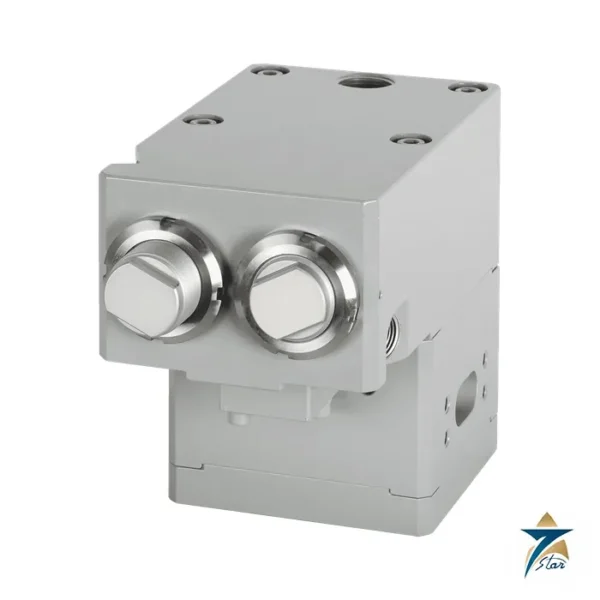
The BD has two adjusting screws. One sets the positioner flow level at which the booster switches on, and the other sets the level at which it switches off. This lets the commissioning engineer keep the booster out of play during small corrections, where the positioner alone gives stable control, and bring it in only during large, fast moves. The brochure notes that the regulation screw cannot be ejected by internal air pressure and that the adjustment is accurate and lockable.
Internally the brochure highlights a metal piston design with a high-integrity diaphragm. An optional Cv limiter is available, and the exhaust can be collected, for example with a silencer, protection or check valve arrangement, and the BD is described as suitable for SL exhaust protection systems.
Choosing the right Cv balance for the BD
With Cv values of 4.5 at the inlet and 9 at the outlet, the BD is built with an exhaust-to-charge ratio of 2. The brochure states that this ratio is the optimal choice, because it increases speed without compromising modulating stability. Making the exhaust much larger than the charge path may lead to overshoot or hunting, while a ratio near 1 gives less speed benefit. If your actuator needs a different balance, ask for the Cv limiter option rather than altering the device in the field.
The positioner must also be matched. The BD can be piloted by a positioner with a Cv between 0.3 and 1, and in ON/OFF duty with a minimum Cv of 0.3. A positioner with a smaller exhaust capacity than this may not generate enough pilot flow to trigger the booster reliably.
Where the BD fits with related IMI STI accessories
The BD belongs to the same instrument accessory range as the UD derivative unit, the CSQ integral quick exhaust valve, the TP pressure switch and the AL air-lock device. The CSQ gives fast exhaust for solenoid or positioner-driven actuators, the TP and AL protect against supply loss, and the BD is the choice when you want a fast two-way move using the positioner exhaust as the trigger. Manifold mounting also lets the BD be combined with other STI accessories on the same actuator without extra fittings or nipples, which reduces leak points, inventory and overall dimensions.
Selecting a BD
- Actuator: the BD is for double acting actuators only; a spring-return actuator needs a different accessory.
- Actuator volume and required stroking time: size the booster so that the Cv gain matches the speed target.
- Housing: aluminium at 4 kg or stainless steel 316 at 11 kg. Allow for the extra weight when planning the actuator bracket or yoke support.
- Supply pressure: from 2.5 to 7 bar operating, with design pressure of 10 bar.
- Mounting: confirm the manifold interface on the actuator or on the accessory block so that the BD seals correctly with its o-rings.
- Options: Cv limiter, collectable exhaust, and the required temperature variant.
Installation, commissioning and maintenance of the BD
Mount the BD on a clean, flat manifold face so that the machined connection faces and o-rings seal without fittings. Make the 1/2″ NPT pilot connection from the positioner exhaust, and use short, adequately sized tubing so that the booster sees the pilot signal without lag. Before pressurizing, check that the o-rings are present and undamaged.
During commissioning, stroke the valve in both directions at several amplitudes. Start with the switch-on screw set conservatively, then reduce it until the BD begins to assist on large moves but remains inactive during small corrections. Watch the valve for overshoot after a large step; if present, adjust the screws or consider the Cv limiter. Lock the adjusters and note the settings. Periodic checks should include listening for continuous leakage from the exhaust, verifying the stroke time against the commissioning record, and keeping the exhaust port free from dust and insects.
Typical applications in Oman and the GCC
Fast-stroking control valves are important on compressor anti-surge service, turbine bypass and steam conditioning lines, large pressure control valves and gas processing trains. These applications use big actuators where positioner speed alone is not enough. In Oman and across the GCC, high ambient temperatures and dust make the 85°C variant, the stainless steel body and a protected exhaust worth considering, especially on outdoor skids and offshore platforms.
BD variant overview
| Option |
Value |
Typical fit |
| Aluminium |
4 kg |
Onshore skids where weight matters |
| Stainless steel 316 |
11 kg |
Offshore, coastal and corrosive areas |
| -20°C to 70°C |
Standard |
General service |
| -40°C to 70°C |
Available |
Cold ambient |
| -20°C to 85°C |
Available |
Hot enclosures |
Information to send with a BD request for quotation
- Part number BD and the housing material.
- Actuator model, volume and required stroking time in each direction.
- Positioner model and its exhaust Cv.
- Supply pressure and ambient temperature range.
- Option requirements: Cv limiter, collectable exhaust, silencer or protection.
- Manifold interface details, quantity and delivery location.
Documents and quotation
The manufacturer brochure for the IMI STI BD is attached on this page as a PDF, so your engineers can compare it with the data above before ordering. Seven Star LLC is an independent supplier in Muscat and does not act on behalf of the brand, and we do not publish prices online.
To receive a quotation for the IMI STI BD, send the details listed in the previous section by email or through the RFQ form. We reply with availability, lead time and commercial terms for delivery in Oman and across the GCC.
Other Models in the Sti Booster Range
Seven Star LLC supplies models from the Sti Booster range in Oman and the GCC. Compare the related models below and request a quote for the one that matches your application.




















Reviews
There are no reviews yet.