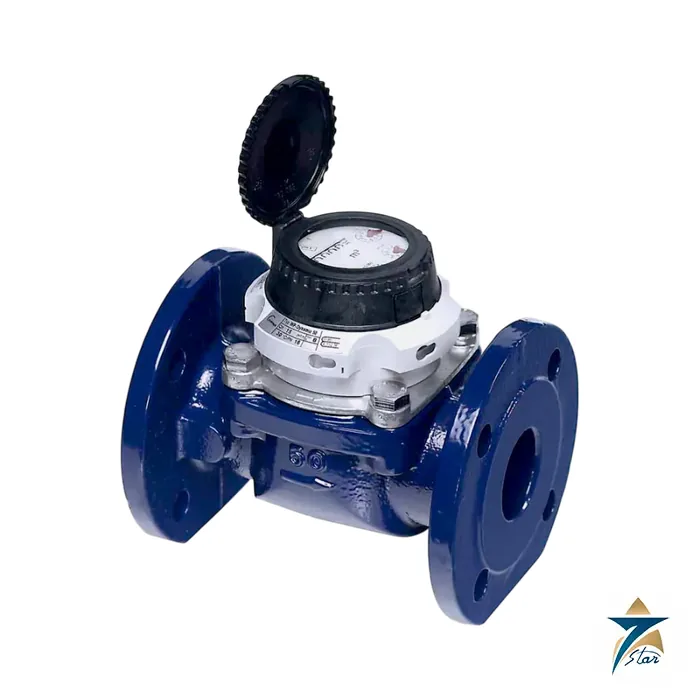
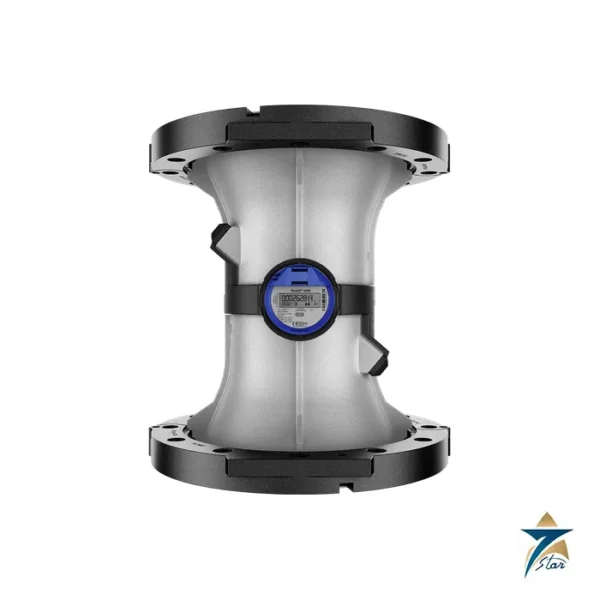
The Sensus WP-Dynamic is a turbine water meter for cold water up to 50 degC at PN 16, made in sizes DN 40 to DN 300. It is designed for measuring high, relatively constant flow rates, for example behind pumps, and it combines a hermetically sealed IP68 register with a patented hydrodynamically balanced rotor and a pattern-approved, removable measuring element. A powder-coated cast iron body gives corrosion protection.
Technical specifications
| Parameter |
Specification |
| Product |
Sensus WP-Dynamic turbine water meter, cold water up to 50 degC, PN 16 |
| Nominal sizes |
DN 40, 50, 65, 80, 100, 125, 150, 200, 250, 300 |
| Body |
PN 16 cast iron with powder coating; plastic measuring element and rotor; brass or stainless steel parts also used |
| Register |
Hermetically sealed, IP68; can be rotated through 360 degrees; smallest reading 0.0005 m3 (DN 50 to 125) or 0.005 m3 (DN 150 to 300) |
| Installation |
Horizontal, vertical or inclined; meter head upwards or sideways; unrestricted straight pipe 3 x DN upstream; no abrupt restrictions downstream |
| Rotor |
Patented hydrodynamically balanced rotor and patented symmetrical calibration adjustment |
| Options |
Up to 3 pulsers (1 x OD, 2 x RD) fitted without breaking the approval seal; 1/4 in connection port for pressure sensors |
| Pulse values |
RD 01: 0.1 and 1 m3 (DN 40-125) or 1 and 10 m3 (DN 150-300); OD 01: 0.001 m3 or 0.01 m3; OD 03: 0.01 m3 or 0.1 m3 |
| Applications |
Measurement of high, relatively constant flow rates, for example behind pumps; not affected by external magnetic fields; pattern approved removable measuring element |
Performance according to OIML R49 / ISO 4064 (m3/h)
| DN |
40 |
50 |
65 |
80 |
100 |
125 |
150 |
200 |
250 |
300 |
| Q3 continuous |
25 |
40 |
63 |
100 |
160 |
250 |
400 |
630 |
1000 |
1600 |
| Q4 peak (short time) |
31.25 |
50 |
78.75 |
125 |
200 |
312.5 |
500 |
787.5 |
1250 |
2000 |
| Q2 transitional |
0.63 |
0.64 |
1.01 |
1.6 |
2.6 |
4 |
6.4 |
10.1 |
16 |
40.6 |
| Q1 minimum |
0.4 |
0.4 |
0.63 |
1 |
1.6 |
2.5 |
4 |
6.3 |
10 |
25.4 |
| Ratio |
63 |
100 |
100 |
100 |
100 |
100 |
100 |
100 |
100 |
63 |
Order numbers, PN 16
| DN |
40 |
50 |
65 |
80 |
80 |
100 |
125 |
150 |
200 |
250 |
300 |
| Length (mm) |
220 |
200 |
200 |
200 |
225 |
250 |
250 |
300 |
350 |
450 |
500 |
| Order no. |
828593 |
828595 |
828597 |
828599 |
828601 |
828603 |
828605 |
828607 |
828717 |
828719 |
828743 |
Measuring element, register and pulsers
The measuring element is plastic and removable, so it can be exchanged without replacing the body, and the register can be turned through 360 degrees for easy reading. The meter is not affected by external magnetic fields and has high overload capability; the data sheet lists a maximum peak flow Qmax per size. Up to three pulsers, one type OD and two type RD, can be fitted without breaking the approval seal, and a quarter inch port allows a pressure sensor to be connected. The table of performance data is given both for the manufacturer values and for OIML R49 and ISO 4064.
Sizing and installation
Select the size from the continuous flow Q3 rather than from the pipe diameter, which can lead to oversizing, and check the ratio of 63 or 100 and the minimum flow Q1. Turbine meters need an unrestricted straight pipe of 3 x DN upstream and no abrupt restrictions downstream, and can be installed horizontally, vertically or inclined with the meter head upwards or sideways. The order numbers in the table identify each DN and length, and the sheet notes that other overall lengths are available on request. For the DN 80 size two lengths are listed, and the dials differ by size: DN 50 to 125 read to 0.0005 m3 and DN 150 to 300 to 0.005 m3. Check the approvals required by the utility, since the data sheet carries European (OIML and ISO) performance data.
Key features for bulk water measurement
- Woltman-type turbine principle with the rotor axis parallel to the flow, giving low pressure loss at high flow rates compared with volumetric or single-jet meters.
- Hydrodynamically balanced rotor that reduces bearing load and wear, supporting long-term accuracy in continuous service.
- Removable measuring insert, so a meter can be recalibrated or exchanged in the workshop while the body stays in the pipeline.
- Sealed IP68 register that tolerates flooded meter chambers, a common condition in underground pits.
- Pulser options for remote reading, data loggers, SCADA and dosing control, added without breaking the approval seal.
- Pressure sensor port that lets network operators record pressure at the same point where flow is measured.
Understanding Q1, Q2, Q3 and Q4
Under OIML R49 and ISO 4064, Q3 is the permanent flow rate at which the meter is expected to operate continuously within the maximum permissible error, and Q4 is the overload flow that can be passed for short periods. Q1 is the lowest flow at which the meter still meets the lower accuracy zone, and Q2 marks the boundary between the lower and upper accuracy zones. The ratio Q3/Q1 shows the measuring range of the meter: a higher ratio means good accuracy over a wider span of flows. When most of the consumption takes place at very low flow, such as night use in a residential building, a turbine meter may under-register, and a combination meter or an electromagnetic meter may be more suitable.
Typical applications
| Application |
Why the WP-Dynamic fits |
| Pump station outlets and transfer mains |
High, stable flows close to Q3 with low head loss. |
| District metered areas and bulk supply points |
Pulse outputs and pressure port for network monitoring. |
| Irrigation mains for parks and farms |
Large flows during irrigation cycles and flexible installation orientation. |
| Industrial process and cooling water |
Totalised consumption for cost allocation and loss detection. |
Installation and maintenance practice
- Fit a strainer upstream to protect the rotor from stones, sand and debris, particularly after pipeline construction.
- Ensure the pipe is always full of water at the meter position; air pockets cause over-registration and rotor damage.
- Install isolating valves on both sides so the measuring element can be removed without draining the main.
- Avoid placing partly open valves, reducers or pumps directly downstream.
- Flush new pipework before installing the measuring insert.
- Inspect the strainer and check meter readings against expected consumption at regular intervals, and plan recalibration of the measuring element according to the utility policy.
Operating in Oman and GCC water networks
Water networks in the region carry desalinated, blended and groundwater supplies, and sand intrusion during pipe repairs is a well-known cause of meter wear, which makes upstream strainers particularly important. Meter chambers can flood during rare heavy rain events, where the IP68 register is an advantage. Because the maximum water temperature is 50 °C, check that exposed above-ground pipework in direct sun does not exceed this temperature. Utilities may require local approval or testing in addition to OIML-based data, so the approval requirement should be stated at enquiry stage.
What to include in an RFQ
- DN, overall length and the order number from the table above, with quantity.
- Expected minimum, normal and maximum flow, and operating pressure.
- Required pulsers and pulse value, and whether a pressure sensor port is needed.
- Flange standard and any approval or test certificate required by the client.
Documents and quotation
The linked file is the four-page Sensus WP-Dynamic data sheet LB 1101 INT (09.2020 edition). Before ordering confirm the DN, overall length, pulsers, pressure port and the approvals needed. See also related flowmeters and the ABB AquaMaster4 FEW400 electromagnetic flowmeter for comparison. Seven Star LLC, an independent supplier in Muscat, will prepare a quotation from your project requirements.









Reviews
There are no reviews yet.