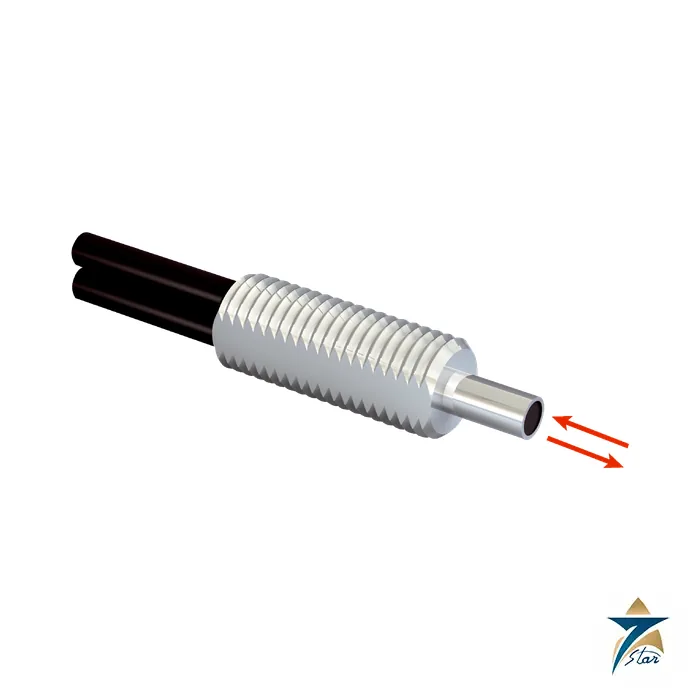
LL3-DB01 is a SICK LL3 plastic fiber-optic cable (part no. 5308074) for use with a fiber-optic amplifier. It is a proximity system: send and receive fibres are combined in one coaxial head, a threaded sleeve with M6 thread, and it is 2,000 mm long. SICK lists these compatible amplifiers: GLL70, WLL80, WLL180, GLL170(T), WLL24 Ex, KTL180.
Fibre proximity head for tight places: the LL3-DB01
A fibre cable has no electronics, so its performance depends on the amplifier it is plugged into and on the operating mode of that amplifier. The data sheet quotes a maximum sensing range of 1,250 mm (Sensing range of WLL80 at 8 ms), referring to the WLL80 amplifier at 8 ms, and a minimum detectable object diameter of 0.015 mm; slower, more sensitive modes give more range and faster modes give less. Light leaves the head axially with an angle of dispersion of 60°.
Materials: fibres Polymethylmethacrylat (PMMA), sheath Polyethylen (PE), head stainless steel. Minimum bending radius 25 mm. The cable can be shortened to length with the fibre cutter supplied. Operating temperature –40 °C … +70 °C, weight 31 g.
Technical specifications
| Parameter |
Specification |
| Type code |
LL3-DB01 |
| Part number |
5308074 |
| EAN |
4047084110269 |
| Product family |
Fiber-optic cables (accessory) |
| Device type |
Fiber-optic cables |
| Functional principle |
Proximity system |
| Fiber-optic head design |
Threaded sleeve |
| Application |
Standard |
| Compatible fiber-optic amplifiers |
GLL70, WLL80, WLL180, GLL170(T), WLL24 Ex, KTL180 |
| Sensing range max. |
1,250 mm (Sensing range of WLL80 at 8 ms) |
| Minimal object diameter |
0.015 mm |
| Optical fiber head: Angle of dispersion |
60° |
| Optical fiber head: Integrated lens |
No |
| Optical fiber head: Compatibility tip adapters |
No |
| Optical fiber: Compatibility with infrared light |
No |
| Optical fiber: Optical fiber cable can be shortened |
Yes |
| Optical fiber: Adapter end sleeves required |
No |
| Included with delivery |
Mounting, 2 x M6 hexagon nut, 2 x washer, FC fiber cutter (5304141) |
| Optical fiber head: Light emission |
Axial |
| Optical fiber head: Thread diameter (housing) |
M6 |
| Optical fiber head: Optical fiber taper diameter |
≥ 2.8 mm |
| Optical fiber head: Optical fiber taper length after 2 mm |
≥ 5 mm |
| Optical fiber: Fiber length |
2,000 mm |
| Optical fiber: Bending radius |
25 mm |
| Optical fiber: Dynamic flexibility (robotics) |
No |
| Optical fiber: Outside diameter, optical fiber cable connection |
2.2 mm |
| Optical fiber: Fiber arrangement |
Coaxial |
| Optical fiber: Core structure |
S: Ø 1 mm, R: 16 x Ø 0,25 mm Coaxial |
| Material: Optical fiber head |
Stainless steel |
| Material: Sheath |
Polyethylen (PE) |
| Material: Fibers |
Polymethylmethacrylat (PMMA) |
| Weight |
31 g |
| Ambient operating temperature |
–40 °C … +70 °C |
Type code LL3-DB01 and part number 5308074
LL3 is the plastic fibre-cable line, and the letters and digits after the hyphen describe the head and fibre arrangement. SICK’s catalogue also lists LL3-DB01-3 (part no. 5322552), LL3-DB01-10 (5308075) and LL3-DB01-30 (5324662) under their own part numbers, so check the data sheet of the exact variant you need. The part number for this 2 m version is 5308074.
Other active types in the same SICK family, each with its own part number:
- LL3-DB06 (part no. 5326006)
- LL3-DB09 (part no. 5325991)
- LL3-DB02 (part no. 5308083)
- LL3-DB04 (part no. 5325990)
- LL3-DB03 (part no. 5313021)
Fitting and compatibility notes
Delivered with the cable: Mounting, 2 x M6 hexagon nut, 2 x washer, FC fiber cutter (5304141). The head screws into a M6 hole or bracket and is locked with the two nuts and washers. Do not bend the fibre tighter than the stated radius, and keep it away from sharp edges. Check that your amplifier is in the compatible list before ordering; the cable is not suitable for infrared light amplifiers according to the data sheet.
Selecting a fibre proximity head for the task
Choosing the LL3-DB01 is mainly a question of the space available, the target and the amplifier. A proximity system detects light reflected back from the object itself, so the target’s surface, colour and angle all influence how far it can be detected. The range figure on this page refers to one amplifier in one response setting; in practice, start from the application rather than from the maximum value and confirm reliable detection with a trial on the real object and background.
- Confirm the amplifier on the machine is one of the compatible types listed by SICK.
- Check that the head can be mounted through an M6 hole with room for the nuts and washers supplied.
- Plan the fibre route so the cable reaches the amplifier within its length without bending tighter than the stated radius.
- Consider whether the background behind the target is bright or reflective, since a proximity system may see it as well.
Installation and set-up steps
Mount the amplifier first, then fix the head and lay the fibre loosely along its route before cutting. Use the supplied fibre cutter to make a single clean cut, because a crushed or angled fibre end reduces the light reaching the amplifier. Insert the fibre ends into the amplifier according to the amplifier instructions, making sure the send and receive fibres go to the correct positions. Secure the fibre at intervals so machine movement does not pull on it, as the data sheet does not rate this cable for dynamic flexing in robotic applications.
With the system powered, teach or adjust the amplifier using the real target in its normal position and then without the target, so the switching threshold sits well between the two conditions. Check detection at the edges of the expected position range, not only at the centre.
Keeping detection stable in the Gulf
Factories and packaging lines in Oman and the GCC can be hot, dusty and, near the coast, humid. The stainless steel head and the stated ambient temperature range suit many such locations, but dust and residue on the head face reduce the reflected light and can cause missed detections over time. Include the head in routine cleaning with a soft, dry cloth, and avoid aiming it where product debris collects. Keep the PE-sheathed fibre away from hot surfaces and sharp edges, and protect it in cable trays or conduit where forklifts or operators could damage it.
Points to include in an RFQ
- Part number 5308074 and the quantity required.
- The amplifier type the cable will be used with, so compatibility can be checked.
- Whether a different length variant from the LL3-DB01 family is needed instead of the 2 m version.
Documents and quotation
This page carries a copy of the SICK data sheet for LL3-DB01 (part no. 5308074), so the dimensional drawing and the electrical data are one click away. Use the RFQ form with the part number, quantity and delivery point; we reply with a quotation and the delivery information we can confirm. Related items are listed under Automation Accessories. Please check the electrical output, the connector and the measuring or switching range against the old device before you order. Where this page and the data sheet disagree, follow the data sheet.








Reviews
There are no reviews yet.