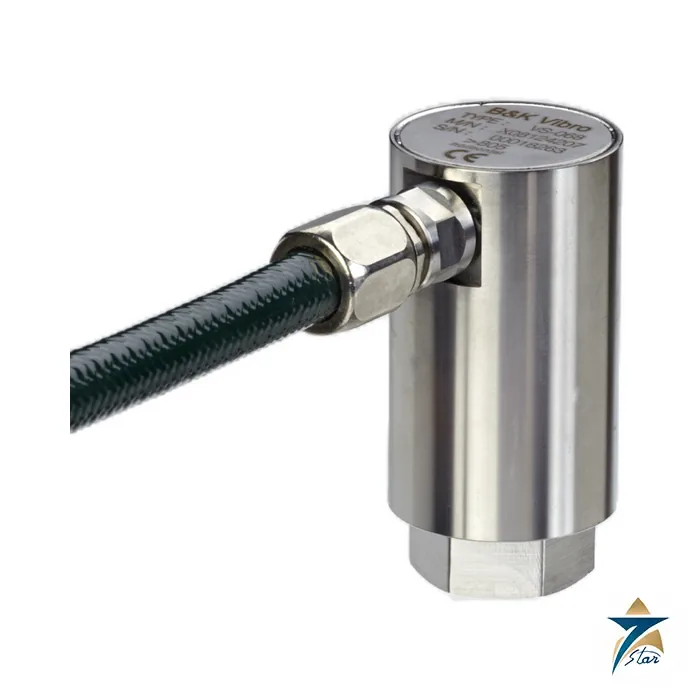
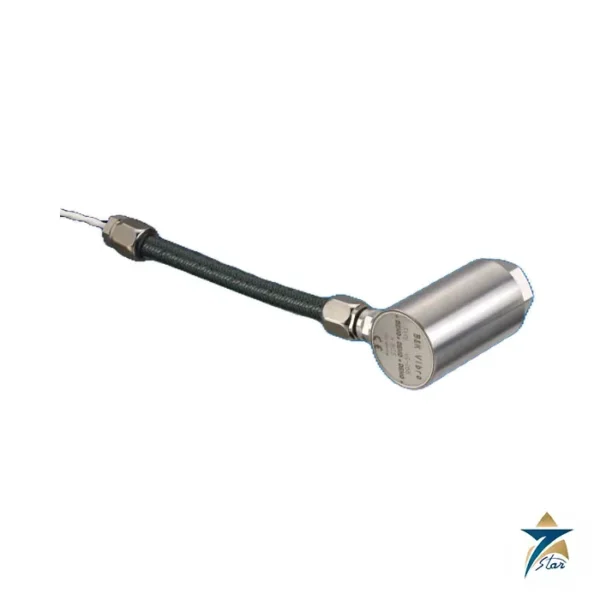
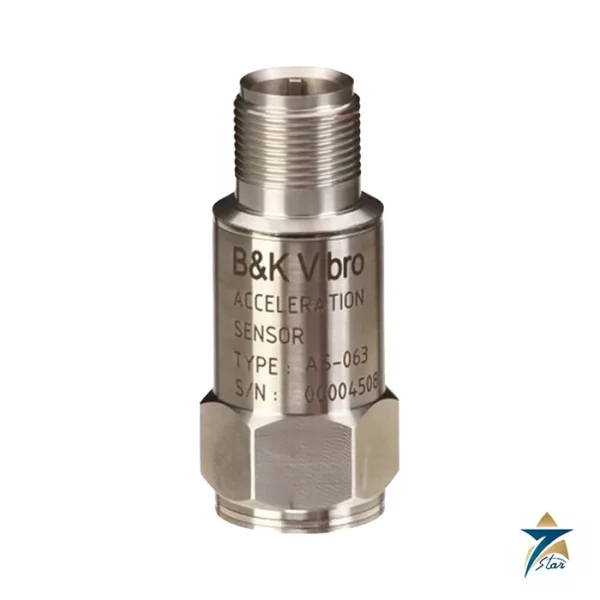
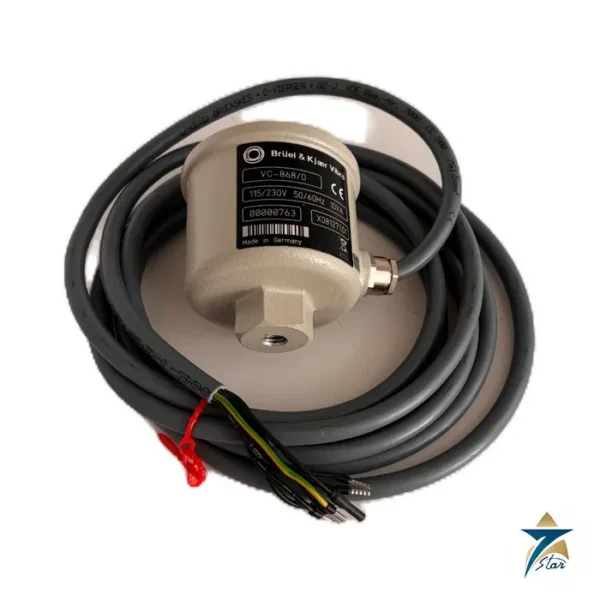
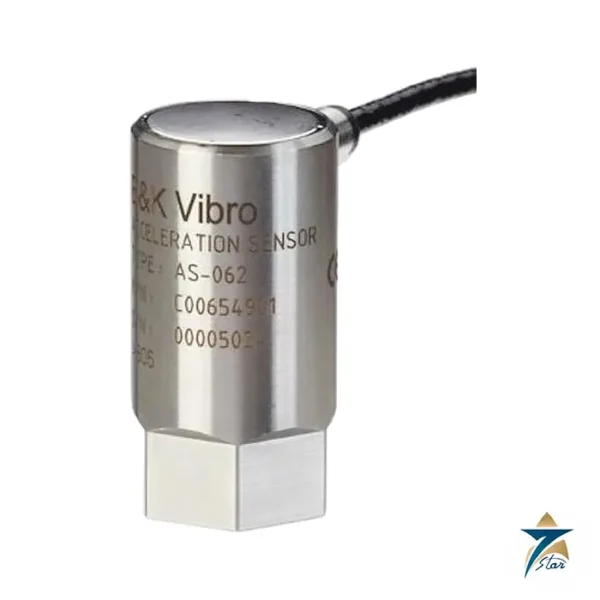
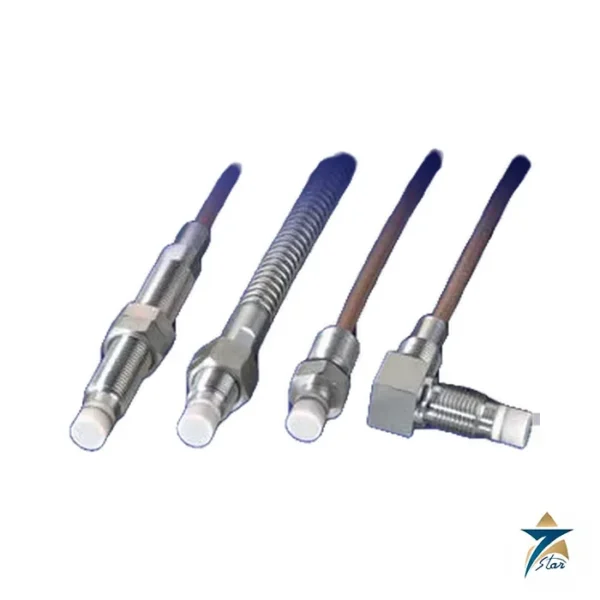
The Brüel & Kjær VS-068 is the standard electrodynamic velocity sensor from Brüel & Kjær Vibro for permanent installation, measuring in the horizontal direction. It is supplied in the configuration requested for this page: operating range -40 to +80 °C, a 5 m cable with open wire ends and a steel protective conduit. Because the sensor generates its own voltage, it needs no power supply and delivers a high output voltage at low internal resistance, which keeps wiring to a monitoring rack simple.
Horizontal velocity sensing for bearing housings
Velocity sensors of this family measure absolute casing and bearing vibration on machines in the frequency range 1 Hz to 2000 Hz. Inside the stainless-steel housing a sprung coil moves in a magnetic field, so the induced voltage follows the vibration velocity directly. The VS-068 is the horizontal variant: it is mounted so that the measurement direction lies in the horizontal plane, typically across a bearing housing where radial vibration is picked up. Its natural frequency is 8 Hz, and the monitoring instruments from the same maker apply a linearization circuit matched to this response so that readings remain accurate well below that frequency, down to 1 Hz.
The brochure lists the housing as oil-, water- and dust-tight, with low sensitivity to external magnetic fields thanks to its special construction, and suitable for chemically aggressive surroundings. The protection class is IP 66.
Technical specifications
Values below are taken from the Brüel & Kjær Vibro velocity sensor brochure (May 2024) and the VS-068 / 069 / 077 / 079 instruction manual (V10).
| Parameter |
Specification |
| Order code |
VS-068 |
| Measurement direction |
Horizontal |
| Operating condition |
Standard for permanent installations |
| Cable length / protection |
5 m, open ends, with steel protective conduit |
| Measuring principle |
Electrodynamic (moving coil), self-generating, no supply required |
| Measured quantity |
Vibration velocity (absolute casing or bearing vibration) |
| Sensitivity at 80 Hz |
100 mV/mm/s ±5 % |
| Frequency range |
10 Hz to 2000 Hz; 1 Hz to 2000 Hz with linearization |
| Natural frequency |
8 Hz ±10 % |
| Internal impedance |
4 kΩ ±5 % |
| Transverse sensitivity |
Below 7 % |
| Max. admissible vibration displacement |
±0.45 mm |
| Operating temperature |
-40 to +80 °C (short-term up to +100 °C) |
| Housing |
Stainless steel, hermetically sealed |
| Protection class |
IP 66 |
| Sensor weight without cable |
Approx. 500 g |
| Mounting |
Central M10 thread; M10 x 25 mm stud, 14 Nm; M10 x M8 adapter, 7.1 Nm |
| Connection cable |
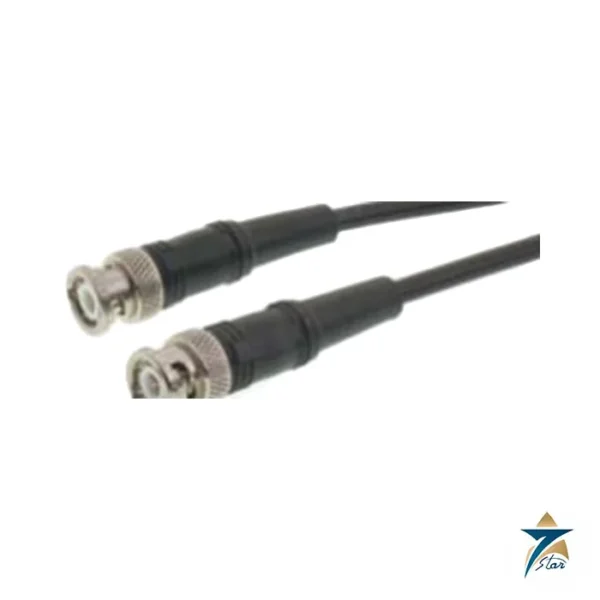
Integrated, 2 x 0.14 mm² shielded PTFE, 3.3 mm diameter, 5 m, open wire ends |
| Cable protection |
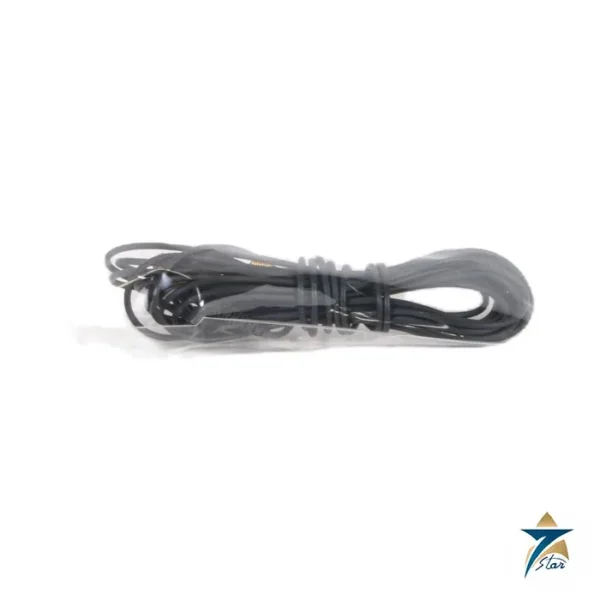
Flexible steel protective conduit with PU sheath, 11.5 mm outside diameter |
| Conduit fitting |
17 mm wrench size, M12 x 1.5 connection thread |
| EMC standard |
EN 61326-1 |
| Hazardous-area approval |
None (standard version) |
Cable, conduit and mounting details
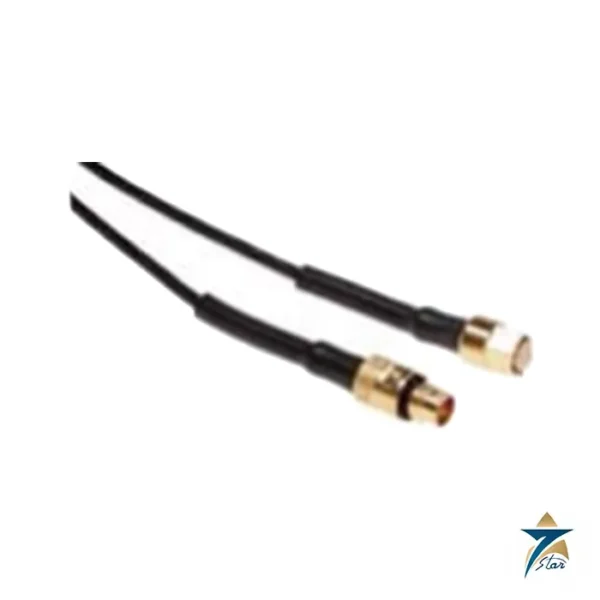
The fixed cable is a 2-core, shielded PTFE cable of 2 x 0.14 mm² and 3.3 mm diameter, 5 m long, ending in open wires. The manual allows the connecting cable to be extended up to 200 m when a terminal box is used; the standard installation example in the brochure shows the AC-2104/0 junction box and AC-112 signal cable. For protection against mechanical damage and to improve EMC safety, the cable should be laid in steel protective conduits or pipes with a minimum bending radius of 60 mm. A flexible steel conduit with PU sheath, 11.5 mm outside diameter, is delivered with the sensor, and its fitting uses an M12 x 1.5 thread with a 17 mm wrench size.
The sensor is fixed centrally on an M10 stud, 25 mm long, tightened to 14 Nm, or with the M10 x M8 adapter at 7.1 Nm. The manual asks for a flat mounting surface of at least 35 mm diameter with Ra 0.8 µm, a centred M10 hole 25 mm deep, thread locking such as LOCTITE 243, and a penetration depth of the stud in the sensor of 10 mm at most. The sensor body is supplied with both thread adapters and documentation.
Choosing between VS-068 and related order codes
The order code fixes direction, temperature range and cable design, so select it against the measurement point. The brochure groups the permanent-installation sensors as follows.
| Order code |
Direction |
Operating condition |
Temperature range |
Cable |
| VS-068 |
Horizontal |
Standard, permanent installation |
-40 to +80 °C |
5 m, steel protective conduit |
| VS-069 |
Vertical |
Standard, permanent installation |
-40 to +80 °C |
5 m, steel protective conduit |
| VS-077 |
Horizontal and vertical |
Standard, permanent installation |
-40 to +80 °C |
5 m, steel protective conduit |
| VS-079 |
Horizontal and vertical |
Extended temperature range |
-40 to +200 °C |
5 m, steel protective conduit |
| VS-0168 / VS-0169 |
Horizontal / vertical |
Ex-areas (II 2 G Ex d IIC T6 Gb) |
-10 to +70 °C |
10 m, no protective conduit |
The VS-068 and VS-069 share the same electrical data and differ only in measurement direction. Where one sensor must pick up both directions, the VS-077 is the listed option. This standard version carries no hazardous-area approval; for Ex-areas the brochure lists separate codes that are not interchangeable.
Where the VS-068 fits in a monitoring system
The VS-068 output is a velocity signal in mm/s, which is the quantity ISO 20816 (formerly ISO 10816) uses to judge the vibration severity of a machine from measurements on non-rotating parts such as bearing housings. That makes it a natural choice for permanent condition and protection monitoring on electric motors, centrifugal pumps, fans, blowers, gearboxes and the bearing pedestals of steam and gas turbines. On most horizontal-shaft machines the largest radial vibration is found across the bearing housing, which is exactly the position this horizontal version is designed for.
A common arrangement is to fit a VS-068 horizontally and a VS-069 vertically at the same bearing, so that the monitor sees both radial directions with identical sensitivity and frequency response. Because the sensor is self-generating and passive, it keeps working without loop power, and the high output of 100 mV/mm/s gives a good signal-to-noise ratio over long cable runs to the junction box and rack. During commissioning, confirm the mounting direction against the arrow on the drawing, check that the conduit does not pull on the sensor body, and record a baseline reading at normal load so that later trends can be compared with it.
Documents and quotation
The official Brüel & Kjær Vibro velocity sensors brochure (English, 05/2024) is attached to this page and lists the order codes, electrical data, cable designs and dimensions. The brochure states that all data are non-binding, so confirm the exact order code, direction and cable arrangement against the current manufacturer documents before ordering. Seven Star LLC is an independent supplier based in Muscat and supplies this sensor on request with the quotation and the technical documents; no price is shown on this page. Related items are listed under Vibration Monitoring.























Reviews
There are no reviews yet.