- Automation & ControlView all 3,075 products
- Automation Accessories
- AC Drives
- PLC & I/O Cards
- Industrial Communications
- Vibration Monitoring
- Isolator & Barrier
- Controllers & Data Acquisition
- Safety Switches & Guard Locking
- Motor Soft Starters
- Encoders
- CCTV & Security
- Pneumatic Cylinders
- HMI Displays
- Servo Drives
- Industrial Computers
- Machine Vision
- Automation Software
- Robotics
















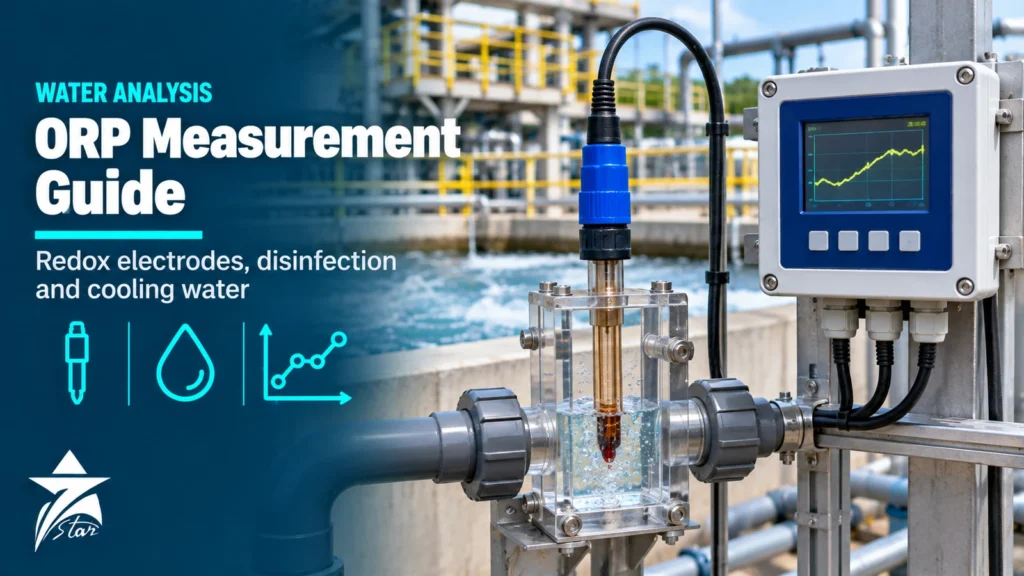
Oxidation reduction potential, usually shortened to ORP or redox potential, tells you whether a solution tends to oxidise or reduce other substances. It is measured in millivolts and responds to the balance of oxidising agents such as chlorine, ozone and hydrogen peroxide against reducing agents such as sulfite, bisulfite and sulfide. ORP measurement is widely used in drinking water, swimming pools, cooling towers, reverse osmosis pretreatment and industrial wastewater, where it gives a fast and low maintenance signal for controlling chemical dosing. This guide explains how the sensor works, what the reading really means, and how to keep it reliable.
What the ORP Value Means
An ORP sensor measures the voltage between a noble metal electrode and a reference electrode. A positive value indicates an oxidising solution, a negative value a reducing solution. The reading depends on all the redox active species present, their concentrations and the pH, so ORP is not a direct measurement of a single chemical. It is best used as a control and trend signal: when the oxidant dose rises the ORP rises, and when a reducing chemical is added it falls. For a specific concentration, such as free chlorine in mg/l, a dedicated amperometric or colorimetric analyzer is needed, as described in our chlorine analyzer guide.
| Typical solution | Approximate ORP range (vs Ag/AgCl) | Meaning |
|---|---|---|
| Well disinfected pool or potable water with free chlorine | +650 to +800 mV | Strongly oxidising, good disinfection |
| Untreated surface water | +100 to +400 mV | Mildly oxidising |
| RO feed after dechlorination with bisulfite | Below about +200 to +300 mV, site specific | Oxidant removed to protect membranes |
| Anaerobic digester or septic wastewater | -200 to -400 mV | Strongly reducing, sulfide possible |
These ranges are indicative. Every site should establish its own set points by comparing ORP readings with laboratory or analyzer results for the chemical being controlled.
How an ORP Sensor Is Built
- Measuring electrode: usually platinum, which suits most oxidising applications, or gold, which is preferred with strong oxidants such as ozone and in some cyanide and chromium processes.
- Reference electrode: normally silver and silver chloride in potassium chloride electrolyte, the same system used in pH sensors.
- Junction: a ceramic, PTFE or open aperture junction that connects the reference electrolyte to the process.
- Temperature sensor: often included, although ORP is not usually temperature compensated in the same way as pH.
- Combination sensors: many models combine pH and ORP electrodes, or offer digital electronics that store calibration data in the sensor head.
Because the reference system is the same as for pH sensors, most of the reference problems described in our guide to industrial pH measurement also apply to ORP: junction blockage, electrolyte poisoning by sulfide and drift from dilution of the reference electrolyte.
Reference Systems and Reporting
ORP values depend on the reference electrode used. Industrial sensors normally read against a silver and silver chloride reference, while scientific literature often reports values against the standard hydrogen electrode. The difference is roughly 200 mV, depending on the electrolyte concentration and temperature. When you compare readings from different instruments or from published set points, always confirm which reference is used, or the comparison can be badly wrong.
Main Applications of ORP Measurement
| Application | What ORP controls | Notes |
|---|---|---|
| Swimming pools and water parks | Chlorine or bromine dose | Often combined with pH control because chlorine effectiveness depends on pH |
| Drinking water disinfection | Oxidant dose and residual trend | Confirm residual with a free chlorine analyzer |
| RO and desalination pretreatment | Sodium bisulfite dose for dechlorination | Protects polyamide membranes from oxidation |
| Cooling towers | Oxidising biocide dose | Saves chemical compared with timer dosing |
| Cyanide destruction | Oxidation by hypochlorite at high pH | Two stage process with separate ORP and pH set points |
| Chromium reduction | Reduction of hexavalent chromium at low pH | Endpoint detected by ORP drop |
| Biological wastewater | Anoxic and anaerobic zone conditions | Used for nitrogen and phosphorus removal control |
| Aquaculture and food processing | Ozone and disinfectant levels | Gold electrodes often preferred with ozone |
ORP Measurement in RO Pretreatment
Polyamide reverse osmosis membranes are damaged by free chlorine. Many desalination and water reuse plants in Oman chlorinate the seawater or feed water for biofouling control, then dose sodium bisulfite before the cartridge filters to remove the residual oxidant. ORP measurement after the bisulfite injection point gives a fast alarm or interlock if dechlorination fails. Plants usually combine it with a free chlorine analyzer for confirmation and select the alarm set point from commissioning data rather than a generic figure.
Checking and Calibrating ORP Sensors
Unlike pH, an ORP sensor is not normally calibrated at several points. Instead, it is checked against a redox standard solution with a known potential, for example 220 mV or 470 mV at a stated temperature and reference. Quinhydrone saturated pH buffers are also used in some laboratories. If the reading differs from the standard by more than the tolerance set by the site, typically 10 to 20 mV, clean the electrode and check again. Many transmitters allow a single offset adjustment, but a large offset is usually a sign that the sensor needs cleaning or replacement rather than adjustment.
- Use fresh standard solution and discard it after use.
- Rinse the sensor with clean water between solutions.
- Allow enough time for the reading to stabilise; platinum electrodes can respond slowly after long exposure to a reducing solution.
- Record the reading and offset in the calibration log so drift can be tracked, following the approach in our article on instrument calibration programs.
Cleaning the Metal Electrode
The noble metal surface must be clean to respond correctly. Oil, biofilm, scale and oxide films slow the response and shift the reading. Soft deposits can be removed with water and a soft cloth, scale with dilute acid and oil with a mild detergent. Some manufacturers allow light polishing of the platinum ring with a fine abrasive. After cleaning, many electrodes need conditioning in the process or in a standard solution before the reading is stable. Always follow the manufacturer cleaning instructions for the specific sensor.
Installation Tips for Reliable ORP Measurement
- Install the sensor where the chemical is fully mixed, but close enough to the dosing point to keep the control loop fast.
- Use a flow cell or immersion fitting that keeps the sensor wet at all times and prevents air bubbles collecting on the electrode.
- Mount the sensor at an angle of at least 15 degrees from horizontal when the electrolyte design requires it.
- Keep sample velocity steady; very low flow slows response and very high flow can cause noise.
- Ground the solution properly and use the instrument solution ground pin when available to avoid stray voltages.
- Keep cable runs short for analog sensors, or use digital sensors where long distances are unavoidable.
Common Errors and How to Avoid Them
| Problem | Possible cause | Fix |
|---|---|---|
| Slow response | Dirty or oxidised metal surface, low flow | Clean electrode, improve sample flow |
| Reading drifts over days | Reference poisoning or electrolyte dilution | Replace reference or sensor, choose a poison resistant design |
| Reading noisy | Ground loop, air bubbles, electrical interference | Use solution ground, remove bubbles, check cable routing |
| Wrong value against standard | Dirty electrode, aged standard, wrong reference | Clean, use fresh standard, confirm reference type |
| Dosing control unstable | Sensor too far from dosing point, poor mixing | Relocate sensor, add mixing, tune controller |
Transmitters, Controllers and Portable Meters
Online ORP sensors connect to a transmitter or controller that displays the value, provides 4 to 20 mA or digital outputs and controls dosing pumps through relays or pulse outputs. Multi channel water treatment controllers can combine pH, ORP and conductivity on one unit for cooling towers and pools. Portable and benchtop meters are used for spot checks and for verifying online sensors. For dosing pumps that act on the ORP signal, choose a pump with the right turndown and chemical compatibility for hypochlorite or bisulfite.
Selected ORP Sensors and Instruments in Our Catalog
The table below lists a selection of ORP sensors, transmitters and meters from our catalog.
| Product | Type | Typical use |
|---|---|---|
| Endress+Hauser CPS76E Memosens | Digital pH and redox process sensor | Water and process monitoring |
| ABB 100E 12 mm pH and redox sensor | General purpose analog sensor | Water treatment |
| ABB TBX series hot tap retractable sensor | High pressure retractable sensor | Process lines without shutdown |
| Rosemount 396PVP TUpH | pH and redox sensor | Wastewater and dirty service |
| JUMO digiLine pH/ORP/T | Digital sensor electronics | Long cable runs and Modbus |
| JUMO AQUIS 500 pH | pH and redox transmitter and controller | Dosing control |
| JUMO ecoTRANS pH 03 | DIN rail pH and redox transmitter | Panel mounted systems |
| ABB AWT210 | Two wire multi parameter transmitter | Process analytics |
| SEKO Kontrol 102 | Water treatment controller | Pools and cooling towers |
| Hanna HI98190 | Portable pH and redox meter | Field checks |
| Horiba LAQUA PH1100 | Benchtop pH and redox meter | Laboratory verification |
| JUMO 202820 immersion fittings | Sensor fittings | Tank and basin installation |
Browse more in our liquid analysis sensors category. To get a quotation, send the application, process temperature and pressure, mounting type, cable length and transmitter or controller requirements through our quote request form or to [email protected].
Sourcing ORP Sensors in Oman Through Seven Star LLC
Seven Star LLC is an independent supplier in Oman of ORP and pH sensors, transmitters, water treatment controllers, portable and benchtop meters, flow cells and redox standard solutions for ORP measurement. We quote products from manufacturers such as Endress+Hauser, ABB, Rosemount, JUMO, SEKO, Hanna Instruments and Horiba. Electrode material, reference type, process connection and output options are confirmed against the manufacturer data at quotation.
Frequently asked questions
What does ORP measure?
ORP, or oxidation reduction potential, measures in millivolts the tendency of a solution to oxidise or reduce. It responds to the combined effect of oxidants such as chlorine and ozone and reducing agents such as bisulfite and sulfide, and also depends on pH.
Can ORP replace a chlorine analyzer?
ORP is a fast and robust control signal, but it does not measure chlorine concentration directly because pH and other chemicals affect the reading. Most plants use ORP for control and a free chlorine analyzer for confirmation.
When should I use a gold ORP electrode instead of platinum?
Platinum suits most applications. Gold is often preferred with strong oxidants such as ozone and in some cyanide and chromium treatment processes where platinum can give less stable readings.
How do I check an ORP sensor?
Immerse it in a fresh redox standard solution of known potential, wait for a stable reading and compare it with the stated value for the reference type and temperature. A large difference usually means the electrode needs cleaning or replacement.
Why is ORP used in RO pretreatment?
ORP downstream of sodium bisulfite injection shows whether residual chlorine has been removed before the feed reaches polyamide membranes, which are damaged by oxidants. It provides a fast alarm or interlock if dechlorination fails.
Who supplies ORP sensors and analyzers in Oman?
Seven Star LLC is an independent supplier in Oman that quotes ORP and pH sensors, transmitters, controllers and meters from manufacturers such as Endress+Hauser, ABB, JUMO and Hanna Instruments. Send your requirements through the quote request form or to [email protected].
Was this guide helpful?One click helps us write better guides for engineers.
Thank you! Glad it helped. Need this equipment for your project? Request a quotation
Thank you. We will use this to improve the guide.