- Automation & ControlView all 1,969 products
- AC Drives
- PLC & I/O Cards
- Industrial Communications
- Automation Accessories
- Vibration Monitoring
- Controllers & Data Acquisition
- Isolator & Barrier
- CCTV & Security
- Safety Switches & Guard Locking
- Encoders
- HMI Displays
- Motor Soft Starters
- Industrial Computers
- Servo Drives
- Pneumatic Cylinders
- Machine Vision
- Automation Software
- Robotics
















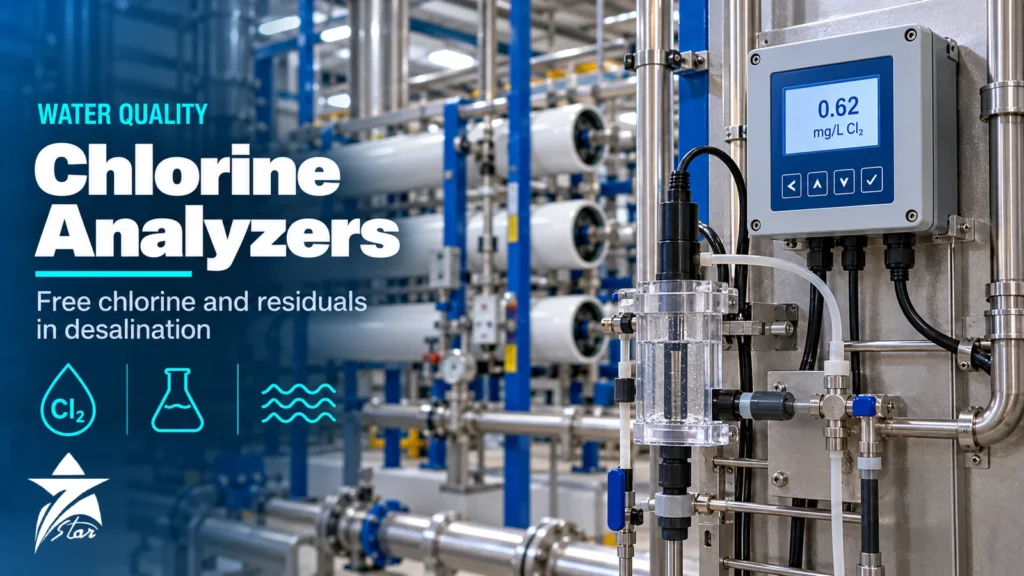
Chlorine does two opposite jobs in a desalination plant. At the intake it is dosed to stop marine growth; a few metres downstream it must be removed completely before it reaches polyamide RO membranes; and at the end of the plant it is dosed again to keep potable water safe through the distribution network. A chlorine analyzer sits at each of these points, and each needs a different range, technology and level of reliability. This guide explains the chemistry that affects measurement, compares amperometric and colorimetric analyzers, and sets out where and how to measure chlorine, residual disinfectant and dechlorination performance in SWRO, thermal desalination and potable water systems.
Free, Combined and Total Chlorine
When chlorine gas or sodium hypochlorite is added to water, it forms hypochlorous acid (HOCl) and hypochlorite ion (OCl⁻). Together these are free chlorine. HOCl is the far stronger disinfectant, and the balance between the two depends on pH: the dissociation constant corresponds to a pKa of roughly 7.5 at 25 °C, so at pH 7.5 the two forms are about equal and above pH 8 hypochlorite dominates.
If ammonia is present, chlorine combines to form chloramines, called combined chlorine. Free plus combined chlorine is total chlorine. Utilities that use chloramination for long networks monitor total chlorine; those that use free chlorine monitor free chlorine and often total as well, to detect ammonia contamination.
Seawater adds a complication
Seawater contains bromide. Chlorine added to seawater rapidly oxidises bromide to hypobromous acid, so the residual oxidant in a chlorinated intake is largely bromine species. Most free chlorine analyzers respond to these oxidants as well, which is acceptable for control but means the reading is better described as total residual oxidant expressed as chlorine. Keep this in mind when comparing online values with laboratory methods.
Measurement Technologies
Membrane-covered amperometric sensors
A gold or platinum cathode sits behind a membrane that HOCl diffuses through, producing a current proportional to concentration. Because the sensor responds mainly to HOCl, the transmitter needs a pH measurement to calculate free chlorine across the pH range; above roughly pH 8–8.5 the HOCl fraction becomes small and accuracy suffers. Reagent-free operation, continuous output and low running cost make these the most common choice for potable water and post-treatment. They need a constant flow, periodic membrane and electrolyte replacement, and calibration against a DPD reference.
Open-cell (bare electrode) amperometric analyzers
These use two or three bare electrodes in a flow cell, often with abrasive beads or a rotating element that keeps the electrodes clean. They suit dirty or high-fouling water such as intake seawater. Some designs dose a pH buffer to stabilise the measurement. Mechanical cleaning parts wear and must be maintained.
Colorimetric DPD analyzers
The analyzer adds DPD reagent and buffer to a sample batch and measures the pink colour photometrically. With iodide added, it measures total chlorine. DPD is the laboratory reference method and on-line DPD analyzers are accepted for regulatory reporting in many jurisdictions; in the US, EPA Method 334.0 covers the use of on-line chlorine analyzers for compliance. Drawbacks are a measurement cycle of a few minutes rather than continuous output, reagent consumption and waste, and reagent shelf life that shortens in high ambient temperature.
Total chlorine and chlorine dioxide sensors
Dedicated membrane sensors exist for total chlorine, using a different membrane and electrolyte that respond to chloramines as well as free chlorine, and for chlorine dioxide, which some industrial and potable water systems use because it does not form chlorinated by-products in the same way. Each is a separate sensor type: a free chlorine sensor will not read chloramines or chlorine dioxide correctly, so confirm the disinfectant before ordering. Where several oxidants may be present together, ask the manufacturer for its cross-sensitivity data rather than assuming selectivity.
ORP as an indicator
Oxidation-reduction potential does not measure chlorine concentration, but it responds strongly to the presence or absence of oxidants. It is widely used on RO feed downstream of bisulfite dosing as a fast, robust indicator that dechlorination is complete.
Technology Comparison
| Criterion | Membrane amperometric | Open-cell amperometric | Colorimetric DPD | ORP |
|---|---|---|---|---|
| Measures | Free chlorine (with pH), or total with specific sensors | Free or total oxidant | Free or total chlorine | Oxidising/reducing tendency, not concentration |
| Output | Continuous | Continuous | Batch cycle, minutes | Continuous |
| Reagents | None | Sometimes buffer | DPD and buffer | None |
| Fouling tolerance | Moderate | High (self-cleaning) | Moderate (sample filtered) | Moderate |
| Best location | Product water, distribution | Intake, dirty water | Regulatory points, low-level verification | RO feed after dechlorination |
| Main maintenance | Membrane, electrolyte, calibration | Cleaning beads, electrodes | Reagents, tubing, pump | Cleaning, check solution |
Measurement Points in a Desalination Plant
- Intake and pretreatment: continuous or shock chlorination, often by on-site electrochlorination of seawater, to control bio-growth in intake pipes, screens and media filters. Analyzers confirm the residual oxidant leaving the dosing point and at the far end of the pretreatment system.
- RO feed after dechlorination: sodium bisulfite or metabisulfite is dosed to remove residual chlorine before the cartridge filters and membranes. ORP and a low-range chlorine analyzer verify that no oxidant reaches the membranes.
- Thermal plants: MSF and MED units chlorinate seawater feed to control fouling; residual measurement at the brine and cooling outfalls is also used for environmental reporting.
- Post-treatment: after remineralisation, chlorine is dosed for disinfection; analyzers control dosing and confirm the residual after the contact tank.
- Storage and distribution: analyzers at reservoirs, pumping stations and network points confirm that a residual remains to the far end of the system.
Protecting RO Membranes
Polyamide thin-film composite membranes are damaged by oxidants. Membrane manufacturers typically state that feed water must be essentially free of chlorine, and give a cumulative tolerance in the order of 1,000 to 2,000 ppm-hours of exposure before salt rejection starts to fall. That sounds generous until you realise that 1 mg/L for six weeks reaches the same figure. Dechlorination must therefore be continuous and verified.
- Typical practice doses bisulfite with a margin above stoichiometry to cover incomplete reaction; manufacturer guidance gives the ratios.
- ORP on RO feed is commonly kept below about 300–350 mV with an alarm and trip at the upper limit; check the membrane supplier’s guidance for the exact value.
- Overdosing bisulfite is not harmless: excess reductant consumes oxygen and supports biofouling, and some studies link overdosing combined with transition metals to membrane oxidation.
- Use a low-range chlorine or total oxidant analyzer in addition to ORP where membrane value is high, because ORP alone does not quantify the residual.
Potable Water Residual Targets
WHO guidelines set a health-based guideline value of 5 mg/L for free chlorine and describe effective disinfection as at least 0.5 mg/L free chlorine after a minimum 30 minutes contact time at pH below 8. National standards in each GCC country specify their own residual requirements for treated water and distribution, so the analyzer range must cover both the dosing point and the expected minimum at the network extremities. In hot climates, chlorine decays faster in storage tanks and long pipelines, so residuals at remote points need closer monitoring in summer.
Installation and Sample Handling
- Take samples from the side of the pipe, not the top or bottom, to avoid air and sediment.
- Keep sample lines short; chlorine decays in the line, especially in warm water and with biofilm in the tubing.
- Use constant-head overflow or flow regulators so amperometric sensors see stable flow.
- Install the pH sensor in the same flow cell as the free chlorine sensor for accurate compensation.
- Shade panels and keep reagents in cool storage; DPD reagent life drops in hot field enclosures.
- Route drain lines correctly; DPD waste contains reagents that may need separate disposal under site rules.
Calibration and Verification
Amperometric sensors are calibrated by comparison: take a grab sample at the sensor outlet, measure it with a laboratory or portable DPD photometer, and adjust the analyzer span. Zero is verified with chlorine-free water. DPD analyzers are checked with secondary standards or by comparison with a laboratory instrument. Record every comparison, including discrepancies left uncorrected, so the interval can be justified. For broader guidance, see our water quality analyzer guide for desalination, wastewater and boiler water.
Common Mistakes
- Measuring free chlorine with an amperometric sensor without pH compensation in water whose pH varies.
- Calibrating immediately after a membrane change, before the sensor has stabilised.
- Using ORP as a residual concentration measurement for potable water compliance.
- Placing the analyzer before the contact tank and assuming the residual at the outlet is the same.
- Ignoring sample line decay on long runs to a central analyzer house.
Troubleshooting
| Symptom | Likely cause | Action |
|---|---|---|
| Amperometric reading low against DPD | Membrane fouled, low flow, high pH | Clean or replace membrane; check flow; verify pH compensation |
| Reading drifts after membrane change | Insufficient polarisation | Wait for stabilisation before calibration |
| DPD results erratic | Expired reagent, air in tubing, dirty cuvette | Replace reagent, prime pump, clean cell |
| RO feed ORP rising | Bisulfite pump failure or dose too low | Check dosing pump, tank level and ratio |
| Intake residual unstable | Electrochlorinator output varying | Check generator current, flow and cell condition |
Specification Checklist
- Parameter: free chlorine, total chlorine, chlorine dioxide or residual oxidant
- Range at each point, including low-level verification after dechlorination
- Water type: seawater, brine, permeate or potable water; pH range and temperature
- Technology preference: reagent-free amperometric or DPD colorimetric
- Regulatory requirements for reporting
- Outputs, communication and panel layout with pH and ORP
- Existing analyzer model and consumables part numbers
Seven Star LLC supplies chlorine analyzers and consumables in the liquid analytics range, including chlorine, pH and ORP sensors, complete analyzer panels and reagents, membranes and electrolyte kits.
Chlorine Analysers We Supply
These examples cover colorimetric and amperometric measurement.
| Product | Type | Where it fits |
|---|---|---|
| Hach CL17sc Colorimetric Chlorine Analyzer | Colorimetric chlorine analyser | Potable water. |
| Swan AMI Codes-II Colorimetric Chlorine and Disinfectant Analyzer | Colorimetric chlorine analyser | Disinfectant measurement in water. |
| Rosemount 499ACL-01-54 Free Chlorine Sensor | Free chlorine sensor | Continuous measurement. |
| JUMO tecLine Cl2 Free Chlorine Sensor | Free chlorine sensor | Continuous measurement. |
| Hach 21055-69 DPD Free Chlorine Reagent Powder Pillows | DPD free chlorine reagent | Reagent for colorimetric analysers and tests. |
Send the chlorine type, range and water conditions through our quote request form.
Sourcing Chlorine Analyzers Through Seven Star LLC
Seven Star LLC supplies amperometric and colorimetric chlorine analyzers, ORP sensors and spare consumables on request for desalination, potable water and industrial water plants in Oman and the GCC. We help with selection and cross-checking part numbers for analyzers from manufacturers such as Hach, Endress+Hauser, ProMinent, Yokogawa and Emerson. Availability and lead time are confirmed at quotation.
Send the analyzer nameplate, the measuring points and ranges, and your RFQ, and we will return a matched offer for analyzers, sensors and consumables.
Frequently asked questions
What is the difference between free and total chlorine?
Free chlorine is hypochlorous acid plus hypochlorite ion. Total chlorine adds combined chlorine, mainly chloramines formed when chlorine reacts with ammonia. Plants using chloramination monitor total chlorine, while free chlorine systems often measure both to detect ammonia.
Why does a free chlorine sensor need pH compensation?
Membrane amperometric sensors respond mainly to hypochlorous acid, and the HOCl fraction falls as pH rises because the pKa is about 7.5. The transmitter uses a pH measurement to calculate total free chlorine, and accuracy falls at high pH where little HOCl remains.
Is ORP enough to protect RO membranes from chlorine?
ORP is a fast and robust indicator that dechlorination is working, and it is widely used for alarms and trips on RO feed. It does not measure chlorine concentration, so plants protecting expensive membranes often add a low-range chlorine or oxidant analyzer for confirmation.
Should I choose an amperometric or DPD chlorine analyzer?
Amperometric analyzers are reagent-free and give continuous output, which suits dosing control. DPD colorimetric analyzers are close to the laboratory reference method and are often used at regulatory points, but they consume reagents and measure in cycles of a few minutes.
Do chlorine analyzers work in seawater?
Yes, but chlorine added to seawater converts bromide to hypobromous acid, so the reading represents total residual oxidant expressed as chlorine. Open-cell self-cleaning designs are often chosen for intake water because of fouling.
How often should a chlorine analyzer be calibrated?
Amperometric sensors are typically checked weekly against a DPD grab sample, with adjustment when the difference exceeds the site tolerance. DPD analyzers mostly need reagent replacement and periodic verification. Trend comparisons to set the interval for each point.
Was this guide helpful?One click helps us write better guides for engineers.
Thank you! Glad it helped. Need this equipment for your project? Request a quotation
Thank you. We will use this to improve the guide.