- Vibration Monitoring
- Industrial Communications
- AC Drives
- PLC & I/O Cards
- Automation Accessories
- Controllers & Data Acquisition
- Encoders
- Industrial Computers
- CCTV & Security
- Safety Switches & Guard Locking
- Motor Soft Starters
- Isolator & Barrier
- HMI Displays
- Pneumatic Cylinders
- Servo Drives
- Automation Software
- Robotics
- Machine Vision
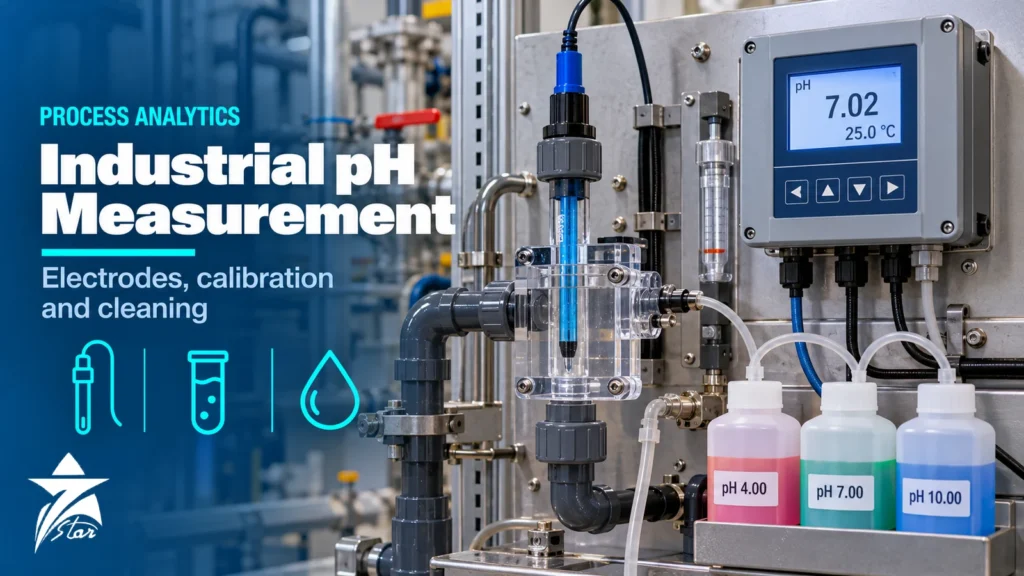
A pH loop that reads 0.3 units wrong looks healthy on the DCS until the effluent permit is breached, the caustic scrubber overdoses or the cooling tower starts to scale. Industrial pH measurement fails in predictable ways: the glass ages, the reference junction clogs or is poisoned, temperature is compensated incorrectly, or the sensor is calibrated in a way that hides the real fault. This guide explains how process pH electrodes and reference systems work, which construction suits which duty, how to calibrate and clean without introducing new errors, and what to specify for harsh services such as sour water, high-solids slurries, hot alkaline streams and fluoride-bearing acids.
How a Process pH Sensor Actually Works
A combination pH sensor contains two half-cells. The measuring half-cell is a thin pH-sensitive glass membrane whose outer hydrated layer exchanges hydrogen ions with the process; the potential across it changes with hydrogen ion activity. The reference half-cell, normally a silver/silver chloride element in potassium chloride electrolyte, is meant to deliver a constant potential regardless of the process. The two are electrically connected to the sample through the liquid junction, a porous path that lets a tiny amount of electrolyte contact the process.
The output follows the Nernst equation. At 25 °C the theoretical slope is 59.16 mV per pH unit, falling to about 54.2 mV at 0 °C and rising to about 74 mV at 100 °C. Around pH 7 the output is close to 0 mV, which is why most transmitters treat pH 7 as the isopotential point. Everything that goes wrong in the field shows up as one of three symptoms: a reduced slope (tired or coated glass), an offset shift (reference contamination or junction potential), or slow, noisy response (high glass impedance, blocked junction or ground loops).
Electrode Glass and Body Options
Not all pH glass is the same. General-purpose glass is optimised for ambient water and neutral effluent. High-temperature and high-alkalinity glasses resist dissolution in hot caustic and reduce sodium error, the low reading that appears above roughly pH 12 when sodium ions start to respond like hydrogen ions. Low-resistance glass helps in cold samples, because membrane impedance rises sharply as temperature falls and the signal becomes noisy and slow.
- Membrane shape: spherical bulbs give the fastest response in clean water; flat or recessed membranes resist breakage and self-clean better in slurries and fibrous streams.
- Body material: glass bodies for laboratory-grade chemical resistance, PPS, PVDF or Ryton-type polymers for mechanical robustness, and titanium or stainless guards for abrasive service.
- Solution ground: a metal pin in contact with the process allows diagnostics such as glass and reference impedance measurement and protects against stray currents.
- Integral temperature element: a Pt100 or Pt1000 built into the sensor is standard for automatic temperature compensation; separate elements introduce lag.
- Alternatives to glass: ISFET sensors suit food and some slurry services where glass breakage is unacceptable, and antimony electrodes are used where fluoride would attack glass, at the cost of lower accuracy.
Reference Junctions Compared
Most pH problems are reference problems. The junction must stay open enough for electrolyte to flow but not so open that process liquid migrates inward. The table compares the common designs.
| Junction type | How it works | Best suited to | Weak points |
|---|---|---|---|
| Ceramic frit (single) | Small porous ceramic plug, low electrolyte outflow | Clean water, potable and cooling water | Clogs with solids, oils and precipitates; easily poisoned |
| Annular PTFE / porous polymer | Large ring of porous plastic around the glass | Wastewater, light slurries, general process | Slower electrolyte exchange; can still foul with heavy oils |
| Open junction (gel or polymer electrolyte) | Electrolyte contacts process directly through an aperture | Heavy slurries, emulsions, precipitating samples | Faster electrolyte depletion; sensitive to pressure spikes |
| Double junction | Second electrolyte chamber between the Ag/AgCl element and the process | Sulfide, heavy metals, strong reducing or oxidising streams | Higher cost; outer chamber still fouls eventually |
| Pressurised / flowing KCl reservoir | External electrolyte supply keeps positive outflow | High-pressure lines, high-accuracy pure water | Needs refilling and pressure regulation |
Sulfide is the classic poison. Hydrogen sulfide and sulfide ions react with silver to form silver sulfide, which blackens the junction, shifts the reference potential and eventually makes calibration impossible. Sour water strippers, refinery caustic treatment, tail gas units and anaerobic digesters all need double-junction or poison-resistant reference designs. The same logic applies to streams containing heavy metals, cyanide or strong complexing agents.
Temperature Compensation: Two Different Corrections
Engineers often assume that automatic temperature compensation makes the reading correct at any temperature. It corrects only one of two effects. Electrode compensation adjusts the Nernst slope for the actual temperature, about 0.198 mV per pH unit per °C, and is handled by the built-in RTD. Solution temperature effect is real chemistry: the pH of the process itself changes with temperature because dissociation constants change. Pure water, for example, is neutral at pH 7.0 at 25 °C but at a lower pH at higher temperatures.
Some transmitters offer a solution temperature coefficient (in pH per °C) or a dedicated high-purity water correction. Use these only when the process chemistry is known; otherwise report pH at process temperature and make sure laboratory comparison samples are measured at the same temperature. Many apparent disagreements between online and grab-sample results are simply a hot process sample cooling in the lab beaker.
Calibration: Doing It Right
A two-point buffer calibration remains the reference method. Bracket the operating range: pH 4 and 7 for acidic duty, pH 7 and 10 for alkaline duty. Fresh buffers matter; pH 10 buffer absorbs carbon dioxide from air and drifts within days once opened, especially in hot climates. Follow a disciplined sequence.
- Record the as-found reading in the process and in the first buffer before any adjustment, so calibration history shows real drift.
- Rinse the sensor with clean water and blot (do not wipe) the glass; wiping builds static charge on the membrane.
- Immerse in the first buffer at a known temperature and wait for a stable reading, typically one to three minutes for a healthy sensor.
- Repeat with the second buffer, then review slope and offset reported by the transmitter.
- Accept the sensor only if slope and offset are within the limits your site uses; many transmitters default to a slope window of roughly 90–105 % and an offset within ±30–60 mV.
- Return to process and compare against a fresh grab sample measured at the same temperature.
Between buffer calibrations, a single-point standardisation against a laboratory grab sample is useful for correcting offset, but it cannot detect a falling slope. If standardisations keep increasing in size, the sensor is telling you it needs cleaning or replacement. For a wider view of intervals and traceability, see our guide on building an instrument calibration program.
Cleaning Methods by Fouling Type
Cleaning should match the coating. Using the wrong chemical wastes time or damages the glass.
- Carbonate and hydroxide scale: dilute hydrochloric acid (around 1–5 %) for a few minutes, then rinse and soak in pH 4 buffer or storage solution.
- Oil and grease: warm water with a mild detergent; a short rinse in isopropyl alcohol only if the body material allows it.
- Protein and biological film: enzymatic cleaner or pepsin/HCl solution, common in food and wastewater.
- Sulfide blackening of the junction: thiourea-based cleaning solutions are offered by several sensor makers; if the reference potential does not recover, replace the sensor.
- Automatic cleaning: water or air jet sprays, or retractable housings with programmed chemical washes, for streams that coat within hours.
After any acid or caustic clean, allow the glass to rehydrate before calibration. Calibrating immediately after a strong clean locks a temporary offset into the transmitter.
Industrial pH Measurement in Harsh Process Applications
Sour water, amine and refinery caustic
Expect sulfide poisoning and high temperature. Specify double-junction or poison-resistant references, high-temperature glass and a retractable housing so sensors can be withdrawn under pressure without a shutdown. Valve and housing materials must be compatible with sour service.
Slurries and precipitating streams
Lime neutralisation, gypsum slurry and mining tailings abrade glass and block ceramic frits. Flat-surface glass, open or large annular junctions and higher sample velocities help. Install so that solids do not settle on the sensor face, typically at an angle in a vertical upward-flowing pipe.
Hydrofluoric and fluoride-bearing acids
Fluoride attacks silica glass, and attack accelerates at low pH and higher temperature. Some manufacturers offer HF-resistant glass formulations for limited concentrations; otherwise antimony electrodes or periodic sensor replacement are accepted strategies.
High-purity water
Boiler feedwater and RO permeate have very low conductivity, so the junction potential becomes unstable and readings drift with flow. Use sensors designed for low ionic strength, flowing-junction or pressurised references, a stable flow-through cell, and stainless sample tubing to limit carbon dioxide pickup.
Installation Details That Decide Sensor Life
- Mount sensors at least about 15° above horizontal so the internal electrolyte stays in contact with the glass and air bubbles move away from the membrane.
- Keep the sensor wet at all times; a dry glass membrane needs hours of rehydration and may never fully recover.
- Avoid high points where gas collects and low points where solids settle.
- Use retractable insertion housings with isolation valves on pressurised lines, and flow cells on sample panels where the process is too hot or too dirty.
- Respect cable length limits for analogue sensors; high-impedance glass signals pick up noise. Digital sensors with electronics in the head avoid most of this problem.
- In classified areas, select sensors and transmitters with the correct Ex certification and intrinsically safe barriers; see our hazardous area classification guide.
GCC Site Conditions
Ambient heat changes pH maintenance. Field transmitters and sample panels in direct sun can exceed 60 °C on surface temperature, which shortens LCD life and accelerates buffer degradation if bottles are stored in field cabinets. Shade the sample panel, keep buffers and spare sensors in air-conditioned stores, and note that unused sensors also have a shelf life: the reference electrolyte slowly changes even in storage, so rotate stock by date. Seawater cooling and intake systems add chloride, bio-growth and barnacle fouling, so plan for regular mechanical cleaning. Dust ingress into open junction caps during maintenance is another frequent cause of slow response in desert plants.
Troubleshooting Quick Reference
| Symptom | Likely cause | Action |
|---|---|---|
| Slope below about 85 % | Aged or coated glass | Clean for the fouling type; replace if slope does not recover |
| Large offset, drifting | Poisoned or depleted reference | Check reference impedance; replace sensor or refill electrolyte |
| Slow response, minutes to settle | Blocked junction, cold sample, high glass impedance | Clean junction; verify temperature; check impedance diagnostics |
| Noisy, jumping reading | Ground loop, damaged cable, air bubbles | Use solution ground, check cable shield and mounting angle |
| Reads correctly in buffer, wrong in process | Junction potential or solution temperature effect | Compare grab sample at same temperature; consider different junction |
| Reading stuck near pH 7 | Cracked glass or shorted cable | Inspect membrane; check sensor and cable resistance |
Industrial pH Measurement Specification Checklist
Before requesting a sensor or a complete loop, collect the following information.
- Process medium, normal pH range and possible excursions
- Process temperature and pressure range, including CIP or steam-out conditions
- Contaminants: sulfide, fluoride, solids, oils, heavy metals, organic solvents
- Installation type: insertion, retractable, flow cell or submersion
- Process connection size and standard, plus wetted material requirements
- Signal type: analogue sensor, digital sensor or smart transmitter with HART or fieldbus
- Hazardous area classification and required certification
- Existing transmitter model and sensor part number if replacing like for like
Seven Star LLC supplies pH sensors, transmitters and fittings within the liquid analytics range, including liquid analysis sensors and accessories such as holders, cables and buffer solutions.
Sourcing pH Measurement Equipment Through Seven Star LLC
Seven Star LLC supplies process pH electrodes, retractable housings, transmitters and calibration consumables on request for plants in Oman and across the GCC. We help with selection and cross-checking part numbers, including like-for-like replacements for installed sensors from manufacturers such as Endress+Hauser, Mettler Toledo, Yokogawa and Emerson, and suggest alternatives where a sensor is no longer produced. Availability and lead time are confirmed at quotation.
Send us the sensor nameplate or order code, the process conditions and your RFQ, and we will return a matched pH sensor and transmitter offer for your duty.
Frequently asked questions
Why does my pH sensor read correctly in buffer but wrong in the process?
Buffers are clean, well-buffered solutions, while process streams may create junction potentials, coat the glass or change pH with temperature. Compare against a grab sample measured at the same temperature, check the junction for fouling, and consider whether solution temperature effects explain the difference.
How often should an industrial pH sensor be calibrated?
There is no single interval. Start with weekly checks on critical loops and extend or shorten the interval based on recorded as-found drift. Clean, stable water services often run for a month or more, while coating or sulfide-bearing streams may need checks every few days.
What slope and offset values mean a pH sensor should be replaced?
A healthy sensor typically shows a slope close to 100 % of the Nernst value and a small offset. Many sites replace sensors when the slope stays below about 85–90 % after cleaning or the offset exceeds roughly ±30–60 mV, but use the limits defined by your transmitter manufacturer and site procedure.
Which pH sensor is best for H2S or sour water?
Choose a double-junction or poison-resistant reference so sulfide cannot reach the silver/silver chloride element quickly. High-temperature glass and a retractable housing are usually needed as well, because sour water services are often hot and pressurised.
Can a pH electrode be stored dry?
No. The glass membrane must stay hydrated, and the junction can crystallise if it dries out. Store sensors with the protective cap filled with storage solution or pH 4 buffer with KCl, as recommended by the manufacturer, not in distilled water.
Does automatic temperature compensation make pH readings temperature-independent?
Only partly. It corrects the electrode's Nernst slope for temperature but not the real change in the process solution's pH with temperature. For comparisons, always measure lab and online values at the same temperature or apply a known solution coefficient.
Was this guide helpful?One click helps us write better guides for engineers.
Thank you! Glad it helped. Need this equipment for your project? Request a quotation
Thank you. We will use this to improve the guide.