- Automation & ControlView all 2,679 products
- Automation Accessories
- AC Drives
- PLC & I/O Cards
- Industrial Communications
- Vibration Monitoring
- Controllers & Data Acquisition
- Isolator & Barrier
- Motor Soft Starters
- Safety Switches & Guard Locking
- CCTV & Security
- Encoders
- HMI Displays
- Servo Drives
- Pneumatic Cylinders
- Industrial Computers
- Machine Vision
- Automation Software
- Robotics
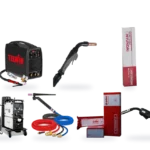
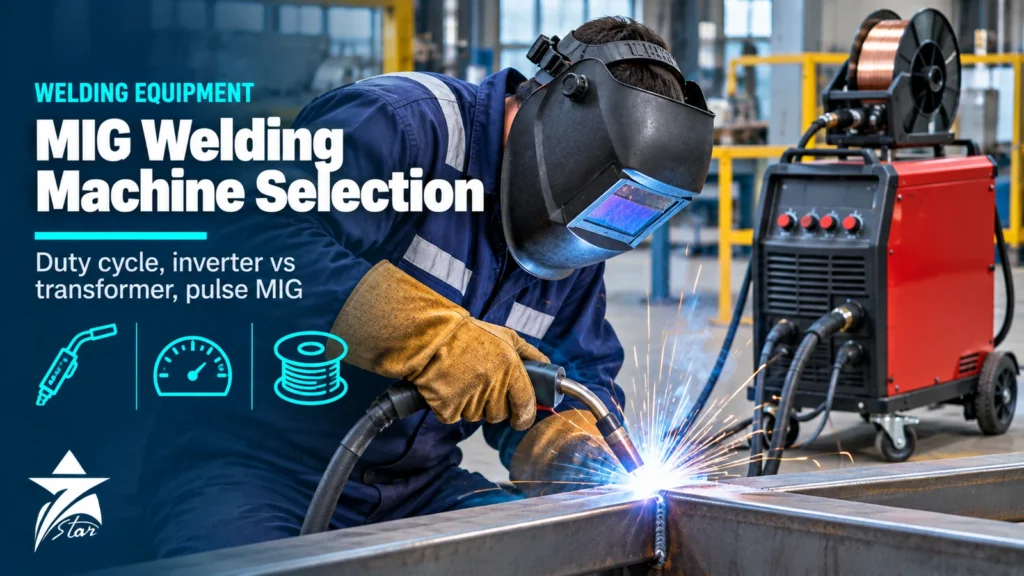
A MIG welding machine feeds a continuous solid or cored wire through a torch while a shielding gas protects the weld pool. It is the main process in most steel fabrication shops because it is fast, easy to learn and suits both thin sheet and thick plate. But machines that look similar on a catalogue page can behave very differently in a workshop: one runs all shift on 1.2 mm wire, another overheats after a few minutes. This guide explains the points that really decide the choice: current and duty cycle, the type of power source, synergic and pulse functions, the wire feeder, and the supply on site.
MIG, MAG and GMAW: The Same Process Family
MIG (metal inert gas) and MAG (metal active gas) are the European names; GMAW (gas metal arc welding) is the American name for the same family. Strictly, MIG uses an inert gas such as argon for aluminium, and MAG uses an active mixture such as argon with carbon dioxide for steel. In practice most people call every machine a MIG welder, and the machine is the same; the wire, the gas and the settings change. If you are still deciding between processes, our comparison of SMAW, GMAW, FCAW, GTAW and SAW explains where MIG fits against stick, TIG and submerged arc welding.
Step 1: Welding Current and Duty Cycle
Start from the work, not from the MIG welding machine. Plate thickness, joint type, wire diameter and welding position set the current you need. Typical working ranges for solid steel wire are:
| Wire diameter | Typical current range | Typical use |
|---|---|---|
| 0.8 mm | About 40 to 150 A | Thin sheet, car body and light gauge work |
| 1.0 mm | About 60 to 220 A | General fabrication, sheet and medium plate |
| 1.2 mm | About 90 to 320 A | Structural steel, heavy plate, spray transfer |
| 1.6 mm | About 150 to 450 A | Heavy fabrication and high deposition work |
These are general ranges; the wire manufacturer data sheet gives the exact values for each product and gas. Then look at duty cycle. Under IEC 60974-1 the duty cycle is the percentage of a 10-minute period that the machine can weld at a given current, at 40 °C ambient, without overheating. A rating of 400 A at 60% means 6 minutes of arc time and 4 minutes of rest in every 10 minutes at 400 A. The same machine can usually run continuously (100%) at a lower current.
- Compare machines at the same current. “350 A at 35%” and “300 A at 100%” describe very different machines.
- Check the ambient temperature of the rating. Some data sheets quote 25 °C, which looks better than the same machine at 40 °C.
- In Oman, workshops and sites often run above 40 °C in summer. Leave a margin, because the real duty cycle falls as the temperature rises.
- Real arc-on time in manual welding is usually lower than people expect, but robotic and mechanised welding can approach 100%.
Step 2: Inverter or Transformer Power Source
Older MIG welding machine designs are transformer-rectifier units with tap switches or a thyristor control. Most new machines are inverters, which convert the mains to high frequency, transform it, and rectify it again under electronic control.
| Point | Inverter | Transformer-rectifier |
|---|---|---|
| Weight and size | Light and compact; easier to move on site | Heavy; usually stays in the workshop |
| Arc control | Fast electronic control, synergic and pulse programs | Simple; voltage set by switch or knob |
| Efficiency | Higher efficiency and power factor | Lower; draws more current for the same output |
| Supply | Sensitive to poor supply; follow the generator rules of the manufacturer | Tolerant of rough conditions |
| Repair | Electronic boards; needs a trained service partner | Simple parts; easy to repair locally |
For most new purchases an inverter is the better choice. A transformer machine still makes sense for a simple, heavy-duty steel line where the operators only need short-circuit or spray welding and robustness matters more than features.
Step 3: Metal Transfer Modes and Pulse MIG
How the molten metal crosses the arc depends on current, voltage and gas. Knowing the transfer modes helps you decide whether you need a pulse machine.
- Short-circuit (dip) transfer: low current; the wire touches the pool many times per second. Good for thin sheet, root runs and positional welding.
- Globular transfer: an intermediate range with large drops and spatter; usually avoided.
- Spray transfer: high current with an argon-rich gas; a fine stream of droplets, deep fusion and high deposition, but mainly in the flat and horizontal positions.
- Pulsed spray: the machine switches between a high peak current and a low background current, detaching about one droplet per pulse. You get spray-like quality at a lower average heat input.
Pulse MIG is very useful for stainless steel and aluminium, for thin material that distorts easily, and for positional welding with less spatter. Many machines also offer modified short-arc and pulse processes with brand names of their own; compare them on real test welds, not only on the data sheet. For simple steel fabrication in the flat position, a standard machine without pulse is often enough.
Buy the duty cycle you need at your real ambient temperature, and buy pulse only if your materials and positions benefit from it.
Step 4: Synergic Control and Programs
A synergic MIG welding machine links wire speed, voltage and, on pulse machines, the pulse parameters to one main setting. The operator selects the wire material, diameter and gas, then adjusts one knob for thickness or current, and the machine keeps the other values in balance. This shortens setup time and makes results more repeatable between welders. Useful features to compare:
- Number and quality of synergic lines for the wires and gases you actually use.
- Job memory, so that tested settings for a qualified procedure can be saved and recalled.
- Lock or access levels, to keep production settings unchanged.
- Display of actual current and voltage, useful when you work to a welding procedure specification.
- Data logging or network connection for welding quality records on larger projects.
Step 5: Compact Machine or Separate Wire Feeder
In a compact machine the wire feeder is built into the power source cabinet. In a separate (modular) system the wire feeder sits in its own case, connected to the power source by an interconnection cable.
- Compact: simple, cheaper, good for workshops and light site work where the work is close to the machine.
- Separate feeder: the operator carries a light feeder to the work while the heavy power source stays on the ground or in a container. Long interconnection cables let you weld far from the source, for example on structures, tanks and ship work.
- Twin feeders: some systems run two wire feeders from one source, so two wire types can be ready without changing spools.
Check the drive system of the feeder. A 4-roll drive gives better grip and smoother feeding than a 2-roll drive, especially with long torches and cored wire. Use the right drive rolls: V-groove for solid steel wire, knurled rolls for flux-cored wire, and U-groove rolls for aluminium, which is soft and deforms easily.
Step 6: Torch, Cooling and Cables
The torch is where most problems start. Choose a torch rated for the current and duty cycle you use:
- Gas-cooled torches are lighter and simpler, and are fine for moderate currents.
- Water-cooled torches, with a cooling unit, are normally used at higher currents and long arc-on times, typically above about 300 A.
- Keep the torch cable as short as the job allows; long cables make wire feeding harder.
- Use the correct liner: steel liners for steel wire, PTFE or similar plastic liners for aluminium and often for stainless wire.
- For aluminium over long distances, a push-pull torch or spool gun gives much more reliable feeding.
Size the return (earth) cable and clamp correctly and connect it close to the weld. A poor return connection causes unstable arcs, and stray welding current can damage bearings, instrument cables and electronic equipment on site.
Step 7: Wire and Shielding Gas
The machine must match the consumables. Common combinations are:
| Material | Typical wire | Typical gas |
|---|---|---|
| Carbon steel | Solid wire such as AWS A5.18 ER70S-6 | CO2 or argon with CO2 (for example ISO 14175 M21) |
| Carbon steel, cored | Flux-cored or metal-cored wire | Gas as specified by the wire maker; self-shielded wires need no gas |
| Stainless steel | Matching stainless wire, for example 308LSi or 316LSi | Argon with a small addition of CO2 or O2 |
| Aluminium | ER4043 or ER5356 type wire | Pure argon, or argon-helium for thick sections |
Spray and pulsed spray transfer need an argon-rich gas; with pure CO2 the arc stays in short-circuit or globular mode. Always follow the qualified welding procedure where one applies. Our guide to welding electrode classification explains AWS codes and storage for stick electrodes, which follow similar logic.
Step 8: Supply, Generators and Site Conditions
An industrial MIG welding machine in Oman normally runs on a 400/415 V three-phase supply. Before you order, check:
- The input current and recommended fuse rating at the output you will use.
- Whether the machine accepts a wide voltage tolerance, useful on weak site supplies.
- Generator compatibility. Inverters need a generator of sufficient size and good voltage regulation; the manufacturer usually states a minimum generator rating.
- Enclosure protection. Machines rated IP23S are the usual choice for outdoor site work.
- Dust and heat. Sand and high ambient temperatures shorten the life of fans and boards; clean filters and keep the air path open.
For pipeline and power piping work where repeatability is critical, mechanised and orbital systems may be a better choice than manual MIG; see our article on orbital pipe welding.
MIG Welding Machine Checklist
- Materials: carbon steel, stainless, aluminium, galvanised?
- Thickness range and positions (flat, vertical, overhead)?
- Wire diameters and wire types (solid, flux-cored, metal-cored)?
- Current needed and duty cycle at your real ambient temperature?
- Pulse needed, or is standard MIG enough?
- Compact machine or separate feeder? Distance from source to work?
- Gas-cooled or water-cooled torch? Torch length?
- Supply voltage, generator use and outdoor protection rating?
- Spare parts on hand: contact tips, nozzles, liners, drive rolls?
MIG Welding Machines From Our Catalog
Examples of MIG/MAG welding machines in our catalog. Each link goes to the product page with more detail.
| Product | Type | Typical use |
|---|---|---|
| EWM Picomig 305 puls TKM Pulse MIG/MAG Welding Machine | Compact pulse inverter | Workshop and site work on steel, stainless and aluminium |
| EWM Phoenix XQ 500 puls D Pulse MIG/MAG Welding Machine | Industrial pulse system | Heavy fabrication and high-current welding |
| EWM Titan XQ 400 AC puls MIG-AC Aluminium Welding Machine | AC pulse MIG | Thin aluminium and low heat input work |
| Kemppi X5 Power Source 500 Pulse MIG/MAG Welding Power Source | Pulse power source | Industrial fabrication with separate feeder |
| Kemppi Kempact 323A MIG/MAG Welding Machine | Compact MIG/MAG | Light fabrication and maintenance |
| Fronius TransSteel 5000 Pulse MIG/MAG Welding Machine | Pulse MIG/MAG for steel | Steel construction and heavy plate |
| Lorch S8 SpeedPulse XT MIG-MAG Pulse Welding Machine | Pulse MIG/MAG | Production welding on steel and stainless |
| Lorch MicorMIG 500 MIG/MAG Welding Machine with Wire Feeder Case | Inverter with separate feeder case | Site and structural work far from the source |
| GYS NEOPULSE 500 G Pulsed MIG/MAG Welding Power Source | Pulse power source | Heavy fabrication and shipyard work |
| Miller Deltaweld 500 Industrial MIG Welding Power Source | Industrial MIG power source | High duty production welding |
| Miller Multimatic 255 Multiprocess Welder with Pulsed MIG | Multiprocess MIG, stick and TIG | Maintenance teams that need several processes |
| OTC Daihen Welbee II P500L Pulse MIG Welding Power Source | Pulse power source | Fabrication and mechanised welding |
Browse more in our MIG/MAG welding machines category and the wider welding equipment range. To get a quotation, send the materials, thickness range, wire diameters, required current and duty cycle, supply voltage and whether you need a separate wire feeder through our quote request form or to [email protected].
Sourcing MIG Welding Equipment in Oman Through Seven Star LLC
Seven Star LLC is an independent supplier in Oman of industrial equipment, including welding machines and accessories. We quote MIG/MAG machines, wire feeders, torches and cooling units from manufacturers such as EWM, Kemppi, Fronius, Lorch, GYS, Miller and OTC Daihen, and we can match an existing machine by model or propose an equivalent for the same current, duty cycle and processes. Specifications and lead time are confirmed against the manufacturer data at quotation.
Frequently asked questions
What does duty cycle mean on a MIG welding machine?
Duty cycle is the percentage of a 10-minute period that the machine can weld at a given current without overheating. Under IEC 60974-1 it is measured at 40 degrees C ambient. For example, 400 A at 60% means 6 minutes of welding and 4 minutes of rest in each 10 minutes at 400 A.
Is an inverter MIG welder better than a transformer machine?
For most new purchases, yes. Inverters are lighter, more efficient and give better arc control, synergic programs and pulse. Transformer machines are heavier and simpler, and are still used for robust steel welding where advanced features are not needed.
When do I need a pulse MIG welding machine?
Pulse MIG is useful for stainless steel, aluminium, thin material that distorts easily and positional welding with low spatter. It gives spray-like quality at a lower average heat input. For simple steel work in the flat position, a standard machine is often enough.
Should I choose a compact machine or a separate wire feeder?
A compact machine has the feeder built in and suits workshops and work close to the machine. A separate feeder lets the operator carry a light feeder to the work while the power source stays in one place, which is better for structures, tanks and large sites.
Which drive rolls should I use for MIG wire?
Use V-groove rolls for solid steel wire, knurled rolls for flux-cored wire and U-groove rolls for aluminium wire. A 4-roll drive feeds more smoothly than a 2-roll drive, especially with long torches.
Who supplies MIG welding machines in Oman?
Seven Star LLC is an independent supplier in Oman that quotes MIG/MAG welding machines, wire feeders and torches from EWM, Kemppi, Fronius, Lorch, GYS, Miller and OTC Daihen. Send the materials, thickness, wire size, current and supply voltage through the quote request form or to [email protected].
Was this guide helpful?One click helps us write better guides for engineers.
Thank you! Glad it helped. Need this equipment for your project? Request a quotation
Thank you. We will use this to improve the guide.