- Automation & ControlView all 2,664 products
- Automation Accessories
- AC Drives
- PLC & I/O Cards
- Industrial Communications
- Vibration Monitoring
- Controllers & Data Acquisition
- Isolator & Barrier
- Safety Switches & Guard Locking
- Motor Soft Starters
- CCTV & Security
- Encoders
- HMI Displays
- Servo Drives
- Pneumatic Cylinders
- Industrial Computers
- Machine Vision
- Automation Software
- Robotics
















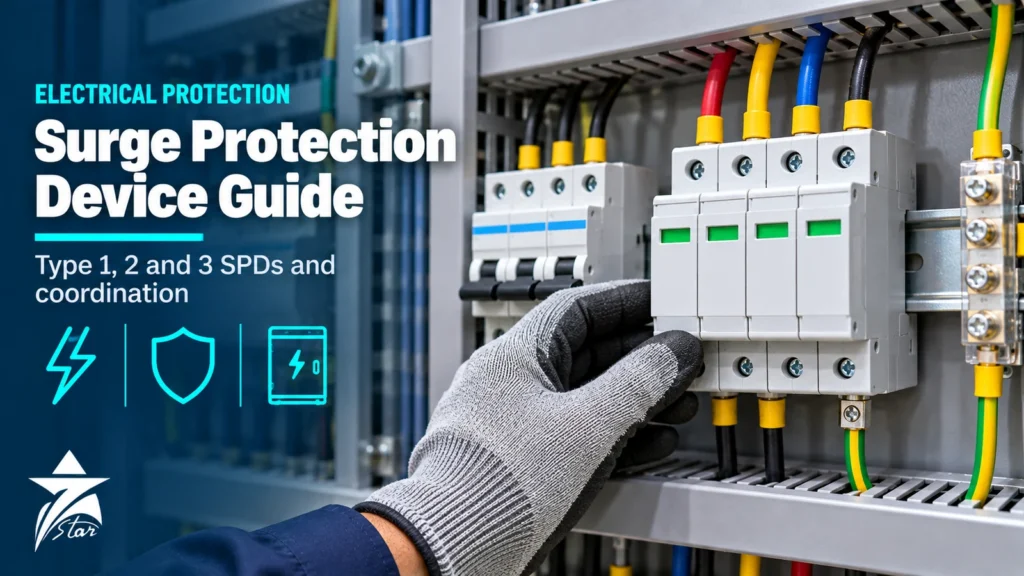
A surge protection device (SPD) limits short voltage spikes on power and signal lines and diverts the surge current safely to earth before it reaches sensitive equipment. PLCs, drives, instruments, telecom equipment and LED lighting are all damaged by transient overvoltages, and the damage is often invisible at first: a board degrades a little with every surge until it fails months later with no obvious cause. This guide explains the types of SPD, the ratings on the label, how to connect them for different earthing systems, and the installation mistakes that make an SPD ineffective.
Where Do Surges Come From?
Lightning is the cause most people think of. A direct strike to a building or an overhead line injects enormous currents, and a strike nearby induces surges into cables and earthing systems. But on most industrial sites in Oman the more frequent surges come from inside the installation:
- Switching of large motors, transformers and capacitor banks.
- Operation of contactors, relays and solenoid coils without suppression.
- Fault clearing by breakers and fuses on the same network.
- Generator start-up and changeover between mains and generator supply.
- Variable frequency drives and other power electronics.
Lightning surges are rare but carry a lot of energy. Switching surges are smaller but happen thousands of times. A good surge protection scheme handles both.
SPD Types: Type 1, Type 2 and Type 3
IEC 61643-11 classifies low-voltage power SPDs by the test they pass. The European EN 61643-11 uses the same classes. North American practice under UL 1449 also uses the names Type 1, 2 and 3, but there they describe the installation location and are not the same as the IEC types, so do not compare them directly.
| Type (IEC class) | Test waveform | Where it is installed | Purpose |
|---|---|---|---|
| Type 1 (Class I) | Impulse current Iimp, 10/350 µs | Main incoming board, at the service entrance | Handles partial lightning currents where the building has an external lightning protection system or is fed by an overhead line |
| Type 2 (Class II) | Nominal discharge current In and maximum Imax, 8/20 µs | Main and sub-distribution boards, machine control panels | Main protection against induced lightning surges and switching surges |
| Type 3 (Class III) | Combination wave (Uoc) | Close to sensitive equipment | Fine protection after a Type 2 device, for very sensitive loads |
| Type 1+2 combined | Both Iimp and In | Main board where space is limited | One device that covers the Type 1 and Type 2 roles |
Protection works in stages. A Type 1 device at the incomer diverts most of the energy; a Type 2 device in the distribution board clamps what is left; a Type 3 device near a sensitive load gives the final fine protection. The stages must be coordinated, which normally means some cable length between them or a device designed to coordinate without it. Follow the manufacturer coordination rules.
Understanding the Ratings on an SPD Label
| Rating | Meaning | How to choose |
|---|---|---|
| Uc | Maximum continuous operating voltage | Must be above the highest normal voltage between the terminals it connects. For 230/400 V systems, 275 V phase to neutral is common; check the earthing system and supply tolerance. |
| Up | Voltage protection level, the residual voltage the SPD lets through | Must be lower than the impulse withstand voltage of the equipment it protects. Lower is better. |
| In | Nominal discharge current (8/20 µs) that the device withstands repeatedly | Typical Type 2 values are 5 to 20 kA. Higher In means longer life at the same surge level. |
| Imax | Maximum discharge current (8/20 µs) that it withstands once | Often quoted in catalogs, such as 40 kA or 65 kA. Do not compare an Imax figure from one maker with an In figure from another. |
| Iimp | Impulse current (10/350 µs) for Type 1 devices | Chosen from a lightning risk assessment, often 12.5 kA or 25 kA per pole for buildings with external lightning protection. |
| Isccr | Short-circuit current rating with the specified backup protection | Must be equal to or higher than the prospective short-circuit current at the point of installation. |
A useful reference is the impulse withstand voltage of equipment in a 230/400 V installation under IEC 60664-1: about 6 kV for equipment at the origin of the installation, 4 kV for distribution equipment, 2.5 kV for ordinary appliances and 1.5 kV for sensitive electronics. A surge protection device that protects electronics needs an effective Up comfortably below 1.5 kV once the voltage drop on its connecting leads is added.
Connecting the SPD to the Earthing System
The wiring arrangement depends on the earthing system of the supply. Choosing the wrong one can leave the installation unprotected or create a safety hazard.
- TN-S (separate neutral and earth, common in industrial plants): protection from each phase and from neutral to earth, called 4+0, or a 3+1 arrangement with a spark gap between neutral and earth.
- TN-C (combined PEN conductor): protection from each phase to PEN, called 3+0.
- TT (local earth electrode, common on some rural or small supplies): a 3+1 arrangement, with varistors from phase to neutral and a spark gap from neutral to earth, so that a failed varistor cannot put mains voltage on the earth.
- IT (isolated or high-impedance earthed, used on some critical process supplies): needs SPDs with a Uc high enough to survive a first earth fault, often rated for the phase-to-phase voltage.
No surge protection device works without a low-impedance earth and good equipotential bonding. The surge current has to go somewhere; if the earth path is long or high in resistance, the voltage across the protected equipment stays high.
Installation: Lead Length Is Everything
Every metre of connecting wire adds inductive voltage during a fast surge, roughly 1 kV per metre for a large surge current. That voltage adds directly to the Up of the device. A Type 2 SPD with Up 1.3 kV connected with 1.5 metres of wire can let through well over 2.5 kV to the equipment.
- Keep the total length of the phase connection and the earth connection as short as possible. IEC 60364-5-53 recommends not more than 0.5 m in total.
- Run the conductors to and from the SPD close together to reduce the loop area.
- Connect the SPD earth directly to the main earth bar of the board, not through a long separate wire.
- Use the conductor size given in the manufacturer instructions and the wiring rules.
- Keep the protected outgoing cables away from unprotected incoming cables in the panel, so the surge does not couple across.
Backup Protection and End of Life
A varistor in an SPD degrades with every large surge and eventually fails, usually towards a short circuit. Most SPDs include an internal thermal disconnector, but they also need an external backup fuse or breaker of the type and rating the manufacturer specifies. That device must clear an SPD failure without tripping the whole supply where possible. Many manufacturers offer an integrated breaker or a coordinated backup device for this reason.
Choose devices with plug-in cartridges and a visual end-of-life indicator, and with a remote signalling contact where the panel is monitored by a PLC or SCADA. A remote alarm tells maintenance staff that a cartridge needs replacing before the next surge finds the equipment unprotected. In Schneider Electric Acti9 ranges, for example, an “r” suffix on the model indicates the version with a remote signalling contact.
Signal, Data and Instrument Lines
Surges also enter equipment through 4-20 mA loops, RS-485 networks, Ethernet, telephone lines and antenna cables, especially when cables run between buildings or out to field instruments. A PLC protected only on its power supply can still be damaged through its I/O.
- Fit signal SPDs at both ends of long field cables, close to the equipment they protect.
- Match the SPD to the signal: voltage, current, frequency or data rate, and the number of wires.
- On intrinsically safe circuits, use SPDs certified for that use and include them in the loop documentation. See our guide on Zener barriers vs galvanic isolators.
- Remote instruments in wells, tanks and pipelines are at high risk; our article on submersible level transmitters explains surge protection on long instrument cables.
Solar PV systems need SPDs designed for DC, rated for the open-circuit voltage of the string and tested to the PV-specific part of the standard, on both the DC and AC sides of the inverter.
A Simple Surge Protection Device Selection Checklist
- Is there an external lightning protection system or an overhead supply line? If yes, a Type 1 or Type 1+2 device is needed at the incomer.
- What is the earthing system (TN-S, TN-C, TT or IT)? It sets the connection type and Uc.
- What is the impulse withstand of the equipment to protect? It sets the required Up, including lead length.
- What is the prospective short-circuit current? It sets the backup protection and Isccr.
- Are there sensitive loads more than a short cable run from the main SPD? Add Type 3 devices near them.
- Which signal, data and PV lines enter or leave the building? Add the matching signal or DC SPDs.
- Is remote monitoring available? Specify remote signalling contacts.
An SPD is only as good as its installation: the right type for the location, an Up below what the equipment can withstand, short leads and a solid earth.
Surge Protection Devices From Our Catalog
Examples of surge protection products in our catalog. Each link goes to the product page.
Browse more in our switchgear, enclosures and distribution category, and see our guide to circuit breaker types for the backup protection side. To get a matching quotation, send the supply voltage, earthing system, the location in the installation, the short-circuit level and the equipment you need to protect through our quote request form or to [email protected].
Sourcing Surge Protection in Oman Through Seven Star LLC
Seven Star LLC is an independent supplier in Oman of electrical distribution, automation and instrumentation products. We quote surge protection devices and replacement cartridges from manufacturers such as Schneider Electric, Phoenix Contact, OBO Bettermann, Hager and Finder, and we can match an existing installed SPD by part number or propose an equivalent with the same type, Uc, Up and connection arrangement. Ratings, approvals and lead time are confirmed against the manufacturer data at quotation.
Frequently asked questions
What is the difference between Type 1, Type 2 and Type 3 surge protection devices?
A Type 1 SPD is tested with a 10/350 microsecond impulse current and is installed at the main incomer where there is a lightning risk. A Type 2 SPD is tested with an 8/20 microsecond current and protects distribution and control panels. A Type 3 SPD gives fine protection close to sensitive equipment, after a Type 2 device.
What do Uc and Up mean on an SPD?
Uc is the maximum continuous operating voltage the SPD can stand permanently; it must be above the highest normal system voltage. Up is the voltage protection level, the residual voltage the device lets through during a surge; it must be below what the protected equipment can withstand.
Do I need a Type 1 surge protection device?
A Type 1 or Type 1+2 device is normally needed at the main board when the building has an external lightning protection system or is supplied by an overhead line. A lightning risk assessment to IEC 62305 decides the requirement and the impulse current rating.
Why must SPD connecting wires be short?
During a fast surge every metre of wire adds a large inductive voltage, roughly 1 kV per metre for a big surge current, on top of the device Up. IEC 60364-5-53 recommends keeping the total connection length to about 0.5 m so the equipment sees the protection level it was designed for.
Does an SPD need a fuse or circuit breaker?
Yes. SPDs need the backup fuse or breaker type and rating specified by the manufacturer, so that a failed device is disconnected safely. Some ranges include an integrated or coordinated backup device.
Who supplies surge protection devices in Oman?
Seven Star LLC is an independent supplier in Oman that quotes surge protection devices and cartridges from Schneider Electric, Phoenix Contact, OBO Bettermann, Hager and Finder. Send the supply voltage, earthing system, location and short-circuit level through the quote request form or to [email protected].
Was this guide helpful?One click helps us write better guides for engineers.
Thank you! Glad it helped. Need this equipment for your project? Request a quotation
Thank you. We will use this to improve the guide.