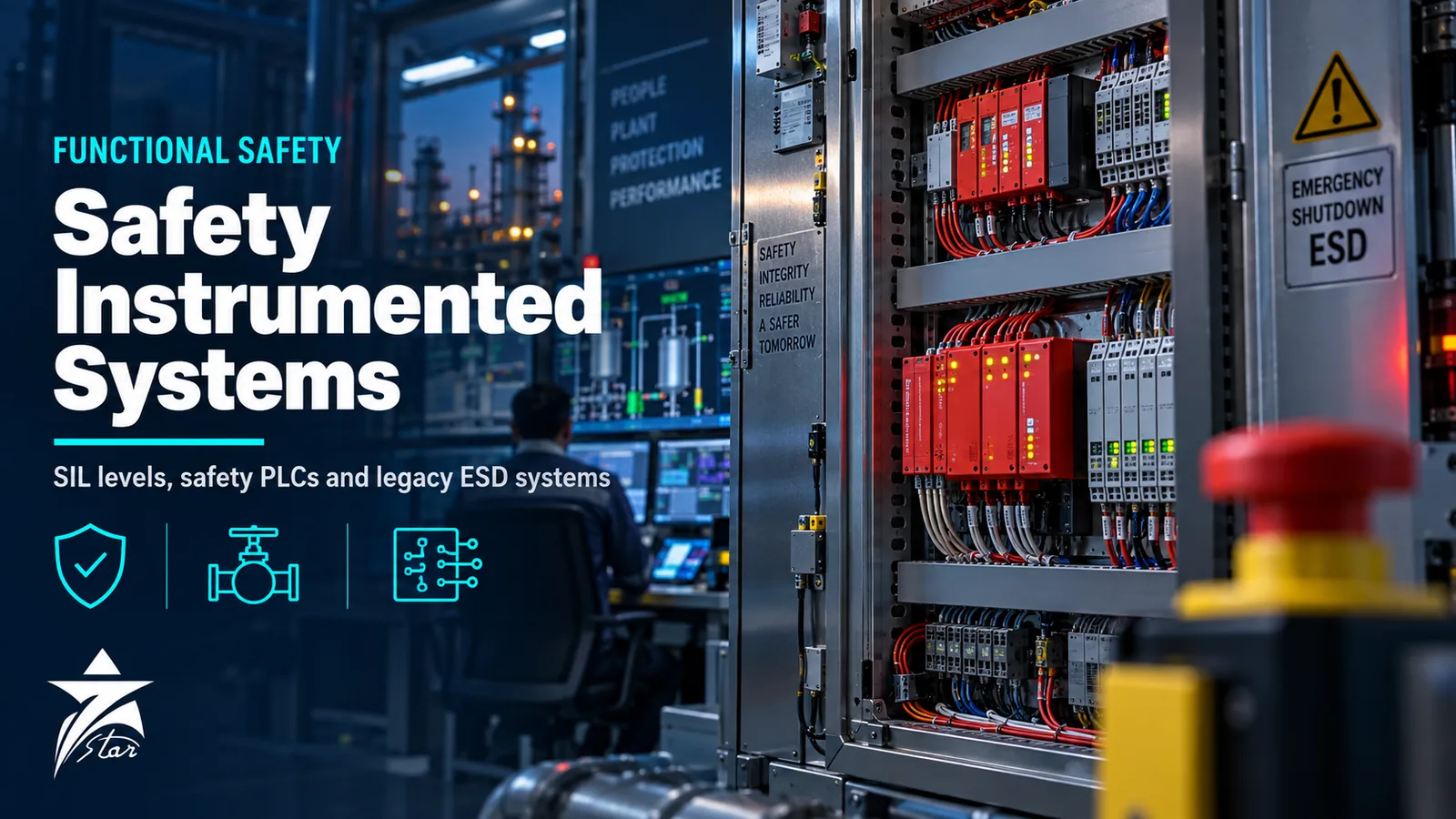
Safety Instrumented Systems in Oman: SIL Levels, Safety PLC Architectures and Managing Legacy ESD Systems
Every hazardous process has a last line of automated defence: the system that closes the shutdown valve, trips the compressor or depressurises the vessel when everything else has failed. That is the safety instrumented system (SIS). Unlike the basic process control system, it is designed, tested and maintained to a documented level of reliability, and it is subject to international standards that regulators and insurers expect operators to follow.
This article explains how an SIS is specified under IEC 61511, what Safety Integrity Levels actually mean, how the main safety PLC architectures differ, and how operators in Oman can manage the growing challenge of supporting emergency shutdown (ESD) systems that were installed 20 or 30 years ago.
What Makes a Safety Instrumented System Different
An SIS is made up of one or more safety instrumented functions (SIFs). Each SIF has three parts: a sensor that detects a hazardous condition, a logic solver that decides to act, and a final element that brings the process to a safe state. A typical SIF might be: two pressure transmitters on a separator, a safety PLC voting between them, and a shutdown valve on the inlet.
What distinguishes an SIS from ordinary control is not the hardware alone. It is the combination of:
- Independence from the basic process control system (BPCS), so that a single failure cannot disable both the control function and the protection
- Quantified reliability, expressed as a probability of failure on demand
- Defined proof testing to reveal hidden failures before a demand occurs
- Formal management of change so that bypasses, setpoint changes and software modifications are controlled and documented
The Standards: IEC 61508 and IEC 61511
IEC 61508 is the base functional safety standard used by manufacturers to design and certify safety-related equipment. IEC 61511 is the process-sector standard used by operators, engineering contractors and integrators to design, operate and maintain an SIS across its full lifecycle. When a transmitter or safety PLC is described as “SIL 3 capable”, it has been assessed against IEC 61508; whether a complete SIF actually achieves SIL 3 is determined under IEC 61511.
Understanding SIL Levels
Safety Integrity Level is a measure of the risk reduction a SIF must provide. For low-demand mode, which covers most process shutdown functions, the bands are:
| SIL | Average probability of failure on demand (PFDavg) | Risk reduction factor |
|---|---|---|
| SIL 1 | 0.1 to 0.01 | 10 to 100 |
| SIL 2 | 0.01 to 0.001 | 100 to 1,000 |
| SIL 3 | 0.001 to 0.0001 | 1,000 to 10,000 |
| SIL 4 | Below 0.0001 | Above 10,000 |
SIL 4 is rarely, if ever, used in the process industries. Most process SIFs are SIL 1 or SIL 2, with SIL 3 reserved for the highest-consequence scenarios. A useful sign of good engineering is when a SIL 3 requirement triggers a review of whether the process design itself can be changed to reduce the hazard.
The Safety Lifecycle in Practice
- Hazard and risk assessment. A HAZOP identifies what can go wrong; a layer of protection analysis (LOPA) or risk graph determines how much risk reduction each SIF must deliver.
- Safety Requirements Specification (SRS). Documents every SIF: the trip condition, setpoint, response time, safe state, SIL target, proof test interval and bypass requirements.
- Design and engineering. Selection of sensors, logic solver and final elements, plus architecture and PFD calculations that show each SIF meets its target.
- Factory and site acceptance testing. Verifies the logic and hardware against the SRS.
- Operation and proof testing. Periodic tests reveal dangerous undetected failures. The assumed proof test interval in the PFD calculation must match what actually happens in the field.
- Management of change and decommissioning. Every modification goes back through the lifecycle.
Safety PLC Architectures
The logic solver is usually a certified safety PLC. Its architecture determines how it tolerates hardware faults.
| Architecture | How it works | Strength | Typical use |
|---|---|---|---|
| 1oo1D | Single channel with extensive diagnostics | Simple, economical | SIL 1 to SIL 2 functions, machinery safety |
| 1oo2 / 1oo2D | Two channels, either can trip | High safety, lower availability | SIL 3 where nuisance trips are tolerable |
| 2oo3 (TMR) | Three channels, majority vote | High safety and high availability | Large ESD systems, continuous-process plants |
| Quad or redundant 1oo2D | Two redundant 1oo2D pairs | High safety and high availability | Large process safety systems |
HIMA
HIMA is one of the few companies that builds only safety systems, and its equipment is installed across oil and gas, refining and chemical plants in the Gulf. The HIMA HIMax platform is designed for SIL 3 applications that must run continuously, with redundant, hot-swappable modules that allow maintenance and modification without a plant shutdown. The HIQuad X is HIMA’s modernised successor to the long-established HIQuad H41q and H51q systems and is intended to simplify migration from that installed base.
Triple modular redundant (TMR) controllers
TMR systems run three independent processing channels and vote on every output, so a single failure neither causes a trip nor stops the protection. The ICS Triplex Trusted platform, now part of Rockwell Automation, is a well-known TMR system; components such as the T8110B Trusted TMR processor, T8403 digital input module and T8100 controller chassis remain in service at many facilities.
Integrated and compact safety PLCs
For smaller processes, burner management, packaged equipment and machinery safety, compact safety controllers such as the ABB AC500-S provide SIL 3 capability within a familiar PLC environment. Integrated control and safety platforms, such as Emerson DeltaV SIS, share engineering tools with the DCS while maintaining the required separation.
The Other Two-Thirds: Sensors and Final Elements
Most PFD calculations show that the logic solver contributes only a small share of the total failure probability. Sensors and, above all, final elements dominate. That means:
- Use transmitters with IEC 61508 certification or proven-in-use justification, and apply voting (1oo2 or 2oo3) where the SIL target requires it.
- Treat shutdown valves, actuators and solenoids as safety equipment. Partial stroke testing can extend the effective proof test interval, but only if it is actually performed and recorded.
- Avoid sharing transmitters between the BPCS and SIS unless the risk assessment explicitly allows it.
The Legacy ESD Challenge
Many emergency shutdown systems in Oman were installed during the major field and plant developments of the 1990s and 2000s. Platforms such as the HIMA H41q and H51q, for example the H41q-HRS fail-safe control system, have proven extremely reliable, which is exactly why so many are still running. The difficulty is not performance; it is support.
As systems age, operators face shrinking availability of spare CPU, I/O, coupling and power supply modules; engineering software that runs only on old operating systems; and fewer engineers familiar with the platform. Typical spares requirements for H51q installations include the F8650X central module, F7553 coupling module, F7131 power supply monitoring module, F8621A coprocessor and F1101 analog input modules, along with the ELOP II engineering software and hardlock key.
A practical obsolescence strategy
- Audit the installed base. Record every module type, quantity, hardware revision and firmware version, including spares held on site.
- Assess criticality. Identify single points of failure and modules with no on-site spare.
- Secure critical spares. Where support is ending, buy spares while genuine, correctly-revisioned stock is still available, and verify compatibility with the installed firmware.
- Plan the migration. Use the spares strategy to buy time, not to avoid decisions. A planned migration, aligned with a turnaround, is far less risky than a forced replacement after an unrecoverable failure.
- Follow management of change. Any replacement module, firmware change or logic modification must follow the site’s functional safety management process.
Buying Safety System Hardware: What to Check
- Exact part number, hardware revision and firmware version compatibility with the installed system
- Genuine origin and traceable supply chain, especially for legacy modules
- Certificates of conformity and, for new equipment, IEC 61508 certification documentation
- Condition and testing records for any refurbished item, and whether your operator’s standards permit refurbished modules in SIS service
- Availability of engineering software licences and hardware keys
How Seven Star LLC Supports SIS Owners in Oman
Seven Star LLC supplies safety PLC hardware, spare modules and engineering software from HIMA, Rockwell Automation and ABB, alongside the SIL-capable transmitters, valve positioners and actuators that complete each safety function. Browse our PLC and I/O range, or read our article on Oman Industry 4.0 and the new procurement playbook for how digital projects interact with safety systems.
Send Seven Star LLC your ESD or SIS module list, and we will confirm availability, revision compatibility and lead times for each item before you commit.
More Blog