- Automation & ControlView all 3,053 products
- Automation Accessories
- AC Drives
- PLC & I/O Cards
- Industrial Communications
- Vibration Monitoring
- Isolator & Barrier
- Controllers & Data Acquisition
- Safety Switches & Guard Locking
- Motor Soft Starters
- Encoders
- CCTV & Security
- Pneumatic Cylinders
- HMI Displays
- Servo Drives
- Industrial Computers
- Machine Vision
- Automation Software
- Robotics
Brand: Autonics
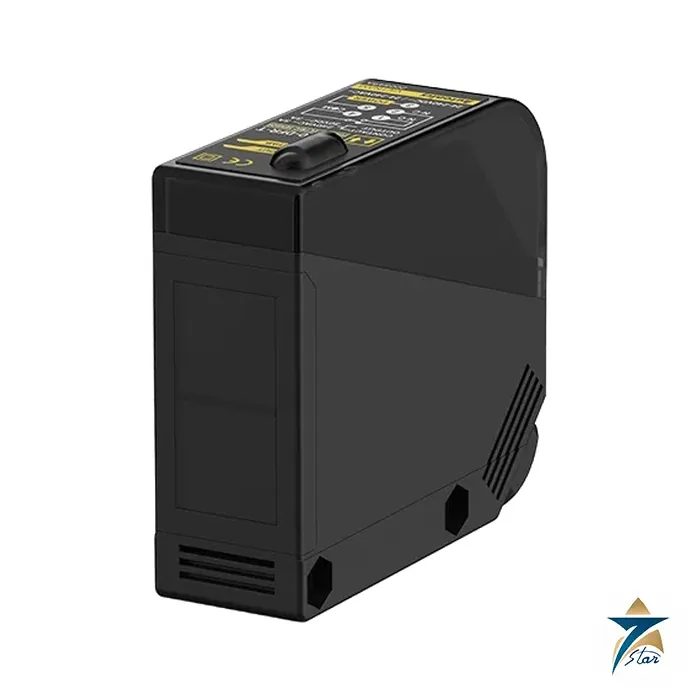
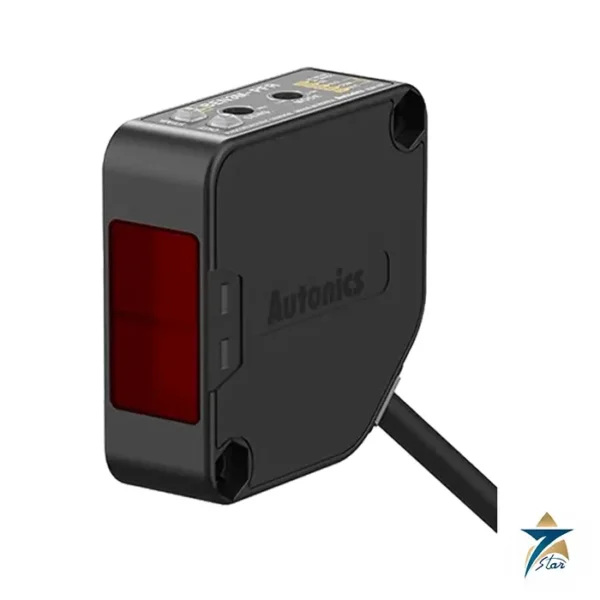
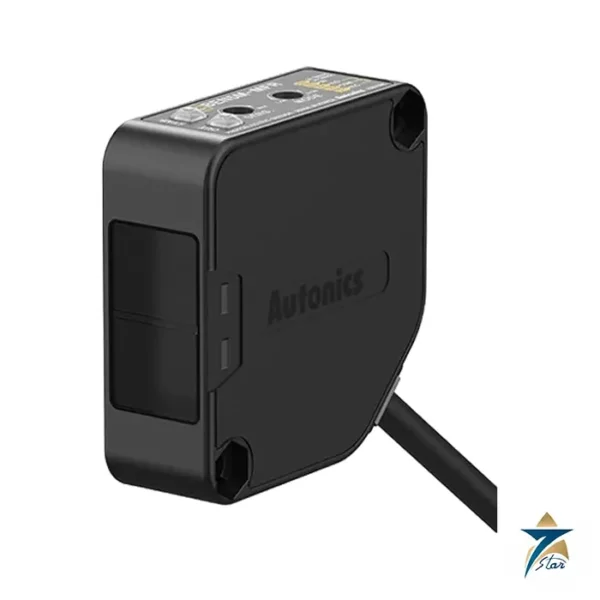
Autonics BX3M-PFR-T Polarized Photoelectric Sensor with Timer
Description
Overview
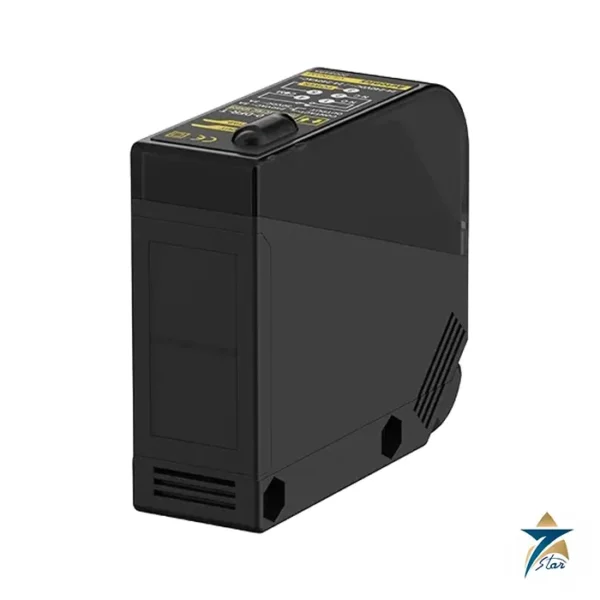
Few photoelectric sensors combine polarized optics, a universal supply, a relay contact and a programmable timer in one body, and the Autonics BX3M-PFR-T does all four. It is a rectangular BX series sensor with screw terminals, working on any supply from 24 to 240 V AC or DC, detecting objects over 0.1 to 3 m against an MS-3 reflector, and offering four timer modes that can be set with switches and a dial. Seven Star LLC is an independent supplier serving Oman and the GCC.
What each part of Autonics BX3M-PFR-T means
BX is the series with terminal block connection and a robust IP65 housing. The 3M is a sensing distance of 3 metres, and P stands for the polarized retroreflective type. FR gives AC/DC power with a relay contact output, as opposed to DT, which is DC power with a transistor output. The suffix T is the function code: it signals that a built-in timer is included, where an empty suffix means no function. The through-beam emitter and receiver digits do not apply to a reflective sensor.
Autonics BX3M-PFR-T data table
| Parameter | Value from the manual |
|---|---|
| Sensing type | Polarized retroreflective |
| Sensing distance | 0.1 to 3 m with reflector MS-3 |
| Object | Opaque, minimum diameter 60 mm |
| Light source | Red, 660 nm |
| Response time | 20 ms or less (relay model) |
| Supply | 24 to 240 V AC 50/60 Hz or 24 to 240 V DC, plus or minus 10 percent |
| Consumption | 3 VA or less |
| Output | 1c relay, 250 V AC 3 A or 30 V DC 3 A resistive |
| Relay life | 50 million mechanical, 100,000 electrical |
| Timer | OFF, ON delay, OFF delay, one shot; 0.1 to 5 s by adjuster |
| Mode | Light ON or Dark ON by switch |
| Indicators | Operation yellow, self-diagnosis green |
| Dielectric strength | 1,500 V AC for 1 minute |
| Ambient | minus 20 to plus 55 degrees C, 35 to 85 percent RH |
| Protection | IP65 |
| Connection | Terminal type, round wire 6 to 10 mm, 0.8 N m screws |
| Housing | PC case, acrylic sensing part, steel bracket |
| Weight | about 149 g (standard model 148 g plus 1 g) |
How the Autonics BX3M-PFR-T differs from other BX variants
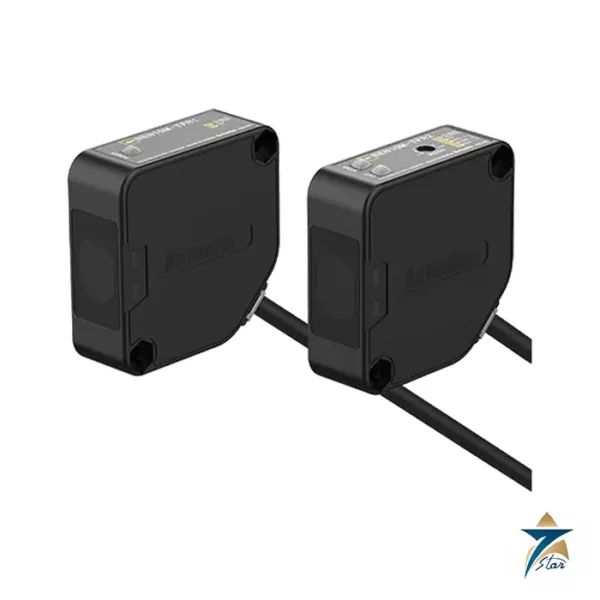
The BX range covers a 15 m through-beam (BX15M-T), a 5 m retroreflective (BX5M-M), this 3 m polarized unit and a 700 mm diffuse type (BX700-D). The through-beam type detects objects of 15 mm, the other two reflective types need 60 mm. Light sources also vary: 850 nm infrared for the through-beam, 940 nm for the retroreflective and diffuse, and 660 nm red for the polarized type. The reflector is MS-2 for the 5 m model but MS-3 for the Autonics BX3M-PFR-T. The standard polarized BX3M-PFR weighs about 148 g; the T suffix adds the timer and 1 g. DT versions swap the relay for a transistor and add a self-diagnosis output.
Timer functions in practice
The timer can be turned off or set to ON delay, OFF delay or one shot delay through the two switches SW1 and SW2, and the time is set with the adjuster between 0.1 and 5 seconds. An OFF delay stretches a short interruption so that a PLC with a slow scan can see it, an ON delay filters out brief interruptions from small debris or flutter, and a one shot gives a fixed length pulse regardless of how long the object stays in the beam. Combined with the relay output, this removes the need for an external timer relay in many door, gate and conveyor circuits. The delay applies to the output regardless of Light ON or Dark ON selection, so decide first which state means the beam is blocked, and only then choose the delay mode and time.
Applications in Oman and the GCC
With the wide supply and relay output it is a favourite for retrofit work: automatic gates, car park barriers, roller doors, conveyor hand-offs and level of cartons in a chute. The polarized optics ignore shiny vehicle bodies and metal sheet. IP65 means dust-tight and resistant to water jets, which suits outdoor gates and washdown-adjacent equipment, within the limit of 55 degrees C. Beware that the Gulf summer sun on a dark housing can push the temperature above this, so shade it.
Wiring the terminals
Use round wire with an outside diameter of 6 to 10 mm so that the cable gland seals properly, strip it and fit crimp terminals approved for the screw size, and tighten the terminals to 0.8 N m. If you extend the wire, use AWG 20 or heavier up to 100 m. Terminals 1 and 2 carry the supply, and terminals 3, 4 and 5 are the relay contacts: common, normally open and normally closed. Ground the F.G. terminal where the supply is a switching type or near inverters, and add a noise suppression capacitor between 0 V and F.G. as the manual advises.
Alignment and sensitivity
Install the sensor facing the MS-3 reflector, parallel to its surface and at least 0.1 m away. Set the mode switch to Light ON or Dark ON, then find the sensitivity range as described in the manual: turn the adjuster from minimum to the point where the yellow indicator turns on with the beam clear, then from this point to maximum and find where it turns on with the beam blocked, and select the midpoint. The green self-diagnosis light shows that the light level is stable and the margin is sufficient; if it flickers, clean the optics or move the reflector closer.
Maintenance
Wipe the lens cover and the reflector with a dry cloth, check that the cable gland is tight, and re-tighten the terminals after thermal cycling. The relay is rated for 100,000 electrical operations, so heavy duty or fast cycle applications should use a DT transistor version. Never open or inspect the unit while power is applied.
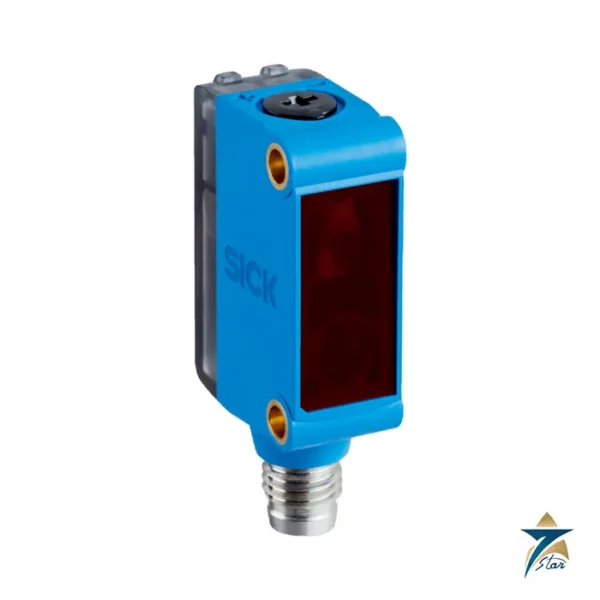
Related items you may also need: Autonics E40S6-2500-6-L-5 Rotary Encoder Incremental | SICK KT5W-2N1116 KT5 Contrast Sensor, NPN, RGB LED | SICK GL6-P4211 G6 Retro-Reflective Photoelectric Sensor, M8 | All Autonics products.
Documents and quotation
The Autonics BX series manual covering the Autonics BX3M-PFR-T is attached with its ordering code, timer diagrams, wiring and dimensions. Send an RFQ with the part number Autonics BX3M-PFR-T, quantity and delivery location in Oman or the GCC.
Other Models in the BX Range
Seven Star LLC supplies models from the BX range in Oman and the GCC. Compare the related models below and request a quote for the one that matches your application.
| Model | Category | |
|---|---|---|
| Autonics BX700-DFR Diffuse Photoelectric Sensor 700 mm | Photoelectric Sensors | View details |
| Autonics BX3M-PFR-T Polarized Photoelectric Sensor with Timer | Photoelectric Sensors | You are viewing this model |
Datasheets & Documents
- Datasheet Autonics BX3M-PFR-T Polarized Photoelectric Sensor with Timer Datasheet Download
Reviews (0)
How would you rate this product? Cancel reply
About brand
Autonics is a South Korean maker of sensors and controllers, founded in 1977 as a small engineering business making controllers for looms. It took the Autonics name in 1988 and opened a new corporate headquarters in Busan in 2014. Autonics makes proximity and photoelectric sensors, rotary encoders, temperature controllers, counters, timers and stepper motor systems, with factories in Busan and Yangsan.
Seven Star LLC lists the Autonics E40S6-2500-6-L-5 incremental rotary encoder and supplies Autonics sensors and control devices in Oman and the GCC.
Autonics company profile
| Founded | 1977, South Korea |
|---|---|
| Current name | Autonics, since 1988 |
| Headquarters | Busan, South Korea |
| Factories | Busan and Yangsan |
| Product families | E40 and E50 rotary encoders, PR proximity sensors, BJ photoelectric sensors, TK temperature controllers |
Milestones
- 1977: The company is founded.
- 1988: Renamed Autonics Corporation.
- 2014: Opens its Busan headquarters.
Reading the Autonics E40S encoder code
E40S is the 40 mm diameter shaft-type incremental encoder, and the 6 that follows is the 6 mm shaft. 2500 is the resolution in pulses per revolution. The next 6 means six output signals: A, B and Z with their inverted signals. L is a line driver output and the final 5 is a 5 V DC supply. The same 40 mm body is made in hollow shaft form as the E40H and E40HB series.
Where Autonics encoders are used
Servo and spindle feedback, conveyor length measurement, packaging and printing machines.
Ordering Autonics encoders: what we need
Send the complete model string from the label. If it is worn off, give the body and shaft diameter, pulses per revolution, output type, supply voltage and cable or connector style.
Facts checked against Autonics corporate profiles, October 2026.
Browse Autonics products by category: Encoders.
FAQ
Questions about the Autonics BX3M-PFR-T Polarized Photoelectric Sensor
Answers from our engineering team on installation, compatibility and integration.
01What does the T in Autonics BX3M-PFR-T mean?
The T in the last position is the function code for a built-in timer, selectable as OFF, ON delay, OFF delay or one shot, from 0.1 to 5 seconds.
02What reflector does the Autonics BX3M-PFR-T use?
The polarized retroreflective 3 m model works with reflector MS-3, giving a sensing distance of 0.1 to 3 m on opaque objects of at least 60 mm.
03What supply and output does the Autonics BX3M-PFR-T have?
It runs from 24 to 240 V AC or DC and has a 1c relay output rated 250 V AC 3 A or 30 V DC 3 A resistive.
04How is the Autonics BX3M-PFR-T connected?
It is a terminal type; wire with 6 to 10 mm round cable is tightened on the screw terminals at 0.8 N m.
05What protection rating does the Autonics BX3M-PFR-T have?
The housing is rated IP65 and works from minus 20 to plus 55 degrees C at 35 to 85 percent relative humidity.


Reviews
There are no reviews yet.