- Automation & ControlView all 3,044 products
- Automation Accessories
- AC Drives
- PLC & I/O Cards
- Industrial Communications
- Vibration Monitoring
- Isolator & Barrier
- Controllers & Data Acquisition
- Safety Switches & Guard Locking
- Motor Soft Starters
- Encoders
- CCTV & Security
- Pneumatic Cylinders
- HMI Displays
- Servo Drives
- Industrial Computers
- Machine Vision
- Automation Software
- Robotics
Brand: Autonics
Autonics BEN10M-TFR 10 m Through-Beam Photoelectric Sensor
Description
Overview
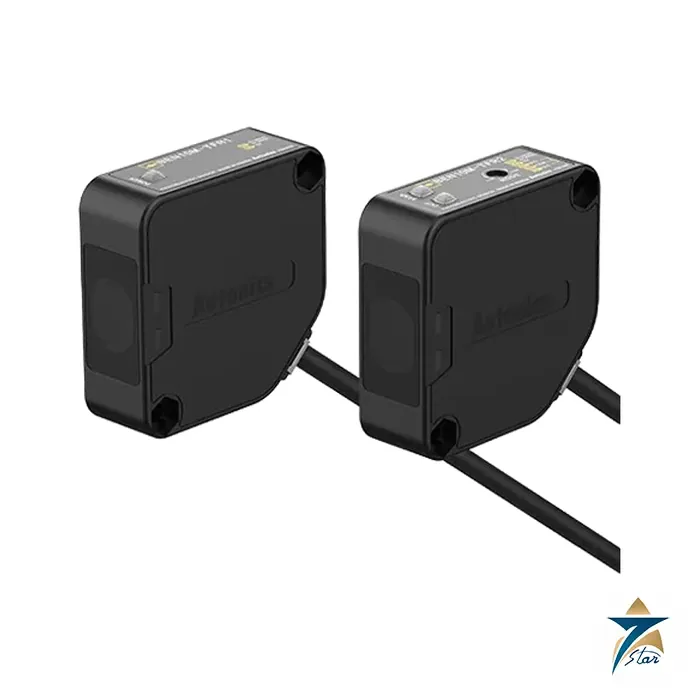
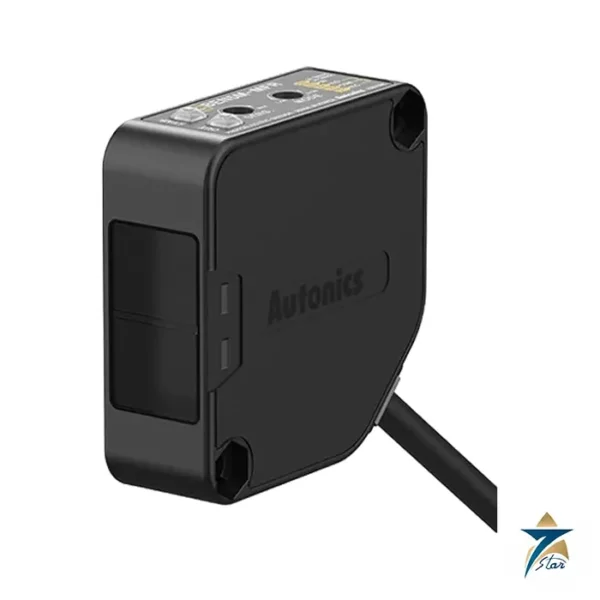
Ten metres is a long way for a photoelectric beam in a compact housing, and that is what the Autonics BEN10M-TFR delivers. It is the through-beam member of the BEN series, supplied as an emitter and a receiver pair, and its receiver switches a relay contact from any supply between 24 and 240 V, either AC or DC. That universal supply and relay output make it a practical choice on old and new panels alike, where the voltage on site is not always the usual 24 V DC. Seven Star LLC is an independent supplier serving Oman and the GCC.
What the Autonics BEN10M-TFR code says
BEN is the series name. The 10M states the sensing distance of 10 metres, and the M after the number means that the unit is metres and not millimetres. T marks the through-beam sensing type, as against M for retroreflective, P for polarized retroreflective and D for diffuse. FR indicates AC/DC power with a relay contact output, while DT would mean DC power with a transistor output. The manual adds that a number 1 or 2 may follow for the emitter and receiver when the pair is managed separately, but it is not required when ordering.
Autonics BEN10M-TFR specification table
| Parameter | Value from the manual |
|---|---|
| Sensing type | Through-beam, emitter plus receiver |
| Sensing distance | 10 m |
| Detectable targets | Opaque and translucent materials, minimum diameter 16 mm |
| Light source | Infrared, peak wavelength 850 nm |
| Response time | 20 ms or less (relay model) |
| Supply | 24 to 240 V AC at 50/60 Hz or 24 to 240 V DC, plus or minus 10 percent |
| Power consumption | 4 VA or less |
| Output | Relay, 1c, 250 V AC 3 A or 30 V DC 3 A resistive |
| Relay life | 50 million mechanical, 100,000 electrical operations |
| Operation mode | Light ON or Dark ON, set by adjuster |
| Indicators | Operation (red), stability (green), power (red, emitter) |
| Ambient light | Sunlight up to 11,000 lx, incandescent up to 3,000 lx |
| Dielectric strength | 1,000 V AC for 1 minute |
| Vibration and shock | 1.5 mm, 10 to 55 Hz, 2 hours; 500 m/s2 |
| Temperature | minus 20 to plus 65 degrees C |
| Protection | IP50 |
| Cable | 5 mm, 2 m; emitter 2-wire, receiver 5-wire |
| Housing | Heat resistant ABS, PC sensing part |
| Weight | about 354 g |
How the Autonics BEN10M-TFR differs from other BEN variants
The BEN family offers four reach classes. The retroreflective BEN5M-M covers 0.1 to 5 m with its reflector and needs a target of at least 60 mm diameter, the polarized BEN3M-P covers 0.1 to 3 m, and the diffuse BEN300-D senses at 300 mm on white paper. The Autonics BEN10M-TFR is the only one that needs two housings, since the beam travels between emitter and receiver, but it has twice the range of the retroreflective version and can detect an object as small as 16 mm across, whereas the reflective types need 60 mm. The through-beam sensor is also the only one for which the light source is 850 nm infrared, against 940 nm for the retroreflective and 660 nm red for the polarized type. Choose it when the object is dark, shiny, translucent or irregular, and when the longest possible reach matters more than having a single housing.
Where to use the Autonics BEN10M-TFR
A 10 m beam crosses conveyor tracks, loading gates, roller shutter doors, vehicle bays and the width of a packaging line. In warehouses and ports in the GCC the sensor is used for presence at a loading bay, in car washes for vehicle detection, and in water or food plants for bottle and carton counting. Since it accepts up to 240 V AC, it can be powered directly from a mains control circuit without a dedicated 24 V supply, a point appreciated in older switchrooms and temporary installations.
Alignment and setting
Place the emitter and receiver facing each other, so that the optical axes are on the same line; the manual stresses that the two should be installed facing each other and parallel with the sensing sides. Fix with the supplied brackets and M4 bolts. Choose Light ON or Dark ON mode before powering up, because the mode has to be set with the power off. Then check the green stability indicator: when it is on, the received light is well above the operating level. Mark the final bracket position, and tighten the screws so that vibration cannot walk the alignment away.
Wiring and safety
With the AC/DC model, the emitter takes the supply through the brown and blue wires, while the receiver has the supply wires plus the relay contacts as black (normally open), white (common) and grey (normally closed) leads, according to the connection diagram. Never connect or inspect the sensor with power on, and do not exceed the relay contact ratings of 3 A, since overloading can weld contacts. When a load is inductive, use a surge suppressor across it. The IP50 housing is not meant for washdown, so keep the pair in a dry location or behind a cover.
Maintenance
Clean the lenses with a dry cloth; water and organic solvents are warned against in the manual. Look for dust build-up in cement or sand environments, which lowers the received light and eventually the stability indicator. Relay contacts wear with use, up to 100,000 electrical operations under rated load, so on a fast counting application a DT transistor model may be a better choice.
When a pair is replaced, re-check the alignment after fitting, since a small tilt of either housing moves the beam across a distance of ten metres by a noticeable amount. Record the alarm and relay states during the test so that the new pair can be compared with the old behaviour, and keep a note of the selected Light ON or Dark ON mode for future service visits.
Related items you may also need: Autonics E40S6-2500-6-L-5 Rotary Encoder Incremental | SICK WTB4FP-22161100A00 W4 Background Suppression Sensor | Omron E3Z-T61 Photoelectric Sensor 15 m through-beam | All Autonics products.
Documents and quotation
The Autonics BEN series manual covering the Autonics BEN10M-TFR is attached to this page and gives the order code table, wiring, characteristic curves and dimensions. Send an RFQ with the part number Autonics BEN10M-TFR, the quantity and the delivery location in Oman or the GCC.
Other Models in the BEN Range
Seven Star LLC supplies models from the BEN range in Oman and the GCC. Compare the related models below and request a quote for the one that matches your application.
| Model | Category | |
|---|---|---|
| Autonics BEN5M-MFR Retroreflective Photoelectric Sensor 5 m | Photoelectric Sensors | View details |
| Autonics BEN10M-TFR 10 m Through-Beam Photoelectric Sensor | Photoelectric Sensors | You are viewing this model |
Datasheets & Documents
- Datasheet Autonics BEN10M-TFR 10 m Through-Beam Photoelectric Sensor Datasheet Download
Reviews (0)
How would you rate this product? Cancel reply
About brand
Autonics is a South Korean maker of sensors and controllers, founded in 1977 as a small engineering business making controllers for looms. It took the Autonics name in 1988 and opened a new corporate headquarters in Busan in 2014. Autonics makes proximity and photoelectric sensors, rotary encoders, temperature controllers, counters, timers and stepper motor systems, with factories in Busan and Yangsan.
Seven Star LLC lists the Autonics E40S6-2500-6-L-5 incremental rotary encoder and supplies Autonics sensors and control devices in Oman and the GCC.
Autonics company profile
| Founded | 1977, South Korea |
|---|---|
| Current name | Autonics, since 1988 |
| Headquarters | Busan, South Korea |
| Factories | Busan and Yangsan |
| Product families | E40 and E50 rotary encoders, PR proximity sensors, BJ photoelectric sensors, TK temperature controllers |
Milestones
- 1977: The company is founded.
- 1988: Renamed Autonics Corporation.
- 2014: Opens its Busan headquarters.
Reading the Autonics E40S encoder code
E40S is the 40 mm diameter shaft-type incremental encoder, and the 6 that follows is the 6 mm shaft. 2500 is the resolution in pulses per revolution. The next 6 means six output signals: A, B and Z with their inverted signals. L is a line driver output and the final 5 is a 5 V DC supply. The same 40 mm body is made in hollow shaft form as the E40H and E40HB series.
Where Autonics encoders are used
Servo and spindle feedback, conveyor length measurement, packaging and printing machines.
Ordering Autonics encoders: what we need
Send the complete model string from the label. If it is worn off, give the body and shaft diameter, pulses per revolution, output type, supply voltage and cable or connector style.
Facts checked against Autonics corporate profiles, October 2026.
Browse Autonics products by category: Encoders.
FAQ
Questions about the Autonics BEN10M-TFR 10 m Through-Beam Photoelectric
Answers from our engineering team on installation, compatibility and integration.
01What is the sensing distance of the Autonics BEN10M-TFR?
It is a through-beam sensor with a sensing distance of 10 m, using an infrared emitter at 850 nm and a separate receiver unit.
02What supply does the Autonics BEN10M-TFR use?
It accepts 24 to 240 V AC at 50/60 Hz or 24 to 240 V DC, plus or minus 10 percent, with a power consumption of 4 VA or less.
03What output does the Autonics BEN10M-TFR have?
The receiver has a 1c relay contact output rated 250 V AC 3 A or 30 V DC 3 A resistive load, with a response time of 20 ms or less.
04What is the smallest object the Autonics BEN10M-TFR detects?
The manual gives a minimum sensing target of 16 mm diameter, for opaque objects, and the beam can also detect translucent materials.
05What is the protection rating of the Autonics BEN10M-TFR?
The housing is rated IP50, so it is meant for indoor or sheltered locations at minus 20 to plus 65 degrees C, not for washdown.


Reviews
There are no reviews yet.