- Automation & ControlView all 3,188 products
- Automation Accessories
- AC Drives
- PLC & I/O Cards
- Industrial Communications
- Vibration Monitoring
- Controllers & Data Acquisition
- Isolator & Barrier
- Safety Switches & Guard Locking
- Encoders
- Motor Soft Starters
- CCTV & Security
- Pneumatic Cylinders
- HMI Displays
- Servo Drives
- Industrial Computers
- Machine Vision
- Automation Software
- Robotics
















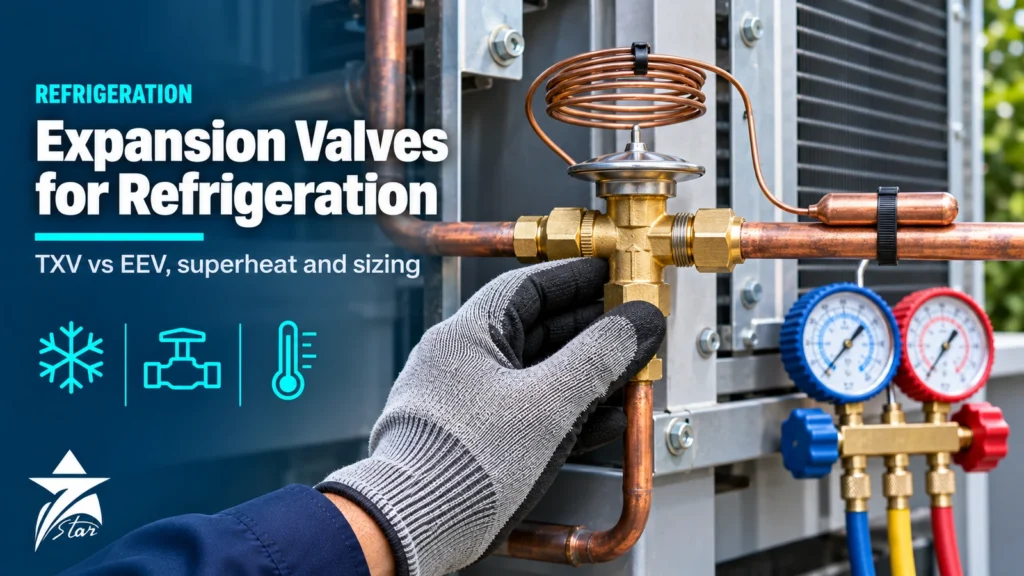
Every vapour compression system, from a cold room to a large chiller, needs a device that drops the refrigerant from condensing pressure to evaporating pressure and feeds the evaporator with the right amount of liquid. Feed too little and the evaporator is starved, capacity falls and the compressor runs hot. Feed too much and liquid can return to the compressor and damage it. The expansion valve does this job, and its selection, setting and installation have a direct effect on efficiency and reliability. This guide explains how thermostatic and electronic valves work, how superheat is controlled, how to size them, and how to find the faults that are most often blamed on the valve.
What Superheat Means
Superheat is the difference between the actual temperature of the refrigerant vapour at the evaporator outlet and its saturation temperature at the evaporator pressure. If the suction line at the bulb is at 2 degrees Celsius and the saturation temperature corresponding to the suction pressure is minus 4 degrees Celsius, the superheat is 6 K. A positive superheat shows that all the liquid has evaporated before the vapour leaves the evaporator. Typical settings for direct expansion systems are in the range of about 4 to 8 K, depending on the evaporator design and the manufacturer recommendations. Too high a superheat wastes evaporator surface, while too low a superheat risks liquid floodback.
How a Thermostatic Expansion Valve Works
A thermostatic expansion valve, or TXV, balances three forces on its diaphragm. The bulb, clamped to the suction line at the evaporator outlet, contains a charge whose pressure rises with suction line temperature and pushes the valve open. The evaporator pressure below the diaphragm and the adjustable spring push it closed. When superheat increases, bulb pressure rises and the valve opens to feed more refrigerant. When superheat falls, it closes. Turning the adjusting spindle changes the spring force and therefore the static superheat.
| Feature | Purpose | When to use |
|---|---|---|
| Internal equalizer | Senses pressure at the evaporator inlet | Small evaporators with low pressure drop |
| External equalizer | Senses pressure at the evaporator outlet | Evaporators with distributors or high pressure drop |
| MOP charge | Limits maximum evaporating pressure | Protects the compressor motor from overload at pull down |
| Interchangeable orifice | Allows capacity change without replacing the body | Service stock and system modification |
| Bleed port | Equalizes pressures during the off cycle | Low starting torque compressors |
How an Electronic Expansion Valve Works
An electronic expansion valve, or EEV, is driven by a controller that reads a pressure transmitter and a temperature sensor at the evaporator outlet, calculates superheat and positions the valve. Two main types are in use. Stepper motor valves move a needle or slide in small steps and give continuous modulation. Pulse width modulated valves open and close fully in a cycle of a few seconds, with the open time setting the average flow. Because the control is in software, an EEV can hold a lower and more stable superheat, adapt to load changes and work with low head pressure.
TXV vs EEV Comparison
| Factor | Thermostatic valve | Electronic valve |
|---|---|---|
| Control | Mechanical, self contained | Controller with sensors |
| Superheat stability | Good at design conditions | Very good across a wide load range |
| Capacity range | Limited turndown | Wide turndown |
| Head pressure | Needs stable condensing pressure | Works with floating head pressure |
| Energy savings | Baseline | Lower superheat and lower head pressure improve efficiency |
| Power needed | None | Controller and valve need power, often with backup to close on failure |
| Cost and complexity | Lower | Higher, but integrates with building and plant controls |
For small standalone systems, a well selected TXV is simple and reliable. For supermarket cases, cold stores, variable speed compressors, heat pumps and chillers that operate across wide loads, an electronic valve usually gives better efficiency and control.
Sizing an Expansion Valve
Valve capacity depends on refrigerant, evaporating temperature, condensing temperature, liquid subcooling and pressure drop across the valve. Use the manufacturer selection software or tables, and check capacity at both design and extreme conditions:
- Select the valve for the actual refrigerant, such as R404A, R407C, R410A, R134a, R448A, R449A, R744 or R717.
- Use the real pressure drop across the valve, subtracting losses in the liquid line, distributor and distributor tubes.
- Check that the valve can still feed full load when condensing pressure is low, as well as when it is high.
- Allow for liquid subcooling, since flash gas in the liquid line reduces capacity.
- Avoid large oversizing, which causes hunting and unstable superheat at part load.
Ambient temperatures in Oman can exceed 45 degrees Celsius, so condensing pressures are often high during summer and much lower in winter nights. A valve sized only for summer conditions may struggle in winter if head pressure control is not provided.
Bulb Installation and Superheat Setting
- Mount the TXV bulb on a clean, horizontal section of the suction line close to the evaporator outlet, away from the suction header and any trap.
- Place it on the side of the pipe in the position recommended by the manufacturer, typically between the 1 and 4 o clock positions depending on pipe size, never on the bottom.
- Clamp it with the supplied metal strap to give good thermal contact, and insulate it from ambient air.
- Connect an external equalizer line downstream of the bulb, on the top of the suction line.
- Measure superheat with a calibrated pressure gauge and an accurate clamp on thermometer, and adjust in small steps, allowing time to stabilize.
Common Faults Blamed on the Expansion Valve
| Symptom | Possible cause | Check |
|---|---|---|
| High superheat, low suction pressure | Low charge, flash gas, blocked filter drier or strainer, lost bulb charge | Sight glass, subcooling, pressure drop across drier |
| Low superheat, floodback | Valve oversized, bulb loose or badly placed, setting too low | Bulb position and contact, setting and selection |
| Hunting superheat | Oversized valve, poor bulb location, unstable head pressure | Valve capacity, head pressure control |
| Valve iced or frozen | Moisture in the system freezing at the orifice | Moisture indicator, replace drier |
| Poor capacity in winter | Low condensing pressure reducing valve capacity | Head pressure control settings |
| Electronic valve not opening | Sensor failure, wiring, controller fault or coil failure | Controller alarms, sensor readings, coil test |
Many valve replacements are unnecessary. Check refrigerant charge, subcooling, filter drier condition and the liquid line solenoid valve before changing the valve itself. For solenoid valve problems, see our solenoid valve selection guide.
Industrial Refrigeration Expansion Devices
Ammonia and large industrial systems often use different devices. Hand regulating valves set a fixed flow, motor operated valves are positioned by a plant controller, and high or low pressure float valves feed liquid according to level in a receiver or surge drum. Pilot operated servo valves combine pressure regulation, solenoid and expansion functions in one body. Transcritical CO2 systems use high pressure electronic valves to control gas cooler pressure as well as evaporator feed. These valves must be selected with the plant control philosophy in mind. Our article on control valve selection and sizing explains general valve sizing principles used in process plants.
Refrigerant Compatibility and Replacement Parts
Each valve body, power element and orifice is built for a specific refrigerant or refrigerant group. The pressure temperature relationship of the bulb charge must match the system refrigerant, otherwise the static superheat will be wrong across the operating range. When a plant is converted from R22 or R404A to a lower GWP refrigerant such as R448A, R449A or R513A, check whether the existing power element and orifice can stay, or whether a new element or a complete valve is needed. Ammonia systems need steel bodies and seals rated for R717, since copper and brass are not compatible. CO2 systems need valves rated for the much higher working pressures, often 90 bar or more on the high side.
For maintenance stock, record the full order code of each valve in service, including the power element, orifice size, connection type and equalizer type. Ordering only by the valve family name often leads to the wrong charge or capacity arriving on site.
Commissioning Checklist
- Confirm the valve type, refrigerant and orifice against the design capacity before installation.
- Fit a filter drier and sight glass with moisture indicator upstream of the valve.
- Check that the liquid line delivers bubble free, subcooled liquid at full load.
- Mount and insulate the bulb or sensor correctly and route the equalizer line to the suction line.
- Record suction pressure, suction temperature, superheat and subcooling at stable operation and keep them for future comparison.
Selected Refrigeration Valves in Our Catalog
The table below shows a selection of refrigeration control valves from our catalog.
| Product | Type | Typical use |
|---|---|---|
| Danfoss TCAE 068U4281 | Thermostatic valve for R22 and R407C | Air conditioning and chillers |
| Danfoss TCBE 068U4202 | Thermostatic valve, 21 kW | Larger DX systems |
| Danfoss TUBE 068U1718 | Thermostatic valve for R404A and R507A | Commercial refrigeration |
| Danfoss TE 2 068Z2900 | Thermostatic valve for R744 | CO2 systems |
| Danfoss ETS 12.5 | Stepper motor electronic valve | Chillers and heat pumps |
| Danfoss ETS 12C Colibri | Compact stepper motor valve | Commercial systems |
| Danfoss AKV 20-3 | Pulse width modulated valve | Supermarket and cold stores |
| Danfoss ICM 20-B | Motor operated valve | Industrial ammonia plants |
| Danfoss ICMTS 20A | Motor valve for transcritical CO2 | Gas cooler pressure control |
| Danfoss HFI 050 | High pressure float valve | Industrial liquid feed |
| Danfoss REG-SA 25 | Hand regulating valve | Fixed flow regulation |
| Danfoss KVP 22 | Evaporator pressure regulator | Minimum evaporator pressure |
| Danfoss CPCE 22 | Hot gas bypass regulator | Capacity control |
Browse more in our refrigeration valves category. To get a quotation, send the refrigerant, capacity, evaporating and condensing temperatures, connection type and quantity through our quote request form or to [email protected].
Sourcing Refrigeration Valves in Oman Through Seven Star LLC
Seven Star LLC is an independent supplier in Oman of thermostatic and electronic expansion valves, pressure regulators, solenoid valves, shut off valves and industrial refrigeration controls for HVAC contractors, cold stores, food plants and process facilities. We quote products from manufacturers such as Danfoss, Emerson, Carel, Sporlan and Parker. Capacities, refrigerants, connections and approvals are confirmed against the manufacturer data at quotation.
Frequently asked questions
What does an expansion valve do?
It reduces the refrigerant pressure from condensing to evaporating level and controls how much liquid enters the evaporator, usually by holding a set superheat at the evaporator outlet.
What is the difference between a TXV and an EEV?
A TXV is a mechanical valve controlled by a bulb, evaporator pressure and a spring. An EEV is positioned by an electronic controller using pressure and temperature sensors, giving wider turndown and more stable superheat.
What superheat should a TXV be set to?
Many direct expansion systems run with superheat of about 4 to 8 K, but the correct value depends on the evaporator design and manufacturer recommendation. Measure carefully before adjusting.
When is an external equalizer needed?
An external equalizer is needed when the evaporator has a significant pressure drop, such as with a refrigerant distributor, so that the valve senses the pressure at the evaporator outlet.
Why does my system have high superheat?
Common causes include low refrigerant charge, flash gas in the liquid line, a blocked filter drier or strainer, an undersized valve, low head pressure or a lost bulb charge.
Who supplies expansion valve products in Oman?
Seven Star LLC is an independent supplier in Oman that quotes thermostatic and electronic expansion valves and refrigeration controls from manufacturers such as Danfoss, Emerson and Carel. Send your requirements through the quote request form or to [email protected].
Was this guide helpful?One click helps us write better guides for engineers.
Thank you! Glad it helped. Need this equipment for your project? Request a quotation
Thank you. We will use this to improve the guide.