- Automation & ControlView all 3,166 products
- Automation Accessories
- AC Drives
- PLC & I/O Cards
- Industrial Communications
- Vibration Monitoring
- Controllers & Data Acquisition
- Isolator & Barrier
- Safety Switches & Guard Locking
- Encoders
- Motor Soft Starters
- CCTV & Security
- Pneumatic Cylinders
- HMI Displays
- Servo Drives
- Industrial Computers
- Machine Vision
- Automation Software
- Robotics
















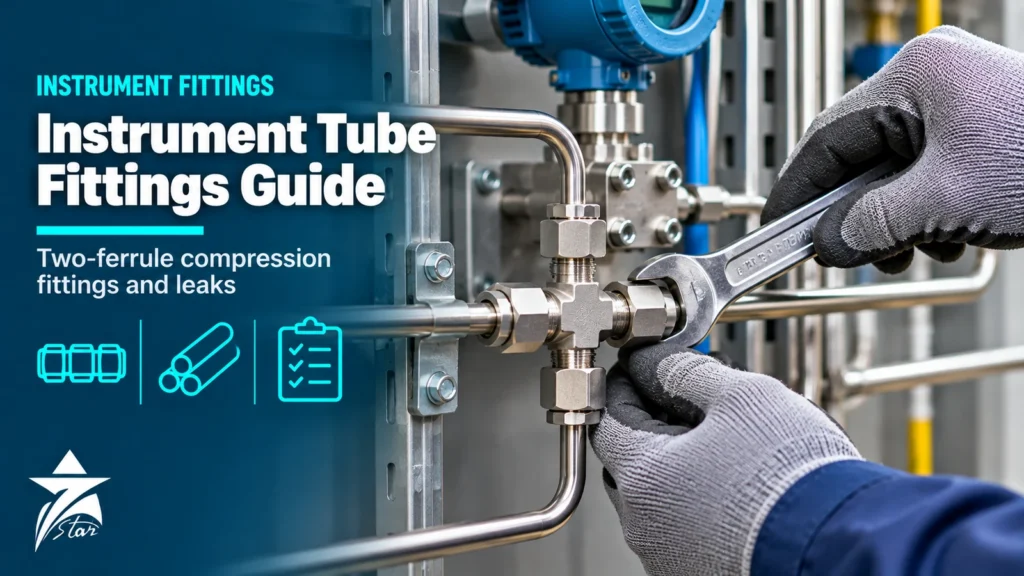
Small bore tubing carries process pressure to transmitters and gauges, instrument air to valve actuators, sample gas to analysers and chemicals to injection points. Every one of these lines depends on the joints at each end. Instrument tube fittings are small and inexpensive compared with the equipment they connect, yet a single leaking fitting can cause a false transmitter reading, a valve that fails to stroke, a fugitive emission or, in hazardous service, a fire. This guide explains how two ferrule compression fittings work, how to choose tubing, how to make up and inspect fittings correctly, and why leaks occur.
How Two Ferrule Compression Fittings Seal
A two ferrule fitting has four parts: the body, the nut, the back ferrule and the front ferrule. When the nut is tightened, it drives the back ferrule forward. The back ferrule pushes the front ferrule into the tapered mouth of the body, where it forms a seal against the body and the tube. At the same time, the back ferrule hinges inward and grips the tube, holding it against pressure and vibration. The result is a seal and a grip that do not depend on threads, sealants or tape. Single ferrule designs and flare fittings, such as 37 degree flare fittings for hydraulic systems, use different principles and have their own installation rules.
Common Fitting Types
| Fitting | Function | Typical use |
|---|---|---|
| Union | Joins two tubes of the same size | Straight runs and repairs |
| Reducing union | Joins tubes of different sizes | Transition from 1/2 in to 1/4 in |
| Male connector | Tube to male pipe thread | Instrument and valve ports |
| Female connector | Tube to female pipe thread | Connection to male threaded parts |
| Union elbow and tee | Change direction or branch | Manifold and panel tubing |
| Bulkhead union | Passes tubing through a panel wall | Analyser and instrument cabinets |
| Port connector and reducer | Connects tubing directly into a fitting port | Compact assemblies |
| Caps and plugs | Close tube ends or ports | Testing and spare connections |
Pipe threads on connectors need a suitable sealant or tape, applied only to male threads and kept away from the first thread to avoid contamination. The tube end of the fitting must never be sealed with tape.
Selecting Tubing for Instrument Tube Fittings
The fitting can only perform as well as the tube it grips. Tubing should be specified with care:
- Material compatible with the fitting and the process, typically 316 stainless steel for most instrument service, with alloys such as 6Mo, alloy 625, alloy 825 or duplex for chloride and sour environments.
- Seamless or welded and drawn tubing suitable for gripping, fully annealed and of controlled hardness, since hard tubing resists the ferrule grip.
- Correct outside diameter tolerance and a smooth surface free from scratches, dents and weld beads where the ferrules seal.
- Wall thickness chosen from the manufacturer pressure tables for the size, material and design temperature, with allowance for temperature derating.
- Fractional and metric sizes kept strictly separate, since 6 mm and 1/4 in or 12 mm and 1/2 in are close but not interchangeable.
Coastal and offshore sites in Oman see chloride rich air and high surface temperatures. Pitting and crevice corrosion of 316 tubing under clamps and at fittings is a known problem in such conditions, which is why higher alloy tubing and fittings are often specified for exposed lines.
Pressure and Temperature Ratings
The working pressure of a tubing system is normally limited by the tube rather than the fitting. Manufacturers publish tables that give the allowable working pressure for each tube size, wall thickness and material, usually at ambient temperature, with derating factors for higher temperatures. Check both the tube and the fitting ratings, together with any valves, manifolds and gauges in the same line, and use the lowest value as the system limit. In hot climates, lines exposed to direct sun can run far above the ambient air temperature, so allow for this when checking ratings for instrument tube fittings on outdoor racks and skids.
Correct Make Up of Instrument Tube Fittings
Always follow the manufacturer installation instructions for the specific fitting series. A typical procedure for two ferrule fittings in fractional sizes from 1/4 in to 1 in is:
- Cut the tube square with a tube cutter or saw guide and deburr the inside and outside edges.
- Insert the tube fully into the fitting until it bottoms against the shoulder of the body, then turn the nut finger tight.
- Mark the nut at a reference position, such as the six o clock position.
- Hold the body steady with a backup wrench and tighten the nut by the specified amount, commonly one and a quarter turns for these sizes.
- Smaller sizes such as 1/16, 1/8 and 3/16 in usually require only three quarters of a turn, and some metric sizes have their own values.
- Check the make up with the manufacturer gap inspection gauge.
Turning the nut by a counted amount rather than by feel gives consistent results across different technicians. Larger sizes and some high pressure services may require hydraulic pre swaging tools.
Gap Inspection Gauges
A gap inspection gauge checks the distance between the nut and the body hex after initial make up. If the gauge will not enter the gap, the fitting has been sufficiently tightened. If it slides in, the fitting has not been tightened enough and must be completed. Gauges are specific to the fitting series and size, and are intended for first time installation only. Pre swaged or retightened fittings cannot be checked this way. Many plants make gap gauge checks part of their tubing installation quality records.
Disassembly and Reassembly
Two ferrule fittings can usually be disassembled and remade many times. On reassembly, insert the tube with its preswaged ferrules into the body until the front ferrule seats, tighten the nut to the previous position with a wrench, and then tighten slightly further as instructed. Keep each preswaged tube end with its original fitting body where possible. Replace ferrules and nuts that are damaged, and never mix components from different manufacturers, since ferrule geometry and tolerances differ and a mixed assembly may not seal or hold.
Common Causes of Leaks
| Cause | Result | Prevention |
|---|---|---|
| Tube not bottomed in the body | Weak grip, tube blow out under pressure | Mark the tube and check insertion depth |
| Insufficient nut turns | Leak at the ferrule seal | Count turns and use the gap gauge |
| Scratched or oval tube | Leak path past the front ferrule | Inspect and handle tubing carefully |
| Mixed components or sizes | Poor seal and grip | Use one manufacturer and verify size |
| Hard or wrong wall tube | Ferrules cannot grip correctly | Specify tubing to the fitting requirements |
| Vibration and poor support | Fatigue cracks near the nut | Clamp tubing at suitable intervals |
| Corrosion in chloride service | Pitting and crevice attack | Choose suitable alloys and avoid crevices |
Leak test tubing systems after installation using the method required by the project, such as a pressure hold test or a leak detection solution. For valve leakage standards, see our article on valve leak testing to API 598 and ISO 5208.
Instrument Tube Fittings in Impulse Lines and Manifolds
Pressure and differential pressure transmitters normally connect through valve manifolds and impulse lines made with instrument tube fittings, needle valves and gauge accessories. Good hook up design includes correct slope, isolation and venting points, and support for the tubing. Our article on instrument impulse lines and hook ups explains these details, and our pressure transmitter selection guide covers the instruments at the end of the line.
Good Practice on Site
- Train technicians on the specific fitting series and keep gap gauges and instructions with the tool kit.
- Store fittings and tubing capped and clean to keep dirt out of the system.
- Use proper tube benders to keep the minimum bend radius and avoid flattening the tube.
- Keep a straight length of tube at the fitting, as advised by the manufacturer, before any bend.
- Label tubing and fittings by material where several alloys are used on the same site.
- Never tighten or loosen fittings while the system is under pressure.
Selected Tube Fittings and Accessories in Our Catalog
The table below shows a selection of fittings, valves and gauge accessories from our catalog.
| Product | Type | Typical use |
|---|---|---|
| Swagelok SS-12M0-6 | Metric union, 12 mm | Joining metric tubing |
| Swagelok SS-810-6-4 | Reducing union, 1/2 x 1/4 in | Size transitions |
| Swagelok SS-810-1-8 | Male connector, 1/2 in tube x 1/2 in MNPT | Threaded ports |
| Swagelok SS-810-7-8 | Female connector, 1/2 in tube x 1/2 in NPT | Threaded connections |
| Swagelok SS-810-9 | Union elbow, 1/2 in | Direction changes |
| Swagelok SS-810-3 | Union tee, 1/2 in | Branch connections |
| Swagelok SS-600-R-4 | Tube reducer, 3/8 x 1/4 in | Port reductions |
| Swagelok SS-810-C | Tube cap, 1/2 in | Closing tube ends |
| Parker Triple-Lok | 37 degree flare fitting | Hydraulic systems |
| Swagelok SS-20VS4 | Vee stem needle valve | Isolation and fine flow |
| FITOK 3DSS-FNS8-A | 3 valve direct mount manifold | DP transmitters |
| WIKA 910.11 | Gauge shut off valve | Pressure gauge isolation |
Browse more in our instrument valves and fittings category. To get a quotation, send the fitting type, tube sizes, material, end connections, quantity and pressure rating through our quote request form or to [email protected].
Sourcing Tube Fittings in Oman Through Seven Star LLC
Seven Star LLC is an independent supplier in Oman of tube fittings, needle valves, manifolds, gauge accessories and instrument tubing for oil and gas, petrochemical, power and water projects. We quote products from manufacturers such as Swagelok, Parker, FITOK, WIKA and Hy-Lok. Materials, sizes, pressure ratings and certificates are confirmed against the manufacturer data at quotation.
Frequently asked questions
How do two ferrule tube fittings seal?
Tightening the nut drives the back ferrule forward, which pushes the front ferrule into the tapered body to seal against the body and tube. The back ferrule grips the tube to resist pressure and vibration.
How many turns should a tube fitting nut be tightened?
For many two ferrule fittings in sizes from 1/4 in to 1 in, the nut is tightened one and a quarter turns from finger tight, while very small sizes need three quarters of a turn. Always follow the manufacturer instructions for the series and size.
What is a gap inspection gauge?
It is a gauge that checks the gap between the nut and body after first make up. If the gauge does not enter the gap, the fitting is sufficiently tightened. It cannot be used on reassembled fittings.
Can fittings from different manufacturers be mixed?
No. Ferrule geometry, materials and tolerances differ between manufacturers, so mixing nuts, ferrules and bodies can result in leaks or poor tube grip. Use complete fittings from one manufacturer.
Why do instrument tube fittings leak?
Common causes are tubes not fully inserted, insufficient tightening, scratched or oval tubing, mixed components, wrong tube hardness or wall thickness, vibration and corrosion.
Who supplies instrument tube fittings in Oman?
Seven Star LLC is an independent supplier in Oman that quotes tube fittings, valves and manifolds from manufacturers such as Swagelok, Parker, FITOK and WIKA. Send your requirements through the quote request form or to [email protected].
Was this guide helpful?One click helps us write better guides for engineers.
Thank you! Glad it helped. Need this equipment for your project? Request a quotation
Thank you. We will use this to improve the guide.