- Automation & ControlView all 3,104 products
- Automation Accessories
- AC Drives
- PLC & I/O Cards
- Industrial Communications
- Vibration Monitoring
- Isolator & Barrier
- Controllers & Data Acquisition
- Safety Switches & Guard Locking
- Encoders
- Motor Soft Starters
- CCTV & Security
- Pneumatic Cylinders
- HMI Displays
- Servo Drives
- Industrial Computers
- Machine Vision
- Automation Software
- Robotics
















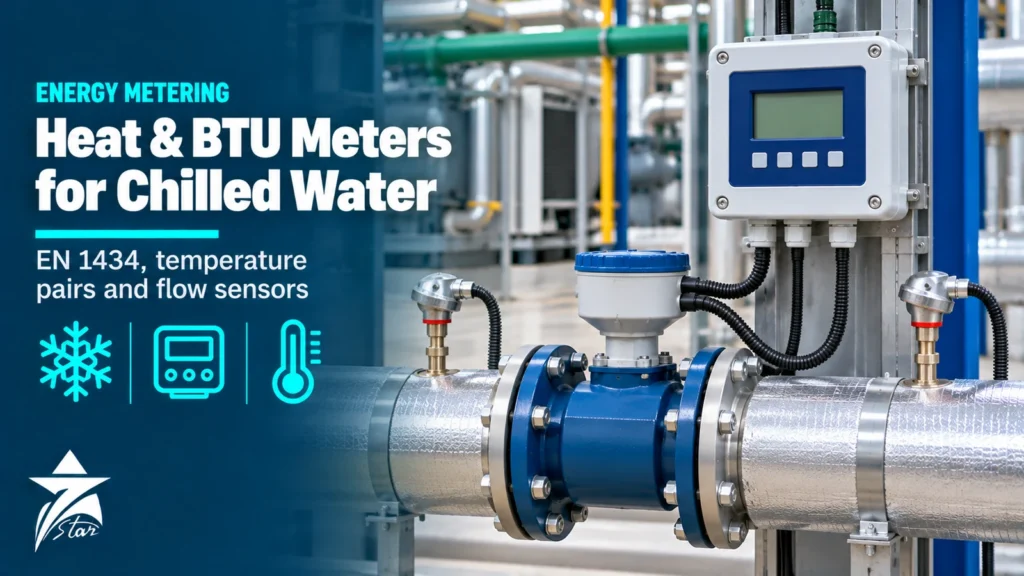
In hot climates the biggest energy flow in most commercial buildings is not electricity to lights or sockets but chilled water from a central plant or a district cooling network. Malls, hotels, hospitals, office towers and residential compounds in Oman increasingly need to know how much cooling each building, floor or tenant actually consumes, either to bill it fairly or to find waste. A BTU meter, also called a thermal energy meter, heat meter or cooling energy meter, provides that measurement. This guide explains how the meters work, which standards apply, how to choose flow and temperature sensors, and the installation details that decide whether the readings can be trusted.
How a BTU Meter Works
Thermal energy delivered by a water circuit is the product of the flow volume, the temperature difference between supply and return, and the heat capacity and density of the water. Every BTU meter therefore has three parts:
- A flow sensor that measures the volume of water passing through the circuit.
- A matched pair of temperature sensors, one in the supply pipe and one in the return pipe.
- An energy calculator that combines flow and temperature difference, applies the water properties at the measured temperatures and totals the energy in kWh, MWh, ton-hours or BTU.
The calculator integrates the energy continuously, so short changes in flow or temperature are captured. Many meters also log peak flow, peak power, average temperatures and operating hours, which are valuable for diagnosing plant performance.
Energy Units Used in Cooling
| Unit | Meaning | Conversion |
|---|---|---|
| kWh or MWh | SI unit of energy, used by most European meters and many tariffs | 1 kWh = 3,412 BTU |
| Ton-hour (TRh) | One refrigeration ton of cooling for one hour, common in GCC district cooling | 1 TRh = 12,000 BTU = 3.517 kWh |
| BTU and MBTU | British thermal unit, used in US practice | 1 MBTU = 1,000,000 BTU |
| Refrigeration ton (TR) | Cooling power, not energy | 1 TR = 3.517 kW |
Confirm the unit required by the billing contract before ordering, because changing the display unit later may break the legal verification seal on some meters.
Standards: EN 1434, OIML R75 and MID
The European standard EN 1434 and the international recommendation OIML R75 define the performance of heat meters, including accuracy classes, temperature sensor requirements and testing. In Europe, heat meters used for billing must be approved under the Measuring Instruments Directive, MID. Cooling meters are not covered by MID, but many manufacturers certify cooling or combined heat and cooling meters to EN 1434 or to national approvals, such as PTB in Germany. GCC utilities and district cooling operators often specify EN 1434 class 2 meters as a minimum for tenant billing. Check the actual project specification, because some operators require approval from their own laboratory or a particular communication protocol.
| EN 1434 flow sensor class | Maximum permissible error, simplified | Typical use |
|---|---|---|
| Class 1 | About plus or minus 1 to 2 percent depending on flow | High value billing, plant level metering |
| Class 2 | About plus or minus 2 to 5 percent depending on flow | Most tenant and building billing |
| Class 3 | About plus or minus 3 to 5 percent depending on flow | Non billing monitoring |
Choosing the Flow Sensor for a BTU Meter
The flow sensor contributes most of the total error, so choose it carefully. Our guide to choosing the right flow meter covers general principles; for thermal energy metering the main options are:
| Flow sensor type | Strengths | Limitations |
|---|---|---|
| Inline ultrasonic | No moving parts, wide turndown, low pressure loss, good long term stability | Needs straight runs and clean, air free water |
| Electromagnetic | Very wide turndown, unaffected by moderate debris, all pipe sizes | Needs conductive water and correct grounding |
| Mechanical multi jet or Woltmann | Low cost for small sizes | Wear, pressure loss, affected by scale and debris |
| Clamp-on ultrasonic | No pipe cutting, ideal for retrofits and verification | Accuracy depends on pipe data and installation |
Size the flow sensor by the actual flow range, not the pipe size. Chilled water systems often run for long periods at 20 to 30 percent of design flow, so a sensor sized only for peak flow may spend most of its life at the bottom of its range where errors grow. For retrofit projects, clamp-on meters avoid shutting down the system; our article on clamp-on flow meter installation explains how to achieve reliable results. For magnetic flow sensors, see our electromagnetic flow meter guide.
Temperature Sensor Pairs and the Low Delta T Problem
Chilled water systems typically operate with a design temperature difference of 5 to 8 degrees Celsius, for example 6 degrees supply and 13 degrees return. In practice many buildings suffer from low delta T syndrome, where the difference falls to 2 or 3 degrees. Because energy is proportional to the temperature difference, a sensor error of only 0.1 degree becomes a large percentage error at small differences. This is why EN 1434 requires matched temperature sensor pairs and specifies a minimum temperature difference for each meter.
- Use factory matched Pt100, Pt500 or Pt1000 sensor pairs supplied with the meter, never two unrelated sensors.
- Pt500 and Pt1000 sensors reduce the effect of cable resistance compared with Pt100 in two wire connection.
- Install both sensors in identical pockets or direct immersion fittings with the same insertion depth.
- Keep cable lengths as supplied, since shortening or extending them can upset the matching.
- Insulate the pockets and the pipe around them so that the sensors read the water temperature and not the ambient air.
More background on resistance thermometers is given in our article on RTD versus thermocouple selection.
Energy Calculator Features
- Heat, cooling or combined heat and cooling metering, with a switching threshold for systems that change mode.
- Glycol compensation for systems that use water glycol mixtures, which change heat capacity and density.
- Data logging of daily and monthly values for billing disputes and audits.
- Alarms for sensor faults, air in the flow sensor, reverse flow and leaks.
- Mains or battery power, with battery life typically stated in years.
- Pulse inputs for additional water or electricity meters on the same communication module.
BTU Meter Communication and BMS Integration
Manual reading of hundreds of meters is slow and error prone. Modern installations use wired M-Bus, wireless M-Bus, Modbus RTU or TCP, BACnet MS/TP or IP, or LoRaWAN for automatic meter reading. District cooling operators usually connect their meters to a central billing system, while building owners integrate them into the BMS so energy use can be compared with chiller performance. Our article on chillers and cooling towers in hot climates shows how cooling energy data helps improve plant efficiency.
Installation Rules That Decide Accuracy
- Install the flow sensor in the pipe specified by the manufacturer, supply or return, because the calculator uses this to choose the correct density.
- Provide the straight inlet and outlet runs stated in the manual, and keep the sensor away from pumps, control valves and elbows.
- Ensure the pipe is always full, avoiding high points where air collects.
- Install strainers upstream to protect mechanical and ultrasonic sensors from debris.
- Use isolation valves and a bypass where the meter must be removed for verification without stopping cooling.
- Seal the sensors and calculator after commissioning so that tampering can be detected.
Pressure independent control valves and energy valves are often installed next to the meter in fan coil and AHU circuits. Our guide to PICV and FCU valve kits explains how these components work together.
District Cooling and Tenant Billing
District cooling plants supply chilled water to many buildings through energy transfer stations, where heat exchangers separate the network from the building system. A billing grade BTU meter is installed on the primary side at each station, and buildings often install sub meters for each tenant on the secondary side. For billing, the contract should specify the meter accuracy class, verification interval, data access, the procedure for disputed readings and who owns and maintains the meters. Periodic verification, for example every 4 to 5 years or as required by the operator, keeps confidence in the readings.
Selected BTU Meters and Energy Meter Components in Our Catalog
The table below lists a selection of thermal energy meters, calculators and flow sensors from our catalog.
| Product | Type | Typical use |
|---|---|---|
| Kamstrup MULTICAL 403 | Compact ultrasonic heat and cooling meter | Apartments and tenant billing |
| Kamstrup MULTICAL 303 | Compact heat and cooling meter | Small residential and commercial units |
| Kamstrup MULTICAL 603 | Heat and cooling energy calculator | Building and plant metering |
| Kamstrup MULTICAL 803 | Advanced energy calculator | District energy and large plants |
| Kamstrup ULTRAFLOW 54 DN15-125 | Ultrasonic flow sensor | Energy meter flow measurement |
| Kamstrup ULTRAFLOW 54 DN150-300 | Large ultrasonic flow sensor | Plant and network mains |
| pFlow E3E | Inline ultrasonic energy meter | HVAC chilled water circuits |
| pFlow E3CL | Clamp-on thermal energy flow meter | Retrofit and verification |
| pFlow D116-BTU (HD) | Wall mounted ultrasonic energy meter | Plant room metering |
| Dynasonics UHC-120 | Thermal energy meter | Commercial HVAC monitoring |
| Belimo Energy Valve EV..R2+BAC | Control valve with energy meter | AHU and FCU circuits |
| JUMO PCW-M-PtNi Pt500 | Platinum chip temperature sensor | Temperature measurement elements |
Browse more in our heat and BTU energy meters category. To get a quotation, send the pipe size, flow range, supply and return temperatures, accuracy class, communication protocol and power supply through our quote request form or to [email protected].
Sourcing BTU Meters in Oman Through Seven Star LLC
Seven Star LLC is an independent supplier in Oman of thermal energy meters, cooling and heat meters, energy calculators, ultrasonic flow sensors, clamp-on energy meters and energy valves for HVAC and district cooling projects. We quote products from manufacturers such as Kamstrup, pFlow, Dynasonics, Belimo and JUMO. Accuracy class, temperature sensor type, communication options and approvals are confirmed against the manufacturer data at quotation.
Frequently asked questions
What does a BTU meter measure?
A BTU meter measures the thermal energy delivered by a water circuit. It combines the flow volume with the temperature difference between supply and return pipes and totals the energy in units such as kWh, ton-hours or BTU.
Why do BTU meters need matched temperature sensors?
Chilled water systems run with small temperature differences, often only a few degrees. A small error between two unmatched sensors becomes a large percentage error in energy, so EN 1434 requires factory matched sensor pairs.
Which flow sensor is best for chilled water energy metering?
Inline ultrasonic and electromagnetic flow sensors are the most common choices because they have no moving parts and a wide turndown. Clamp-on ultrasonic meters suit retrofits where the pipe cannot be cut.
What is low delta T syndrome?
Low delta T syndrome occurs when the difference between chilled water supply and return temperatures falls well below design, often because of faulty valves or coils. It reduces chiller efficiency and makes accurate energy measurement harder.
Can BTU meters connect to a BMS?
Yes. Most meters offer M-Bus, Modbus, BACnet, wireless M-Bus or LoRaWAN communication, so readings can be sent to a BMS or a billing system automatically.
Who supplies BTU meters in Oman?
Seven Star LLC is an independent supplier in Oman that quotes thermal energy meters, energy calculators and flow sensors from manufacturers such as Kamstrup, pFlow and Belimo. Send your requirements through the quote request form or to [email protected].
Was this guide helpful?One click helps us write better guides for engineers.
Thank you! Glad it helped. Need this equipment for your project? Request a quotation
Thank you. We will use this to improve the guide.