- Automation & ControlView all 3,089 products
- Automation Accessories
- AC Drives
- PLC & I/O Cards
- Industrial Communications
- Vibration Monitoring
- Isolator & Barrier
- Controllers & Data Acquisition
- Safety Switches & Guard Locking
- Encoders
- Motor Soft Starters
- CCTV & Security
- Pneumatic Cylinders
- HMI Displays
- Servo Drives
- Industrial Computers
- Machine Vision
- Automation Software
- Robotics
















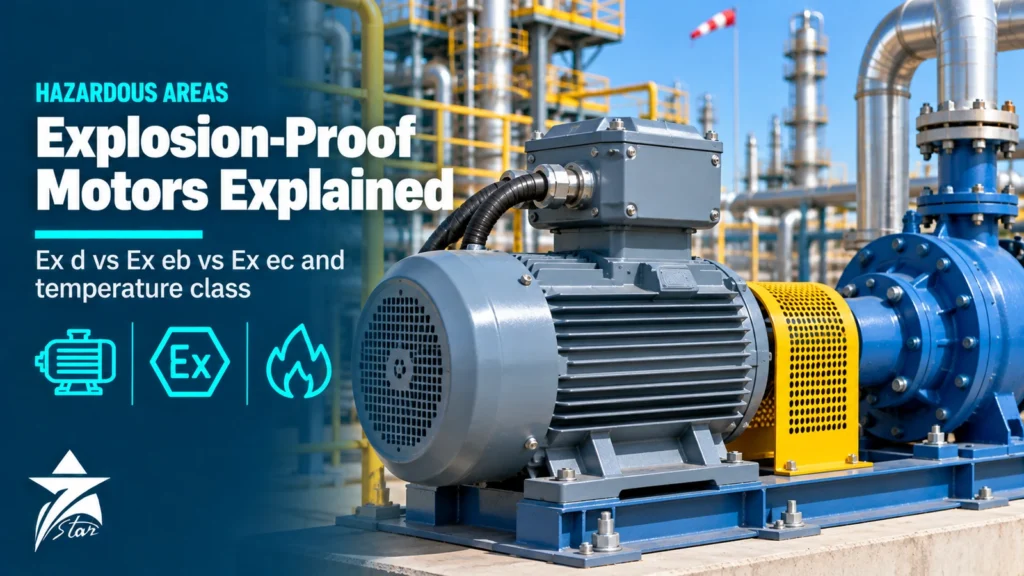
Oil and gas facilities, refineries, chemical plants, fuel depots and gas processing sites all have areas where a flammable gas, vapour or dust may be present. Any electric motor installed there must be built so that it cannot ignite that atmosphere, either through sparks, hot surfaces or an internal fault. The common term is explosion-proof motor, although IEC standards use more precise names such as flameproof, increased safety and non sparking. This guide explains the protection types, how to read the Ex marking, what changes in hot climates and when a variable frequency drive is used, and how to keep a hazardous area motor safe throughout its life.
Start With the Area Classification
The motor is selected from the hazardous area classification of the location. Under IEC and ATEX practice, gas areas are classified as Zone 0, Zone 1 or Zone 2 and dust areas as Zone 20, 21 or 22, depending on how often an explosive atmosphere is present. Motors are normally installed in Zone 1 or Zone 2, and in Zone 21 or 22 for dust. The classification also defines the gas group and temperature class required. Our article on hazardous area classification explains zones, groups and equipment protection levels in detail.
Explosion-Proof Motor Protection Types
| Protection type | Standard | Principle | Typical zones |
|---|---|---|---|
| Ex db flameproof | IEC 60079-1 | Enclosure withstands an internal explosion and prevents flame transmission through controlled flamepaths | Zone 1 and Zone 2 |
| Ex eb increased safety | IEC 60079-7 | No sparking parts in normal operation, extra measures against excessive temperature and arcs | Zone 1 and Zone 2 |
| Ex ec increased safety, level c | IEC 60079-7 | Non sparking design for normal operation, replaced the former Ex nA marking | Zone 2 only |
| Ex db eb combination | IEC 60079-1 and 60079-7 | Flameproof motor body with an increased safety terminal box | Zone 1 and Zone 2 |
| Ex pxb pressurised | IEC 60079-2 | Enclosure purged and kept under positive pressure with clean air or inert gas | Large motors in Zone 1 and Zone 2 |
| Ex tb or Ex tc dust protection | IEC 60079-31 | Dust tight enclosure with limited surface temperature | Zone 21 and Zone 22 |
In North America the term explosion-proof refers specifically to Class I Division 1 motors built to UL 674 and the National Electrical Code, which are similar in principle to flameproof Ex d motors. Projects in Oman generally follow IEC, ATEX or IECEx certification, but some packages from US suppliers arrive with NEC Class and Division ratings, so the two systems must be compared carefully.
Reading the Ex Marking
A typical nameplate marking such as Ex db eb IIB T4 Gb contains all the key information:
- Ex db eb: the protection types, here a flameproof enclosure with an increased safety terminal box.
- IIB: the gas group. Group IIA covers gases such as propane, IIB covers ethylene and similar gases, and IIC covers hydrogen and acetylene, the most demanding group. A IIC motor can also be used in IIB and IIA areas.
- T4: the temperature class, meaning the maximum surface temperature does not exceed 135 degrees Celsius.
- Gb: the equipment protection level, suitable for Zone 1 gas areas.
- Ta: the permitted ambient temperature range, which is critical in hot climates.
| Temperature class | Maximum surface temperature |
|---|---|
| T1 | 450 degrees Celsius |
| T2 | 300 degrees Celsius |
| T3 | 200 degrees Celsius |
| T4 | 135 degrees Celsius |
| T5 | 100 degrees Celsius |
| T6 | 85 degrees Celsius |
The motor temperature class must be lower than the autoignition temperature of the gases present. T3 and T4 are the most common requirements in oil and gas.
Ambient Temperature Ratings for an Explosion-Proof Motor
Standard Ex certificates often cover an ambient range of minus 20 to plus 40 degrees Celsius. Outdoor installations in Oman regularly exceed this in summer, and motors in sun exposed or enclosed areas run hotter still. An explosion-proof motor used above its certified ambient temperature is outside its certificate, even if it runs without problems. Specify the actual maximum ambient, for example plus 50 or plus 55 degrees Celsius, and ask for a motor certified for that ambient. Higher ambient ratings may require a larger frame, reduced output or a lower temperature rise insulation design. Sun shades help but do not replace the correct certified rating.
Flameproof Ex d Explosion-Proof Motor Designs in Practice
Flameproof motors are robust and widely used for pumps, compressors and fans in Zone 1. Their enclosure is strong enough to contain an internal explosion, and the gaps between joints such as the shaft, end shields and terminal box are machined to precise widths and lengths so that escaping gases cool below ignition temperature. These flamepaths must never be painted, gasketed unless the certificate allows it, or damaged during maintenance. Cable entries must use certified Ex d cable glands or barrier glands where required by the installation code, and unused entries must be closed with certified stopping plugs.
Increased Safety Ex eb and Ex ec Motors
Increased safety motors rely on avoiding sparks and hot spots rather than containing an explosion. They are lighter than flameproof motors and often cheaper in larger sizes, but they need correct protection. For Ex eb motors the certificate states a time called tE, which is the time the stalled motor takes to heat from rated operating temperature to the limiting temperature, and the ratio of starting current to rated current. The motor protection relay must trip within the tE time under locked rotor conditions. Ex ec motors are permitted only in Zone 2 and are a cost effective choice for many process plants where most of the area is classified Zone 2.
Operating an Explosion-Proof Motor on a VFD
Variable frequency drives save energy and improve process control, but they change the motor heating pattern, add voltage spikes and can cause bearing currents. For hazardous areas the rules are stricter than for safe area motors. Detailed guidance on drive selection in hot conditions is given in our article on VFD selection for hot climates.
- Use a motor whose Ex certificate explicitly covers converter operation, including the speed range and load type, constant or quadratic torque.
- Flameproof motors on VFDs normally require PTC thermistors in the windings connected to a certified thermistor relay that trips the drive on overtemperature.
- Increased safety Ex eb motors on converters usually need to be certified together with the drive type or according to specific conditions stated on the certificate.
- Limit voltage peaks with output reactors or sine filters where cable lengths are long or the motor insulation system requires it.
- Use insulated bearings or shaft grounding to prevent bearing currents, which can damage bearings and, in theory, create sparks.
- Locate the drive in a safe area or in a suitably certified enclosure.
Efficiency Classes for Hazardous Area Motors
Explosion protected motors are included in efficiency regulations in many markets. IE3 and IE4 versions are now available in flameproof and increased safety designs. Because many hazardous area motors drive pumps and compressors that run continuously, higher efficiency often pays back quickly. Our guide to motor efficiency classes explains IE2, IE3 and IE4 requirements.
Installation, Inspection and Repair
Installation and inspection of electrical equipment in hazardous areas follow IEC 60079-14 and IEC 60079-17. Inspections are graded as visual, close or detailed, and the frequency depends on the zone and environment. Typical checks include correct marking, intact flamepaths, tight covers, certified glands and plugs, earthing, cable condition, corrosion and the setting of protection devices. Repairs and overhauls must follow IEC 60079-19, preferably by a workshop experienced in Ex equipment, so that the motor keeps its certification after rewinding or bearing replacement. Insulation resistance and winding checks described in our article on electric motor failure causes apply equally to Ex motors.
Specifying an Explosion-Proof Motor for Quotation
- Output power, speed, voltage, frequency, mounting arrangement and frame size.
- Hazardous area zone, gas group, temperature class and equipment protection level.
- Maximum and minimum ambient temperature and whether the motor is outdoors in direct sun.
- Starting method and whether the motor will run on a VFD, with speed range and load type.
- Required protection type, for example Ex db, Ex db eb, Ex eb or Ex ec.
- Efficiency class, insulation class, thermistors, space heaters and bearing insulation.
- Cable entry sizes and gland type, and the certification scheme required, such as ATEX or IECEx.
Selected Hazardous Area Motors and Accessories in Our Catalog
The table below lists a selection of explosion protected motors and related accessories from our catalog.
| Product | Type | Typical use |
|---|---|---|
| CEMP E3A/E4A Series | Flameproof Ex db motors, IE3 and IE4 | Pumps, fans and compressors in Zone 1 |
| CEMP E3H/D and E4H/D | Flameproof brake motors | Hoists and handling in hazardous areas |
| CEMP AAB30/AAC30 frame 56 | Small aluminium Ex db motors | Small drives and instrument skids |
| G400K G-3LM6-048-00-00-01 | Ex servo motor | Motion control in hazardous areas |
| AUMA SAEx | Ex multi turn valve actuator | Valve automation in Zone 1 |
| Flender ATEX couplings | ATEX certified couplings | Motor to pump connections |
| Siemens 3RN2010-1CA30 | Thermistor motor protection relay | PTC monitoring on VFD duty |
| CMP C2K | Ex eb cable gland for armoured cable | Motor terminal box entries |
| CMP PX2K | Ex d barrier cable gland | Flameproof enclosures |
| CMP E1FW | Ex cable gland for SWA and AWA cable | Armoured motor cables |
| BARTEC ESP | Ex e GRP junction box | Field terminations |
| Adalet CSC4X6 | Ex e operator enclosure | Local motor control stations |
Browse more in our electric motors category. To get a quotation, send the power, speed, voltage, zone, gas group, temperature class, ambient range and drive details through our quote request form or to [email protected].
Sourcing Hazardous Area Motors in Oman Through Seven Star LLC
Seven Star LLC is an independent supplier in Oman of flameproof, increased safety and dust protected motors, Ex brake motors, thermistor relays, Ex cable glands, junction boxes and local control stations. We quote products from manufacturers such as CEMP, AUMA, Flender, Siemens, CMP, BARTEC and Adalet. Protection type, gas group, temperature class, ambient rating, converter suitability and certification are confirmed against the manufacturer data at quotation.
Frequently asked questions
What is the difference between Ex d and Ex e motors?
An Ex d flameproof motor has an enclosure that contains an internal explosion and prevents flame from escaping through machined flamepaths. An Ex e increased safety motor prevents ignition by avoiding sparks and hot spots in the first place and needs correct overload protection based on its tE time.
Can I use an Ex ec motor in Zone 1?
No. Ex ec, which replaced the former Ex nA marking, is suitable only for Zone 2. Zone 1 requires an equipment protection level of Gb, such as Ex db or Ex eb.
What does T4 mean on an explosion-proof motor?
T4 is the temperature class. It means the maximum surface temperature of the motor will not exceed 135 degrees Celsius, so it can be used where the gases present have an autoignition temperature above that value.
Can an explosion-proof motor run on a VFD?
Yes, if the Ex certificate covers converter operation. Flameproof motors usually need winding thermistors connected to a certified relay, and increased safety motors often need certification with the specific drive type. Bearing currents and voltage peaks must also be managed.
Why does ambient temperature matter for Ex motors?
Ex certificates are valid only within the stated ambient range, often minus 20 to plus 40 degrees Celsius. Sites with higher summer temperatures need motors certified for the actual maximum ambient to keep the temperature class valid.
Who supplies explosion-proof motors in Oman?
Seven Star LLC is an independent supplier in Oman that quotes flameproof and increased safety motors, Ex brake motors, cable glands and protection relays from manufacturers such as CEMP, Siemens and CMP. Send your requirements through the quote request form or to [email protected].
Was this guide helpful?One click helps us write better guides for engineers.
Thank you! Glad it helped. Need this equipment for your project? Request a quotation
Thank you. We will use this to improve the guide.