PS-N12P: what this PS-N series sensor is and how its code reads
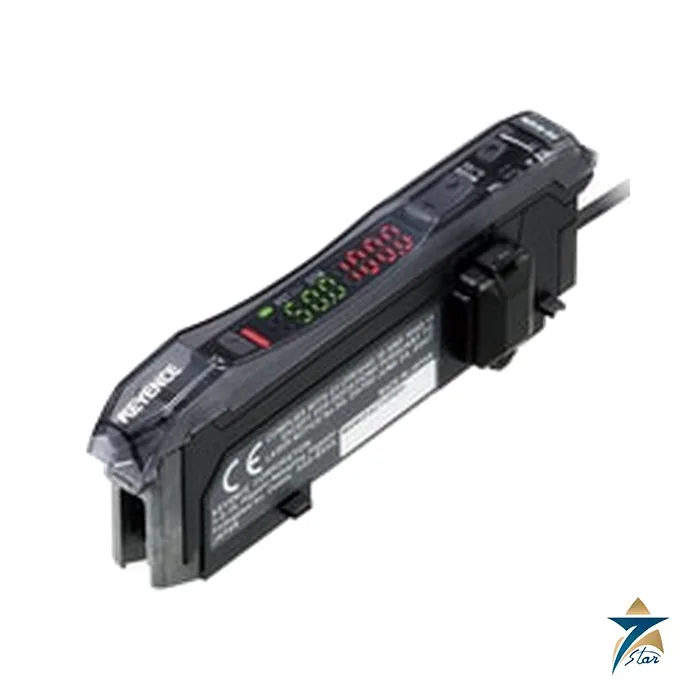
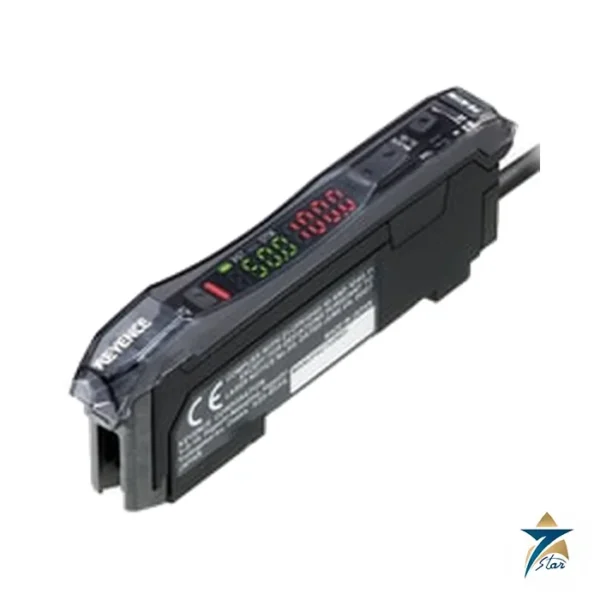
PS-N12P is a Keyence PS-N series product, listed by the maker as: Amplifier Unit, Cable Type, Expansion Unit, PNP. The PS-N series is a digital photoelectric amplifier line: a slim 9.8 mm wide amplifier unit that connects to a separate sensor head or fiber unit. Main units hold the settings and outputs, and expansion units are clipped alongside to add channels without extra wiring to the PLC for power. Seven Star LLC supplies PS-N12P in Oman and the GCC as an independent supplier in Muscat, not affiliated with the manufacturer.
The 12 in PS-N12P marks the expansion unit, the P suffix marks PNP output, and the cable version has a fixed cable instead of an M8 connector.
PS-N12P is an expansion unit: it relies on a main unit for supply, so it cannot be used alone. Use it when a PLC channel needs one more sensing point beside an existing PNP main unit such as PS-N11P. Expansion units are 9.8 mm wide, which helps when rail space is limited.
PS-N12P technical specifications
| Parameter |
Specification |
| Manufacturer / part number |
Keyence / PS-N12P |
| Product description |
Amplifier Unit, Cable Type, Expansion Unit, PNP |
| Type |
Cable |
| Output |
PNP |
| Main unit/Expansion unit |
Expansion unit |
| I/O |
Control outputs: 1 output |
| Output selection |
LIGHT-ON/DARK-ON (switch-selectable) |
| Timer function |
Timer OFF/OFF-delay timer/ON-delay timer/One-shot timer, Timer duration selectable: 1 ms to 9999 ms, Maximum error against the setting value: ±10% max. |
| Control output |
PNP open collector 30 V, (without expansion) 100 mA max., (with expansion) 20 mA max, residual voltage 1.2 V max. (when the output current is 10 mA or less)/2.2 V max. (when the output current is 10 to 100 mA) |
| Number of interference prevention units |
4 for TURBO/SUPER/ULTRA/MEGA (When set to DOUBLE, the number of interference-prevention units will be doubled) |
| Response time |
500 µs (TURBO) /1 ms (SUPER) /4 ms (ULTRA) /16 ms (MEGA) |
| External input |
Input time 2 ms (ON)/20 ms (OFF) or more |
| Case size |
H 32.6 mm × W 9.8 mm × L 78.7 mm |
| Unit expansion |
Up to 16 units (Up to 17 units including 1 main unit can be connected in total.) |
| Protection circuit |
Reverse polarity protection, Over-current protection, Surge absorber |
| Rating |
Power voltage: 24 VDC (operating voltage 10 to 30 VDC (with ripple)), Ripple (P-P) 10 % or less, Class 2 or LPS |
| Power consumption |
Normal: 860 mW or less (at 30V. 30 mA max. at 24 V, 35 mA max. at 12 V) Eco on mode (ALL): 750 mW or less (at 30V. 26 mA max. at 24 V, 28 mA max. at 12 V) Eco Full mode: 540 mW or less (at 30V. 19 mA max. at 24 V, 21 mA max. at 12 V) |
| Environmental resistance |
Ambient temperature: -20 to +55 °C (No freezing) |
| Relative humidity |
35 to 85 % RH (No condensation) |
| Vibration resistance |
10 to 55 Hz, Double amplitude 1.5 mm , 2 hours in each of the X, Y, and Z directions |
| Shock resistance |
500 m/s² , 3 times in each of the X, Y, and Z directions |
| Material |
Case: Main unit and cover material: Polycarbonate |
| Cable |
PVC |
| Weight |
Approx. 65 g |
Values in the table are taken from the maker’s model page for PS-N12P. Treat them as nominal and confirm the exact conditions in the instruction manual before final design.
How the sensing principle behind PS-N12P works
With a separate-amplifier photoelectric sensor, the head contains only the optical elements and the amplifier contains the LED driver, the receiver electronics and the decision logic. The amplifier pulses the light source, measures the returned intensity, compares it with a stored threshold and switches the output. Digital amplifiers show both the live value and the threshold, so a technician can see the real margin instead of just an on or off lamp.
Response-time modes trade speed against stability: a faster mode catches small or quick objects, a slower one averages out noise and gives more excess gain on difficult targets. Mutual-interference prevention lets neighbouring amplifiers run side by side without crosstalk, which matters in dense machine builds.
Where PS-N12P fits: related PS-N series parts
These amplifiers are one half of a system. The head or fiber unit decides what can be detected and over what distance, while the amplifier decides response time, output type and timer logic. Main units and expansion units of the same polarity are meant to be combined on a DIN rail.
The PS-N series range includes the following part numbers, which are listed for cross-reference: PS-N11N, PS-N12N, PS-N11CN, PS-N12CN, PS-N10, PS-N11P, PS-N12P, PS-N11CP and PS-N12CP. Whether a particular combination is compatible should be confirmed from the maker’s documents. Closely related models from the same family that you may also want to compare include PS-N11N.
Selecting PS-N12P: ordering checklist
- Main unit or expansion unit: only the main unit carries the supply and the full output current.
- Output polarity (NPN or PNP) and cable or M8 connector style.
- The sensor head or fiber unit that will be connected, and the response time it needs.
- Number of channels, noting the unit-expansion limit in the table.
- Whether timer functions are needed so the PLC program can be simplified.
- DIN rail space and ambient temperature when several amplifiers are grouped.
For PS-N12P specifically, confirm the output type, the connection style and the rated distance shown in the table above against the real installation drawing before placing an order.
Installing and maintaining PS-N12P
Snap the amplifier onto a DIN rail, join expansion units to the main unit before wiring power, and connect the sensor head cable only with the power off. Run the automatic sensitivity set-up with the target present and then absent, and read back the excess-gain value to confirm a healthy margin.
At maintenance, re-run the set-up if a head has been cleaned or replaced, record the threshold in your maintenance log and keep expansion units of the same polarity as spares. Avoid grouping many amplifiers in a hot panel without checking the derating note in the table.
Typical applications of PS-N12P in Oman and the GCC
Panel-mounted amplifiers like these are common inside machine control cabinets for packaging, bottling, labelling and assembly equipment across Oman and the GCC. In desalination and water treatment skids they read small heads for container presence, valve flags and gate positions, with the amplifier kept in a cool, dust-free cabinet away from the harsh outdoor atmosphere.
Typical for adding extra detection points beside an existing main amplifier without more wiring. Extra heat, dust and humidity are normal in the region, so check the ambient temperature and enclosure rows in the table against the real mounting location, including direct sunlight on outdoor skids.
PS-N series models compared with PS-N12P
The table lists the PS-N series models in our current range with the maker’s own description, to help you see how PS-N12P differs from its neighbours.
| Model |
Maker description |
| PS-N12P |
Amplifier Unit, Cable Type, Expansion Unit, PNP |
| PS-N11N |
Amplifier Unit, Cable Type, Main Unit, NPN |
Information to send with your PS-N12P RFQ
- Exact part number: PS-N12P (and quantity, including any matching transmitter, receiver, reflector or head).
- Output polarity required by your PLC input card (NPN or PNP).
- Cable length or connector type and the mounting method.
- Ambient conditions: temperature, washdown, dust and direct sunlight.
- Project reference, delivery location in Oman or the GCC and required lead time.
- Any related items needed, such as brackets, cables, reflectors or a mating amplifier.
Documents and quotation
Send us the part number PS-N12P and we will confirm available documents, including the maker’s datasheet and instruction manual where we can provide them. Prices are quoted per request and are not shown on this page.
Seven Star LLC is an independent supplier in Muscat serving Oman and the GCC. We are not affiliated with the manufacturer, and we quote against your RFQ with delivery and lead time confirmed in the quotation.
Other Models in the Keyence Ps N Range
Seven Star LLC supplies models from the Keyence Ps N range in Oman and the GCC. Compare the related models below and request a quote for the one that matches your application.




















Reviews
There are no reviews yet.