Samson 2371 hygienic pressure reducing valve: Type 2371-10 and 2371-11
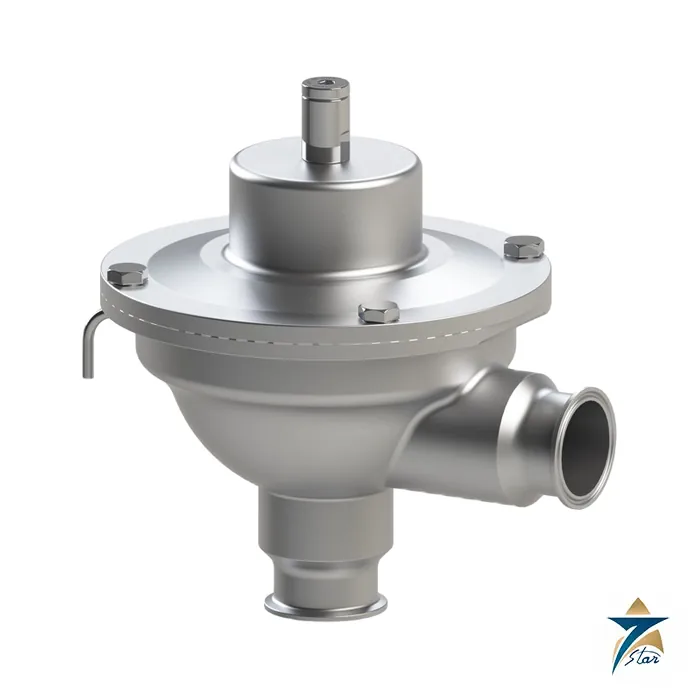
The Samson 2371 series is a stainless steel pressure reducing valve designed for food, beverage and pharmaceutical plants. It is an angle-pattern diaphragm regulator with a body free of dead cavities, so it can be cleaned in place (CIP) and sterilised in place (SIP). Two actuators share the same hygienic body: the Type 2371-10 takes its set point from an external air signal, while the Type 2371-11 is adjusted by hand with a spring. Set points run from 0.4 to 6 bar (6 to 90 psi), with nominal sizes DN 15 to 50 or NPS ½ to 2 and a maximum inlet pressure of 10 bar. Seven Star LLC supplies the Samson 2371 in Oman and the GCC as an independent supplier based in Muscat.
The wetted surfaces are precision-machined to Ra 0.8 µm or better, the materials are FDA-compliant and the diaphragm complies with USP Class VI at 121 °C. A test connection allows leakage monitoring of the operating diaphragm, a feature that matters wherever process fluid and compressed air must not mix.
Decoding the Samson 2371-10 and 2371-11 types
- 2371 – the hygienic pressure reducing valve series.
- -10 – pneumatic set point adjustment; the set point pressure pc (maximum 8 bar) comes from an external compressed air supply.
- -11 – manual set point adjustment with a set point screw, tensioned with an 8 mm Allen key.
Beyond this, the ordering details are size, connection standard, surface finish, seal material and optional stem locking.
Samson 2371 technical specifications
| Parameter |
Specification |
| Manufacturer / part number |
Samson Type 2371-10 (pneumatic) and Type 2371-11 (manual) pressure reducing valves |
| Function |
Outlet pressure reduction; valve closes as output pressure rises |
| Nominal size |
DN 15 to 50 (DIN) or NPS ½ to 2 (ANSI) |
| Set point range |
0.4 to 6 bar / 6 to 90 psi; 2371-11 ranges 0.4–1.2, 1–3, 2.5–4.5, 4–6 bar; 2371-10 0.5–6 bar (2.5–6 bar for KVS 16) |
| Max. operating (inlet) pressure |
10 bar / 150 psi |
| Operating temperature |
0 to 160 °C (32 to 320 °F); sterilisation 180 °C for up to 30 minutes |
| KVS / CV |
2371-10: KVS 10 or 16 (CV 12 or 20); 2371-11: KVS 0.63 (soft seat), 1.0, 2, 3.5, 5.2 (CV 0.75, 1.2, 2.5, 4, 6) |
| Leakage class |
Metal seat: Class I (≤0.05 % of KVS/CV); soft seat: Class IV (≤0.01 %) |
| Body and cover |
2371-10: 1.4409 / CF3M; 2371-11: 1.4404 / 316L |
| Plug |
1.4404 / 316L metal seat; EPDM soft seal optional |
| Diaphragm |
PTFE-coated EPDM, USP Class VI-121 °C |
| Surface finish |
Inside Ra ≤0.8 µm standard; Ra ≤0.6 polished, Ra ≤0.4 satin or mirror optional; outside glass bead blasted |
| Pneumatic connections |
Set point pressure G ¼ (2371-10); CIP connection G 1/8 |
How the 2371 reduces and holds outlet pressure
Medium enters the angle body from below, passes between plug and seat and leaves from the side. The valve is open when idle and closes when the outlet pressure p2 pushes on the diaphragm harder than the set point force. Outlet pressure therefore depends on the flow, as for any proportional regulator.
In the manual type the force comes from springs. Turning the set point screw clockwise raises spring tension and the pressure setting, and turning it anticlockwise lowers it. A locking screw prevents vibration from changing the setting. In the pneumatic type a compressed air signal (pc, up to 8 bar) replaces the springs; the ratio between pc and the outlet pressure is not necessarily one to one, so calibrate on site. Two diaphragms in that version give an extra barrier if one ruptures, and any leaking medium escapes through the test bore where it can be seen.
CIP and SIP with the 2371: stem locking
Both actuators can be fitted with a stem lock that holds the plug in the open position, so cleaning and sterilising media flow through the full seat area. The lock is pneumatic for both types (pV 1 bar on the -10, 6 bar on the -11), and the manual type additionally offers a manual pin that screws in place of the blanking plug. Control action returns when the lock is released, since the spring pulls the actuating unit back.
Connections and surface finishes
- Threaded: DIN 11864-1 form A series A, B, C; DIN 11887; ISO 2853 (IDF); SMS 1146
- Clamp: DIN 11864-3 form A series A, B, C; DIN 32676; ISO 2852; BS 4825 part 3; ASME BPE
- Flange: DIN 11864-2 form A series A, B, C
- Special versions: DIN EN 1092-1 B2 and ASME B16.5 Class 150 flanges, DN 50 body with DN 65 connections, body and plug in 1.4435, pure PEEK plug seal
Where the 2371 fits and related Samson regulators
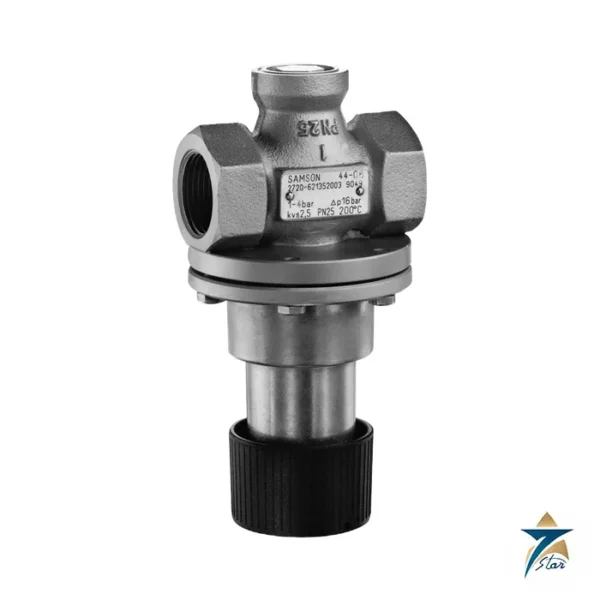
This regulator is the hygienic member of the Samson self-operated range. For general industrial reducing duty, the Series 44 regulators (44-0B, 44-1B, 44-2) use cast or machined bodies with bellows or diaphragm actuators, while Type 2406 handles excess pressure on gases. Because it needs a pressure drop and a clean supply, use a strainer or sterile filter upstream where particles or biofilm could reach the seat.
Selection and ordering checklist for the 2371
- Choose pneumatic or manual set point adjustment.
- Define the outlet set point and check it fits one of the available ranges.
- Give the maximum flow and pressure drop; read KVS or CV against the data sheet.
- Choose size, connection standard and surface finish (polished or mirror for pharma).
- Decide on metal or soft seat, plus PEEK or other special seals.
- Ask for stem locking when CIP or SIP is part of the plant cycle.
Installation, commissioning and maintenance
Mount the regulator free of pipe stress with the actuator on top, the axis vertical, the inlet at the bottom and the outlet to the side, following the flow arrow. Route the test connection discharge to a visible place. Commission the manual type by removing the blanking plug and adjusting the set point screw with the Allen key; for the pneumatic type, set the control air pressure while checking outlet pressure on a gauge.
Inspect diaphragms during planned stops, as hygienic duty with repeated steam cycles ages elastomers. Keep spare diaphragms and plug seals matched to the original materials, and record the serial number so the right parts are supplied.
Typical applications in Oman and the GCC
Pharmaceutical plants, dairies, juice and beverage lines, water treatment skids and cleanroom utilities in the region need a hygienic regulator for steam, process water and clean gases. High ambient temperatures and frequent CIP cycles favour a stainless steel body without dead pockets, and the stem lock reduces cleaning time.
Information to send with an RFQ for the 2371
- Medium, temperature, CIP/SIP parameters
- Inlet pressure, outlet set point, and flow
- Size, connection standard and surface finish
- Pneumatic or manual set point, stem lock requirement
- Seal materials, project tag number and delivery location
Documents and quotation
A Samson datasheet for the Type 2371-10 and 2371-11 is attached on this page, with the full connection tables and materials.
Send your duty and Seven Star LLC will quote the Samson 2371 for delivery in Oman and the GCC.
Other Models in the Samson Self Operated Regulators Range
Seven Star LLC supplies models from the Samson Self Operated Regulators range in Oman and the GCC. Compare the related models below and request a quote for the one that matches your application.






















Reviews
There are no reviews yet.