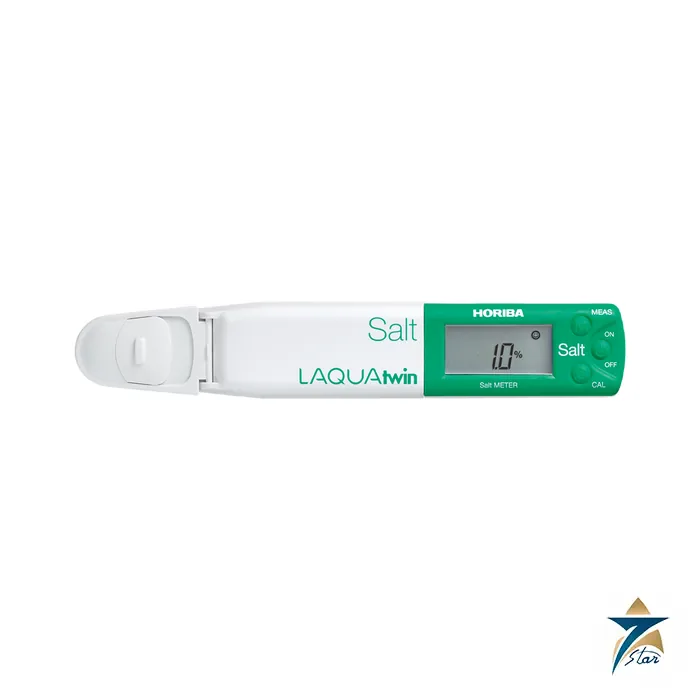
LAQUAtwin-Salt-22 measures salt content directly as percent NaCl by weight, from 0.01 % to 25 %, using an ion-selective flat sensor on a pocket-size meter; it needs only a few drops of sample and gives a reading that the display locks once it is stable.
Salt content read straight in percent, not converted from conductivity
Most hand-held salinity checks infer salt from conductivity. The Salt-22 is different: the manual lists its measurement principle as the ISE (ion-selective electrode) method, with a response membrane on a flat sensor, and its target as salinity expressed as a weight percentage. Calibration uses sodium chloride standards, by default 0.5 % and 5.0 %, which the meter treats as its first and second calibration points.
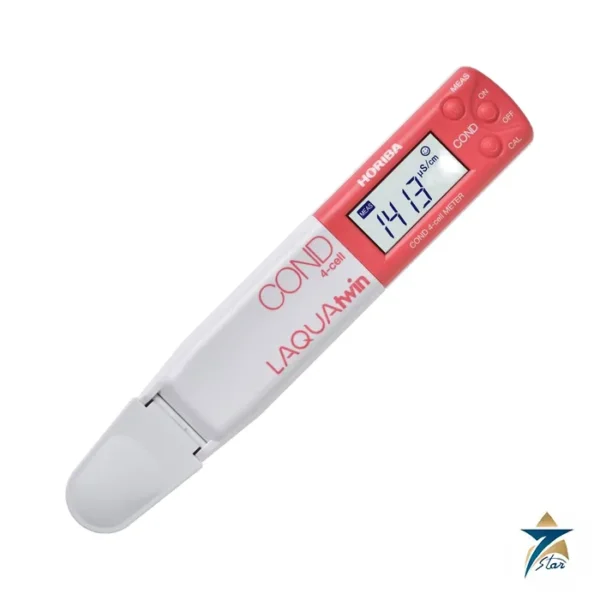
The housing, display and battery system are the same as the other LAQUAtwin pocket meters, so one person can carry a pH, a conductivity and a salt meter that all follow the same CAL / MEAS / ON-OFF key logic. A sample of more than 0.3 mL is called for, and the optional sampling sheet B reduces that to 0.05 mL.
Features stated in the instruction manual
- Range 0.01 % to 25 % by weight, with display resolution that coarsens from 0.01 % to 0.1 % to 1 % as the value rises.
- Two-point calibration, default 0.5 % and 5.0 % NaCl, with the reading at 25 °C shown for one second after each point.
- Auto stable (AS) default, auto hold (AH) optional; reading lock with a stability icon.
- Custom monochrome LCD with backlight; automatic power off.
- Replacement sensor S021 snaps on and off, so a worn sensor does not mean a new meter.
Technical specification
Measurement data
| Parameter |
Specification |
| Model |
LAQUAtwin-Salt-22 |
| Target |
Salinity (NaCl, percent by weight) |
| Measurement principle |
ISE (ion-selective electrode) method |
| Minimum sample volume |
More than 0.3 mL (0.05 mL or more with sampling sheet B) |
| Measurement range |
0.01 % to 25 % by weight |
| Resolution |
0.00 % to 0.99 %: 0.01 %; 1.0 % to 9.9 %: 0.1 %; 10 % to 25 %: 1 % |
| Calibration |
Up to 2 points; default 0.5 % and 5.0 % |
| Accuracy |
Within 10 % of the reading after two-point calibration with 0.5 % and 5.0 % standards at one temperature (standard error and 1-digit rounding excluded) |
Operating and physical data
| Parameter |
Specification |
| Environment |
5 °C to 40 °C; 85 % relative humidity or less, no condensation |
| Power / battery life |
2 x CR2032; approx. 400 h continuous with backlight off |
| Material |
ABS epoxy (main material) |
| Dimensions / mass |
164 x 29 x 20 mm excluding projections; approx. 50 g without batteries |
| Waterproofing |
IP67 (1 m for 30 min); not for use underwater |
Parts and consumables
| Parameter |
Specification |
| Sensor S021, Salt |
Part No. 3200459866 |
| Standard 514-05, NaCl 0.5 % |
Part No. 3999960112 |
| Standard 514-50, NaCl 5.0 % |
Part No. 3999960113 |
| Sampling sheet B, Y046, 100 sheets |
Part No. 3200053858 |
Matching the standards to your samples
The manual advises calibrating with two standards that differ by a factor of ten or more and bracket the salinity you expect. The supplied 0.5 % and 5.0 % pair covers typical brines and food-grade solutions; for very high or very low salinity the manual warns that accuracy may be poorer, so check a known standard before trusting a result near the ends of the range.
Because this is an ion-selective sensor, the interfering-ion table in the manual matters: acids influence the result and the meter should be used between 3 pH and 9 pH, and high levels of monovalent cations such as potassium can cause errors. For samples with fine particles, the sampling sheet holder cover and sheet B keep solids off the membrane.
Setup, conditioning and measurement routine
Fit two CR2032 cells and the S021 sensor, then condition the sensor by leaving a few drops of the 5.0 % standard on the flat sensor for a few hours with the meter off. Rinse under running water and calibrate. To measure, open the light shield cover, wet the whole flat sensor with sample, close the cover (this also limits evaporation and light) and read the value when the stable mark appears.
Between samples, rinsing the sensor with the next sample once or twice improves accuracy, according to the manual. Store with the sensor cleaned in tap water, dabbed dry and both covers closed. An Er4 message during calibration calls for conditioning and a fresh standard; if it repeats, replace the sensor.
Salt checks in food, process and cleaning work
Percent-salt readings are useful wherever brine strength is controlled: food brines and marinades, cleaning-bath strength, and quick screening of soil or water extracts. In a hot climate, keep the standards and the meter at room temperature; the manual limits operation to 5 °C to 40 °C and notes that sample and ambient temperature should match for the lowest error.
Accessories and sister models
Standards 514-05 and 514-50, sensor S021 and sampling sheet B are listed with part numbers above. A pH or conductivity LAQUAtwin shares the same body and can be quoted alongside.
Selection and installation notes
Laboratory and field water analysis instruments are selected from the parameter, the range and the accuracy needed. Calibrate with fresh buffers or standards that bracket the expected readings, rinse the sensor between samples, keep the sensor wet and clean as the maker advises, record the temperature with every reading and replace sensors at the interval the manual states. Keep the calibration record with the results.
Information needed for a quotation
Send the full model code, the quantity, the delivery location in Oman or the GCC, the intended use and any accessories needed, so that the complete package can be quoted together.
Documents and supply information
The manufacturer data sheet is attached to this page and should be read together with the project specification and the site risk assessment before a purchase is confirmed. Ratings, standards and dimensions are quoted as printed on that sheet. Lead time, stock position and certificates available with the shipment are confirmed in the quotation, and we supply to Oman and the wider GCC region for industrial, utility and building services projects.
Frequently asked questions
What is the measuring range of the Salt-22?
0.01 % to 25 % salinity by weight, per the manual.
Which standards are used for calibration?
Defaults are 0.5 % and 5.0 % NaCl, part numbers 3999960112 and 3999960113.
Does the sample pH matter?
Yes. The manual says acids influence the result and recommends measuring between 3 pH and 9 pH.
How much sample is required?
More than 0.3 mL, or 0.05 mL with the optional sampling sheet B.
Does Seven Star LLC act as a Horiba distributor?
No, we are an independent supplier in Muscat and supply Horiba items on request rather than acting as a Horiba channel partner.
Documents and quotation
Download the official Horiba instruction manual for LAQUAtwin-Salt-22 from this page. As an independent supplier based in Muscat, Seven Star LLC supplies Horiba items on request: use the quote form with the quantity you need. Check every value in the document against your own specification before you order. Browse similar items in the category.











Reviews
There are no reviews yet.